
Are modern catalytic converters restrictive?
Discussion


Was reading a post on another forum , where the OP has a remapped Focus ST and wants to remove the cat as he thinks it's restrictive. I know on the Mountune '260ps' kit for the ST, they just replace the puny factory intercooler, remap via software and add a K&N panel filter , result as in Evo mag's long-termer case 285hp/340ft/lb using stock exhaust and cat.
So, does anyone have any facts from testing or whatever that the modern cats are restrictive to power output at this level.
(I know how a cat is constructed by the way!)
So, does anyone have any facts from testing or whatever that the modern cats are restrictive to power output at this level.
(I know how a cat is constructed by the way!)
Edited by GVK on Sunday 11th August 19:52
A typical modern catalyst will drop approx 50kPa across it at full load using something like a 400cpsi substrate. Swapping to a 100cpsi substrate (and moving to a metal matrix from a ceramic one) will effect a significant reduction in pressure loss (up to 50% lower loss). On a highly boosted engine, once you include turbo and spark efficiency, sensitivity to post turbine back pressure can be as much as ~1.5bhp/kPa and as a result, large power gains are possible. Of course the OEM can't do this due to having to meet strict type approval and conformity of production emissions limits.
(There can be a bigger issue for N/a engines, where the requirement for close coupled cats (to hit aggressive time to lightoff targets) has a knock on effect on the exhaust manifold design and hence power output.)
(There can be a bigger issue for N/a engines, where the requirement for close coupled cats (to hit aggressive time to lightoff targets) has a knock on effect on the exhaust manifold design and hence power output.)
I have the Mountune MP260 on my car and it is great. I then fitted a sports cat and downpipe to the stainless system I had already fitted to the car. Difference ? The car definitely spools up quicker and has made a very noticeable gain to pace since I had it done. I have no before or after numbers, but it was worth doing.
Max_Torque said:
A typical modern catalyst will drop approx 50kPa across it at full load using something like a 400cpsi substrate. Swapping to a 100cpsi substrate (and moving to a metal matrix from a ceramic one) will effect a significant reduction in pressure loss (up to 50% lower loss). On a highly boosted engine, once you include turbo and spark efficiency, sensitivity to post turbine back pressure can be as much as ~1.5bhp/kPa and as a result, large power gains are possible. Of course the OEM can't do this due to having to meet strict type approval and conformity of production emissions limits.
(There can be a bigger issue for N/a engines, where the requirement for close coupled cats (to hit aggressive time to lightoff targets) has a knock on effect on the exhaust manifold design and hence power output.)
I guess you are talking about this kind of arrangement...(There can be a bigger issue for N/a engines, where the requirement for close coupled cats (to hit aggressive time to lightoff targets) has a knock on effect on the exhaust manifold design and hence power output.)

It looks pretty poor to me.
When they went racing they did this...
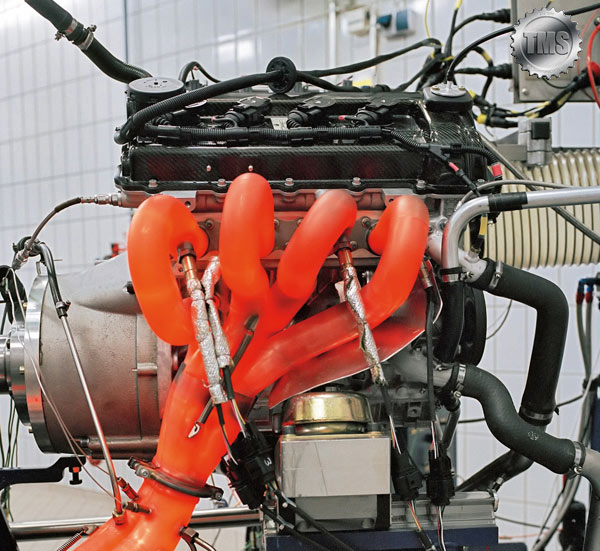
not sure how long the lambda sensors will last though?
Edited by stevesingo on Sunday 11th August 22:20
GVK said:
So,in short,in your opinion de-catting can produce more power on a modern cat equipped vehicle?
With a suitable remap yes. Just removing the cat will have a smaller effect because the current torque based EMS systems control to a target charge air mass. (and will just "turn the boost down" if the engine pressure ratio is artificially improved by de-catting etc50kPa sounds a little on the high side Max, but it's a while since I've been involved in attempting Euro-b ks emissions. My memory is more like 30kPa, back in the day.
Well, I do remember the rule-of-thumb that 1kPa back pressure reduction was worth 1.4kPa BMEP, for NA engines. Either way you cut it, there's nigh on a half Bar BMEP improvement to be had by de-catting. This is about a 4-5% increase in power, although, as Max says, turbochargers make this calculation more complex, since lowering the losses gives more pressure ratio for the turbine which also improves efficiencies.
It's also worth understanding that back pressure is a square-law function of flow rate, so it's not nearly the problem in the mid-range that it is at peak power. In the real world (c.f. racing world) this means it's generally pretty irrelevant which is probably why road cars don't have a big problem with catalysts and DPF's
ks emissions. My memory is more like 30kPa, back in the day.Well, I do remember the rule-of-thumb that 1kPa back pressure reduction was worth 1.4kPa BMEP, for NA engines. Either way you cut it, there's nigh on a half Bar BMEP improvement to be had by de-catting. This is about a 4-5% increase in power, although, as Max says, turbochargers make this calculation more complex, since lowering the losses gives more pressure ratio for the turbine which also improves efficiencies.
It's also worth understanding that back pressure is a square-law function of flow rate, so it's not nearly the problem in the mid-range that it is at peak power. In the real world (c.f. racing world) this means it's generally pretty irrelevant which is probably why road cars don't have a big problem with catalysts and DPF's
50kPa would be a topish limit number for a car that uses staged high density catalyst substrate bricks in a single can when aiming to meet all current worldwide homologation limits. Super high performance stuff will aim to be a bit lower, and will trade of catalyst cell density for a higher precious metal loading (i.e. a more expensive cat).
You can, and in effect you have this with multicylinder engines (especially "V" engines with a Cat per bank). In terms of emissions however, the name of the game is getting a quick light off, ie getting the active elements in the catalyst coating to a temperature where they start converting pollutants into Co2. As such, the higher the exhaust mass flow you can get through the smallest thermal inertia cat/exh system the better. For OEM's Cats are all about costs. If you make a million cars, then saving even £1 off the price of the cat is worthwhile ! As such you will aim for the lowest mass of precious metals that delivers the homologation emissions levels
Gassing Station | Engines & Drivetrain | Top of Page | What's New | My Stuff