
Itb’s Which trumpet profile?
Discussion


Last time i played with trumpets, this was the result, here i went from the Classic proper "trumpet" profile, to the tight radius design, BUT i also went from 53mm ID to 55mm ID, this is the same ID as the itb's, the original trumpets were sleeved into the body, so possibly restricting flow?
And i also increased length by around 3", but its just not practical as i cant package it with filters on.

And i also increased length by around 3", but its just not practical as i cant package it with filters on.


Mignon said:
Brummmie said:
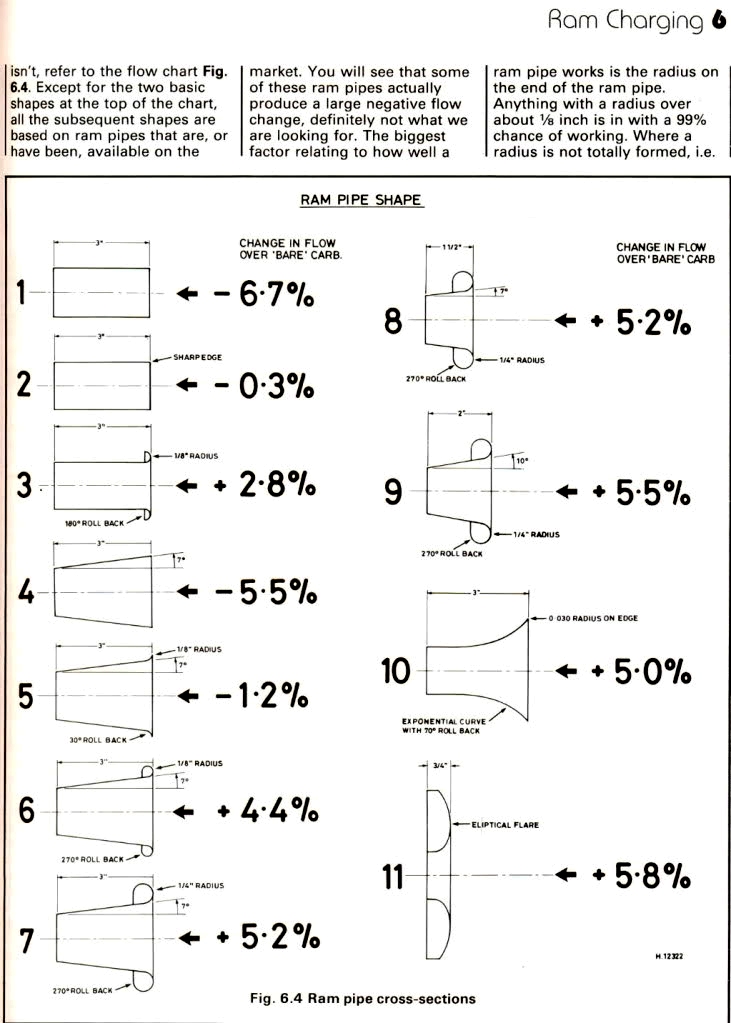
Thats interesting...So its saying the classic "Trumpet" style is what to go for!!
I can see me making a set up of each and trying them..
Ummm no. Several other designs beat the trumpet style, the best being an elliptical flare.I can see me making a set up of each and trying them..
Unless you're running an NA F1 engine, the actual shape of the trumpets is really pretty small beer! What matters is their length, taper, and the shape of the air box volume surrounding them, esp the opposite wall as this reflects pressure waves back towards the trumpet.
So, ask yourself, are you going to spot a 1 or 2 % power difference?
So, ask yourself, are you going to spot a 1 or 2 % power difference?
Max_Torque said:
Unless you're running an NA F1 engine, the actual shape of the trumpets is really pretty small beer! What matters is their length, taper, and the shape of the air box volume surrounding them, esp the opposite wall as this reflects pressure waves back towards the trumpet.
So, ask yourself, are you going to spot a 1 or 2 % power difference?
2% at 600bhp is 12bhp, and if I have the choice i’ll Take it, with the correct runner length and careful cam selection hopefully it’s going to add up.So, ask yourself, are you going to spot a 1 or 2 % power difference?
stevesingo said:
Brummmie said:
Max_Torque said:
Unless you're running an NA F1 engine, the actual shape of the trumpets is really pretty small beer! What matters is their length, taper, and the shape of the air box volume surrounding them, esp the opposite wall as this reflects pressure waves back towards the trumpet.
So, ask yourself, are you going to spot a 1 or 2 % power difference?
2% at 600bhp is 12bhp, and if I have the choice i’ll Take it, with the correct runner length and careful cam selection hopefully it’s going to add up.So, ask yourself, are you going to spot a 1 or 2 % power difference?
Hence my point at the F1 Team. When you go 100% on it (a-la F1 team) then you can afford to blitz the details for a few bhp. But unless you are an F1 team, for most people, ime, another 4 hours on a chassis dyno, or just about any time at all on an engine dyno, will find far, far more power than spending that time on worrying about radii........
(if you ARE going 100% on your engine, i salute you, and look forwards to seeing the dyno results !!)
Mr2Mike said:
stevesingo said:
A small radius, but not one large enough to ensure the flow around it stays attached at all times, produces a turbulent flow path, full of little eddy currents and recirculating air flows. This tumbles off that edge, and runs around in front of the trumpet, where the turbulence acts to reduce the ability of that trumpet to cleanly ingest a nice, linear flow of air.
A sharp edge acts to suddenly "break off" the boundary layer. One moment it's sliding past the outside edge of the trumpet, then whamoo, it's in free space. This sudden break away means the air has less time to start spinning, and you get a cleaner, more laminar airflow profile on the front face of the trumpet.
You see the same effect if you go look at the roof spoilers on many hatchback cars, which "fill in" the gap above the hatchback, making the back of the car squarer. You'd think that would increase drag, but by getting a clean breakaway, the air spilling over the back of the car is more laminar and hence there is less drag
Generally the rules for boundary layer go as follows:
1) if possible, have changes of direction and radii that are large enough to keep the boundary layer attached at all flow states (remember, intake runners are very dynamic, and have lots of pressure waves and flow accelerations, so the "mean" flow velocity might stay attached, but the much faster IVO pressure pulse flow might not!)
2) If you don't have enough space for a proper radius or bend, consider a sharp change in form to cleanly break away the boundary layer when and where you want it
Mr2Mike said:
One thing that confused me ~30 years back when I first read the A series bible is the difference between 1 & 2. Why does sharpening the edge of a straight pipe improve the flow over one with a flat cut on the end? I thought a sharp edge was exactly the thing to avoid?
I'm not even clear what the difference is between 1 & 2, but I guess 1 is square cut and 2 has an external taper down to a 'point' at the end. I don't know, what difference this makes and this is pure speculation, but I think the goal of the later designs is to keep the radial flow attached as it transitions to an axial flow, and the different designs essentially have different pressure/speed gradients along that path. The square cut would have a purely radial flow close by the surface which would detach and leave an annular separation bubble on the inside of the intake. That would reduce the effective cross section area. Perhaps by reducing that end surface to a point it discourages air flow from taking that radial path so the separation bubble is reduced - a bit like using an horizontal fence to keep air out of an underbody tunnel.
Max_Torque said:
broadly speaking, because of turbulent flow, which can be extremely counter intuitive!
A small radius, but not one large enough to ensure the flow around it stays attached at all times, produces a turbulent flow path, full of little eddy currents and recirculating air flows. This tumbles off that edge, and runs around in front of the trumpet, where the turbulence acts to reduce the ability of that trumpet to cleanly ingest a nice, linear flow of air.
A sharp edge acts to suddenly "break off" the boundary layer. One moment it's sliding past the outside edge of the trumpet, then whamoo, it's in free space. This sudden break away means the air has less time to start spinning, and you get a cleaner, more laminar airflow profile on the front face of the trumpet.
You see the same effect if you go look at the roof spoilers on many hatchback cars, which "fill in" the gap above the hatchback, making the back of the car squarer. You'd think that would increase drag, but by getting a clean breakaway, the air spilling over the back of the car is more laminar and hence there is less drag
Generally the rules for boundary layer go as follows:
1) if possible, have changes of direction and radii that are large enough to keep the boundary layer attached at all flow states (remember, intake runners are very dynamic, and have lots of pressure waves and flow accelerations, so the "mean" flow velocity might stay attached, but the much faster IVO pressure pulse flow might not!)
2) If you don't have enough space for a proper radius or bend, consider a sharp change in form to cleanly break away the boundary layer when and where you want it
Thanks, that's a very clear explanation and makes total sense now. A small radius, but not one large enough to ensure the flow around it stays attached at all times, produces a turbulent flow path, full of little eddy currents and recirculating air flows. This tumbles off that edge, and runs around in front of the trumpet, where the turbulence acts to reduce the ability of that trumpet to cleanly ingest a nice, linear flow of air.
A sharp edge acts to suddenly "break off" the boundary layer. One moment it's sliding past the outside edge of the trumpet, then whamoo, it's in free space. This sudden break away means the air has less time to start spinning, and you get a cleaner, more laminar airflow profile on the front face of the trumpet.
You see the same effect if you go look at the roof spoilers on many hatchback cars, which "fill in" the gap above the hatchback, making the back of the car squarer. You'd think that would increase drag, but by getting a clean breakaway, the air spilling over the back of the car is more laminar and hence there is less drag
Generally the rules for boundary layer go as follows:
1) if possible, have changes of direction and radii that are large enough to keep the boundary layer attached at all flow states (remember, intake runners are very dynamic, and have lots of pressure waves and flow accelerations, so the "mean" flow velocity might stay attached, but the much faster IVO pressure pulse flow might not!)
2) If you don't have enough space for a proper radius or bend, consider a sharp change in form to cleanly break away the boundary layer when and where you want it

Gassing Station | Engines & Drivetrain | Top of Page | What's New | My Stuff