
Stripped Drive Shaft threads - opinions sought
Discussion


Thank you for accepting me to the forum,
I got my car back from a local dealer telling me that the drive shaft threads stripped while removing the nut. The car was in for a bearing replacement and they informed me the nut became tight when trying to remove it. The mechanic didn't notice and thread damage before starting the job, I have owned the car from new and this drive shaft nut has never been removed before.
I don't want to jump to conclusions but in all my experience I have never seen threads stripped by removal of such a nut, if anything I would expech the nut to clean these theads if the were damaged before. I grew up through motorsport and prerparing cars, and also have 40+ years of experience as an electro mechanical engineer, I can find no such weakness previously reported on Google so seaking experience and opinions of others.
Thx in advance,
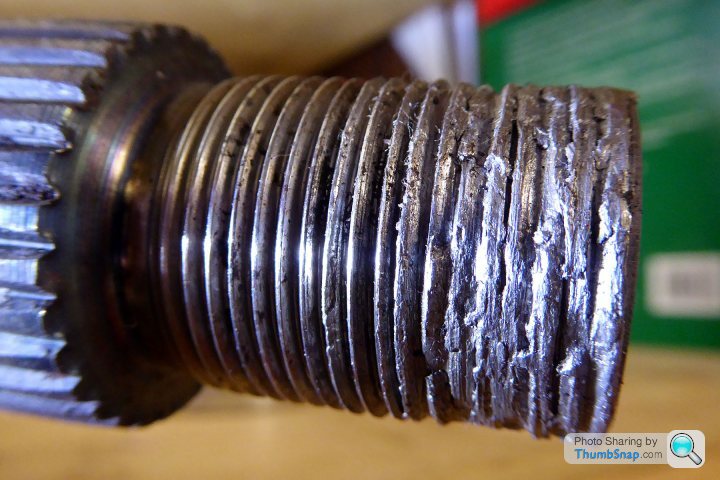
I got my car back from a local dealer telling me that the drive shaft threads stripped while removing the nut. The car was in for a bearing replacement and they informed me the nut became tight when trying to remove it. The mechanic didn't notice and thread damage before starting the job, I have owned the car from new and this drive shaft nut has never been removed before.
I don't want to jump to conclusions but in all my experience I have never seen threads stripped by removal of such a nut, if anything I would expech the nut to clean these theads if the were damaged before. I grew up through motorsport and prerparing cars, and also have 40+ years of experience as an electro mechanical engineer, I can find no such weakness previously reported on Google so seaking experience and opinions of others.
Thx in advance,
Ultra Sound Guy said:
The only time I've seen anything like that was with stainless nuts and threads where they were over-torqued and tried to weld themselves up!
 I have occasionally had that happen with stainless (on much smaller threads) where the nut seizes and removing it galls the thread to buggery. But not on hardened steel like a driveshaft.
 Equally, to do that by driving a nut on cross-threaded would take some doing.
Superhoop said:
Krikkit said:
Were the nuts a staked-in type? Is it possible the staked portion has broken up, then when rattling the nut off this has been dragged over the threads?
This was exactly what I was think too.. Only staked driveshaft nuts I've done have staked into a depression on the driveshaft - never damaged on removing or fitting but I do like to use a pointed punch to open up the staked part.
Same issues as others with stainless steel galling.
I note your OP says that they told you the nut became tight whilst being undone but the mechanic didn't notice. If that's the case I'd call BS - if he didn't notice then how could he say it tightened up?
Same issues as others with stainless steel galling.
I note your OP says that they told you the nut became tight whilst being undone but the mechanic didn't notice. If that's the case I'd call BS - if he didn't notice then how could he say it tightened up?
There is a damaged thread over half way down, I'm wondering if the thread was damaged as it was inserted during the original build? The nut may have tightened up, but sustained damage as it was wound on, probably by machine, then when the garage removed it the thread was just destroyed.
morgrp said:
Superhoop said:
Krikkit said:
Were the nuts a staked-in type? Is it possible the staked portion has broken up, then when rattling the nut off this has been dragged over the threads?
This was exactly what I was think too.. I think a bit of the stake has broken off during removal (possibly they just rattle-gunned it off rather than un-staking with a punch), then once the thread starts going it collects more swarf and the damage increases as it goes. I've done something similar myself, although it was intentional as a) the shaft joint wasn't replaceable and buggered and b) the nut was proving a b
 d to remove.
Cross threading stuff when undoing things is pretty rare Inwould have thought. I’ve never done it but managed to cross thread plenty of stuff when doing things up.
I wonder if they put the nut back on a few turns and then beat the living daylights out of it to get the shaft released and this caused the damage?
I wonder if they put the nut back on a few turns and then beat the living daylights out of it to get the shaft released and this caused the damage?
why do people think nuts or bolts that when removed on their cars by someone other than themselves, automatically become the responsibility of the person doing it, rather than acknowledge it is 'their' car and 'their' corroded or stuck, or seized, or damaged nut or bolt? Do it yourself then eh?
there is damage further down the thread, and corrosion spots perhaps all the way down, so clearly not new, and of course has never been off before, ever. There isn't generally a huge amount of thread protruding from these, and what is there is, is as likely to suffer fatigue of some sort as the rest of the joint. This has marks below where I would consider an exposed thread to be, maybe the staked part is a factor but then I'd suggest existing conditions are more.
stating the nut has never ever been touched, not at all, nope, n.e.v.e.r. Hmmm did you have a go and it got tight so you took it to someone else? Did it have a significant chance of doing this anyway based on condition, which is why you took it to someone you don't trust, then could write about as is typical on here? The mechanic didn't notice anything unusual before removal perhaps, because he didn't examine it closely and is more trusting than you maybe?
so, what if this shoe was on the other foot?
actually what could have happened is the nut potentially freed and undone a couple of threads, and tapped to free the spline, distorting the thread, galling it on further removal. However, as plausible as this is, there isn't clear evidence of hammer blows so you need the nut, and an end view, then you're still going to have to debate what came first. Not every garage, in fact very few, will have a press to remove these parts, they'll nearly all get a thump out.
there is damage further down the thread, and corrosion spots perhaps all the way down, so clearly not new, and of course has never been off before, ever. There isn't generally a huge amount of thread protruding from these, and what is there is, is as likely to suffer fatigue of some sort as the rest of the joint. This has marks below where I would consider an exposed thread to be, maybe the staked part is a factor but then I'd suggest existing conditions are more.
stating the nut has never ever been touched, not at all, nope, n.e.v.e.r. Hmmm did you have a go and it got tight so you took it to someone else? Did it have a significant chance of doing this anyway based on condition, which is why you took it to someone you don't trust, then could write about as is typical on here? The mechanic didn't notice anything unusual before removal perhaps, because he didn't examine it closely and is more trusting than you maybe?
so, what if this shoe was on the other foot?
actually what could have happened is the nut potentially freed and undone a couple of threads, and tapped to free the spline, distorting the thread, galling it on further removal. However, as plausible as this is, there isn't clear evidence of hammer blows so you need the nut, and an end view, then you're still going to have to debate what came first. Not every garage, in fact very few, will have a press to remove these parts, they'll nearly all get a thump out.
Certainly could be cross-threading putting it back on with an air gun. If it was taking it off then I don't think the threads wouldn't be chewed so much towards the end as by that time the threads on the nut would be breaking down.
First question though is does the hub (or whatever bolts to the shaft) take up the whole length of the pristine threads? If it doesn't then this wasn't a taking it off issue, as if it had 'welded up' or whatever, the damaged threads would be from the position the nut sat and outwards. So I'd be getting the nut, finding out how thick the thing is it bolted to, and putting it alongside to see if the damage starts from the position the nut sat.
But here's an alternative, and in my book more likely. Is it a left hand thread and the bloke used an air gun to 'undo' it and stripped the threads - or he thought is was a left have thread when it wasn't, and tried to undo left hand style. Assuming the nut would be tight anyway the bloke could easily mistake tightening and stripping threads to loosening. I seem to recall the Tuscan hubs were 250ft/lb - I had to buy a monster torque wrench just for the job, and with so much force required there would be the expectation of a similarly massive torque to undo it with an air gun - nut starts to move as threads strip, so keep the power on and while it looks like it's turning and undoing it's actually just stripping the threads. This is the one that gets my vote.
First question though is does the hub (or whatever bolts to the shaft) take up the whole length of the pristine threads? If it doesn't then this wasn't a taking it off issue, as if it had 'welded up' or whatever, the damaged threads would be from the position the nut sat and outwards. So I'd be getting the nut, finding out how thick the thing is it bolted to, and putting it alongside to see if the damage starts from the position the nut sat.
But here's an alternative, and in my book more likely. Is it a left hand thread and the bloke used an air gun to 'undo' it and stripped the threads - or he thought is was a left have thread when it wasn't, and tried to undo left hand style. Assuming the nut would be tight anyway the bloke could easily mistake tightening and stripping threads to loosening. I seem to recall the Tuscan hubs were 250ft/lb - I had to buy a monster torque wrench just for the job, and with so much force required there would be the expectation of a similarly massive torque to undo it with an air gun - nut starts to move as threads strip, so keep the power on and while it looks like it's turning and undoing it's actually just stripping the threads. This is the one that gets my vote.
Toltec said:
PhillipM said:
tvrolet said:
But here's an alternative, and in my book more likely. Is it a left hand thread
It's a lot less likely if you actually look at the right hand thread in the photo.tvrolet said:
...or he thought is was a left have thread when it wasn't, and tried to undo left hand style ...
I couldn't make out from the photo if the threads were left hand or right hand so I kept the options open 
I'm still going with mistakenly tightening rather than loosening.
Gassing Station | Engines & Drivetrain | Top of Page | What's New | My Stuff