
Racing Car Airbox / Plenum / Cold Air Feed advice please!
Discussion


Hi,
I race in a series of seven type cars, and we have just converted to MX5 1800 VVT engine. I'm new to this type of engine, and could do with hearing your opinions on air intakes.
The engine has a control plenum, with the original butterfly valve / throttle body whatever you want to call it on the end, finishing with a foam conical air filter. This is under the bonnet / nosecone area on the car.
Other people have fitted a scoop on the bonnet and ducted the air filter to behind the scoop, but I don't think that is the best way, as I want my car to be as slippery as possibly through the air, and don't want a big bonnet scoop.
Strictly we aren't allowed a fixed Airbox, however one could be formed with some strategically placed 'heat shielding' sealed against the underside of the nosecone.
I've been thinking about taking a cold air feed taken from behind the nosecone next to the rad, and ducting it up into the 'airbox' which would then be pressurised. Would this give me a RAM air effect?
We have to run a control map on the engine, so I'm not expecting big gains or anything, but an improved throttle response would be beneficial.
So... Would I be better off:
1 - Just making a scoop and doing what everyone else is doing? (downsides are aero and the fact it will fill the under bonnet area with air, which will parachute which we don't want).
2 - Try the 'airbox idea' as detailed in the photo below, and experiment with different sizes / shapes etc
3 - naca duct in the nosecone ducted straight onto the foam filter and try to seal it against the filter so excess air doesnt flow past it and into the bonnet area.. (see 3rd image)
Any advice or suggestions would be welcomed
 Untitled by Olly Olly, on Flickr
 by Olly Olly, on Flickr
I race in a series of seven type cars, and we have just converted to MX5 1800 VVT engine. I'm new to this type of engine, and could do with hearing your opinions on air intakes.
The engine has a control plenum, with the original butterfly valve / throttle body whatever you want to call it on the end, finishing with a foam conical air filter. This is under the bonnet / nosecone area on the car.
Other people have fitted a scoop on the bonnet and ducted the air filter to behind the scoop, but I don't think that is the best way, as I want my car to be as slippery as possibly through the air, and don't want a big bonnet scoop.
Strictly we aren't allowed a fixed Airbox, however one could be formed with some strategically placed 'heat shielding' sealed against the underside of the nosecone.
I've been thinking about taking a cold air feed taken from behind the nosecone next to the rad, and ducting it up into the 'airbox' which would then be pressurised. Would this give me a RAM air effect?
We have to run a control map on the engine, so I'm not expecting big gains or anything, but an improved throttle response would be beneficial.
So... Would I be better off:
1 - Just making a scoop and doing what everyone else is doing? (downsides are aero and the fact it will fill the under bonnet area with air, which will parachute which we don't want).
2 - Try the 'airbox idea' as detailed in the photo below, and experiment with different sizes / shapes etc
3 - naca duct in the nosecone ducted straight onto the foam filter and try to seal it against the filter so excess air doesnt flow past it and into the bonnet area.. (see 3rd image)
Any advice or suggestions would be welcomed
Untitled by Olly Olly, on Flickr by Olly Olly, on Flickr
Not sure what your scrutineers would deem a fixed airbox, but it seems to me your best bet while honoring the regs would be to find a reasonably high pressure area and make sure it is flooded with as much cold air as you can arrange. The nose cone is the ideal place to take cold air from.
Getting ram pressure is find if you you can get it for free, but the gains are really very small (maybe 1% at 100 mph assuming complete pressure recovery). On the other hand the losses from pulling in hot air can be quite high, and heat soak can amplify those losses at the worst times..
Getting ram pressure is find if you you can get it for free, but the gains are really very small (maybe 1% at 100 mph assuming complete pressure recovery). On the other hand the losses from pulling in hot air can be quite high, and heat soak can amplify those losses at the worst times..
GreenV8S said:
Not sure what your scrutineers would deem a fixed airbox, but it seems to me your best bet while honoring the regs would be to find a reasonably high pressure area and make sure it is flooded with as much cold air as you can arrange. The nose cone is the ideal place to take cold air from.
Getting ram pressure is find if you you can get it for free, but the gains are really very small (maybe 1% at 100 mph assuming complete pressure recovery). On the other hand the losses from pulling in hot air can be quite high, and heat soak can amplify those losses at the worst times..
Thanks. I'm sure I could use the allowances for heat shield to make an airbox, it's just whats going to be the most beneficial for me. Nada duct straight into the filter might be an easier option, but there wouldn't be as much pressure around the filter as there would if I got the box idea working... I know very little about this kind of thing! Getting ram pressure is find if you you can get it for free, but the gains are really very small (maybe 1% at 100 mph assuming complete pressure recovery). On the other hand the losses from pulling in hot air can be quite high, and heat soak can amplify those losses at the worst times..
Whichever one we go for there will be cold air, and it wont be sucking any hot air from the engine bay
Pulling hot air off a hot radiator that the filter is actually touching is a really great way to loose a fair bit of power!
As a minimum, fit a baffled tray between the rad and the filter, preferably of a low thermally conductive material (fibreglass etc). If you shape that baffle so it curves over the top to the rad, it can also guide the cold air that builds up in front of the rad, at high pressure, over the top of the rad, between that baffle and the nose cone or bonnet, and into the filter.
You'll never get a positive ram effect onto the throttle (100 mph, is 45m/s, and a dynamic pressure (at 1bar 25 degC) of 1.2 kPa ie just only a 1.2% increase, so if you car makes 100 bhp, it'll make 101 with the ram air, ie irrelevant...) but you will increase the effective charge density. For example air typically comes off the back of a coolant radiator at 40 to 50 degC, even at reasonably high speed, and a drop of 25 degC is an increase in air charge density of around 10%, which is 10 bhp on our "100 bhp" engine ;-)
As a minimum, fit a baffled tray between the rad and the filter, preferably of a low thermally conductive material (fibreglass etc). If you shape that baffle so it curves over the top to the rad, it can also guide the cold air that builds up in front of the rad, at high pressure, over the top of the rad, between that baffle and the nose cone or bonnet, and into the filter.
You'll never get a positive ram effect onto the throttle (100 mph, is 45m/s, and a dynamic pressure (at 1bar 25 degC) of 1.2 kPa ie just only a 1.2% increase, so if you car makes 100 bhp, it'll make 101 with the ram air, ie irrelevant...) but you will increase the effective charge density. For example air typically comes off the back of a coolant radiator at 40 to 50 degC, even at reasonably high speed, and a drop of 25 degC is an increase in air charge density of around 10%, which is 10 bhp on our "100 bhp" engine ;-)
Max_Torque said:
Pulling hot air off a hot radiator that the filter is actually touching is a really great way to loose a fair bit of power!
As a minimum, fit a baffled tray between the rad and the filter, preferably of a low thermally conductive material (fibreglass etc). If you shape that baffle so it curves over the top to the rad, it can also guide the cold air that builds up in front of the rad, at high pressure, over the top of the rad, between that baffle and the nose cone or bonnet, and into the filter.
You'll never get a positive ram effect onto the throttle (100 mph, is 45m/s, and a dynamic pressure (at 1bar 25 degC) of 1.2 kPa ie just only a 1.2% increase, so if you car makes 100 bhp, it'll make 101 with the ram air, ie irrelevant...) but you will increase the effective charge density. For example air typically comes off the back of a coolant radiator at 40 to 50 degC, even at reasonably high speed, and a drop of 25 degC is an increase in air charge density of around 10%, which is 10 bhp on our "100 bhp" engine ;-)
Thanks. The bonnet that I had made actually sits on top of the rad, (and the rad sits at quite a shallow angle for aero) so any air that passed over the rad would have been forced out thorough an opening between the nosecone and bonnet. As a minimum, fit a baffled tray between the rad and the filter, preferably of a low thermally conductive material (fibreglass etc). If you shape that baffle so it curves over the top to the rad, it can also guide the cold air that builds up in front of the rad, at high pressure, over the top of the rad, between that baffle and the nose cone or bonnet, and into the filter.
You'll never get a positive ram effect onto the throttle (100 mph, is 45m/s, and a dynamic pressure (at 1bar 25 degC) of 1.2 kPa ie just only a 1.2% increase, so if you car makes 100 bhp, it'll make 101 with the ram air, ie irrelevant...) but you will increase the effective charge density. For example air typically comes off the back of a coolant radiator at 40 to 50 degC, even at reasonably high speed, and a drop of 25 degC is an increase in air charge density of around 10%, which is 10 bhp on our "100 bhp" engine ;-)
We literally just fitted the plenum and haven't driven anywhere, so I wasn't going to keep the filter touching the rad! I was planning to have it angle further back, with heat shield between the 'airbox' and the rad.
If I modify the bonnet then I could easily use the air passing over the top of the rad as you say, but I figured that would get warmed slightly from the rad, whereas if I put a separate duct in, it would be 'pure' cold air. I'm proabably over thinking this though...
We only have 140bhp, but literally ever 1% counts, as all the cars are running to strike set of regs, so any advantage will be gladly taken
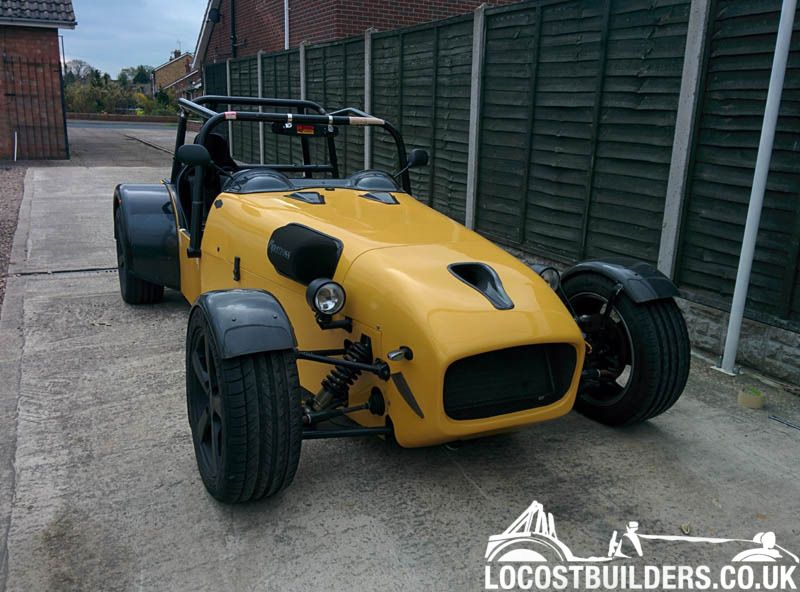
I have done similar to the yellow car in your OP, albeit unfinished at the moment but the duct is glassed into the nosecone with mesh on the underside of the twin inlets, sanded and painted etc. will take a pic next time I’m in the garage.
The idea is then to create an ally box underneath where a large cone filter will sit. This will then feed off to a carbon airbox (already got this) to feed the jenveys. Engine is a 2.0l duratec.
I went with this idea for the same reasons as you - didn’t like the scoops, wanted a neat front end and this solved a lot of packaging issues. I’ve since seen this implemented on a couple of cars in the UK.
The idea is then to create an ally box underneath where a large cone filter will sit. This will then feed off to a carbon airbox (already got this) to feed the jenveys. Engine is a 2.0l duratec.
I went with this idea for the same reasons as you - didn’t like the scoops, wanted a neat front end and this solved a lot of packaging issues. I’ve since seen this implemented on a couple of cars in the UK.
Make sure you have an air temperature sensor at a sensible location...and work from there as to what is best.
As for aero side of things in terms of any restrictions, I doubt it is of any real concern given the vehicle, engine and actual application which would be fairly low speed, low power and in a race environment with little clean air anyway.
As for aero side of things in terms of any restrictions, I doubt it is of any real concern given the vehicle, engine and actual application which would be fairly low speed, low power and in a race environment with little clean air anyway.
Found some photos on my laptop:
ITB’s have a homemade backing plate and a bought in generic airbox cover. Clearance to the bonnet is tight but fits:


Hard to see from these photos but I have just enough space between the engine and rad to have the intake do a 90deg bend into a 3 sided ally box (once I make one) which will seal to the nosecone on the top side using foam strips. Initial plan was to duct the two inlets through a box filter to the airbox but there is not enough room. As above posters note, I didn’t think ram effect would be a benefit but the naca duct should work well and take cold air in without risk of dirt/debris that the low down snorkels do (I have fitted diamond mesh over the back side of the inlets to prevent large bits of pickup getting in the engine bay)


ITB’s have a homemade backing plate and a bought in generic airbox cover. Clearance to the bonnet is tight but fits:
Hard to see from these photos but I have just enough space between the engine and rad to have the intake do a 90deg bend into a 3 sided ally box (once I make one) which will seal to the nosecone on the top side using foam strips. Initial plan was to duct the two inlets through a box filter to the airbox but there is not enough room. As above posters note, I didn’t think ram effect would be a benefit but the naca duct should work well and take cold air in without risk of dirt/debris that the low down snorkels do (I have fitted diamond mesh over the back side of the inlets to prevent large bits of pickup getting in the engine bay)
shirt said:
Found some photos on my laptop:
ITB’s have a homemade backing plate and a bought in generic airbox cover. Clearance to the bonnet is tight but fits:
Hard to see from these photos but I have just enough space between the engine and rad to have the intake do a 90deg bend into a 3 sided ally box (once I make one) which will seal to the nosecone on the top side using foam strips. Initial plan was to duct the two inlets through a box filter to the airbox but there is not enough room. As above posters note, I didn’t think ram effect would be a benefit but the naca duct should work well and take cold air in without risk of dirt/debris that the low down snorkels do (I have fitted diamond mesh over the back side of the inlets to prevent large bits of pickup getting in the engine bay)
Thanks for the info and pics. Very interesting. Have you by any chance got any photos of the 3 sided alloy box? ITB’s have a homemade backing plate and a bought in generic airbox cover. Clearance to the bonnet is tight but fits:
Hard to see from these photos but I have just enough space between the engine and rad to have the intake do a 90deg bend into a 3 sided ally box (once I make one) which will seal to the nosecone on the top side using foam strips. Initial plan was to duct the two inlets through a box filter to the airbox but there is not enough room. As above posters note, I didn’t think ram effect would be a benefit but the naca duct should work well and take cold air in without risk of dirt/debris that the low down snorkels do (I have fitted diamond mesh over the back side of the inlets to prevent large bits of pickup getting in the engine bay)
Cold air will make a difference, ram won't. Can you duct the rad air so it doesn't go anywhere near any of the inlet tract? Don't know about a seven but in a saloon you can get a low pressure area at the front of the bonnet, not good for taking air in but can be used to take hot air out from behind the rad.
ol said:
Thanks for the info and pics. Very interesting. Have you by any chance got any photos of the 3 sided alloy box?
Unfortunately not as I haven’t got that far, car is sat in the projects queue waiting for attention.It should be 5 sided really. Open topped cube with a cut out for the inlet with return flanges in the open side with the whole thing shaped to the underside of the nosecone. Bit of foam tape and when the nose is on should create a fairly well sealed box for the filter to sit in.
Gassing Station | Engines & Drivetrain | Top of Page | What's New | My Stuff