
something is up with the turbo gauge/needle
Discussion


I need some help troubleshooting and narrow down what the issue(s) could be.
(2013 VW Scirocco R, A/T, 66000 km)
I'm definitely noticing a lot more now than before the needle in my defi turbo boost gauge
(similar to this one in the photo):

is going up pretty high (up to 1.0 bar) while just stepping on the gas lightly. I don't really notice
anything seriously wrong with the driving, just some usual turbo lag or a little jerky motion when
accelerating but mostly the needle in the boost gauge is not normal (I know that for sure!).
Just light cruising, at around 60 km/h and giving it a little acceleration to pass is making
my needle go up to 0.5 - 1 bar and I'm not even pushing over 3000 rpms but the turbo boost needle
goes up to 0.5-1 and then goes back into vacuum when I let off the gas.
I have a recording of my driving from a year ago and I re-watched it. For the 20 minutes of driving,
it almost never went up to 0.5 bar and certainly not 1 bar unless I was putting it down to the floor.
Accelerating and cruising around 80-100km/h always had my boost needle at around -0.4 to 0
even when accelerating it would barely go over 0 because I wasn't driving hard.
I'm trying to figure what is causing the needle to go so high at such low speeds and low rpms?
Could it be the gauge itself is faulty or I'm getting a false reading? Doubtful because I also have a
digital gauge built in and when I check boost on that, it shows the exact same readings as the mechanical
boost gauge.
Could this be an issue related to the turbo boost itself? Or some hoses/connectors that went bad? Boost controller or something about the solenoid?
(2013 VW Scirocco R, A/T, 66000 km)
I'm definitely noticing a lot more now than before the needle in my defi turbo boost gauge
(similar to this one in the photo):
is going up pretty high (up to 1.0 bar) while just stepping on the gas lightly. I don't really notice
anything seriously wrong with the driving, just some usual turbo lag or a little jerky motion when
accelerating but mostly the needle in the boost gauge is not normal (I know that for sure!).
Just light cruising, at around 60 km/h and giving it a little acceleration to pass is making
my needle go up to 0.5 - 1 bar and I'm not even pushing over 3000 rpms but the turbo boost needle
goes up to 0.5-1 and then goes back into vacuum when I let off the gas.
I have a recording of my driving from a year ago and I re-watched it. For the 20 minutes of driving,
it almost never went up to 0.5 bar and certainly not 1 bar unless I was putting it down to the floor.
Accelerating and cruising around 80-100km/h always had my boost needle at around -0.4 to 0
even when accelerating it would barely go over 0 because I wasn't driving hard.
I'm trying to figure what is causing the needle to go so high at such low speeds and low rpms?
Could it be the gauge itself is faulty or I'm getting a false reading? Doubtful because I also have a
digital gauge built in and when I check boost on that, it shows the exact same readings as the mechanical
boost gauge.
Could this be an issue related to the turbo boost itself? Or some hoses/connectors that went bad? Boost controller or something about the solenoid?
Edited by cornflakes2 on Thursday 5th September 00:57
How about the BOV? I was told that I should have maintenance done on it once a year or every six months?
I was told they simply remove it, open it up to clean it and re-apply this pink liquid (special oil) that keeps it lubricated and I guess
if you don't do this once a year, it can lose the oiliness and not function optimally. Could the BOV have anything to do with my turbo boost readings?
How about the EVAP Purge regulator? When I got the canister replaced, he told me about the purge regulator valve but it looked like it had already been replaced because the clamps/crimps were not the factory ones so that indicates previous owner had already had it replaced.
EDIT: sorry correction, I don't have a BOV. Mine is a forge diverter valve. So if this isn't maintained or cleaned/re-lubricated every year, might it be a cause for the turbo issues?
I was told they simply remove it, open it up to clean it and re-apply this pink liquid (special oil) that keeps it lubricated and I guess
if you don't do this once a year, it can lose the oiliness and not function optimally. Could the BOV have anything to do with my turbo boost readings?
How about the EVAP Purge regulator? When I got the canister replaced, he told me about the purge regulator valve but it looked like it had already been replaced because the clamps/crimps were not the factory ones so that indicates previous owner had already had it replaced.
EDIT: sorry correction, I don't have a BOV. Mine is a forge diverter valve. So if this isn't maintained or cleaned/re-lubricated every year, might it be a cause for the turbo issues?
Edited by cornflakes2 on Thursday 5th September 05:27
mickrick said:
Have you considered your gauge might be reading correctly?
Sounds to be it's not dumping excess pressure.
Yes! Actually I was thinking that earlier today. If the boost reads so high but not evening driving that fast or hard, it seemsSounds to be it's not dumping excess pressure.
that something is not releasing excess pressure properly which leads to me believe it might have something to do with the diverter valve?
Isn't that what a diverter valve is supposed to do?
Warby80 said:
Find someone with Vcds or a code reader that can log live data.
Get them to log requested v actual boost pressure and you will see pretty quickly if there is even a problem.
Thank you for that! By any chance do you know if my code reader Foxwell NT201 is able to do this? Get them to log requested v actual boost pressure and you will see pretty quickly if there is even a problem.
I should also mention that the car says it has been tuned with APR Stage 2+ but I don't really know if it was or if it was
just badged and advertised that it was. If the previous owner had made some changes to the car and re-programmed
the computer, I'd imagine this could make things more complicated to figure out.
I think it has something to do with what most of you guys said above: "excess pressure" not being released or removed somehow.
cornflakes2 said:
Warby80 said:
Find someone with Vcds or a code reader that can log live data.
Get them to log requested v actual boost pressure and you will see pretty quickly if there is even a problem.
Thank you for that! By any chance do you know if my code reader Foxwell NT201 is able to do this? Get them to log requested v actual boost pressure and you will see pretty quickly if there is even a problem.
I should also mention that the car says it has been tuned with APR Stage 2+ but I don't really know if it was or if it was
just badged and advertised that it was. If the previous owner had made some changes to the car and re-programmed
the computer, I'd imagine this could make things more complicated to figure out.
I think it has something to do with what most of you guys said above: "excess pressure" not being released or removed somehow.
The diverter valves main job is relieving boost pressure when the throttle plate is closed suddenly so not really in the situation you describe.
The ecu has fairly sophisticated boost control that requests a specific amount of boost to be produced by the turbo depending on load/throttle positon etc and then uses the n75 to control the wastegate to achieve this pressure.
It would be pretty unusual for there to be no eml/limp mode in situations where the actual boost is running away from the boost specified by the ecu.
Warby80 said:
I have no idea if your scanner will be able to do live data unfortunately but its worth a try.
The diverter valves main job is relieving boost pressure when the throttle plate is closed suddenly so not really in the situation you describe.
The ecu has fairly sophisticated boost control that requests a specific amount of boost to be produced by the turbo depending on load/throttle positon etc and then uses the n75 to control the wastegate to achieve this pressure.
It would be pretty unusual for there to be no eml/limp mode in situations where the actual boost is running away from the boost specified by the ecu.
Yes, it occurred to me this morning while driving that when I let off the gas, the boost needle goes back into vacuum right away so that should mean there is no issue with my diverter valve (would this assumption be correct?).The diverter valves main job is relieving boost pressure when the throttle plate is closed suddenly so not really in the situation you describe.
The ecu has fairly sophisticated boost control that requests a specific amount of boost to be produced by the turbo depending on load/throttle positon etc and then uses the n75 to control the wastegate to achieve this pressure.
It would be pretty unusual for there to be no eml/limp mode in situations where the actual boost is running away from the boost specified by the ecu.
The issue is when I step on the gas, even just lightly, the boost needle seems to go higher than it should for such low speeds (no uphill, just flat ground straight away roads with no heavy load). It's over-acting (if that is proper?).
I am now looking into the Rosstech VCDS options. Can you recommend if the Rosstech VCDS Hex-Key on their website for $199 (usd) is the appropriate one I should get to be able to communicate with my car and do something like inspect requested boost vs actual boost in a live data?
I'm thinking this Rosstech vcds is a good investment anyways to have since it can tell me anything else about the car now and in the future which will be very helpful.
I saw they have a few versions. I don't think I need the $1000 professional one. I saw a Lite version that is actually free but you have to buy the usb/hex cable (but the software is free).
cornflakes2 said:
Yes, it occurred to me this morning while driving that when I let off the gas, the boost needle goes back into vacuum right away so that should mean there is no issue with my diverter valve (would this assumption be correct?).
The issue is when I step on the gas, even just lightly, the boost needle seems to go higher than it should for such low speeds (no uphill, just flat ground straight away roads with no heavy load). It's over-acting (if that is proper?).
I am now looking into the Rosstech VCDS options. Can you recommend if the Rosstech VCDS Hex-Key on their website for $199 (usd) is the appropriate one I should get to be able to communicate with my car and do something like inspect requested boost vs actual boost in a live data?
I'm thinking this Rosstech vcds is a good investment anyways to have since it can tell me anything else about the car now and in the future which will be very helpful.
I saw they have a few versions. I don't think I need the $1000 professional one. I saw a Lite version that is actually free but you have to buy the usb/hex cable (but the software is free).
For me a a proper version of Vcds has been worth its weight in gold, i got mine 10 years ago before they changed to the limited Vin versions they have now and it has worked on every car i have used it on with no issues right up to brand new cars. The issue is when I step on the gas, even just lightly, the boost needle seems to go higher than it should for such low speeds (no uphill, just flat ground straight away roads with no heavy load). It's over-acting (if that is proper?).
I am now looking into the Rosstech VCDS options. Can you recommend if the Rosstech VCDS Hex-Key on their website for $199 (usd) is the appropriate one I should get to be able to communicate with my car and do something like inspect requested boost vs actual boost in a live data?
I'm thinking this Rosstech vcds is a good investment anyways to have since it can tell me anything else about the car now and in the future which will be very helpful.
I saw they have a few versions. I don't think I need the $1000 professional one. I saw a Lite version that is actually free but you have to buy the usb/hex cable (but the software is free).
I know lots of people buy cheaper ebay cables and then use the light version but that is limited on how much live data you can see and also only gives very basic descriptions for fault codes etc. Also some cheaper cables will not work with the very latest versions of Vcds.
The $199 one would be the one you want and would do everything you needed and be usable on 3 separate cars.
Once you can see the data then yes, a quick look at specified vs actual boost pressure (block 115 in the measuring blocks) will show you if something is amiss. Actual should follow specified closely, if it is running away from it then there is an issue somewhere in the boost control circuit.
Warby80 said:
For me a a proper version of Vcds has been worth its weight in gold, i got mine 10 years ago before they changed to the limited Vin versions they have now and it has worked on every car i have used it on with no issues right up to brand new cars.
I know lots of people buy cheaper ebay cables and then use the light version but that is limited on how much live data you can see and also only gives very basic descriptions for fault codes etc. Also some cheaper cables will not work with the very latest versions of Vcds.
The $199 one would be the one you want and would do everything you needed and be usable on 3 separate cars.
Once you can see the data then yes, a quick look at specified vs actual boost pressure (block 115 in the measuring blocks) will show you if something is amiss. Actual should follow specified closely, if it is running away from it then there is an issue somewhere in the boost control circuit.
Thanks so much for that info. I think I will get the vcds ($199 one). I do believe it is true that it should be one of the most valuable tools to have, even for someone like me who doesn't know much about it, but it really bothers me not knowing and trying to guess in the dark. I really want to know the ins and out of my car and know what exactly is the problem so that the proper fix can be applied. If this device can bridge that gap between not knowing and knowing, it will definitely be worth the investment. I will watch the Humble Mechanic (youtube) who has a good video on vcds and how to use it.I know lots of people buy cheaper ebay cables and then use the light version but that is limited on how much live data you can see and also only gives very basic descriptions for fault codes etc. Also some cheaper cables will not work with the very latest versions of Vcds.
The $199 one would be the one you want and would do everything you needed and be usable on 3 separate cars.
Once you can see the data then yes, a quick look at specified vs actual boost pressure (block 115 in the measuring blocks) will show you if something is amiss. Actual should follow specified closely, if it is running away from it then there is an issue somewhere in the boost control circuit.
I'll update this again when/if I find out what the issue is.
Got my rosstech hex v2 yesterday, did a little test run today and logged some data but not sure exactly what I was doing lol.
I got some readings on requested boost vs specified boost. If anyone can take a look and give me any feedback, would be helpful.


or the logs here:
https://drive.google.com/open?id=1FROTI5qUg-8wu81E...
https://drive.google.com/open?id=1INl1mdUtN3MOF1Gg...
I got some readings on requested boost vs specified boost. If anyone can take a look and give me any feedback, would be helpful.
or the logs here:
https://drive.google.com/open?id=1FROTI5qUg-8wu81E...
https://drive.google.com/open?id=1INl1mdUtN3MOF1Gg...
Edited by cornflakes2 on Saturday 21st September 12:27
Edited by cornflakes2 on Saturday 21st September 17:42
Links to the logs are not working for me.
To start with you are looking for the Actual boost to be following the Specified boost as closely as possible.
Little tip aswell when logging, log the minimum amount of channels you can at a time. Every channel you add slows down the logging considerably and sometimes makes it hard to see things in the log.
To start with you are looking for the Actual boost to be following the Specified boost as closely as possible.
Little tip aswell when logging, log the minimum amount of channels you can at a time. Every channel you add slows down the logging considerably and sometimes makes it hard to see things in the log.
Warby80 said:
Links to the logs are not working for me.
To start with you are looking for the Actual boost to be following the Specified boost as closely as possible.
Little tip aswell when logging, log the minimum amount of channels you can at a time. Every channel you add slows down the logging considerably and sometimes makes it hard to see things in the log.
Sorry! I have corrected the links. Should work now! Thanks for the tip. I think I should only use engine rpm, throttle position/angle or (footpedal), and the requested vs actual boost test (i think the blocks where 032, 033, and 115).To start with you are looking for the Actual boost to be following the Specified boost as closely as possible.
Little tip aswell when logging, log the minimum amount of channels you can at a time. Every channel you add slows down the logging considerably and sometimes makes it hard to see things in the log.
Does this sound about right?
OnTheEdge said:
If that's the Defi gauge you have then it's likely a cheap knock off, eBay was full of these (and Apexi) gauges a while back. The real gauges are not supplied with that cheap clear aquarium type hose for the sensor.
Sorry, that was just a photo I grabbed off the net to find one that looked like mine. It's not the actual one I have (i hope).Here's what mine looks like:
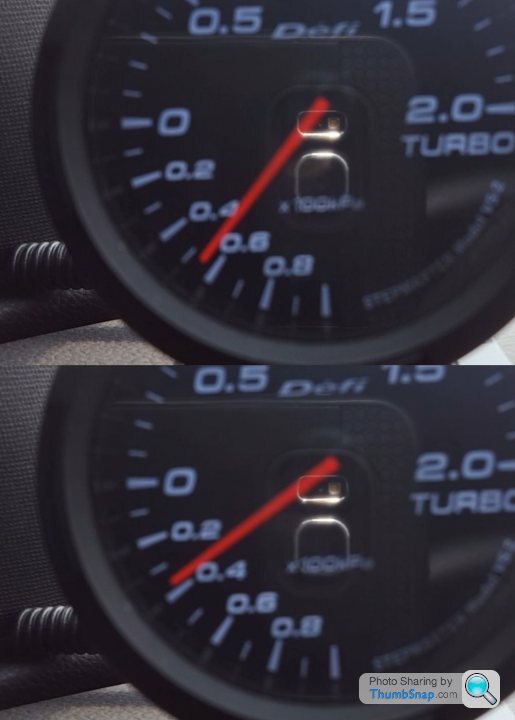

Edited by cornflakes2 on Saturday 21st September 17:49
cornflakes2 said:
Warby80 said:
Links to the logs are not working for me.
To start with you are looking for the Actual boost to be following the Specified boost as closely as possible.
Little tip aswell when logging, log the minimum amount of channels you can at a time. Every channel you add slows down the logging considerably and sometimes makes it hard to see things in the log.
Sorry! I have corrected the links. Should work now! Thanks for the tip. I think I should only use engine rpm, throttle position/angle or (footpedal), and the requested vs actual boost test (i think the blocks where 032, 033, and 115).To start with you are looking for the Actual boost to be following the Specified boost as closely as possible.
Little tip aswell when logging, log the minimum amount of channels you can at a time. Every channel you add slows down the logging considerably and sometimes makes it hard to see things in the log.
Does this sound about right?
Warby80 said:
I think if you do 115 to start with, log a couple of minutes of driving including building boost slowly and then go from there.
Did the readings in my snapshots or log have anything unusual or out of the norm?I had someone else tell me that I'd have to drive under WOT to get the most accurate readings about the boost (requested vs actual).
I'm not sure why I'd have to drive under full load at WOT when the problem was detected by me visually and just the feel of the car under
normal driving conditions (1500-3000 rpm) driving between 60-120 km/h. It's most noticeable when I'm going from stop and accelerating as opposed to
already going at 80 km/h and getting up to 120. Why would a turbo boost reading indicate that it's over working (hitting 1 to 1.5 bar) for just driving it under 100 km/h and barely going over 3000 rpm.
Gassing Station | Engines & Drivetrain | Top of Page | What's New | My Stuff