
Max vertical angle between gearbox and diff?
Discussion


As the title says, I have a drive-train alignment question.
What's the maximum acceptable vertical angle between gearbox and diff?
For those that aren't familiar with the issue, a universal joint changes rotational velocity when operating at an angle.
Two opposing UJ at the same (but opposite) angle (so diff and gearbox are parallel) with correct alignment (UJs mounted at correct rotation) will cancel out this velocity difference giving a nice smooth constant velocity.
Now keeping the diff and gearbox parallel all the time is impossible as the diff will lift at the nose under acceleration and lower at the nose under engine braking.
My build currently has the following:
- Diff pointing down (front higher than back) at 2 degrees
- Gearbox pointing down (front higher than back) at 0.5 degrees
So I have a 1.5 degree difference. Doh!
Under load this will be 1.5 degrees + something?
Under engine braking it will be 1.5 degrees - something?
Before I start shimming the engine mounts (I'm worried about bonnet space but this is hard to check as the body isn't fitted yet) will this angle difference likely to be noticeable?
If it's likely to be mildly noticeable I can ignore for now and fab some custom upper adjustable control arms for the live axle to flatten the diff further down the line.
Thoughts welcome.
Thanks
What's the maximum acceptable vertical angle between gearbox and diff?
For those that aren't familiar with the issue, a universal joint changes rotational velocity when operating at an angle.
Two opposing UJ at the same (but opposite) angle (so diff and gearbox are parallel) with correct alignment (UJs mounted at correct rotation) will cancel out this velocity difference giving a nice smooth constant velocity.
Now keeping the diff and gearbox parallel all the time is impossible as the diff will lift at the nose under acceleration and lower at the nose under engine braking.
My build currently has the following:
- Diff pointing down (front higher than back) at 2 degrees
- Gearbox pointing down (front higher than back) at 0.5 degrees
So I have a 1.5 degree difference. Doh!
Under load this will be 1.5 degrees + something?
Under engine braking it will be 1.5 degrees - something?
Before I start shimming the engine mounts (I'm worried about bonnet space but this is hard to check as the body isn't fitted yet) will this angle difference likely to be noticeable?
If it's likely to be mildly noticeable I can ignore for now and fab some custom upper adjustable control arms for the live axle to flatten the diff further down the line.
Thoughts welcome.
Thanks
John,
Clearly, you have a live axle, with integral diff, as most moderns have independant suspension with the diff bolted to the shell, if it's not part of the engine.
Movement of that live axle will be several centimeters, while the length of the prop shaft will be measured in meters - well, a meter plus a bit anyway. So lets say, 250mm movement on a 1500mm propshaft. If the shaft and diff are perfectly aligned in the middle of that stroke, then at the extreme the angle between them will have a Tangent of 125/1500 = 0.0833 whiich represents an angle of about 4.5 degrees.
So I don't think you need to worry about 1.5 degrees.
John
Clearly, you have a live axle, with integral diff, as most moderns have independant suspension with the diff bolted to the shell, if it's not part of the engine.
Movement of that live axle will be several centimeters, while the length of the prop shaft will be measured in meters - well, a meter plus a bit anyway. So lets say, 250mm movement on a 1500mm propshaft. If the shaft and diff are perfectly aligned in the middle of that stroke, then at the extreme the angle between them will have a Tangent of 125/1500 = 0.0833 whiich represents an angle of about 4.5 degrees.
So I don't think you need to worry about 1.5 degrees.
John
Thanks for your reply.
Yes it is a live axle.
It's four link suspension (not radius arms) so the vertical movement of the axle doesn't matter because the angle of the diff remains the same through the whole suspension travel. Thinking about it, cars fitted with radius arms would have this issue and they seem to work just fine so this gives me a bit of comfort.
On my 4 link setup the only change in angle comes form torquing the diff. I don't really have a way of calculating this as it depends on torque applied, leverage of the control arms and how squishy the bushes are.
The angle of the drive shaft between the two UJs can be anything between 1 degree and whatever the limit of the UJ is. It doesn't affect the gearbox/diff alignment.
Yes it is a live axle.
It's four link suspension (not radius arms) so the vertical movement of the axle doesn't matter because the angle of the diff remains the same through the whole suspension travel. Thinking about it, cars fitted with radius arms would have this issue and they seem to work just fine so this gives me a bit of comfort.
On my 4 link setup the only change in angle comes form torquing the diff. I don't really have a way of calculating this as it depends on torque applied, leverage of the control arms and how squishy the bushes are.
The angle of the drive shaft between the two UJs can be anything between 1 degree and whatever the limit of the UJ is. It doesn't affect the gearbox/diff alignment.
Not sure if this helps, but in agriculture, very few PTO-driven machines are perfectly lined up between the tractor and the implement. With stationary machines it's easier to set them up so that they're quite well lined up, but with machines which work while you're driving - balers, cultivators etc. the angle will be constanly changing.
We run machines requiring upwards of 200 HP at the PTO and have never experienced breakages*, although we do try to be as careful as possible when setting up.
ETA: We lubricate the UJ's on the PTO every time we use the machine. I appreciate that this would be challenging under a car!
We run machines requiring upwards of 200 HP at the PTO and have never experienced breakages*, although we do try to be as careful as possible when setting up.
ETA: We lubricate the UJ's on the PTO every time we use the machine. I appreciate that this would be challenging under a car!
- I realise that I have cursed myself now...
Edited by sunbeam alpine on Monday 28th September 12:27
Edited by sunbeam alpine on Monday 28th September 12:28
gazza285 said:
Same as any other live axle car, only yours will be less so due to the four link. Not something I would worry about.
This is probably right, I've just read in multiple places that you should keep them at the same angle to avoid vibration and can't find the tolerance anywhere.Assuming I don't change anything when I finally get the build finished I guess I'll find out.
stevieturbo said:
montyjohn said:
What's wrong with 2 degrees for the diff angle? Is this not normal? Sounds ok to me.
2 degrees is an absolutely miniscule amount and not even worth giving 2 seconds of consideration to.https://www.chevyhardcore.com/tech-stories/chassis...
"Ideally, the transmission angle and the pinion angle will be parallel, and the resulting driveshaft operating angles will be within 1-degree of each other to cancel out torsional vibrations produced by the U-joints."
https://www.drivelinesnw.com/part-trouble-shooting...
"Please note that the transmission and the differential are parallel, the rules of geometry guarantee that the two operating angles will also be equal + or – 1 degree."
It's quite hard to find articles that state the max operating angle difference and these are the only two I've found so far.
If anyone knows they've operated with more than 1 degree and not had any vibration issues I'd be interested to hear form you.
Also, what are you building? A rolls royce will obviously require better NVH (lower torsional vibration) than a rough n ready track car?
The TV is obviously at a higher frequency than the fundamental prop shaft frequency, and that fundamental frequency is proportional to road speed (being linked to the road via wheels and final drive ratio). But with a reciprocating driveline, you also have a large number of higher frequency components created by your engine. If you have a heavily boosted 3 cyl engine (or a 1 cyl engine!!) then that TV is the main problem, if you have a V12, then yes, your driveline TV could be dominated by the prop!
Realistically, because the driveline is pretty soft (the rear tyres being the main softness) then even if you generate a large amount of TV in the prop, you might not feel it, because the vibartion does not get reacted anwhere stiff.
As others have mentioned, unless you are doing something really wild, in terms of diff angle, then the effect will be small:
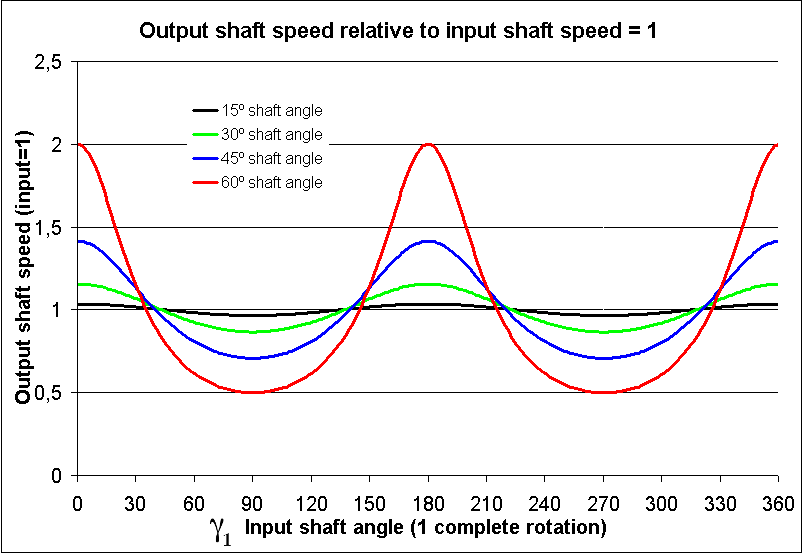
Look at that graph, the black line is at 15 degrees and shows something like a 7% TV. So operating at say 4 degrees mismatch, TV will be down in the single percentage points, ie un-noticable
The TV is obviously at a higher frequency than the fundamental prop shaft frequency, and that fundamental frequency is proportional to road speed (being linked to the road via wheels and final drive ratio). But with a reciprocating driveline, you also have a large number of higher frequency components created by your engine. If you have a heavily boosted 3 cyl engine (or a 1 cyl engine!!) then that TV is the main problem, if you have a V12, then yes, your driveline TV could be dominated by the prop!
Realistically, because the driveline is pretty soft (the rear tyres being the main softness) then even if you generate a large amount of TV in the prop, you might not feel it, because the vibartion does not get reacted anwhere stiff.
As others have mentioned, unless you are doing something really wild, in terms of diff angle, then the effect will be small:
Look at that graph, the black line is at 15 degrees and shows something like a 7% TV. So operating at say 4 degrees mismatch, TV will be down in the single percentage points, ie un-noticable
Also note that the whole point of angling the nose of the diff down slightly is so that the torque reaction of the axle under load brings to alignment closer to optimal. That should be a much smaller effect with a five link setup than with leaf springs, but any compliance in the bushes will give some movement.
Edited by LimSlip on Wednesday 30th September 11:17
stevieturbo said:
Complete and utter nonsense. Between flex in suspension joints, movement of the axle etc etc etc....all of these will easily be far more than 1 degree in multiple directions.
Maybe? But as you can see I'm receiving conflicting information on this one.I think for short periods, prop vibration under high loading is to be expected, but you don't want vibration under light load as that would be very noticeable and continuous. This is why you want your gearbox and diff pinion to be as close to parallel at rest as possible and we make an exception for high loads.
I know a lot of Land Rover owners who lift their suspension by 2” need to fit castor correction arms which are 3 degrees from standard. If they don’t they get unbearable vibration (and this is in a 4x4 which has massive travel).
Max_Torque said:
Also, what are you building?
It's a kit car E-type with a straight six. It's not going to be a track car so I would like it to be smooth. I expect the driveshaft may be the main source of vibration if I’m not careful.Max_Torque said:
Realistically, because the driveline is pretty soft
Thinking about it, I’ll will likely have a two piece prop (I still need to get one made up so not 100% what I will have in the end) with the gearbox end using a rubber donut so this point is even more relevant. Thanks.Through more reading (probably too much) on this topic I think I've figured out how some Radius Arm setups deal with the varying pinion angle (although I don't fully understand it all yet).
- Radius arms and propshaft are as close to the same length as possible (often not achievable).
- Diff points straight to the gearbox flange. This means that for the full suspension travel the angle between the diff pinion and the propshaft remain the same and there is no varying velocity at this diff UJ as it’s a straight union.
- For gearbox end UJ they either use a Double Cardan which is effectively constant velocity or they use a phased propshaft to mask the changes in velocity. I'm not sure how a phased prop achieves this but I'll take their word on it for now.
As a Jag with an IRS...this is of even less concern considering the diff itself will move very little.
And whoever commented that a diff should be pointed nose up.....is incorrect, as a live axle setup would normally be a little nose down as the nose would try to rise under acceleration.
And whoever commented that a diff should be pointed nose up.....is incorrect, as a live axle setup would normally be a little nose down as the nose would try to rise under acceleration.
stevieturbo said:
As a Jag with an IRS...this is of even less concern considering the diff itself will move very little.
And whoever commented that a diff should be pointed nose up.....is incorrect, as a live axle setup would normally be a little nose down as the nose would try to rise under acceleration.
Yep, that was a proper brain fart. The OP's is oriented correctly (nose down) though.And whoever commented that a diff should be pointed nose up.....is incorrect, as a live axle setup would normally be a little nose down as the nose would try to rise under acceleration.
Gassing Station | Engines & Drivetrain | Top of Page | What's New | My Stuff