
Another clutch Question
Discussion


Hi all,
For the tech guys really, my car was hankering for a spankering so i gave it a blast between second and fourth but clutch wouldn't return and fourth was a no go for a few seconds. Clutch pedal stayed flat to the floor. MystVXR mentioned his doing this at shakey's but I didn't realize it would happen on the road while under momentum and not because of a hard standing start. I did change the clutch fluid as stig suggested on the other clutch thread but it's getting worse. Have I knackered a seal or something because fluid keeps getting miscoloured after a drain and a test spank. No judder or anything just a lazy clutch return. If is is a seal can it be easily replaced by me? Will it damage the actual clutch eventually? Sorry for long post.
For the tech guys really, my car was hankering for a spankering so i gave it a blast between second and fourth but clutch wouldn't return and fourth was a no go for a few seconds. Clutch pedal stayed flat to the floor. MystVXR mentioned his doing this at shakey's but I didn't realize it would happen on the road while under momentum and not because of a hard standing start. I did change the clutch fluid as stig suggested on the other clutch thread but it's getting worse. Have I knackered a seal or something because fluid keeps getting miscoloured after a drain and a test spank. No judder or anything just a lazy clutch return. If is is a seal can it be easily replaced by me? Will it damage the actual clutch eventually? Sorry for long post.
 k its your fluid thats blacker than the sock fluff under by big toe nail.
Yeah I already swapped fluid about a week ago... Then did it again two or three times so as to comletely pump it through. Just checked it now and lo and behold it is black again. As far as dragging the cluth goes, on sprints I never do it. Foot on, foot off. Just wish the cluth pedal would follow. Oh, also when not spanking (i.e pootling round town) which is when i probably would slip the clutch, It feels fine.
The problem is the water absorbed into your fluid can boil if your clutch slips or if you give it a hard time. The gas released can make the pedal go hard (or soft)and then you cannot change gear! My LS9 clutch never bedded in properly and slipped, causing the problem you describe. It was changed for a twin plate Spec and has been fine ever since. Try bleeding the fluid completely through and replacing with DOT5?
www.rangeracceleration.com/Clutch_Care.html
www.rangeracceleration.com/Clutch_Care.html
Edited by anonymous-user on Sunday 31st May 16:10
Thanks very much Guys. At least no nasty damage then. I didn't think I would be burning so much fluid so quickly! I will have to drain the whole clutch system completely and refill it. so just one more question.....Can you point me to a step by step clutch drain procedure on these engines or point me in the direction of the bleeder valve thingy. Sorry to sound like a mechanical noob.
The clutch slave cylinder is coaxial around the gearbox input shaft. A hexagon tube radiates outwards to an opening on the side of the bell housing, see picture at the 2 o clock position. You can attach a pipe here and turn with a short 11 mm box spanner with the pipe coming out the centre.
The slave cylinder is aluminium and attached to the gearbox front face also aluminium. So it is well heatsinked to the gearbox. The heat path from friction surfaces is principally via the steel friction disk centre and input shaft. I'm a little surprised this can conduct enough heat through that quickly, but the hard pedal syndrome is widely reported. I have not seen it myself but do feel the clutch gets heaver after long periods of driving and lighter if the car is not used for a few days. I have had the clutch slip once at a drag strip. I did not notice any unusual pedal behaviour and it immediately returned to normal but did smell for a few hours.
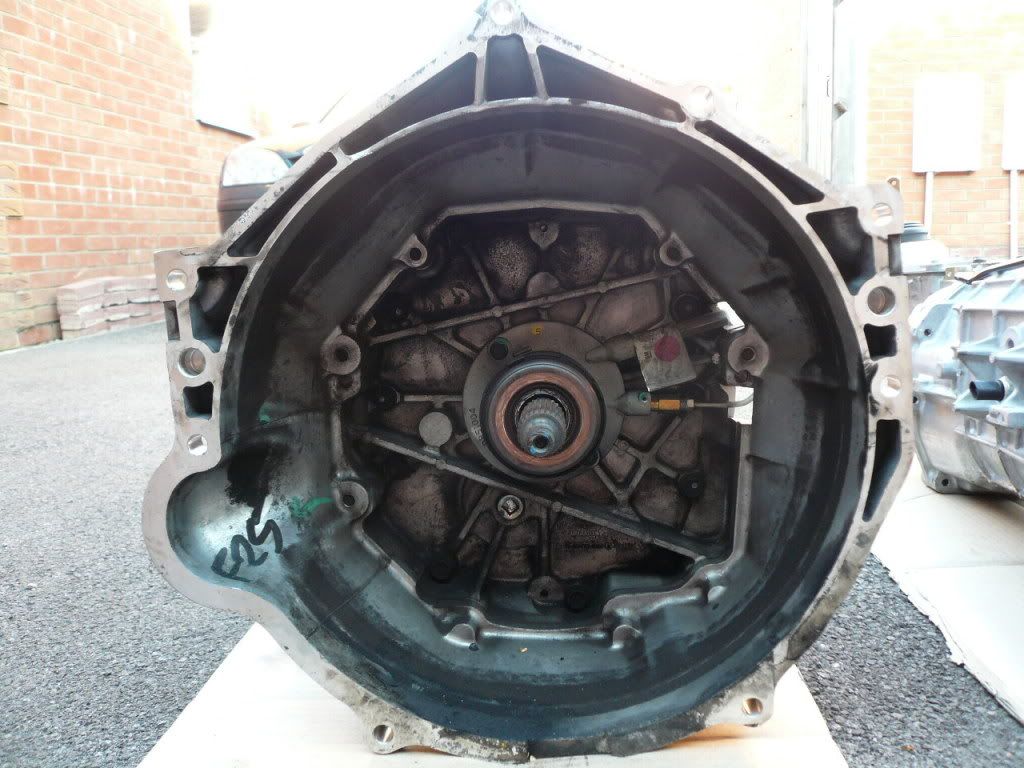
The slave cylinder is aluminium and attached to the gearbox front face also aluminium. So it is well heatsinked to the gearbox. The heat path from friction surfaces is principally via the steel friction disk centre and input shaft. I'm a little surprised this can conduct enough heat through that quickly, but the hard pedal syndrome is widely reported. I have not seen it myself but do feel the clutch gets heaver after long periods of driving and lighter if the car is not used for a few days. I have had the clutch slip once at a drag strip. I did not notice any unusual pedal behaviour and it immediately returned to normal but did smell for a few hours.
[quote=granada203028]The clutch slave cylinder is coaxial around the gearbox input shaft. A hexagon tube radiates outwards to an opening on the side of the bell housing, see picture at the 2 o clock position. You can attach a pipe here and turn with a short 11 mm box spanner with the pipe coming out the centre.
The slave cylinder is aluminium and attached to the gearbox front face also aluminium. So it is well heatsinked to the gearbox. The heat path from friction surfaces is principally via the steel friction disk centre and input shaft. I'm a little surprised this can conduct enough heat through that quickly, but the hard pedal syndrome is widely reported. I have not seen it myself but do feel the clutch gets heaver after long periods of driving and lighter if the car is not used for a few days. I have had the clutch slip once at a drag strip. I did not notice any unusual pedal behaviour and it immediately returned to normal but did smell for a few hours.
Thanks for that. At least I know where the little Bleeder is. I just spoke to a local mechanic type guy and he says that the washer/seal in the master cylinder is breaking down. He said that for the clutch fluid to get so dark after only 10 or 15 miles of driving is a sure sign that the rubber washer/seal is about to fall to bits and all the crap is being sent to the bottle. It did make sense because under heavy clutch use the hydraulic pressure can't keep up with hard and quick changes if the washer/seal isn't sealing. The master cylinder is a bugger to get to so I might get it done properly. Does this sound feasible?
Maybe but if the seal was failing then I would expect leaks and loss of fluid. The system doesn't contain very much. My Rover Vitesse leaked - it ran down the pedal onto my shoe - but was still working OK.
Certainly master cylinder problems are more friendly than slave ones...
I would try flushing it several times as others suggest.
Certainly master cylinder problems are more friendly than slave ones...
I would try flushing it several times as others suggest.
Over 8 years ago I experienced the "no clutch" action at max revs.Confused me and tried the bleed method,new thrust cylinder,different clutch fluid pipe and then different style clutches.Successful with twin plates but apparently none of you have heard of the centrifugal vacumn created by the mass rotating at high rpm.I had'nt until I done some detailed research.Basically at very high rpm (my car was a GTSR making 550bhp at the time)the centrifugal velocity of the rotating mass creates this vacumn within the bellhousing and sucks the clutch plates to the friction plates and will not release.Drop the revs as we have all done as gear selection impossible at these high rpm and then the gear select is ok.
Am I correct in all your experiences??I think I am and a change of clutch assembly to either Mcleod,Spec or Ram twins will in all probability cure your problem.
Or cheaper still do not floor to max,just keep a lower rpm and gear selection ok.Supercharged cars the worst offenders.
Am I correct in all your experiences??I think I am and a change of clutch assembly to either Mcleod,Spec or Ram twins will in all probability cure your problem.
Or cheaper still do not floor to max,just keep a lower rpm and gear selection ok.Supercharged cars the worst offenders.
I'm familiar with the standard LS1 assembly as I have changed it myself to fix judder. It is certainly not possible to create any vacuum in the bell housing total but perhaps between the friction surfaces and pressure plate/flywheel. I have postulated that slip occurs because the burning of the surfaces evolves gas which keeps the surfaces apart and "lubricates". The corollary of this is that vacuum could keep them together.
The large forces involves and small movements are all axial so I cannot see how centrifugal forces at 90 deg could be translated. Remember the slave cylinder disengages the clutch by pressing the pressure plate lever arms against the belleville spring disk moving the pressure plate away from the flywheel. This movement is very small only a few mm. The clutch driven disk just "floats" on the gearbox input shaft.
The plate and flywheel surfaces are machined slightly concave, so they grip around the outside first. As the clutch is engaged it would squeeze gas inwards.
 I like pancakes
Sneakygloworm said:
He said that for the clutch fluid to get so dark after only 10 or 15 miles of driving is a sure sign that the rubber washer/seal is about to fall to bits and all the crap is being sent to the bottle.
He's talking poo.The fluid always goes black with these setups. It's nothing to worry about.
Edited by stevieturbo on Sunday 31st May 20:57
Seriously though this is getting heavy. Reading between the lines are all stock monaro's going to suffer from premature clutch problems. Surely clutch and engine and gears would have been married together and tested at manufacture. I don't want to nursemaid 'ol phat arse all the the time because of weak components. Especially as spares are expensive and may become rare. I don't drive hard a lot so am a bit surprised.
stevieturbo said:
Sneakygloworm said:
He said that for the clutch fluid to get so dark after only 10 or 15 miles of driving is a sure sign that the rubber washer/seal is about to fall to bits and all the crap is being sent to the bottle.
He's talking poo.
The fluid always goes black with these setups. It's nothing to worry about.
Edited by stevieturbo on Sunday 31st May 20:57
okay but will changing or bleeding the fluid right out and replacing it help. I understand that the fluid won't work as well if it's black or contaminated but it happens so fast. I don't really want to (or surely need to) change fluid every weekend. I don't understand the science and physics behind clutches and transmission of power and I bet vaux don't either. they'll just order another complete clutch and chuck me a bill. admittedly it's worth trying it once though.
easiest way to freshen up clutch fluid is to use a large syringe - unscrew filler cap, sook out as much of old fluid as possible, top up with fresh, pump pedal a few times - repeat until fluid stays clear. real diy job and takes about 10mins - just be careful not to drip fluid on paintwork.
Well_Fans said:
easiest way to freshen up clutch fluid is to use a large syringe - unscrew filler cap, sook out as much of old fluid as possible, top up with fresh, pump pedal a few times - repeat until fluid stays clear. real diy job and takes about 10mins - just be careful not to drip fluid on paintwork.
I know this is a standard reply but how is it suppose to work as the slave cylinder is not on a recirculating setup, only one line feeds it so pumping the peddle will not return fluid to the header tank in reality. I appreciate a small amount will move about if only from fluid movement but the only real way to solve the problem is to blead from the slave.S600VXR said:
Well_Fans said:
easiest way to freshen up clutch fluid is to use a large syringe - unscrew filler cap, sook out as much of old fluid as possible, top up with fresh, pump pedal a few times - repeat until fluid stays clear. real diy job and takes about 10mins - just be careful not to drip fluid on paintwork.
I know this is a standard reply but how is it suppose to work as the slave cylinder is not on a recirculating setup, only one line feeds it so pumping the peddle will not return fluid to the header tank in reality. I appreciate a small amount will move about if only from fluid movement but the only real way to solve the problem is to blead from the slave.Gassing Station | HSV & Monaro | Top of Page | What's New | My Stuff