
4.3 Vantage vs 4.7
Discussion


Hi Guys
I am sure this question has come up many times so thank you for your response in advance.
There seems to be a big difference in price between the 4.3,-and 4.7 almost 10 k in some cases.
Is there a huge difference ?
Is there a particular model year or upgrade to look for ? Ie 2006 vs 2007 ?
Is it worth spending more from say a 2008 58 to a 2012 as I have looked at both and can't see a lot of difference apart from the rear lenses etc ?
Thanks in advance. ( by the way I am looking at Manual )
Dazza.
The 4.3 vs 4.7 is subjective really, but I drove a 4.3 and found it lacked mid-range grunt, so saved a bit longer and waited till I could get a 4.7 and i'm glad I went that route. The 4.3's a fine car, and plenty quick enough 99% of the time, but the 4.7 is worth the difference for me. On like for like basis, I don't think you will be paying anywhere near 10K extra just because it's a 4.7 though.
The 4·7 was announced at the Geneva Motor Show in March 2008.
There was quite a long list of changes (sorry not to hand at the moment).
Main production began for delivery from September 2008 (ie Model Year 2009).
You may remember there was quite a financial calamity at that time, dealers had cancelled orders, and the sales of new cars slowed considerably. Aston's total annual production dropped from around 7,000 to 4,000 at that time.
I am telling you this because it partly explains the higher values for the 4·7. Fewer 4·7 Vantages were being produced than earlier, and without looking up the figures, it is even possible that there might still be more 4·3 than 4·7 cars in the UK. One related point to watch, is that some new 4·3 Vantages were still being sold and first registered in the summer of 2009.
If a 4·7 is within your budget, it is generally accepted as being the one to go for. The initial 4·7 model remained mostly unchanged from Model Year 2009 to 2012. The next change was early 2012, which they called Model Year 2012.25.
Good luck finding what you want.
Edited by Jon39 on Saturday 20th February 21:17
I've always said the 4.3 is plenty quick, although it needs to be revved to really access the performance. The 4.7 is quite a bit faster, especially at low and mid revs, but also at the top end. The 4.7 also has the DBS center stack, updated base suspension and the Sports Pack became available. I think the 4.7 is worth the extra money if you want the extra go and the other improvements, but the 4.3 is a fine car too.
Dazza N said:
Is there a huge difference ?
Darren, here is your bedtime reading.
Well you did ask.

I was probably wrong when I referred previously to a Geneva Motor Show announcement. You will see that the following press release is dated two months after that motor show. One of the improvements that is apparent during everyday driving, is improved torque, so more tractable at lower speeds.
..........................................................................
Technical Enhancements for Aston Martin V8 Vantage
Published: May 23, 2008
Tags: Models, Corporate
Gaydon, 23 May 2008.
Aston Martin’s V8 Vantage – originally launched to widespread critical acclaim at the Geneva Motor Show in 2005 – is to receive significant technical enhancements, reaffirming the car’s position as one of the world’s most desirable and exhilarating sports cars.
While the universally distinctive and award-winning shape of the V8 Vantage is retained, the car benefits from a number of technical changes which include significantly up-rated engine performance from a new 4.7 litre power unit in both Coupe and Roadster variants. Other changes include revised dynamics to take full advantage of increased power and torque availability, improved Sportshift™ transmission software and a new sports suspension option.
The 4.7 litre V8 engine has a power output of 420bhp (an 11% increase on the previous 4.3 litre unit) and delivers peak torque of 470Nm (15% increase), providing the V8 Vantage with new reserves of mid-range performance, an improved 0-60mph time of 4.7 seconds and top speed of 180mph (288kph). Combined European fuel economy and CO2 emissions are also improved by 13% (Sportshift™).
Inside, the changes include a new centre console and revised switchgear and the introduction of an ECU replacing the previous V8 Vantage key. Externally, the acclaimed V8 Vantage design appearance is enhanced with a range of new standard and optional 19’’ alloy wheels.
Aston Martin Chief Executive Officer, Dr Ulrich Bez said: “Continued development and evolution of our unique VH (Vertical-Horizontal) architecture has brought even higher levels of refinement and dynamic performance to our whole range.
“With the new 4.7 litre engine and associated changes we have taken the V8 Vantage to new levels of performance to produce an even more desirable sports car.
“The V8 Vantage is now the most successful Aston Martin in our history and we are confident these changes will continue its appeal and driving enjoyment for both new and existing customers.”
Engine
Improvements in performance have been achieved through a number of carefully developed changes to Aston Martin’s acclaimed V8 engine.
The cylinder bore and stroke has been increased from 89mm to 91mm and 86mm to 91mm respectively, giving a total displacement of 4735cc.
The increase in cylinder bore is facilitated by a move to cylinder liners that are pressed into the pre-machined aluminium alloy block, allowing a thinner liner than was possible with the cast-in design of the 4.3 litre engine.
The new forged steel crankshaft provides the 91mm stroke and incorporates new holes in the counter weights for reduced rotating mass and improved inter-bay breathing. New forged steel con-rods and cast aluminium pistons complete the capacity-related changes.
Other key changes include efficiency improvements to the dry sump lubrication system, including a new sump casting with oil pick-up points moved from the front and rear to the sides of the sump. The cylinder heads are modified with a new intake port and an inlet valve size increase from 34.9mm to 35.9mm. The intake manifold has been modified to match the new port to optimise air flow.
Transmission
The V8 Vantage transmissions have also undergone changes to improve performance and to handle the increased levels of power and torque. Both the standard manual stick-shift gearbox and the optional Sportshift™ transmission benefit from a modified clutch and flywheel, reducing clutch pedal efforts and delivering a 0.5kg weight saving, reducing the rotating masses within the powertrain, and hence increasing engine responsiveness.
Aston Martin’s Sportshift™ transmission has undergone a series of specific changes to broaden the capabilities of the gearbox to offer customers enhanced comfort and convenience with sporting capabilities. Changes include a revised control strategy, allowing the transmission, rather than the engine, to dictate how best the engine torque should be deployed to optimise performance and deliver power smoothly and consistently.
‘Dual Throttle Map’ software is also featured. When ‘Comfort’ mode is selected the engine reacts in a smoother more progressive manner to driver throttle inputs and in the default ‘Sports’ mode the throttle mapping is more aggressive, delivering a more dynamic and sporting feel.
Sportshift™ now also has the capability to take inputs from the steering wheel enabling the current gear to be held when the car is negotiating a corner and hill descent detection, allowing a low gear to be held, maximising the effects of engine braking.
Suspension
A series of improvements are introduced to the V8 Vantage chassis and suspension setup to deliver improved body control and low speed ride quality; enabling the driver to take full advantage of the increased performance potential.
A number of the improved components originally introduced on the Vantage Roadster are now carried over to the Coupe, including revised upper damper mountings and bump stops. Additionally, the front spring rates are stiffened by 11% at the front and 5% at the rear.
Steering geometry is also modified to improve steering feel, while the front lower suspension arm compliance bushes are stiffened by 22% to provide enhanced steering response and handling.
The V8 Vantage also now benefits from Bilstein dampers as standard; these low-friction dampers provide improved levels of dynamic capabilities and further improve ride quality.
Design & Optional Equipment
Also introduced as an option for both Coupe and Roadster variants is a new Sports Pack which comprises forged lightweight alloy wheels aiding a lower unsprung mass, re-tuned Bilstein dampers with improved dynamic response, up-rated springs and a revised rear anti-roll bar (Coupe only). The Sports Pack is intended to offer greater agility, high speed body control and precision feel for the most enthusiastic of drivers.
Although the award-winning exterior design of the V8 Vantage remains largely unchanged, a new 20-spoke 19’’ alloy wheel is introduced as standard, with either diamond turned silver or graphite finishes available as options, affording customers maximum choice. Alternatively, as part of the Sports Pack option, a 5-spoke lightweight aluminium wheel will be provided.
In the cabin, a new centre console constructed from die cast zinc alloy with a graphite silver finish is introduced along with a new ECU – first seen on the DBS in 2007. The ECU – constructed from glass, polished stainless steel and polycarbonate - replaces the key used previously for the V8 Vantage. The revised car also includes a new Hard Disk Drive (HDD) Navigation System offering faster route processing, additional features and improved graphics. Full ipod/MP3 integration is retained as standard equipment.
First shown as a concept car at the 2003 North American International Auto Show in Detroit, the V8 Vantage caused a worldwide sensation as it allowed Aston Martin to enter a new sector of the premium sports car market with a genuine alternative to other cars on offer. Deliveries of the V8 Vantage Coupe to customers began in late 2005, joined by a convertible sibling in 2007 when the Vantage Roadster was launched. The car is hand built at Aston Martin’s Headquarters at Gaydon, Warwickshire, UK and to date more than 10,000 have been delivered to customers around the world.
Prices for the revised V8 Vantage will be confirmed at a later date, with deliveries set to commence from quarter three 2008.
- Ends -
-----------------------------------
Specification: Aston Martin V8 Vantage
Body
Two-door style coupe body style with tailgate or two-door body with soft cover convertible top and heated glass rear screen with 2+0 seating.
Bonded aluminium structure, aluminium alloy, steel, composite, and magnesium alloy body.
Extruded aluminium side impact bars.
Halogen projector headlamps (main beam).
LED rear lamps.
Engine
Aston Martin all alloy quad overhead camshaft 32 valve, 4735cc 4.7 litre V8.
Variable inlet camshaft timing.
Dry sump lubrication system.
Fully catalysed stainless steel exhaust system with active bypass valves.
Front-mid mounted engine.
Rear wheel drive.
Transmission
Rear mid-mounted six-speed manual gearbox with optional Sportshift*4 automated manual transmission.
Alloy torque tube with carbon fibre propeller shaft.
Limited slip differential.
Final drive ratio 3.909:1
Steering
Rack and pinion, power assisted steering, 3.0 turns lock to lock.
Column tilt and reach adjustment.
Electronic steering column lock.
Wheels and Tyres
Standard: 19’’ alloy wheels – 20 spoke design - Front: 8.5J x 19’’ / Rear: 9.5J x 19’’. Bridgestone Potenza tyres - Front: 235/40 ZR19. Rear: 275/35 ZR19.
Optional: 19’’ alloy wheels – 7 spoke design - Front: 8.5J x 19’’ / Rear: 9.5J x 19’’. Bridgestone Potenza tyres - Front: 235/40 ZR19. Rear: 275/35 ZR19.
Suspension
Front: Independent double aluminium wishbones incorporating anti-dive geometry, coil springs, anti-roll bar and monotube dampers.
Rear: Independent double aluminium wishbones incorporating anti-squat and anti-lift geometry, coil springs, anti-roll bar and monotube dampers.
Brakes
Radial-mounted four-piston monobloc calipers.
Dynamic Stability Control (DSC).
Traction Control.
Anti-lock Braking System (ABS).
Electronic Brakeforce Distribution (EBD).
Emergency Brake Assist (EBA).
Positive Torque Control.
Front: Ventilated grooved steel discs 355mm diameter
Rear: Ventilated and grooved steel discs 330mm diameter
Interior
Full grain leather interior.
Alcantara headlining.
Alloy facia trim and graphite centre console finish.
Electrically adjustable seats.
Dual stage driver and passenger airbags.
Side airbags. Heated rear screen.
Automatic temperature control.
Organic Electroluminescent (OEL) displays.
Trip computer, Glass ECU.
LED map reading lights. Rear parking sensors.
Tyre pressure monitoring.
Alarm and immobiliser.
Remote control central door locking and boot release.
Battery Disconnect Switch (BDS).
Battery conditioner.
Tracking device (UK only).
In-Car Entertainment
160W Aston Martin Audio System with six-CD autochanger.
Integrated Apple iPod® connector*5.
USB connector with Waveform Audio Format (WAF), Windows Media Player (WMA) and MPEG (MP3) audio file compatibility.
Options
Sportshift*4 automated manual transmission.
Sports Pack.
Hard Disk Drive (HDD) satellite navigation system*1+.
High Intensity Discharge (HID) Headlamps (dipped beam).
Satellite radio system (USA only).
Piano Black facia trim.
Personalised sill plaques.
Auto dimming interior rear view mirror*1.
Auto dimming interior rear view mirror with garage door opener*1.
Alarm upgrade (volumetric and tilt sensor).
Memory seats and exterior mirrors (three positions).
Heated seats.
Front parking sensors.
Tracking device*2.
First aid kit.
Ashtray and cigar lighter.
Cruise control.
Bluetooth telephone preparation*1.
Powerfold exterior mirrors.
Boot mounted umbrella.
700W Aston Martin Premium Audio System with Dolby® Pro Logic II®.
Dimensions
Length: 4380mm (172.5’’)
Boot Capacity Coupe: 300 litres (10.6 cu ft)
Width: 1865mm (73.5’’) exc. mirrors 2025mm (80’’) inc. mirrors
Boot Capacity Roadster: 144 litres (5.0 cu ft)
Height: 1255mm (49.5’’)
Front Track: 1570mm (62.0”)
Wheelbase: 2600mm (102.5’’)
Rear Track: 1560mm (61.5’’)
Weight: 1630kg (3595lb)
Cd: 0.34
Fuel Capacity: 17.6 UK gal (80 litres) 21.1 US gal
Turning Circle: Kerb to kerb: 11.1m (36.5 ft)
Performance
Max speed: 180mph (290 km/h)
Max power: 313kW (420bhp) @ 7000 rpm
Acceleration: 0-60mph 4.7 seconds
0-100km/h (62mph) 4.8 seconds
Max torque: 470 Nm (346 lb.ft) @ 5750 rpm
Fuel Consumption*3
Manual:
Mpg (litres/100km)
Urban 14.2 (19.9)
Extra Urban 27.3 (10.4)
Combined 20.4 (13.9)
Sportshift*4:
Mpg (litres/100km)
Urban 14.6 (19.4)
Extra Urban 29.5 (9.6)
Combined 21.4 (13.2)
CO2 Emissions
Manual: 328g/km Sportshift*4: 312g/km
*1 Not available in all markets, please consult your dealership for details
+ Includes Traffic Messaging Channel (TMC) in Continental Europe
*2 Complies with UK Thatcham Category 5 requirements. Excludes subscription. Standard in the UK.
*3 Data not applicable to North American market
*4 Sportshift trademark is used under licence from Prodrive (Holdings) Ltd
*5 iPod is a trademark of Apple Inc., registered in the U.S. and other countries
Edited by Jon39 on Saturday 20th February 21:18
Handyman2009 said:
I personally bought a 2009 AMV8 Coupe with a 6sp manual as only about 70 units made it to North America that year and only about 400 units produced world wide. Find attached the production numbers from 2007 to 2013, good luck.
Francis
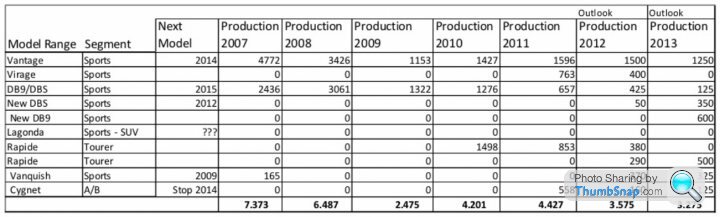
Where did you find the production numbers? I have a 2015 V8V GT, wonder how many they made of them?Francis
V8 Vantage GT said:
Handyman2009 said:
I personally bought a 2009 AMV8 Coupe with a 6sp manual as only about 70 units made it to North America that year and only about 400 units produced world wide. Find attached the production numbers from 2007 to 2013, good luck.
Francis
Where did you find the production numbers? I have a 2015 V8V GT, wonder how many they made of them?Francis
PS: I believed those were Market Research numbers and not actual Aston Martin.
Edited by Handyman2009 on Sunday 21st February 20:43
I thought I wanted a 4.7 sportshift and ended up with a 4.3 manual.
I`d read everything and figured it had to be a 4.7 and I liked the idea of sportshift. Then I drove a 2010 sportshift back to back with a 2007 4.3 manual, and that 4.3 is what I ended up buying.
OK the 4.3 was impeccable, low mileage and ticked all my boxes, but it was a much more engaging drive. I found the power difference to be negligible, there was for sure more mid-range grunt in the 4.7 but not shockingly so.
The other problem I had was in Switzerland pretty much everybody ordered the 4.7 in sportshift so the manual versions are few and far between and when they do pop up the tend to carry a 5-10k premium over the equivalent sportshift.
Yes I do feel I would like some more poke and I may address this with a power upgrade and exhaust, but the 4.3 is not slow, I like the ride and handling even when pushed, it`s comfortable and when I`m driving I never think to myself "I wish I had the new centre console."
I don`t think you can really go wrong with either in a manual. A month after purchase I drove an N430 and still don`t regret buying the 4.3.

Mr.Tremlini said:
The other problem I had was in Switzerland pretty much everybody ordered the 4.7 in sportshift so the manual versions are few and far between and when they do pop up they tend to carry a 5-10k premium over the equivalent sportshift.
Interesting.
I have read here about DB9 (or might be DBS) manuals being very sought after.
Do not know whether this is gradually becoming the same with manual Vantages in U.K.
My 4.7 will not be for sale, so another unavailable manual.
Incidentally, wonderful photographs on your website, Dean.
I think the 4.3 would benefit from a bit more power, but it's still a lovely car as it is. And at least for me, since my 4.3 is a 2006 it would be at least a £15k difference to upgrade, and it's not worth that to me.
Having looked at a 4.7 a few months after getting my car, I didn't like the centre console - thought the early ones looked much nicer, so it was actually a negative against the 4.7 to me (and so was the loss of heated front screen). Minor things, but things that convinced me that it was not as simple as the 4.7 being "better".
Having looked at a 4.7 a few months after getting my car, I didn't like the centre console - thought the early ones looked much nicer, so it was actually a negative against the 4.7 to me (and so was the loss of heated front screen). Minor things, but things that convinced me that it was not as simple as the 4.7 being "better".
Maybe worth looking at the AM Power Pack addon, you know that black intake manifold... it was said to bring the power from 380hp to 400hp I believe. I only see very few 4.3 with this installed when I was shopping around. Here is someone that did it
http://www.6speedonline.com/forums/aston-martin/33...
http://www.6speedonline.com/forums/aston-martin/33...
I think for the powerpack thing to work you need to run on 98 RON fuel all the time too....its some new airboxes, filters and a remap, with different colour manifold. And its pretty much all top end power
The N400 cars had it fitted as OE
personally if that concerned about 20bhp, save up for the 4.7...you wont really notice the 20bhp in a 1.6 ton car...sure its a nice to have on a used car, a bit like the premium stereo option if you like your music
The N400 cars had it fitted as OE
personally if that concerned about 20bhp, save up for the 4.7...you wont really notice the 20bhp in a 1.6 ton car...sure its a nice to have on a used car, a bit like the premium stereo option if you like your music
The 4.7 has more mid range grunt..which essentially means less gear shifting. A bit odd to want that in a sports car but it takes all sorts.
If going for a 4.7 I'd personally go for the model year before they changed the wing mirrors to those off a bus and "updated" the centre console (which was always too ham fisted and fussy IMO). I think that limits you to 1-2yrs' production. Not sure if a 4.7 exists without the "updated" sills, but I'd go for that too if possible.
If going for a 4.7 I'd personally go for the model year before they changed the wing mirrors to those off a bus and "updated" the centre console (which was always too ham fisted and fussy IMO). I think that limits you to 1-2yrs' production. Not sure if a 4.7 exists without the "updated" sills, but I'd go for that too if possible.
All 4.7 cars have the later console. The first year 4.7, MY09, have the original mirrors and the original sills (the sills were standard through the first quarter of '12). Mine is an '09 and to me, it's the sweet spot -- the 4.7 engine, Sports Pack, and the perfect original lines -- nose, tail, sills, mirrors.
About the extra mid-range torque being an odd thing to want -- there's more low-end, mid-range and high-end go. While the difference is most pronounced at lower revs, the extra power is everywhere, so there is a lot to gain from using the revs. I think the performance difference is quite noticeable, but I maintain that the 4.3 is plenty quick.
Handyman, interesting figures about production. I'm in the States -- I wouldn't have thought only 70 manual Coupes came the North America in '09.
Speedraser said:
All 4.7 cars have the later console. The first year 4.7, MY09, have the original mirrors and the original sills (the sills were standard through the first quarter of '12). Mine is an '09 and to me, it's the sweet spot -- the 4.7 engine, Sports Pack, and the perfect original lines -- nose, tail, sills, mirrors.
About the extra mid-range torque being an odd thing to want -- there's more low-end, mid-range and high-end go. While the difference is most pronounced at lower revs, the extra power is everywhere, so there is a lot to gain from using the revs. I think the performance difference is quite noticeable, but I maintain that the 4.3 is plenty quick.
About the extra mid-range torque being an odd thing to want -- there's more low-end, mid-range and high-end go. While the difference is most pronounced at lower revs, the extra power is everywhere, so there is a lot to gain from using the revs. I think the performance difference is quite noticeable, but I maintain that the 4.3 is plenty quick.
My car is the same Model Year as yours, but without the harder suspension option. Have you been to the U.K. recently? Many of the road surfaces (away from Motorways/Freeways) are in a shocking condition. Standard suspension is quite hard enough for me!
A Vantage is both happy when being driven in slow traffic, and at full throttle. A very good engineering achievement. Fewer gear changes (with the 15% extra torque), is helpful during the traffic driving.
Speedraser said:
All 4.7 cars have the later console. The first year 4.7, MY09, have the original mirrors and the original sills (the sills were standard through the first quarter of '12). Mine is an '09 and to me, it's the sweet spot -- the 4.7 engine, Sports Pack, and the perfect original lines -- nose, tail, sills, mirrors.
About the extra mid-range torque being an odd thing to want -- there's more low-end, mid-range and high-end go. While the difference is most pronounced at lower revs, the extra power is everywhere, so there is a lot to gain from using the revs. I think the performance difference is quite noticeable, but I maintain that the 4.3 is plenty quick.
Handyman, interesting figures about production. I'm in the States -- I wouldn't have thought only 70 manual Coupes came the North America in '09.
I am with you on that one, but I got those number directly from Aston Martin. Here is the quoteAbout the extra mid-range torque being an odd thing to want -- there's more low-end, mid-range and high-end go. While the difference is most pronounced at lower revs, the extra power is everywhere, so there is a lot to gain from using the revs. I think the performance difference is quite noticeable, but I maintain that the 4.3 is plenty quick.
Handyman, interesting figures about production. I'm in the States -- I wouldn't have thought only 70 manual Coupes came the North America in '09.
"Dear Mr Vachon
Thank you for your reply.
There were circa 400, 2009 model year V8 vantage coupe manuals built, of these circa 70 were left hand drive and shipped to North America.
Please see below the full car specification sheet as requested.
Kind regards"
Gassing Station | Aston Martin | Top of Page | What's New | My Stuff