
Discussion


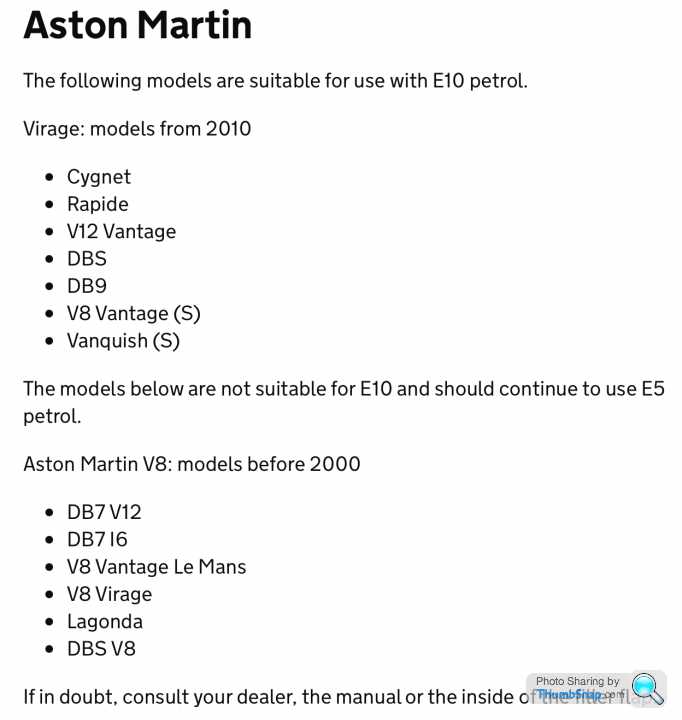
It is not just AM where there is confusion. The dotgov website is as you imply, is very sketchy.
I have not been able to find a complete comprehensive model list anywhere.
I used the Mercedes-Benz customer online question service, in respect of one of my cars, but after receiving the (presumably) automated acknowledgement, did not have any answer at all. Manufacturers are probably only interested in their current models.
If the ESSO supreme continues to be ethanol free (some geographical exceptions), then we do not have any problem.
For users of other petrol, the question arises about winter storage. Should the petrol tank be full, or almost empty? The advice used to be full, so that the amount of air in the tank is reduced. Perhaps that is different with E10.

KevinBird said:
Both DBS's can use E10... the '09 and the latest one, so it probably didnt need any further differentiation.That said I took the decision a while ago to only use Esso Synergy Supreme + going forward (unless of course I get caught short and will have to use regular 99 for one tankful), but I think the downgrade of 95 to E10 is a double whammy for it, and so really helps make more sense of the price differentiation between the two grades.
Edited by AdamV12V on Wednesday 1st September 11:22
This Ethanol in petrol is a slippery slope, in the next few years it'll be E15.....then E20.
I guess the early Gaydon models may struggle, hopefully the forecourts will continue selling premium petrol with either no Ethanol or E5
Not great news if you've got a classic car especially if it's not compatible with Ethanol petrol.
I guess the early Gaydon models may struggle, hopefully the forecourts will continue selling premium petrol with either no Ethanol or E5
Not great news if you've got a classic car especially if it's not compatible with Ethanol petrol.
Agent57 said:
So my manual for DB7 V12 says use 95 or 98 RON. Shell Vmax is 99 RON.
Is that good or bad?
Well the manual was printed before they thought of E10, so its incorrect now. Do not use 95 RON, E10 fuel in it.Is that good or bad?
Vmax 99 RON is fine for it as that is E5, but Esso Synergy Supreme + is even better as it is really E0 (just labelled as E5).

I don't have a local Esso forecourt that sells 99+ so will have to make do with Momentum or V-Power.
To be honest I have had no issues running the V12V (and my Mk1 Focus RS) on Momentum and at present it is only 7p/Ltr (uk) more expensive than the new 95 E10.
So with the supposed slight loss in economy going from 95 E5 TO 95 E10 I will also run both my daily Focus'.... a 2012 1 ltr Ecoboost and an old rusty 2001 1.8 Zetec ...on Momentum going forward.
To be honest I have had no issues running the V12V (and my Mk1 Focus RS) on Momentum and at present it is only 7p/Ltr (uk) more expensive than the new 95 E10.
So with the supposed slight loss in economy going from 95 E5 TO 95 E10 I will also run both my daily Focus'.... a 2012 1 ltr Ecoboost and an old rusty 2001 1.8 Zetec ...on Momentum going forward.
EVR said:
Even the E5 fuel has caused damage in the fuel systems of some older classic cars, so ESSO supreme (ethanol free) has already been a favourite for many years.
Ironically by making the 95 RON fuel less economical and powerful, they are making the cost difference between it and 99 RON fuels much better value, indeed almost twice as much value now from the same price difference, so the Gov is actually driving people who think about it to become less Eco friendly than they were before on the old fuel. 
Since I bought the car (just over 2 years) I have always without faults run it with Q8 Hi-Perform 100 octanes in Italy and various known brands of 98 octanes in Switzerland; the first already is an E10 fuel while the latter... I inquired about it last time but they did not know. And I do not think it is legally required in Switzerland to show on the pump the ethanol %, I could not find it anywhere.
AdamV12V said:
...so the Gov is actually driving people who think about it to become less Eco friendly than they were before on the old fuel
And there's the issue. How many will? Most want to fill at the cheapest pumps and wouldn't notice the difference. To be honest, I've tried 95 RON and 99 RON Esso in my V60 T5 daily and I couldn't really tell any difference in performance or economy, even though Volvo actually recommend premium for best fuel consumption.People seem to be getting confused here between Ethanol content and Octane rating.
The issue with E10 is not the octane rating because Ethanol has a higher octane rating than petrol, it is the 10% ethanol in the fuel, eating away at seals, plastics, gaskets and rubber fuel hoses that presents the problem. E10 is also very hygroscopic, so owners who do low mileages and keep fuel in the car will find the fuel absorbs water easily, rusting out components designed to be protected by petrol, particularly vehicles with steel fuel tanks and pipes.
In fact, you can blend pure ethanol with water and it will not separate. This is why very high power turbo cars use water/methanol injection. It has a very high octane rating and cools as the water converts to steam.
There are protection additives that will protect these components when E10 or even up to E85 that have been used in the US on classic cars for years and personally I use Lucas Safeguard in my pre 2000 cars, motorcycles, generator and other "plant" machinery, lawn mower etc but Wynns also do a similar product.
With the current fuel situation, it may be necessary to use E10 in an unprotected vehicle as Super E5 is currently scarce, but the additives will protect.
If you did'nt already know, E10 increases fuel consumption and decreases power, so a double whammy against you.
The issue with E10 is not the octane rating because Ethanol has a higher octane rating than petrol, it is the 10% ethanol in the fuel, eating away at seals, plastics, gaskets and rubber fuel hoses that presents the problem. E10 is also very hygroscopic, so owners who do low mileages and keep fuel in the car will find the fuel absorbs water easily, rusting out components designed to be protected by petrol, particularly vehicles with steel fuel tanks and pipes.
In fact, you can blend pure ethanol with water and it will not separate. This is why very high power turbo cars use water/methanol injection. It has a very high octane rating and cools as the water converts to steam.
There are protection additives that will protect these components when E10 or even up to E85 that have been used in the US on classic cars for years and personally I use Lucas Safeguard in my pre 2000 cars, motorcycles, generator and other "plant" machinery, lawn mower etc but Wynns also do a similar product.
With the current fuel situation, it may be necessary to use E10 in an unprotected vehicle as Super E5 is currently scarce, but the additives will protect.
If you did'nt already know, E10 increases fuel consumption and decreases power, so a double whammy against you.
Suitable? Maybe, but better tank E5 if possible. Overhere BP Ultimate (98) and Aral Ultimate (102) are even E0 (they claim), but there is no official EU sign for E0, so they are listed as E5.
Be careful with (too much) Ethanol in your fuel, it is not healthy for your car, even it is officially "suitable" (and you need more fuel per mile/kilometer since Ethanol is less efficient).
Be careful with (too much) Ethanol in your fuel, it is not healthy for your car, even it is officially "suitable" (and you need more fuel per mile/kilometer since Ethanol is less efficient).
8Tech said:
People seem to be getting confused here between Ethanol content and Octane rating.
The issue with E10 is not the octane rating because Ethanol has a higher octane rating than petrol, it is the 10% ethanol in the fuel, eating away at seals, plastics, gaskets and rubber fuel hoses that presents the problem. E10 is also very hygroscopic, so owners who do low mileages and keep fuel in the car will find the fuel absorbs water easily, rusting out components designed to be protected by petrol, particularly vehicles with steel fuel tanks and pipes.
In fact, you can blend pure ethanol with water and it will not separate. This is why very high power turbo cars use water/methanol injection. It has a very high octane rating and cools as the water converts to steam.
There are protection additives that will protect these components when E10 or even up to E85 that have been used in the US on classic cars for years and personally I use Lucas Safeguard in my pre 2000 cars, motorcycles, generator and other "plant" machinery, lawn mower etc but Wynns also do a similar product.
With the current fuel situation, it may be necessary to use E10 in an unprotected vehicle as Super E5 is currently scarce, but the additives will protect.
If you didn't already know, E10 increases fuel consumption and decreases power, so a double whammy against you.
^^^^ This ^^^^ The issue with E10 is not the octane rating because Ethanol has a higher octane rating than petrol, it is the 10% ethanol in the fuel, eating away at seals, plastics, gaskets and rubber fuel hoses that presents the problem. E10 is also very hygroscopic, so owners who do low mileages and keep fuel in the car will find the fuel absorbs water easily, rusting out components designed to be protected by petrol, particularly vehicles with steel fuel tanks and pipes.
In fact, you can blend pure ethanol with water and it will not separate. This is why very high power turbo cars use water/methanol injection. It has a very high octane rating and cools as the water converts to steam.
There are protection additives that will protect these components when E10 or even up to E85 that have been used in the US on classic cars for years and personally I use Lucas Safeguard in my pre 2000 cars, motorcycles, generator and other "plant" machinery, lawn mower etc but Wynns also do a similar product.
With the current fuel situation, it may be necessary to use E10 in an unprotected vehicle as Super E5 is currently scarce, but the additives will protect.
If you didn't already know, E10 increases fuel consumption and decreases power, so a double whammy against you.
So far in the UK it's only the unleaded fuel (95 octane) that has been moved to 10% Ethanol. The super unleaded versions, Momentum, V-Power etc. are all still 5% Ethanol, as others have said Esso premium unleaded has no Ethanol in it despite being labelled as E5. I have never put anything less than 98 Octane in my car and the recent change to E10 for regular unleaded means I will never go near it even if I'm low on fuel and at present in my area fuel is scarce.
I'm sure I read or heard a lot of drivers now using the E10 unleaded have complained about worsening fuel consumption.
https://www.express.co.uk/life-style/cars/1494196/...
Edited by BiggaJ on Thursday 7th October 11:24
Gassing Station | Aston Martin | Top of Page | What's New | My Stuff