
Are modern Aston's hand made?
Discussion


Hello,
What part of Modern Astons are hand made now? I know the old vanquish was built at Newport Pagnell but did it have hand rolled body panels like the old Astons at Newport Pagnell? I owned a DB9 and Rapide and thought they were hand made. Was the db7, db9 and Rapide models hand made or were the engines, chassis and body panels "assembled" by hand?
What part of Modern Astons are hand made now? I know the old vanquish was built at Newport Pagnell but did it have hand rolled body panels like the old Astons at Newport Pagnell? I owned a DB9 and Rapide and thought they were hand made. Was the db7, db9 and Rapide models hand made or were the engines, chassis and body panels "assembled" by hand?
In the car manufacturing industry, there is now an enormous variation in the amount of 'hand made' human work involved.
At one extreme is Changan Automotive. No, I had never heard of them either, but presumably they will be heading our way.
90 % of their car construction is done by robots! One car built every 50 seconds. Would you believe it? Photo below. Look closely and you should see a car body amongst the mass of robots.

Even 'premium' manufacturers are moving quickly to robotic assembly. This photo shows a complete Mercedes dashboard being fully installed, without any human involvement.

Aston Martin's are mostly assembled by hand. Cars are moved by automated methods, but few robots. One called the James Bonder, applies adhesive to chassis components.

At the other extreme must be Morgan. Traditional methods, but it is a profitable company, unlike AML.
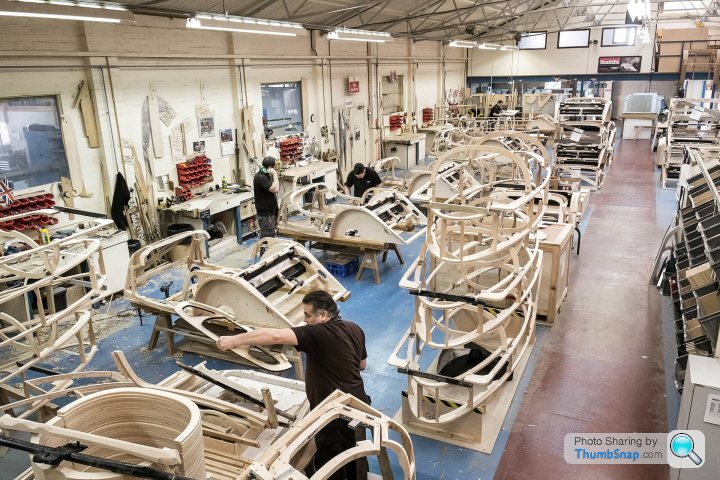
Edited by Jon39 on Wednesday 6th April 11:26
bogie said:
They are "hand assembled". The leather interiors are one of the most hand finished parts. Its not an automated production process like high volume car manufacture.
what would you imagine "hand made" to mean ? panel beaten bodywork panels ? hand laid carbon fibre panels maybe ?
Yes I thought the panels were hand beaten and rolled and then some old guy with eyes like a hawk looks for imperfections that do not exist. The wood and leather was hand carved and stitched. what would you imagine "hand made" to mean ? panel beaten bodywork panels ? hand laid carbon fibre panels maybe ?
Jumpingjackflash said:
bogie said:
They are "hand assembled". The leather interiors are one of the most hand finished parts. Its not an automated production process like high volume car manufacture.
what would you imagine "hand made" to mean ? panel beaten bodywork panels ? hand laid carbon fibre panels maybe ?
Yes I thought the panels were hand beaten and rolled and then some old guy with eyes like a hawk looks for imperfections that do not exist. The wood and leather was hand carved and stitched. what would you imagine "hand made" to mean ? panel beaten bodywork panels ? hand laid carbon fibre panels maybe ?
The bodies of the recent continuation cars (DB4GT, DB5 with 007 toys and the DB4GT Zagato) were not strictly made in the traditional way (from scratch using bucks) but using pre-formed panels that were hand finished to fit (in the manner of the NP Vanquish). All the craftsmen with the skill to produce bodies the old way (Works, Bodylines and others) are all fully engaged with restorations for which there is a waiting list and there is no spare craftsman capacity to shift to a new production line, even if only turning out tiny numbers.
I am sure there the ratio of workmen to robots at Gaydon today is very different from the ratio in mainstream car factories and there is still much more human attention than is typical, even if some of the skills are different from the old days.
Edited by OLDBENZ on Friday 8th April 17:41
Also remember mass produced cars require expensive tooling to enable robots to assemble parts within a given tolerance. The tooling is expensive as that is hand finished so that every part fits exactly without any tweeks.
Low volume cars would be even more expensive if they used that tooling as well. So to have a hand made body panel on a car is really because it is cheaper than the tooling to press out exact parts.
Also way back in the early 2000’s Ford and I’m sure other mass manufacturers were producing a car every 50 seconds on a slow production line.
Low volume cars would be even more expensive if they used that tooling as well. So to have a hand made body panel on a car is really because it is cheaper than the tooling to press out exact parts.
Also way back in the early 2000’s Ford and I’m sure other mass manufacturers were producing a car every 50 seconds on a slow production line.
RobXjcoupe said:
Also way back in the early 2000’s Ford and I’m sure other mass manufacturers were producing a car every 50 seconds on a slow production line.
Interesting.
When a 'car every 50 seconds' was mentioned in the Changan Automotive factory video, I assumed it was because that was a faster rate than ever before, but you suggest not so.
The efficiency incentive for using so many robots, must obviously be to reduce the cost of employee assembly.
Presumably though, there must be a cross over point involving production volumes, to make using so many robots financially advantageous.
With such a huge number of robots, the initial cost, installation, programming etc., must be enormous.
Jon39 said:
Presumably though, there must be a cross over point involving production volumes, to make using so many robots financially advantageous.
Of course. For low-run cars compare the cost of those robots to six old codgers with hammers and see which makes the most sense. That's why Ford works, and also why Morgan works. Aston may be in a bit of a cleft stick.I wonder what the likes of Ferrari and McLaren do? Both have (I think) income from other sources whilst Aston has outgoings to other sources.
Jon39 said:
RobXjcoupe said:
Also way back in the early 2000’s Ford and I’m sure other mass manufacturers were producing a car every 50 seconds on a slow production line.
Interesting.
When a 'car every 50 seconds' was mentioned in the Changan Automotive factory video, I assumed it was because that was a faster rate than ever before, but you suggest not so.
Just sayin'

N7GTX said:
In 1942 at Willow Run, Michigan, which was Ford's plant, B24 Liberators were produced at the rate of one every 59 minutes. Not a robot in sight.
Some say 59, others 63 mins, eg https://www.thehenryford.org/collections-and-resea...Lots of motivated people on good wages and limitless money to spend on them.
I recall seeing something about the US building a whole bomber in a day. And was it a Liberty ship in a week?
Simpo Two said:
N7GTX said:
In 1942 at Willow Run, Michigan, which was Ford's plant, B24 Liberators were produced at the rate of one every 59 minutes. Not a robot in sight.
Some say 59, others 63 mins, eg https://www.thehenryford.org/collections-and-resea...Lots of motivated people on good wages and limitless money to spend on them.
I recall seeing something about the US building a whole bomber in a day. And was it a Liberty ship in a week?

https://www.jaxhistory.org/liberty-ships/#:~:text=...
Jon39 said:
RobXjcoupe said:
Also way back in the early 2000’s Ford and I’m sure other mass manufacturers were producing a car every 50 seconds on a slow production line.
Interesting.
When a 'car every 50 seconds' was mentioned in the Changan Automotive factory video, I assumed it was because that was a faster rate than ever before, but you suggest not so.
The efficiency incentive for using so many robots, must obviously be to reduce the cost of employee assembly.
Presumably though, there must be a cross over point involving production volumes, to make using so many robots financially advantageous.
With such a huge number of robots, the initial cost, installation, programming etc., must be enormous.
Going back to ww2, Ford also built merlin engines. When the drawings and tolerance were looked at Ford told Rolls Royce they needed to improve the tolerance so parts could be massed produced and fit together without any fettling.
RobXjcoupe said:
Going back to ww2, Ford also built merlin engines. When the drawings and tolerance were looked at Ford told Rolls Royce they needed to improve the tolerance so parts could be massed produced and fit together without any fettling.
Well I never: https://www.bbc.co.uk/history/ww2peopleswar/storie...However it seems Ford in America didn't build them because Edsel Ford didn't like us.
Simpo Two said:
RobXjcoupe said:
Going back to ww2, Ford also built merlin engines. When the drawings and tolerance were looked at Ford told Rolls Royce they needed to improve the tolerance so parts could be massed produced and fit together without any fettling.
Well I never: https://www.bbc.co.uk/history/ww2peopleswar/storie...However it seems Ford in America didn't build them because Edsel Ford didn't like us.
In the states Packard built merlins which I think went into the p51 mustang
RobXjcoupe said:
In the states Packard built merlins which I think went into the p51 mustang
The P-51 started with Allison engines, but only became exceptional when Merlins were fitted. Packard made loads of Merlins.Interesting link: https://www.autoweek.com/car-life/classic-cars/a30...
Simpo Two said:
RobXjcoupe said:
In the states Packard built merlins which I think went into the p51 mustang
The P-51 started with Allison engines, but only became exceptional when Merlins were fitted. Packard made loads of Merlins.Interesting link: https://www.autoweek.com/car-life/classic-cars/a30...
Tolerance is crucial to mass production and is as the article says. To fettle by hand is a craft, but equally mass production fine tolerance is crucial for parts to fit exactly every time.
I was a toolmaker for Ford motor company. I helped build and finish by hand automotive press tools. It was an art. I then worked in an engine building Ford plant. Building all manner of petrol derivatives, Jaguar and Volvo also.
Now I help teach students the basics of engineering skills and chat about the stuff I used to get up to within those Ford plants. They do love a story
.So back to the op Aston hand made or not and what’s best, I think mass produced is best. Cheaper to produce, parts are interchangeable and fit properly without fettling.
Body panels that are hand made would never pass inspection when checking for thin out of material. Very crucial these days as safety is a key selling point. Panels that are not in spec will give varied crush test results.
Gassing Station | Aston Martin | Top of Page | What's New | My Stuff