
Anomalies .... ?!
Discussion


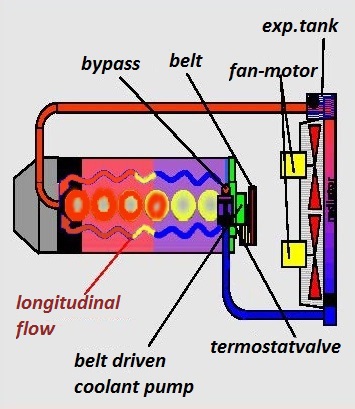
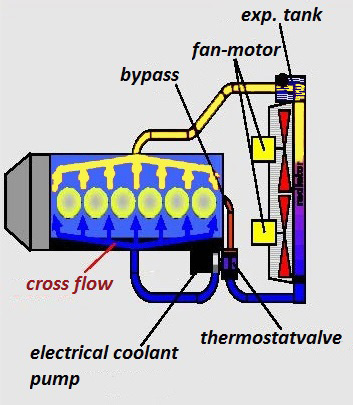
I've seen the same diagrams on the speed six forum in here and I have to say I'm not sold in it as shown. Reason is that if you have inlet and outlet opposite each other, the coolant will take line of least resistance and the coolant at either end (cylinders 1 and 6) will just eddy and get warmer - it's a bit like the pools at the side of a fast flowing river. With coolant going front to back (across a narrow front) then at least there will be few eddies and all cylinders will get cooling albeit I accept the front will be cooler than the back.
It also means that the coolant sensor location becomes a problem, in the centre it isn't giving a true picture.
May be different on a V8 or 4 cylinder where the "front" that the coolant is travelling across is narrower.
This is just my opinion - has anyone tested this?
It also means that the coolant sensor location becomes a problem, in the centre it isn't giving a true picture.
May be different on a V8 or 4 cylinder where the "front" that the coolant is travelling across is narrower.
This is just my opinion - has anyone tested this?


very clever. Have you done anything to the top of the block where the coolant comes up into the heads? i believe there is a large slot at the rear to encourage coolant to flow back there and only a smallish hole in the front of the block near where the water pump exits. so introducing coolant mid_block would tend to put most of the flow to the rear? you are going to tell me you have already addressed this issue aren't you?
Not sure where thats going to get you as there is no air going through the rad? Is this not a fix for a problem that does not exist if the cooling system is working as it should first off? The claims of better power, mpg, engine life etc etc are easy to make without concrete facts to back them up, but in a world were every MPG / BHP or gram of C02 count would not this type system have been fitted by the manufactures in the first place if it was that simple?
The Mechanical Water Pump is one of the last mechanical components of the modern engine which has long been considered an inefficient component that was designed as an accessory from the ever first engines. A mechanical belt driven pump installed on your car engines runs at the same speed as the engine regardless of how hot the engine is. Example: when travelling at high speeds down the freeway, the engine require less cooling as ram air is naturally cooling the engine however, the engine speed is high as is the mechanical water pump thus providing excessive cooling whilst draining the engine of power. Then in heavy traffic in high ambient, the engine is idling or slow and so is the belt driven mechanical pump, even though in this condition, extra coolant flow is required to cool the engine.
With an EWP and a digital controller, the speed of the pump is managed by the controller, which varies the supply voltage to the pump and so varies the speed of the pump, hunting for a target temperature. When the engine reaches the target temperature the controller locks on, constantly changing the pump speed with traffic and throttle conditions, maintaining the target temperature independent of the engine speed.
The important improvement for your vehicle comes from the fact that most of the power the mechanical pump takes from the engine can be reclaimed with the use of an ele.water pump hence the fuel savings. By removing the parasitic power losses of belt-driven water pumps, the ele.water pump may provide up to 10kw of extra power and additional fuel savings. The engine power used by the mechanical pump increases as the cube of its speed – so when the mechanical pump speed doubles from idle speed say; 600rpm to 1200 rpm, the power it takes increases by eight times. Then another eight times going to 2400 rpm, and so on up to maximum engine speed. It is this extra power and torque that is released by deleting the mechanical pump that provides the fuel savings that is estimated to be 3.5% to 10%.
Or take a look for this file too ......
https://drive.google.com/file/d/0B3l0goGWl5mZX1Q3d...
Kind regard
Gregor
With an EWP and a digital controller, the speed of the pump is managed by the controller, which varies the supply voltage to the pump and so varies the speed of the pump, hunting for a target temperature. When the engine reaches the target temperature the controller locks on, constantly changing the pump speed with traffic and throttle conditions, maintaining the target temperature independent of the engine speed.
The important improvement for your vehicle comes from the fact that most of the power the mechanical pump takes from the engine can be reclaimed with the use of an ele.water pump hence the fuel savings. By removing the parasitic power losses of belt-driven water pumps, the ele.water pump may provide up to 10kw of extra power and additional fuel savings. The engine power used by the mechanical pump increases as the cube of its speed – so when the mechanical pump speed doubles from idle speed say; 600rpm to 1200 rpm, the power it takes increases by eight times. Then another eight times going to 2400 rpm, and so on up to maximum engine speed. It is this extra power and torque that is released by deleting the mechanical pump that provides the fuel savings that is estimated to be 3.5% to 10%.
Or take a look for this file too ......
https://drive.google.com/file/d/0B3l0goGWl5mZX1Q3d...
Kind regard
Gregor
This seems like a blatant advert,the obvious question is do you have an RV8 running on this water pump and for how long has it proven successful, mileage etc or is this still in development.
All things considered it's clearly a good idea so do you have evidence the rear of the block stays cooler etc.
cheers Al
All things considered it's clearly a good idea so do you have evidence the rear of the block stays cooler etc.
cheers Al
For me its an important consideration that a failure of the water electric pump, the coolant sensor, the controller or any of the associated wiring including something as simple as a blown fuse on the new circuit will cause the complete system to fail with catastrophic consequences for your engine.
I don't want to dismiss the idea as there are clear advantages to removing the considerable parasitic horse power robbing effects of an engine driven water pump, and there is no doubt electric water pumps are the future, indeed most modern cars already have them.
The elephant in the room is simply an issue of reliability, an engine driven water pump may indeed be highly inefficient but the biggest thing in its favour is reliability, as long as the engine is running and the belt driving the pump is in place you will have the essential flow of coolant needed to ensure engine damage is kept at bay.
I know this is the same argument people used when electric cooling fans started to become the norm, but this is different. You can get away with an electric fan failure but your engine will not survive the failure of an electric water pump system.
People need to be 100% comfortable with the above before they step away from the proven reliability of a traditional direct driven water pump on their old Rover V8.
Actually I do have an electric water pump on my TVR, but it's just there to give water circulation after the engine has stopped turning, it's simply to help with heat surge to the heads when I turn off the hot engine.
My little electric booster pump does not replace the engine driven water pump because personally I wouldn't be comfortable with losing the proven dependability of a traditional mechanical water pump
I don't want to dismiss the idea as there are clear advantages to removing the considerable parasitic horse power robbing effects of an engine driven water pump, and there is no doubt electric water pumps are the future, indeed most modern cars already have them.
The elephant in the room is simply an issue of reliability, an engine driven water pump may indeed be highly inefficient but the biggest thing in its favour is reliability, as long as the engine is running and the belt driving the pump is in place you will have the essential flow of coolant needed to ensure engine damage is kept at bay.
I know this is the same argument people used when electric cooling fans started to become the norm, but this is different. You can get away with an electric fan failure but your engine will not survive the failure of an electric water pump system.
People need to be 100% comfortable with the above before they step away from the proven reliability of a traditional direct driven water pump on their old Rover V8.
Actually I do have an electric water pump on my TVR, but it's just there to give water circulation after the engine has stopped turning, it's simply to help with heat surge to the heads when I turn off the hot engine.
My little electric booster pump does not replace the engine driven water pump because personally I wouldn't be comfortable with losing the proven dependability of a traditional mechanical water pump
Edited by ChimpOnGas on Friday 10th June 09:09
Gassing Station | Chimaera | Top of Page | What's New | My Stuff