
Alternator Output - Test Results Seem Weak
Discussion


Here's what I'm seeing from my 100amp alternator...
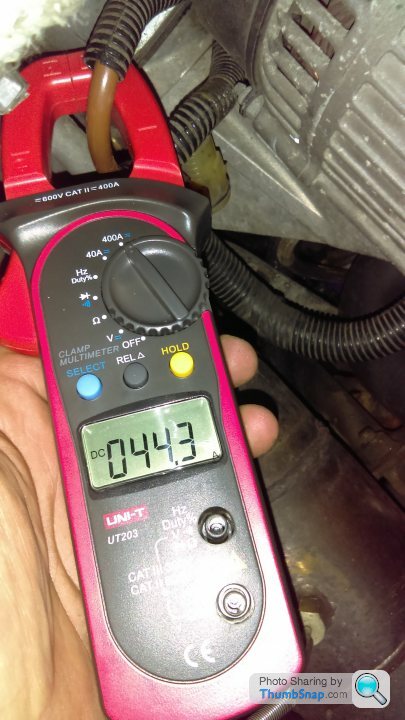
These figures seem very poor to me, what do you think?
Dave.
- Volts at idle = 13.6v
- Volts over 2,00rpm 13.8v (sometimes 14v but hardly ever)
- Amps at idle with no load = 13a
- Amps over 2,000rpm with no load = 13a
- Amps at idle with load (literally everything electrical on) = 44.3a
- Amps over 2,000rpm with load (everything electrical still on) = 52.4a
- Absolute peak maximum volts and amps revving the engine to 3,000rpm = 14v & 53a
These figures seem very poor to me, what do you think?
Dave.

Englishman said:
All looks fine to me, what do you think is poor?
Well, how about 52.4 amps at 2,000rpm and no matter how much I rev the engine beyond 2,000rpm or how much demand I add.... the alternator can't serve up any more that 53 amps?Under load and with literally everything electrical on (headlights, rear fog light, driving lights, both rad fans running, stereo, heater fan/blower motor on the highest setting ect ect) and the very best peak current output I saw was just 53 amps at 3,000rpm.
I've added up the current draw from everything I had running during the test including my Canems ECU, 8 current hungry peak & hold LPG injectors, fuel pump, two MSD coil packs and all the other elements I've already listed above, being super conservative the total has to be 75 amps as an absolute minimum.... probably more like 80-90 amps.
So I seem to have a 100 amp alternator that in a situation of the highest current demand I can create delivers a peak output of just 53 amps, this against what must be an absolute minimum draw of 75 amps, surely that's not right
 . I would expect a test like this would show the alternator kicking out at least 80-90 amps over 2,000rpm and 14.5v at the battery, not the peak of 53 amps and 13.8v I'm seeing.
Ideally I'd like to see more voltage at the battery but I'm not overly concerned about the 13.8v because that still delivers a charged battery, what needs looking at is the low current output. Thinking about it if I've lost a diode in the alternator its output would be 33% down, that's 53 x 1.33 = 70.5 amps still a little low but much closer to what I'd expect to see from the high current/load test described above.
Today I'll run a jump lead from the alternator case directly back to my battery earth terminal to see if I can get a higher figure under load than the rather low absolute peak output of 53 amps I'm getting from my 100 amp alternator.
I'm no auto-electrician but this all seems pretty straightforward stuff to me, an alternator should match the current draw and mine isn't, we have a 100 amp alternator because with everything electrical running a car like ours should draw somewhere between 75-90 amps. We have a 100 amp alternator because it gives at least 10% more capacity than you would ever need, this is good practice as it ensures the alternator is never pushed to it's maximum output which would create heat & dramatically shorten its working life.
To me, my tests seem indicate I need a new alternator..... but perhaps I'm missing something, so I'm happy to be corrected

All seems OK to me.
If you have things not running properly with everything turned on, maybe you have a problem.
Voltage is a potential, current is drawn. The ampage output will only be what is required to run everything. The current rating assigned on a label to electrical items will be the maximum required on, say a very cold day with maximum load.
Unless you turn more things on or apply more load, the current output will only reach what is required. Operating both electric windows at the same time, pressing the brake pedal, the horn etc all add temporary extra load. Attaching a known poor battery would also increase the load a bit more.
If you have things not running properly with everything turned on, maybe you have a problem.
Voltage is a potential, current is drawn. The ampage output will only be what is required to run everything. The current rating assigned on a label to electrical items will be the maximum required on, say a very cold day with maximum load.
Unless you turn more things on or apply more load, the current output will only reach what is required. Operating both electric windows at the same time, pressing the brake pedal, the horn etc all add temporary extra load. Attaching a known poor battery would also increase the load a bit more.
Edited by ianwayne on Thursday 6th April 08:36
Nothing wrong with that - don't forget the charge rate of the alternator is mainly determined by the state of the battery. Put a flat battery on it and you might get a little more out of it, but not much. If you had a much higher charge rate than that you would destroy the battery in no time.
If you really want to check the current being thrown out by an alternator accurately you need a good old fashioned ammeter in series, forget what you are using. Regardless of what you use to measure it you will never see anywhere close to 100A it says on the label. Your guesstimate on your total draw will also be out too because none of those accesories will draw the same amount of current all the time.
In short a lot of wrong theory here is causing you to arrive at the wrong conclusion, if it ain't broke don't fix it
If you really want to check the current being thrown out by an alternator accurately you need a good old fashioned ammeter in series, forget what you are using. Regardless of what you use to measure it you will never see anywhere close to 100A it says on the label. Your guesstimate on your total draw will also be out too because none of those accesories will draw the same amount of current all the time.
In short a lot of wrong theory here is causing you to arrive at the wrong conclusion, if it ain't broke don't fix it
You should be getting 14 to 14.5 Volts at the battery when revving to 3000 RPM and no loads switched on, a slipping fan belt often causes the charge rate to be lower than it should be and there are many cases where the belt seems to be ok and not squealing yet is slipping, the best way to be sure the belt is not slipping is to rev the engine at 3000 + RPM for a couple of minutes while everything is switched on, the temperature of the Alternator pully can now be checked, if the pully is very hot the belt is slipping
Bearing in mind that current clamps can give false readings and I have never used one.
There is a glitch in your testing methods. If you are happy using a current clamp for your tests then that current clamp must be used for all tests.
You have used a current clamp to check the output from the Alternator Positive Supply yet have made an on paper calculation of the total current draw with everything switched on, this is wrong.
The current clamp needs to be used to measure the total current draw at the main battery supply or earth depending which is carrying the full current draw of everything as sometimes there are several cables terminated at the battery and it can be difficult to measure the full current draw, the earth cable may be a better option, this is why an Ammeter in series with the battery is the best method as it will measure everything and be more accurate than a current clamp. Everything on with engine not running will be very close to the total current draw with engine running
Don't use a tool to measure one thing and then calculate on paper another thing
It would be interesting to know the difference in the readings that you get when compairing a current clamp to an Ammeter in series
Also as mentioned above, a poor or low battery will affect the readings, obviously a volt drop in the pos or neg at the Alternator will also affect the readings. If all is good, 14 to 14.5 volts should be at the battery when revving
Bearing in mind that current clamps can give false readings and I have never used one.
There is a glitch in your testing methods. If you are happy using a current clamp for your tests then that current clamp must be used for all tests.
You have used a current clamp to check the output from the Alternator Positive Supply yet have made an on paper calculation of the total current draw with everything switched on, this is wrong.
The current clamp needs to be used to measure the total current draw at the main battery supply or earth depending which is carrying the full current draw of everything as sometimes there are several cables terminated at the battery and it can be difficult to measure the full current draw, the earth cable may be a better option, this is why an Ammeter in series with the battery is the best method as it will measure everything and be more accurate than a current clamp. Everything on with engine not running will be very close to the total current draw with engine running
Don't use a tool to measure one thing and then calculate on paper another thing
It would be interesting to know the difference in the readings that you get when compairing a current clamp to an Ammeter in series
Also as mentioned above, a poor or low battery will affect the readings, obviously a volt drop in the pos or neg at the Alternator will also affect the readings. If all is good, 14 to 14.5 volts should be at the battery when revving
Edited by Penelope Stopit on Thursday 6th April 09:31
If you had charging issues or the engine cranked over slowly, then yes, you could have an alternator or more often, an earthing issue. A voltage drop test should confirm.
Not going to write an essay, but as above, current is drawn as required, not served up, all governed by the equation V=IR. Also as above, the maximum current drawn by a device in typical operation will be well below the figures printed on the devices by manufacturers to allow both for extreme operating conditions and manufacturing tolerances.
Without any symptoms of a problem, if you are worried about checking the maximum output the alternator can deliver, you could try to find a very high power (1500 watt) 0.14 ohm resistor and strapping it across the alternator! More practically, you could just add a few more loads in parallel – discharged batteries are a good suggestion – and monitor the current draw.
Not going to write an essay, but as above, current is drawn as required, not served up, all governed by the equation V=IR. Also as above, the maximum current drawn by a device in typical operation will be well below the figures printed on the devices by manufacturers to allow both for extreme operating conditions and manufacturing tolerances.
Without any symptoms of a problem, if you are worried about checking the maximum output the alternator can deliver, you could try to find a very high power (1500 watt) 0.14 ohm resistor and strapping it across the alternator! More practically, you could just add a few more loads in parallel – discharged batteries are a good suggestion – and monitor the current draw.
As already said, the alternator can cope with a 100A load, but without sufficient load on it, it won't chuck out it's maximum rating - what you're seeing is the output rising to meet or just exceed a load.
Add lots of spot lights to see if you can hit 100A
eta thinking about it the RAC/AA have some very clever kit - it can test the battery state, and can also confirm the alternator is working and charging correctly. How they do that without a huge load I don't know - but that'd be the best way to test whether it's working as it should.
Add lots of spot lights to see if you can hit 100A
eta thinking about it the RAC/AA have some very clever kit - it can test the battery state, and can also confirm the alternator is working and charging correctly. How they do that without a huge load I don't know - but that'd be the best way to test whether it's working as it should.
Edited by andy43 on Thursday 6th April 09:57
Ok chaps so if everyone thinks its fine I'll run with that, I simply added up the current draw from everything I had on and expected to see a higher output from the alternator than 53 amps.
I'll certainly do my voltage drop tests, but I would have thought my 100 amp alternator should match or at least deliver a higher output than 53a (absolute peak), especially when I raise engine speed above 2,000rpm and my load conservatively totals well over 70a?
- Both rad fans: 15a each = 30a
- Davies Craig electric booster pump: 1a
- LPG Injectors: Peak phase 32a & hold phase 12a
- ECU: 2a
- MSD Coil packs x 2: 10a
- LPG Saftey solenoids x 3: 3a
- Fuel pump: 5a
- LED Headlights x 2: 3a
- Dash/instrument lights: 2a
- LED tail lights x 2: 1a
- LED driving lights x`2: 3a
- Rear fog light: 2a
- Heater/blower motor on setting 3: 5a
- Total = 77a
- Alternator output 53a
I'll certainly do my voltage drop tests, but I would have thought my 100 amp alternator should match or at least deliver a higher output than 53a (absolute peak), especially when I raise engine speed above 2,000rpm and my load conservatively totals well over 70a?
The only way to get a true reading would be to disconnect the battery when running the test as you have two voltage sources, and the peak current will depend on the voltage difference from the battery and the alternator output. Personally I would not try this as the alternator output is not smoothed (the battery does this) and it may well glitch your ECU in the process.
blitzracing said:
The only way to get a true reading would be to disconnect the battery when running the test as you have two voltage sources, and the peak current will depend on the voltage difference from the battery and the alternator output. Personally I would not try this as the alternator output is not smoothed (the battery does this) and it may well glitch your ECU in the process.
Never disconnect a car battery when the engine is running. You wont find 1 electrical engineer that teaches this and the worrying thing about this is that it's gone viral that disconnecting the battery when the engine is running will be okIf a battery is disconnected with the engine running there is a very good chance that due to the regulator not having a true voltage the alternator diodes will blow or/and many volts will be passed through 12 volt circuits and lots of components will go up in a puff of smoke
Who tought you this? they should be sacked

Penelope Stopit said:
ChimpOnGas said:
Ok chaps so if everyone thinks its fine I'll run with that
Will you kindly cross my name off your posters that think it's fine listI know you have a problem that can only worsen, these faults don't fix themselves
Having crossed you off the 'It's fine' list, I await your constructive comments on the results of my load test.
Dave.
Penelope Stopit said:
blitzracing said:
The only way to get a true reading would be to disconnect the battery when running the test as you have two voltage sources, and the peak current will depend on the voltage difference from the battery and the alternator output. Personally I would not try this as the alternator output is not smoothed (the battery does this) and it may well glitch your ECU in the process.
Never disconnect a car battery when the engine is running. You wont find 1 electrical engineer that teaches this and the worrying thing about this is that it's gone viral that disconnecting the battery when the engine is running will be okIf a battery is disconnected with the engine running there is a very good chance that due to the regulator not having a true voltage the alternator diodes will blow or/and many volts will be passed through 12 volt circuits and lots of components will go up in a puff of smoke
Who tought you this? they should be sacked

Why would anyone suggest it then say don't do it is also beyond me, a complete waste of keyboard time there from Blitzs????
I most certainly WILL NOT be disconnecting my battery with the engine running, I value my excellent Canems ECU way more than that

The facts as they stand:
FACT 1: With everything electrical on I must (as an absolute minimum) be drawing well over 70 amps
FACT 2: I have a 100amp alternator
FACT 3: With a calculated draw in excess of 70 amps my 100 amp alternator can only muster an absolute peak output 53 amps... even if I raise the revs over 2,000rpm
Is everyone still 100% happy to state this is indeed perfectly acceptable, and if so can you please explain why?
Thanks, Dave.
Penelope Stopit said:
Never disconnect a car battery when the engine is running. You wont find 1 electrical engineer that teaches this and the worrying thing about this is that it's gone viral that disconnecting the battery when the engine is running will be ok
If a battery is disconnected with the engine running there is a very good chance that due to the regulator not having a true voltage the alternator diodes will blow or/and many volts will be passed through 12 volt circuits and lots of components will go up in a puff of smoke
100% correctIf a battery is disconnected with the engine running there is a very good chance that due to the regulator not having a true voltage the alternator diodes will blow or/and many volts will be passed through 12 volt circuits and lots of components will go up in a puff of smoke
Hold on guys-
I said I would not recommend it!!! you are worse than the Daily mail at twisting something
As for things going pop, we have a all sorts of loads on the alternator, the battery is just one of them. You dont suddenly end up with some strange output voltage or over current, if you just remove one load. The alternator regulators will just cope with the shifting load as it should. The bad side of doing this is you have an un smoothed rectified output from the diodes, that is effectively a pulsed DC output, and no ECU is going to like that. Things like motors and lights wont give two hoots.
I said I would not recommend it!!! you are worse than the Daily mail at twisting something
As for things going pop, we have a all sorts of loads on the alternator, the battery is just one of them. You dont suddenly end up with some strange output voltage or over current, if you just remove one load. The alternator regulators will just cope with the shifting load as it should. The bad side of doing this is you have an un smoothed rectified output from the diodes, that is effectively a pulsed DC output, and no ECU is going to like that. Things like motors and lights wont give two hoots.
Edited by blitzracing on Thursday 6th April 12:17
ChimpOnGas said:
- Both rad fans: 15a each = 30
- LPG Injectors: Peak phase 32a & hold phase 12a
- MSD Coil packs x 2: 10A
For the Injectors, how much of the time are they drawing that current, Same with the coil packs, I would not assume that it is constant current and could be as low as 10% of the time, so this will affect the readings that you are getting, as 10A for 10% of the time will look more like 1A continuous.
ChimpOnGas said:
Penelope Stopit said:
ChimpOnGas said:
Ok chaps so if everyone thinks its fine I'll run with that
Will you kindly cross my name off your posters that think it's fine listI know you have a problem that can only worsen, these faults don't fix themselves
Having crossed you off the 'It's fine' list, I await your constructive comments on the results of my load test.
Dave.
There are numerous other faults that could cause your problem and I think you already mentioned one of them in your OP as in ***Diode***, there is also the possibility of a failing stator winding, a dodgy diode or stator winding will have the same symptons
I have already mentioned about by-passing the Alternator Regulator to check for full output and this can be carried out with the Alternator fitted to the engine as long as the voltage at the battery is monitored when doing this, it is important to not rev the vehicle too high when by-passing the regulator, the engine can be revved until the voltage at the battery reaches 15 to 16 Volts for a short period of time and an Ammeter can be used to check for full Alternator output. Don't switch anything on while carrying out the Regulator by-pass test
If it's an easy job to remove the Alternator then do so and get it bench tested but be sure to mention that it's a Max output test that you need carrying out and that you would like to stand there by the test bench and see what the max reading on the ammeter is
Should you decide to do a regulator by-pass test for Alternator Max Output, you will need to find out what Alternator Regulator terminal to link out and what polarity it needs linking to, Regulators switch the rotor/field to negative or positive and this varies by manufacturer, if your vehicle has a Bosch Alternator it is likely to switch field to positive where as a Lucas Alternator is likely to switch field to negative
As mentioned above, the fault could be down to a bad/low battery, a good fully charged battery is the way forward before delving deeper,then if still a problem check for Volt drops
If you don't have 14 to 14.5 Volts at the battery with everything switched off there is definitely a problem, some voltage regulators can regulate to above 14.5 Volts, 14.8 Volts (some). Low Voltage = Low Output
You obviously know what you are doing and have spotted a fault before it develops.
Good Spot
Edited by Penelope Stopit on Thursday 6th April 12:56
Gassing Station | Chimaera | Top of Page | What's New | My Stuff