
Ouch....need new suspension!
Discussion


Went to down to big Colin to book a service and MOT. I happened to mention that the rear end didn't really feel that solid.....i asked Colin to take it for a whizz to see what he thought.
He returned 10 mins later slightly ashen faced saying the car was bloody awful and in fact was trying to kill the driver. Turns out all shock absorbers were borked and was toeing out and in and all sorts...
So....a 12k service and 4 new adjustable / bushes to be done. I've decided to go for protech which seem good value....
On the plus side it will transform the car as I've never felt it has been set up 100%
I've only had it 6 years


He returned 10 mins later slightly ashen faced saying the car was bloody awful and in fact was trying to kill the driver. Turns out all shock absorbers were borked and was toeing out and in and all sorts...
So....a 12k service and 4 new adjustable / bushes to be done. I've decided to go for protech which seem good value....
On the plus side it will transform the car as I've never felt it has been set up 100%
I've only had it 6 years
I’d personally spend a bit more and get what will be better shocks that last much longer in the latest Bilsteins.
If your car never hits water then racing style shocks are ok but the adjusters seize up very easily if road crud gets at them and they cannot take road shocks for long. The Bilsteins will last a decade easily, after market shocks won’t. All imvho of course.
If your car never hits water then racing style shocks are ok but the adjusters seize up very easily if road crud gets at them and they cannot take road shocks for long. The Bilsteins will last a decade easily, after market shocks won’t. All imvho of course.
I wouldnt go protech as classic says ive had a set on for 9 yrs and have just taken them off and fitted new billies as they are leaking again 3 rd time and my griff failed its mot protechs are for track cars really and if they get a sniff of salt the spherical bearings seize .AImho of course .
Having run Gaz Gold Pros for a number of years and then switching to Ben Lang's Mk4 Tuscan 'S' spec Bilsteins, my overall thoughts are rose joints (as used by Gaz & Protech ect) really have no place on road car suspension.
While we all think we are racing driver heroes who spend our lives on the track at 10/10ths, the truth is most of us spend 99% of the time dodging shocking potholes on our very poorly surfaced roads. The Bilsteins use good old rubber bushes which may not sound sexy but they do so for good reason, its the same reason all road cars including Lamborghini, Ferrari, Porsche and Lotus all still use rubber bushes in their suspension too.
Bilstein is a supplier to many of these high end sports car makers, Bilstein make OEM German TuV standard suspension for real world handling built to also give exceptional ride quality, the other usual suspects make suspension in low volumes that is definitely focused on the weekend track day market.
While we all think we are racing driver heroes who spend our lives on the track at 10/10ths, the truth is most of us spend 99% of the time dodging shocking potholes on our very poorly surfaced roads. The Bilsteins use good old rubber bushes which may not sound sexy but they do so for good reason, its the same reason all road cars including Lamborghini, Ferrari, Porsche and Lotus all still use rubber bushes in their suspension too.
Bilstein is a supplier to many of these high end sports car makers, Bilstein make OEM German TuV standard suspension for real world handling built to also give exceptional ride quality, the other usual suspects make suspension in low volumes that is definitely focused on the weekend track day market.
GR_TVR said:
Very happy with my double adjustable protechs.
You can also get them with a rubber bush at the top now which I have done.
Would highly recommend speaking to Joolz if you do decide to go down this route.
Do you have a pic of the rubber Bush. You can also get them with a rubber bush at the top now which I have done.
Would highly recommend speaking to Joolz if you do decide to go down this route.
Are they the same springs
Glad it’s worked out

You've always been able to get rubber bushed protechs but previously only in the 400 series body. A couple of years ago I managed to convince protech to make the bottom of the 600 series body with a rubber bush too. I only sell 600 series (larger) body dampers as the 400 series holds less oil which is less temperature stable in arduous conditions. Sadly most people sell the 400 series for whatever reason, they're all the same price. Rubber bushed 600 series with synthetic oil is a very compliant temperature stable damper.
It has to be said though that no damper is actually improved as a damper as such by fitting rubber bushes. Anything you do which removes the controlling element from the suspension is bad news in pure suspension terms, unless you're struggling with other areas.
A classic struggle area on road cars is compliance over harsh bumps, and rubber bushings help. This is because most dampers are poor at absorbing rapid wheel movements, or in other words high speed piston rod movements which demand a high volume of oil flow through the valving in a short time.
Most dampers however are very good with slower speed piston rod movements. SO how do you convert a high speed rod movement into a slow speed rod? You fit rubber inbetween the main moving parts.
The rubber takes the initial high acceleration forces and slows them down, so instead of the rod having to cope with a sudden increase in acceleration to a rod speed that demands a very high volume of oil flow, you let the rubber take the intial deflection and store that initial high energy, and then release that stored energy over a longer period of time into the rod, and hence into the oil flow.
By fitting a big rubber bush as on all the later TVRs you're actually reducing the demand of the damper to flow a lot of oil in a short time. It's basically a technical bodge, but one which is a necessity for just about every manufacturer because budgets and packaging requirements means they can't actually fit the dampers they would ordinarily choose for performance terms anyway (high oil flow capability means large valve areas means large damper body sizes etc etc). The rubber also has good sound deadening qualities, and by nature of it's own inbuilt damping qualities (chosen hysteresis) doesn't impart any unwanted oscilation / undamped springing into the mix, at least not at frequencies which are an issue. Rubber is also low maintenance, relatively tolerant of muppet installers, tolerant of angle mismatch, cheap, etc etc .. everything a large volume producer might require to make life easy for everyone in the supply/fit chain.
So, rubber makes a damper with small valve area (remember most dampers at low levels are twin tube which means even smaller valve areas than the outside damper body would have you believe) perform well at high rod speeds, where they might otherwise be harsh and unforgiving. Bilstein make good valving (the best in the world? maybe? some may disagree) but they've also probably chosen a big bush because they have accepted they can't get the overall performance, sound etc levels from just their damper alone. They work very well, and for anyone who doesn't want to adjust anything they're a go-to damper .. in fact in tvr land they're the only non adjustable damper?
It has to be said though that no damper is actually improved as a damper as such by fitting rubber bushes. Anything you do which removes the controlling element from the suspension is bad news in pure suspension terms, unless you're struggling with other areas.
A classic struggle area on road cars is compliance over harsh bumps, and rubber bushings help. This is because most dampers are poor at absorbing rapid wheel movements, or in other words high speed piston rod movements which demand a high volume of oil flow through the valving in a short time.
Most dampers however are very good with slower speed piston rod movements. SO how do you convert a high speed rod movement into a slow speed rod? You fit rubber inbetween the main moving parts.
The rubber takes the initial high acceleration forces and slows them down, so instead of the rod having to cope with a sudden increase in acceleration to a rod speed that demands a very high volume of oil flow, you let the rubber take the intial deflection and store that initial high energy, and then release that stored energy over a longer period of time into the rod, and hence into the oil flow.
By fitting a big rubber bush as on all the later TVRs you're actually reducing the demand of the damper to flow a lot of oil in a short time. It's basically a technical bodge, but one which is a necessity for just about every manufacturer because budgets and packaging requirements means they can't actually fit the dampers they would ordinarily choose for performance terms anyway (high oil flow capability means large valve areas means large damper body sizes etc etc). The rubber also has good sound deadening qualities, and by nature of it's own inbuilt damping qualities (chosen hysteresis) doesn't impart any unwanted oscilation / undamped springing into the mix, at least not at frequencies which are an issue. Rubber is also low maintenance, relatively tolerant of muppet installers, tolerant of angle mismatch, cheap, etc etc .. everything a large volume producer might require to make life easy for everyone in the supply/fit chain.
So, rubber makes a damper with small valve area (remember most dampers at low levels are twin tube which means even smaller valve areas than the outside damper body would have you believe) perform well at high rod speeds, where they might otherwise be harsh and unforgiving. Bilstein make good valving (the best in the world? maybe? some may disagree) but they've also probably chosen a big bush because they have accepted they can't get the overall performance, sound etc levels from just their damper alone. They work very well, and for anyone who doesn't want to adjust anything they're a go-to damper .. in fact in tvr land they're the only non adjustable damper?
GR_TVR said:
Cheers, Alun! 
This is the only pic I could find on my car...not the clearest but...!

And some stock photos:


Springs were changed to 400/350.
That’s more like it. This is the only pic I could find on my car...not the clearest but...!
And some stock photos:
Springs were changed to 400/350.
They look very posh
I actually think it comes down to if you like to adjust them or not. I found you find settings your happy with then tend to leave them anyway.
It’s probably an age thing and a bad back
 and I was helping a mate who’s putting a new rear swing arm and damper from a YZF into another bike, lots of geo and lining up, it’s took some time, the point is here’s s bike that weighs around 200 kg yet the rear shocks body is huge.
 This ties in with what Spitfire says about body width etc and taking out those short sharpe shocks from pot holes!
Very interesting,,,,

spitfire4v8 said:
You've always been able to get rubber bushed protechs but previously only in the 400 series body. A couple of years ago I managed to convince protech to make the bottom of the 600 series body with a rubber bush too. I only sell 600 series (larger) body dampers as the 400 series holds less oil which is less temperature stable in arduous conditions. Sadly most people sell the 400 series for whatever reason, they're all the same price. Rubber bushed 600 series with synthetic oil is a very compliant temperature stable damper.
It has to be said though that no damper is actually improved as a damper as such by fitting rubber bushes. Anything you do which removes the controlling element from the suspension is bad news in pure suspension terms, unless you're struggling with other areas.
A classic struggle area on road cars is compliance over harsh bumps, and rubber bushings help. This is because most dampers are poor at absorbing rapid wheel movements, or in other words high speed piston rod movements which demand a high volume of oil flow through the valving in a short time.
Most dampers however are very good with slower speed piston rod movements. SO how do you convert a high speed rod movement into a slow speed rod? You fit rubber inbetween the main moving parts.
The rubber takes the initial high acceleration forces and slows them down, so instead of the rod having to cope with a sudden increase in acceleration to a rod speed that demands a very high volume of oil flow, you let the rubber take the intial deflection and store that initial high energy, and then release that stored energy over a longer period of time into the rod, and hence into the oil flow.
By fitting a big rubber bush as on all the later TVRs you're actually reducing the demand of the damper to flow a lot of oil in a short time. It's basically a technical bodge, but one which is a necessity for just about every manufacturer because budgets and packaging requirements means they can't actually fit the dampers they would ordinarily choose for performance terms anyway (high oil flow capability means large valve areas means large damper body sizes etc etc). The rubber also has good sound deadening qualities, and by nature of it's own inbuilt damping qualities (chosen hysteresis) doesn't impart any unwanted oscilation / undamped springing into the mix, at least not at frequencies which are an issue. Rubber is also low maintenance, relatively tolerant of muppet installers, tolerant of angle mismatch, cheap, etc etc .. everything a large volume producer might require to make life easy for everyone in the supply/fit chain.
So, rubber makes a damper with small valve area (remember most dampers at low levels are twin tube which means even smaller valve areas than the outside damper body would have you believe) perform well at high rod speeds, where they might otherwise be harsh and unforgiving. Bilstein make good valving (the best in the world? maybe? some may disagree) but they've also probably chosen a big bush because they have accepted they can't get the overall performance, sound etc levels from just their damper alone. They work very well, and for anyone who doesn't want to adjust anything they're a go-to damper .. in fact in tvr land they're the only non adjustable damper?
I spend half an hour in the company of a race shock repair/buildman a few years ago when my mate was trying to cheat It has to be said though that no damper is actually improved as a damper as such by fitting rubber bushes. Anything you do which removes the controlling element from the suspension is bad news in pure suspension terms, unless you're struggling with other areas.
A classic struggle area on road cars is compliance over harsh bumps, and rubber bushings help. This is because most dampers are poor at absorbing rapid wheel movements, or in other words high speed piston rod movements which demand a high volume of oil flow through the valving in a short time.
Most dampers however are very good with slower speed piston rod movements. SO how do you convert a high speed rod movement into a slow speed rod? You fit rubber inbetween the main moving parts.
The rubber takes the initial high acceleration forces and slows them down, so instead of the rod having to cope with a sudden increase in acceleration to a rod speed that demands a very high volume of oil flow, you let the rubber take the intial deflection and store that initial high energy, and then release that stored energy over a longer period of time into the rod, and hence into the oil flow.
By fitting a big rubber bush as on all the later TVRs you're actually reducing the demand of the damper to flow a lot of oil in a short time. It's basically a technical bodge, but one which is a necessity for just about every manufacturer because budgets and packaging requirements means they can't actually fit the dampers they would ordinarily choose for performance terms anyway (high oil flow capability means large valve areas means large damper body sizes etc etc). The rubber also has good sound deadening qualities, and by nature of it's own inbuilt damping qualities (chosen hysteresis) doesn't impart any unwanted oscilation / undamped springing into the mix, at least not at frequencies which are an issue. Rubber is also low maintenance, relatively tolerant of muppet installers, tolerant of angle mismatch, cheap, etc etc .. everything a large volume producer might require to make life easy for everyone in the supply/fit chain.
So, rubber makes a damper with small valve area (remember most dampers at low levels are twin tube which means even smaller valve areas than the outside damper body would have you believe) perform well at high rod speeds, where they might otherwise be harsh and unforgiving. Bilstein make good valving (the best in the world? maybe? some may disagree) but they've also probably chosen a big bush because they have accepted they can't get the overall performance, sound etc levels from just their damper alone. They work very well, and for anyone who doesn't want to adjust anything they're a go-to damper .. in fact in tvr land they're the only non adjustable damper?
It was a short but informative conversation about oil and it’s travel through the holes and valuing. Suffice to say my understanding is scetchy so can you elaborate.
He mentioned drilling bigger holes aswell as other things to increase flow.
I’d loved to have spent a day with him as he was a good teacher and at that time it sort of made sense.
My mate didn’t go any faster though

He needs to drive faster for that to happen
And I tell him,,,,
He’s ok
He said he was as fast as me now,,, which he probably is,, that’s not saying much as I’m 4 seconds slower than I used to be I tell him

The valving of a high end damper is incrediby complex .. 3d drillings through the valve assembly, various configurable shims in the shim stack, annular preload rings, separate paths for oil depending if it's compression or rebound and so the ability to generate different resistance curves for each depending on piston speed. You'd need more than a day to get your head around it all!
There used to be some great penske info and pictures on the net somewhere but I can't find it now, but a look through their parts catalogue will show you how intricate the internals of high end dampers can be.
There used to be some great penske info and pictures on the net somewhere but I can't find it now, but a look through their parts catalogue will show you how intricate the internals of high end dampers can be.
Comment for GR_TVR - you would possibly find those dampers easier to adjust if they were mounted with the adjuster 180 degrees round, ie still at the bottom, but facing the exhaust pipe. Then its just a case of lie on the ground by the car and put your arm around under the car and in between the fork of the lower wishbone to reach them.
QBee said:
Comment for GR_TVR - you would possibly find those dampers easier to adjust if they were mounted with the adjuster 180 degrees round, ie still at the bottom, but facing the exhaust pipe. Then its just a case of lie on the ground by the car and put your arm around under the car and in between the fork of the lower wishbone to reach them.
Thanks, I did realise this afterwards but fortunately can still reach in the same way without issue.I did the rears the way you describe but am happy enough with the fronts considering the pain of changing it round!

It's nice to see rubber bushes being recognised here, if you've ever studied the work of the highly talented and innovative British engineer Dr Alexander Eric Moulton you'll understand why. More than anyone else before him, and for years after, Moulton understood the unique and desirable properties of rubber and the benefits of using this amazing and much ignored material in suspension.
Rubber is much overlooked as it’s commonly just seen as another cheap everyday material for use in unsophisticated day to day items, but look closer and you'll find amongst many other things it is in fact a critical and carefully engineered element of nearly all suspension design. There’s a lot more to the use of rubber suspension bushes than you may think, studying its structure and behaviours reveals that rubber actually has some very desirable and unique qualities that still remain unmatched by traditional springs.
If you don't believe me read this.....
http://what-when-how.com/automobile/rubber-suspens...
The selection of rubber by all car makers for use in their bushings, and its continual use in suspension systems to this day, goes way beyond slowing rod speed and assisting valving operation within the damper. Rubber is used for many reasons, including the elimination of noise, harshness and vibration as well as to absorb initial compression before the spring even sees it.... let alone by the time the damper finally controls the spring osculation that will inevitably follow.
Years ago I studied Moulton as part of my Design & Technology 'A' level, his story left a lasting impression on me, so what possesed me to put rose jointed suspension on my Chimaera I'll never know , clearly some lessons need relearning and this time my tutor was Bilstein.
Moulton was a brilliant mind who pushed his obsession with rubber suspension to the limit, which without question or argument absolutely proved his genius

God rest his sole
Rubber is much overlooked as it’s commonly just seen as another cheap everyday material for use in unsophisticated day to day items, but look closer and you'll find amongst many other things it is in fact a critical and carefully engineered element of nearly all suspension design. There’s a lot more to the use of rubber suspension bushes than you may think, studying its structure and behaviours reveals that rubber actually has some very desirable and unique qualities that still remain unmatched by traditional springs.
If you don't believe me read this.....
http://what-when-how.com/automobile/rubber-suspens...
The selection of rubber by all car makers for use in their bushings, and its continual use in suspension systems to this day, goes way beyond slowing rod speed and assisting valving operation within the damper. Rubber is used for many reasons, including the elimination of noise, harshness and vibration as well as to absorb initial compression before the spring even sees it.... let alone by the time the damper finally controls the spring osculation that will inevitably follow.
Years ago I studied Moulton as part of my Design & Technology 'A' level, his story left a lasting impression on me, so what possesed me to put rose jointed suspension on my Chimaera I'll never know
, clearly some lessons need relearning and this time my tutor was Bilstein.Moulton was a brilliant mind who pushed his obsession with rubber suspension to the limit, which without question or argument absolutely proved his genius
God rest his sole

Flippant comments about one of our greatest engineering talents of the last 100 years asside, the unique stress & strain properties of rubber result from its ability to store enormous amounts of energy and to release most of this energy on retraction, it is also a very light compund when compared with other spring mediums/materials.
The unique elastic properties of rubber all arise from the characteristics of elastomers, these properties can be explained quantitatively with the use of the first law of thermodynamics, but in simple terms the energy storing ability of rubber is actually 50 times greater than that of sprung steel!
Of course rubber bushes have some downsides, namely that of deflection, but as we know deflection of a bush can be significantly mitigated and managed simply by increasing the surface area of the bush's bearing faces. This is why we see one of the improvements given to the Mk4 TVR Bilstein coil overs was to increase the diameter and so the bearing surface area of the upper bush.
Here's an image that clearly shows this bush bearing diameter increase as the units evolved as part of the process of development conducted by Ben Lang and the German suspension engineers from Bilstein he worked with when developing the coil overs for the Tuscan 2 and the mighty Sagaris....
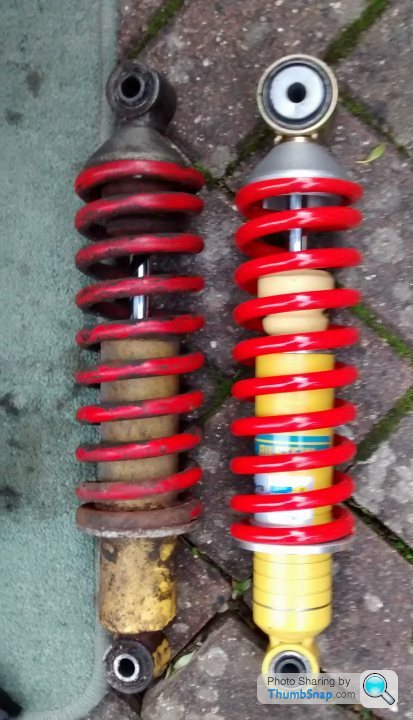
While the Chimaera never enjoyed the benefit of this development in production because production of the Chimaera had ended before this work was done, we can all now enjoy what was learned as it can now be had in a Chimaera coil over unit from Ben Lang built and sent to you directly by the UK Bilstein facility.
With the development in bush size clearly shown in the above photo, now compare the surface area of the solid aluminium bush in the hard as hell rose jointed Gaz Gold Pros....
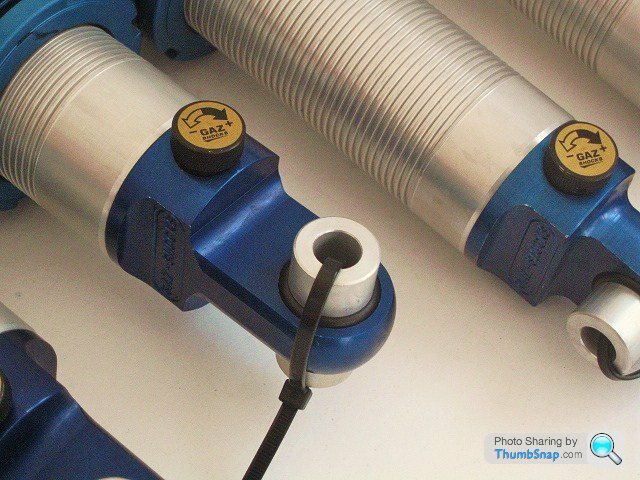
This small diameter solid bush feature is not exclusive to Gaz, all the usual suspect coil over suspension units offered for our cars that use rose joints have the same arrangement, although it does seem Protech offer a proper rubber bush at one end but you do need to specify this or at least go to Kit's and Classics who sell that model.
Remember the upper damper bush is the only point that connects the coil over suspension unit to the chassis, more over ultimately you could argue both coil over bushes are the only two points the chassis and body bolted to it are connected with the road. Consequently the torsional and compression loads on these two points is very high, inevitably therefore both these points play a critical part in the vehicle's handling dynamics but also the ride quality experienced by the driver and passenger.
If you're using your car mostly on the road with the occasional track day thrown in, the big bush Mk4 Bilstiens have to be the best option by far, at £1,000 a set (£250 a corner) they are very good value too. The Bilsteins being steel bodied are heavier and they don't have all the adjustment of Gaz, Protech ect ect... but people need to balance this with the fact they are perfect straight out of the box which makes them the perfect 'fit and just drive' suspension solution for 99% of Chimaera owners who just want to use and enjoy their TVR in real world driving conditions.
The unique elastic properties of rubber all arise from the characteristics of elastomers, these properties can be explained quantitatively with the use of the first law of thermodynamics, but in simple terms the energy storing ability of rubber is actually 50 times greater than that of sprung steel!
Of course rubber bushes have some downsides, namely that of deflection, but as we know deflection of a bush can be significantly mitigated and managed simply by increasing the surface area of the bush's bearing faces. This is why we see one of the improvements given to the Mk4 TVR Bilstein coil overs was to increase the diameter and so the bearing surface area of the upper bush.
Here's an image that clearly shows this bush bearing diameter increase as the units evolved as part of the process of development conducted by Ben Lang and the German suspension engineers from Bilstein he worked with when developing the coil overs for the Tuscan 2 and the mighty Sagaris....
While the Chimaera never enjoyed the benefit of this development in production because production of the Chimaera had ended before this work was done, we can all now enjoy what was learned as it can now be had in a Chimaera coil over unit from Ben Lang built and sent to you directly by the UK Bilstein facility.
With the development in bush size clearly shown in the above photo, now compare the surface area of the solid aluminium bush in the hard as hell rose jointed Gaz Gold Pros....
This small diameter solid bush feature is not exclusive to Gaz, all the usual suspect coil over suspension units offered for our cars that use rose joints have the same arrangement, although it does seem Protech offer a proper rubber bush at one end but you do need to specify this or at least go to Kit's and Classics who sell that model.
Remember the upper damper bush is the only point that connects the coil over suspension unit to the chassis, more over ultimately you could argue both coil over bushes are the only two points the chassis and body bolted to it are connected with the road. Consequently the torsional and compression loads on these two points is very high, inevitably therefore both these points play a critical part in the vehicle's handling dynamics but also the ride quality experienced by the driver and passenger.
If you're using your car mostly on the road with the occasional track day thrown in, the big bush Mk4 Bilstiens have to be the best option by far, at £1,000 a set (£250 a corner) they are very good value too. The Bilsteins being steel bodied are heavier and they don't have all the adjustment of Gaz, Protech ect ect... but people need to balance this with the fact they are perfect straight out of the box which makes them the perfect 'fit and just drive' suspension solution for 99% of Chimaera owners who just want to use and enjoy their TVR in real world driving conditions.
Gassing Station | Chimaera | Top of Page | What's New | My Stuff