
Discussion


Ive read the various threads and seen the locations used but im thinking about relocating my battery to the boot, just so the fuse panel could be moved down to a better more accessible location and tidy that area.
My fuse panel cabling is not long enough to relocate it to behind the seat so i dont wish to mess with that too much.
Im 50/50 about putting it in the boot for safety reasons,so am not totally sold on the idea yet, although i would buy a dry cell battery.
What im wondering is if there is a suitable route to run the battery cables through to the boot without resorting to going outside of the cockpit or pulling out too much carpet etc.
Maybe there is a route through the passenger door sill area?
My fuse panel cabling is not long enough to relocate it to behind the seat so i dont wish to mess with that too much.
Im 50/50 about putting it in the boot for safety reasons,so am not totally sold on the idea yet, although i would buy a dry cell battery.
What im wondering is if there is a suitable route to run the battery cables through to the boot without resorting to going outside of the cockpit or pulling out too much carpet etc.
Maybe there is a route through the passenger door sill area?
I don't know about the cable runs
You mention not being able to move the fuse-box due to length of leads....I read some of this following topic a while back....Have you read this?
https://www.pistonheads.com/gassing/topic.asp?h=0&...
By the time you have untaped the loom you may find that only a few cables if any need extending by using solder and adhesive heat-shrink, obviously all the rear loom cables will reach and may need shortening and you should be able to shorten cables by cutting them to the needed length and crimping new readily available fuse-box terminals to them
You mention not being able to move the fuse-box due to length of leads....I read some of this following topic a while back....Have you read this?
https://www.pistonheads.com/gassing/topic.asp?h=0&...
By the time you have untaped the loom you may find that only a few cables if any need extending by using solder and adhesive heat-shrink, obviously all the rear loom cables will reach and may need shortening and you should be able to shorten cables by cutting them to the needed length and crimping new readily available fuse-box terminals to them
I relocated mine to the boot.
I used an Odessey PCS925 battery. Quite compact but very powerful.
I made a wooden box frame then fibreglassed outsides and bolted it to thebulk head above the petrol tank. With a rachet strap n clip to hold battery secure. Then ran new live and earth wires 25mm sq I think through leftside of boot by the filler and out into cabin by n/s door lat h along floor under carpet and down tunnel sode to existing battery wires.
Will do photos if it helps but cant take them till next week. Can answer Questions you may have though.
Left fuse board where it was but moved it lower and glassed in plywood panel to screw it and ECU too and 100 amp fuse.
Been in 3 yrs now total success very happy loads of passenger leg room and easier access to ecu etc.
I used an Odessey PCS925 battery. Quite compact but very powerful.
I made a wooden box frame then fibreglassed outsides and bolted it to thebulk head above the petrol tank. With a rachet strap n clip to hold battery secure. Then ran new live and earth wires 25mm sq I think through leftside of boot by the filler and out into cabin by n/s door lat h along floor under carpet and down tunnel sode to existing battery wires.
Will do photos if it helps but cant take them till next week. Can answer Questions you may have though.
Left fuse board where it was but moved it lower and glassed in plywood panel to screw it and ECU too and 100 amp fuse.
Been in 3 yrs now total success very happy loads of passenger leg room and easier access to ecu etc.
Edited by blaze_away on Wednesday 6th June 16:39
blaze_away said:
I relocated mine to the boot.
I used an Odessey PCS925 battery. Quite compact but very powerful.
I made a wooden box frame then fibreglassed outsides and bolted it to thebulk head above the petrol tank. With a rachet strap n clip to hold battery secure. Then ran new live and earth wires 25mm sq I think through leftside of boot by the filler and out into cabin by n/s door lat h along floor under carpet and down tunnel sode to existing battery wires.
Will do photos if it helps but cant take them till next week. Can answer Questions you may have though.
Left fuse board where it was but moved it lower and glassed in plywood panel to screw it and ECU too and 100 amp fuse.
Been in 3 yrs now total success very happy loads of passenger leg room and easier access to ecu etc.
Sounds very much like my idea, may consider a proper battery box and mount that above fuel tank.I used an Odessey PCS925 battery. Quite compact but very powerful.
I made a wooden box frame then fibreglassed outsides and bolted it to thebulk head above the petrol tank. With a rachet strap n clip to hold battery secure. Then ran new live and earth wires 25mm sq I think through leftside of boot by the filler and out into cabin by n/s door lat h along floor under carpet and down tunnel sode to existing battery wires.
Will do photos if it helps but cant take them till next week. Can answer Questions you may have though.
Left fuse board where it was but moved it lower and glassed in plywood panel to screw it and ECU too and 100 amp fuse.
Been in 3 yrs now total success very happy loads of passenger leg room and easier access to ecu etc.
Edited by blaze_away on Wednesday 6th June 16:39
I would join new to old cables behind kick panel using correct stud terminals to enable fusebox and trickle charger connections, and also provide a location for jumping if the need ever arose and boot could not be opened.
phillpot said:
[quote=Belle427
Maybe there is a route through the passenger door sill area?
Tried this when moving the battery to the boot in a Chimaera I had, couldn't get through? Sill possibly filled with something like that expanding foam stuff?Maybe there is a route through the passenger door sill area?

I will probably leave it where it is as the cables I intended to use (50mm) would be too hard to hide under the carpet.
Belle427 said:
I will probably leave it where it is as the cables I intended to use (50mm) would be too hard to hide under the carpet.
Way too big in my humble opinion, never had a problem and I used 35mm.And you only need one,can't remember the exact route but took the negative through the boot floor somewhere and connected to the back end of the chassis.
Belle427 said:
Wouldn’t surprise me!
I will probably leave it where it is as the cables I intended to use (50mm) would be too hard to hide under the carpet.
50mm cable sounds good to me, there will be too big a volt drop if you were to use anything less over that distanceI will probably leave it where it is as the cables I intended to use (50mm) would be too hard to hide under the carpet.
It may be the case that you need bigger cable
Always use the volt drop calculator before making a decision on cable size and enter 300 to 350 Amps current draw for the calculation, the current draw does depend on engine compression and what starter is fitted, I always work on the safe side and use 350 Amps current draw which a starter may hit when engaging a high compression cold engine
Volt Drop Calculator is halway down this page https://www.12voltplanet.co.uk/cable-sizing-select...

Penelope Stopit said:
50mm cable sounds good to me, there will be too big a volt drop if you were to use anything less over that distance
It may be the case that you need bigger cable
Always use the volt drop calculator before making a decision on cable size and enter 300 to 350 Amps current draw for the calculation, the current draw does depend on engine compression and what starter is fitted, I always work on the safe side and use 350 Amps current draw which a starter may hit when engaging a high compression cold engine
Volt Drop Calculator is halway down this page https://www.12voltplanet.co.uk/cable-sizing-select...
This is good advice, the originally routed cable is already quite long at approximately 8', TVR used 35mm cable which was marginal for the job/length at best, this was from new and before the cable became internally corroded which all will be by now.It may be the case that you need bigger cable
Always use the volt drop calculator before making a decision on cable size and enter 300 to 350 Amps current draw for the calculation, the current draw does depend on engine compression and what starter is fitted, I always work on the safe side and use 350 Amps current draw which a starter may hit when engaging a high compression cold engine
Volt Drop Calculator is halway down this page https://www.12voltplanet.co.uk/cable-sizing-select...
My battery remains in the passenger footwell but I still upgraded my cable, I used stout 50mm² section marine grade tinned cable and added a second run of the same 50mm² cable from the negative battery terminal to the engine block to complete the loop. My upgraded 50mm² cable now has an OD of 13.3mm where the original TVR 35 mm² cable has an OD of 11.8mm, this doesn't sound like much until you hold both cables in your hand at which point the significant increase in gauge will be obvious.
My 50mm² cable is rated 100 amps higher than the original 35 mm² stuff TVR used, this is significant given the considerable length of the cable itself. I am comparing new cable with new cable here too, expect your string thin TVR original to be corroded internally as mine was so the reduction in resistance will be massive if you fit new marine grade tinned 50mm² cable.
Finally keep in mind the smaller a lead acid battery is the fewer amp hours you'll enjoy, a smaller battery will also deliver fewer amps under load (cranking), with the longer cables you'll invariably need when you place that smaller battery in the boot the outcome can only ever be an increase in resistance. With fewer amps offered by your smaller battery in the first place, and then the increased resistance in the longer cables now running the length of the car it becomes essential you increase the cable gauge to 50mm² as an absolute minimum.
The amp hours reduction a smaller battery gives you is really only a problem if the inevitable parasitic draw every car will exhibit is greater than the accepted maximum range of 25-50 milliamps. TVRs often exhibit a parasitic draw in the order of 200 milliamps or more, so do watch this when you fit a little battery in the boot as it could leave you unable to start the car in just a day or so if you are unable to keep the battery on a float charge.
These fancy expensive small batteries offered by Odyssey and the like are good for what they are, but there's no getting away from the chemistry and physics of lead acid batteries, in simple terms this unavoidable chemistry and physics will always dictate the bigger the lead acid battery is the more cranking amps and amp hours you will enjoy. With lead acid batteries 'Bigger is Better' and the heavier the battery is for its given size is the best measure of it's quality as it tells you how much lead you're getting for your money, I run a full sized Odyssey PC1500 in my passenger footwell, this is a very high quality thing that weighs in at a whopping 22kg!
More on uprating your string thin original cables that cheapskate TVR inflicted on the car here:
https://www.pistonheads.com/gassing/topic.asp?h=0&...
Dave.
ChimpOnGas said:
This is good advice, the originally routed cable is already quite long at approximately 8', TVR used 35mm cable which was marginal for the job/length at best, this was from new and before the cable became internally corroded which all will be by now.
My battery remains in the passenger footwell but I still upgraded my cable, I used stout 50mm² section marine grade tinned cable and added a second run of the same 50mm² cable from the negative battery terminal to the engine block to complete the loop. My upgraded 50mm² cable now has an OD of 13.3mm where the original TVR 35 mm² cable has an OD of 11.8mm, this doesn't sound like much until you hold both cables in your hand at which point the significant increase in gauge will be obvious.
My 50mm² cable is rated 100 amps higher than the original 35 mm² stuff TVR used, this is significant given the considerable length of the cable itself. I am comparing new cable with new cable here too, expect your string thin TVR original to be corroded internally as mine was so the reduction in resistance will be massive if you fit new marine grade tinned 50mm² cable.
Finally keep in mind the smaller a lead acid battery is the fewer amp hours you'll enjoy, a smaller battery will also deliver fewer amps under load (cranking), with the longer cables you'll invariably need when you place that smaller battery in the boot the outcome can only ever be an increase in resistance. With fewer amps offered by your smaller battery in the first place, and then the increased resistance in the longer cables now running the length of the car it becomes essential you increase the cable gauge to 50mm² as an absolute minimum.
The amp hours reduction a smaller battery gives you is really only a problem if the inevitable parasitic draw every car will exhibit is greater than the accepted maximum range of 25-50 milliamps. TVRs often exhibit a parasitic draw in the order of 200 milliamps or more, so do watch this when you fit a little battery in the boot as it could leave you unable to start the car in just a day or so if you are unable to keep the battery on a float charge.
These fancy expensive small batteries offered by Odyssey and the like are good for what they are, but there's no getting away from the chemistry and physics of lead acid batteries, in simple terms this unavoidable chemistry and physics will always dictate the bigger the lead acid battery is the more cranking amps and amp hours you will enjoy. With lead acid batteries 'Bigger is Better' and the heavier the battery is for its given size is the best measure of it's quality as it tells you how much lead you're getting for your money, I run a full sized Odyssey PC1500 in my passenger footwell, this is a very high quality thing that weighs in at a whopping 22kg!
More on uprating your string thin original cables that cheapskate TVR inflicted on the car here:
https://www.pistonheads.com/gassing/topic.asp?h=0&...
Dave.
ChimpOnGas I have read a few of your topics about battery cable size and those with this one do clearly explain the downside of using too thinner cable and batteries of too low capacity. When considering how much work is involved in routing and terminating cables of the correct current carrying capacity, the mind boggles as to why anyone would wish to fit a battery of too low a capacity. As you have mentioned above, the job is all about cranking voltage and that required voltage will not be there for the starter motor when needed unless the correct AH battery is fittedMy battery remains in the passenger footwell but I still upgraded my cable, I used stout 50mm² section marine grade tinned cable and added a second run of the same 50mm² cable from the negative battery terminal to the engine block to complete the loop. My upgraded 50mm² cable now has an OD of 13.3mm where the original TVR 35 mm² cable has an OD of 11.8mm, this doesn't sound like much until you hold both cables in your hand at which point the significant increase in gauge will be obvious.
My 50mm² cable is rated 100 amps higher than the original 35 mm² stuff TVR used, this is significant given the considerable length of the cable itself. I am comparing new cable with new cable here too, expect your string thin TVR original to be corroded internally as mine was so the reduction in resistance will be massive if you fit new marine grade tinned 50mm² cable.
Finally keep in mind the smaller a lead acid battery is the fewer amp hours you'll enjoy, a smaller battery will also deliver fewer amps under load (cranking), with the longer cables you'll invariably need when you place that smaller battery in the boot the outcome can only ever be an increase in resistance. With fewer amps offered by your smaller battery in the first place, and then the increased resistance in the longer cables now running the length of the car it becomes essential you increase the cable gauge to 50mm² as an absolute minimum.
The amp hours reduction a smaller battery gives you is really only a problem if the inevitable parasitic draw every car will exhibit is greater than the accepted maximum range of 25-50 milliamps. TVRs often exhibit a parasitic draw in the order of 200 milliamps or more, so do watch this when you fit a little battery in the boot as it could leave you unable to start the car in just a day or so if you are unable to keep the battery on a float charge.
These fancy expensive small batteries offered by Odyssey and the like are good for what they are, but there's no getting away from the chemistry and physics of lead acid batteries, in simple terms this unavoidable chemistry and physics will always dictate the bigger the lead acid battery is the more cranking amps and amp hours you will enjoy. With lead acid batteries 'Bigger is Better' and the heavier the battery is for its given size is the best measure of it's quality as it tells you how much lead you're getting for your money, I run a full sized Odyssey PC1500 in my passenger footwell, this is a very high quality thing that weighs in at a whopping 22kg!
More on uprating your string thin original cables that cheapskate TVR inflicted on the car here:
https://www.pistonheads.com/gassing/topic.asp?h=0&...
Dave.
If the starter motor is underpowered it's life is shortened, "yes I know people may think less power to the starter means it's not working so hard", the reality is that if the starter is underpowered it will be struggling to reach its cranking speed and will be overheating at every push of the button
Good post Mr ChimpOnGas
I unravelled the fusebox loom today and all being well it looks as if it will just about reach to behind the passenger seat, this is with it being run along the top side of the transmission tunnel.
Could do with another few inches or so but couldn’t we all!
I will probably leave the battery where it is if this is the case as my Ecu now lives under the dash anyway, I can live with leaving the battery as is as it’s pretty easy to get the whole box out.
Could do with another few inches or so but couldn’t we all!
I will probably leave the battery where it is if this is the case as my Ecu now lives under the dash anyway, I can live with leaving the battery as is as it’s pretty easy to get the whole box out.
swisstoni said:
BIG DUNC said:
The PC1500 fits in the original battery box.
They are expensive, but they are really good batteries. As well as the Griff, I also have them in the land rover and the wife's daily driver.
Thanks for that.They are expensive, but they are really good batteries. As well as the Griff, I also have them in the land rover and the wife's daily driver.
https://www.pistonheads.com/gassing/topic.asp?h=0&...
The dimensions of an Odyssey PC1500 are:
Width: 275.6 mm
Depth: 171.7 mm
Height: 198.6 mm
- Pulse Hot Cranking Amps: 1500 (For 5 seconds)
- Cold Cranking Amps: 850
- Hot Cranking Amps: 1250
- Marine Cranking Amps: 1050


You could even argue the carpeted kick board is enough to call the battery secure but if you want to anchor it to the floor I'd be tempted to delete the battery box entirely and bolt in a steel battery tray which are cheap & readily available off FleaBay.
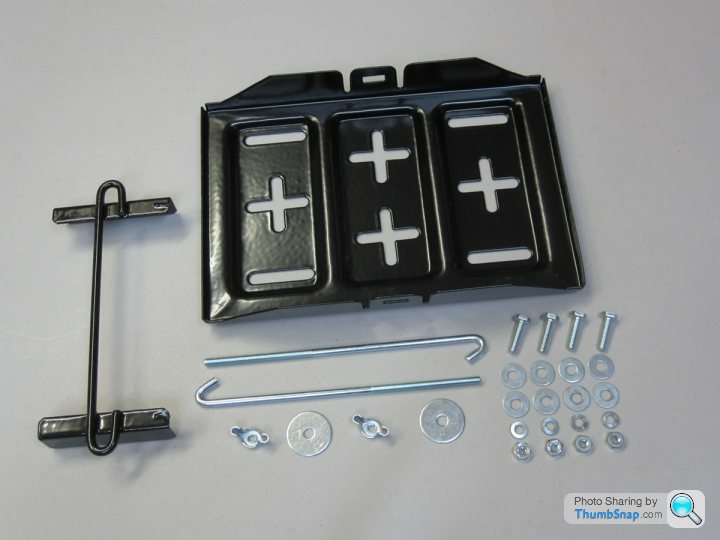
Once the tray is secured to the floor you can lift your battery in and out easily without all the captive nut and box nonsense. Secure the battery to the tray using hook bolts and a bridging bar as shown above or simply use a strap like this...
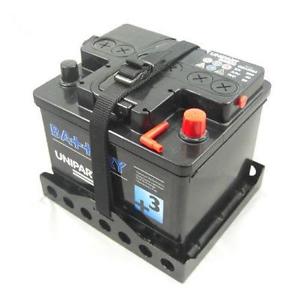
An infinitely better and more convenient solution than the stupid TVR battery box idea

Edited by ChimpOnGas on Thursday 7th June 21:28
Look at the specs. You won’t get better amp hours or cold cranking amps for a battery with those physical dimensions. It is an Epic battery.
I actually bought a battery tray similar to that, but in the end kept the original battery box. I fitted an Anderson connector so I can charge or jump start via that and I expect the PC1500 to last ten years or so, so touch wood won’t be needing to take it out. (Famous last words)
I actually bought a battery tray similar to that, but in the end kept the original battery box. I fitted an Anderson connector so I can charge or jump start via that and I expect the PC1500 to last ten years or so, so touch wood won’t be needing to take it out. (Famous last words)

Also worth noting with the PC1500, you don't have to cut the battery box for the aux terminals.
In the pictures the plastic covers for the aux terminals are on. I removed these and covered them with a piece of this rubber and the battery fitted in the box without needing to cut the box.
In the pictures the plastic covers for the aux terminals are on. I removed these and covered them with a piece of this rubber and the battery fitted in the box without needing to cut the box.
BIG DUNC said:
Also worth noting with the PC1500, you don't have to cut the battery box for the aux terminals.
In the pictures the plastic covers for the aux terminals are on. I removed these and covered them with a piece of this rubber and the battery fitted in the box without needing to cut the box.
The cuts weren't for the plastic cover's as shown, they were for the ring terminals and connecting bolts that secure my charge cables to the additional front auxiliary terminals.In the pictures the plastic covers for the aux terminals are on. I removed these and covered them with a piece of this rubber and the battery fitted in the box without needing to cut the box.
These charge cables are completely hidden running under the carpet and passenger seat entering the void in the 'B' post area, from there the twin core passes over the inner wheel arch and into the boot where it's terminated in an Anderson connector. I left a 3ft tail at the boot end so when I back into my garage I have sufficient reach to connect to a matching Anderson connector I fitted to my Ring Automotive RSCPR35 35A 12V Pro SmartChargePro Smart Battery Charger.
The process I follow is to back into my garage, pop the boot, switch the engine off, lock the car, disconnect the battery using my Battery Bran, hook the battery up to my charger using the auxiliary charging cables connected via the Anderson connectors and let the Ring Automotive RSCPR35 do the rest. Essentially the car is either being driven so the battery is maintained by the alternator, or locked in my garage with my Ring Automotive RSCPR35 gently float charging and maintaining the disconnected battery.
The idea is I'm giving the ultimate Chimaera battery (Odyssey PC1500) the ultimate battery maintenance strategy, this is why I fully expect the PC1500 to last at least 12 years, this is a conservative estimate as I have read tales of people who have had 20 years or more out of their well looked after Odyssey battery.
An Odyssey PC1500 is a very expensive thing but it does exist in a class of one, it's reasonable to expect a cheaper but still decent quality well looked after AGM battery may last 7 years so with the Odyssey PC1500 being twice the price dictates you've got to get past year 14 before the extra investment makes financial sense.
Saying that I just like the extra reliability, huge grunt, and extended service life of the Odyssey PC1500, this combined with the Battery Brain device ensures complete peace of mind. The flat battery frustrations that so often plague TVRs are quite simply dim and distant bad memories for me.
Edited by ChimpOnGas on Friday 8th June 09:47
That makes sense. I didn't use the aux connectors at all, as I charge via an Anderson connector if the car isn't going to be used for a while.
I know people who have abused them, frequently totally discharged them etc (using them for winches off road), and they still last donkeys years.
I think it is safe to say, with the way you treat yours, you wont be changing it for some time.
I know people who have abused them, frequently totally discharged them etc (using them for winches off road), and they still last donkeys years.
I think it is safe to say, with the way you treat yours, you wont be changing it for some time.
Gassing Station | Chimaera | Top of Page | What's New | My Stuff