
fuel arrives at rail, spark present, but no start
Discussion


i was driving my 400 chimi this morning.....the last 2miles b4 my home i was driving it quite hard...suddenly the engine cuts-out...and it ddidnt re-start.
fuel pump primes, fuel arrives at rail inlet, fuel also comming out the return-pipe connection on pressure regulator, spark is perfect but plugs are completely dry and engine doesnt start.
even when my regulator would playing up...there is fuel inside the rail...so when injectors get the signal to open it should fire up, even the pressure might be not ok?
fuel pump primes, fuel arrives at rail inlet, fuel also comming out the return-pipe connection on pressure regulator, spark is perfect but plugs are completely dry and engine doesnt start.
even when my regulator would playing up...there is fuel inside the rail...so when injectors get the signal to open it should fire up, even the pressure might be not ok?
Edited by LLantrisant on Friday 22 March 16:07
difficult....as i have to turn the key for starting and my arms are to short to reach in the enginebay.... noisewise i cannot hear any clicking.....
meanwhile i managed to touch the injectors with my fingers during cranking.....no clicking
the injectors are directly controlled from ECU, without any relais or fuse inbetween i guess?
could it be that an immobiliser or alarm system just interrupts the injectors? but leaves the igntion firing?
meanwhile i managed to touch the injectors with my fingers during cranking.....no clicking
the injectors are directly controlled from ECU, without any relais or fuse inbetween i guess?
could it be that an immobiliser or alarm system just interrupts the injectors? but leaves the igntion firing?
Edited by LLantrisant on Friday 22 March 16:47
Have a look here at the section Ecu initial start up sequence, may help you a little.
http://www.g33.co.uk/pages/technical-fuel-injectio...
http://www.g33.co.uk/pages/technical-fuel-injectio...
The injectors will only click on a rotating engine, so pretty difficult to hear. They are fired in blocks of 4 on each side of the v8, and have two separate circuits from the ECU to switch them. They have 12 volts on one side of the connector and the ECU then grounds the other side of the connector to fire them. Start with the simple stuff and look for 12 volts on the injector connector when the fuel pump runs as you first turn on the ignition?
Belle427 said:
Have a look here at the section Ecu initial start up sequence, may help you a little.
http://www.g33.co.uk/pages/technical-fuel-injectio...
Thanks for that, helps me anyway to understand FI a lot better now.http://www.g33.co.uk/pages/technical-fuel-injectio...


"On turning the ignition back on, a short pulse (about 1- 3 seconds) is sent to the fuel pump to pressurise the fuel rail. Once the starter motor starts to turn the engine, a 12v pulse is fed back to the ECU from the negative side of the coil as it the ignition amplifier switches. The ECU then turns on the fuel pump and energises the fuel relay that provides a fixed 12 volt supply to all the injectors. The transistors in the ECU starts to ground the injectors with a longer pulse than the normal idle pulse for about 3 seconds. This provides enough fuel to start the engine, combined with the stepper motor still being in its wide open position."
looks like the above mentioned "fuel-relay" isnt working or the ECU does not sent any pulses......
looks like the above mentioned "fuel-relay" isnt working or the ECU does not sent any pulses......
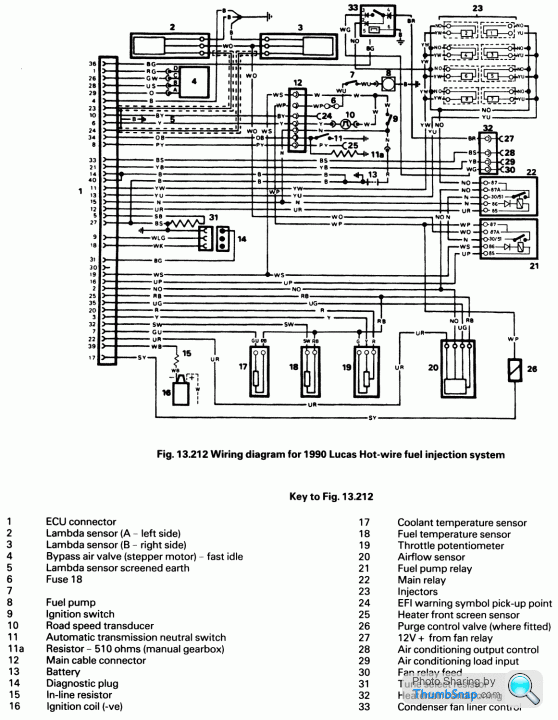
checked main relay: de-mobilizing--> ignition on--> fuel relais clicks and goes off after a few seconds, main relais clicks too.
as a test i changed main relais--> problem remains.
engine turns over...sparks.....after cranking for several seconds it tries to start (firing on a few clyinders for a few milliseconds) and immediatly dies...after that the engine cranking slows down slightly, like the starter motor gets less current or the engine needs to be cranked harder.
what comes up my mind now: before the engine died the first itme (during driving) rev-counter and tacho where jumping between zero and correct value
i meanwhile also checked the resistance inside the wire comming from the ignition module going to the ECU...it should be ~6.8Kohm...i have a reading of 7K..but thats ok i guess..
made another test:
de-mobilizing, ignition on, quickly opening throttle: according to what i have read this simulates acceleration and the ECU should fire the i njectors, which would result in a clicking noise....but there was just quietness.
as a test i changed main relais--> problem remains.
engine turns over...sparks.....after cranking for several seconds it tries to start (firing on a few clyinders for a few milliseconds) and immediatly dies...after that the engine cranking slows down slightly, like the starter motor gets less current or the engine needs to be cranked harder.
what comes up my mind now: before the engine died the first itme (during driving) rev-counter and tacho where jumping between zero and correct value
i meanwhile also checked the resistance inside the wire comming from the ignition module going to the ECU...it should be ~6.8Kohm...i have a reading of 7K..but thats ok i guess..
made another test:
de-mobilizing, ignition on, quickly opening throttle: according to what i have read this simulates acceleration and the ECU should fire the i njectors, which would result in a clicking noise....but there was just quietness.
Edited by LLantrisant on Friday 22 March 21:21
I would double check all the connections to the coil and ignition amp as usually the Rev counter dropping is a sign of a failing ignition module.
Is it possible the ignition module has failed as the description above suggests it’s responsible for sending the pulses back to ecu to fire the injectors.
Is it possible the ignition module has failed as the description above suggests it’s responsible for sending the pulses back to ecu to fire the injectors.
Belle427 said:
I would double check all the connections to the coil and ignition amp as usually the Rev counter dropping is a sign of a failing ignition module.
Is it possible the ignition module has failed as the description above suggests it’s responsible for sending the pulses back to ecu to fire the injectors.
The module is a possible culprit. My classic Range Rover used to eat them on a regular basis.Is it possible the ignition module has failed as the description above suggests it’s responsible for sending the pulses back to ecu to fire the injectors.
The module amplifies a tiny signal pulse produced within the dizzy and earths the coil negative side so the coil produces a high tension spark.
I believe the OP has already tested the connection between coil and ECU so I have to assume he is happy with the connection at the coil. Still worth checking again as it takes a bizarre route from coil to ECU almost as if someone at Rover forgot about it and added it in later. It leaves the coil and crosses the front of the engine behind the dizzy, runs along under the injector rail towards the back of the engine, comes out to a connector in the loom that runs along the underside of the air inlet hose (this loom is the MAF wiring), it then goes back into the main loom to the ECU.
OP. Has the ignition module been replaced? Was the new one fitted using the white heat transfer paste? They do overheat.
Originally the module was on the side of the dizzy but got too hot so Rover moved it to the coil bracket which was mounted over on the inner wing. TVR moved it back into the heat on the side of the plenum.
Steve
Are we getting crossed wires here- the first bit says good spark, but dry plugs, so the amp would not be my first point of call. Id get a can of easy start and spray it the plenum through one of the blanking plug holes and see if it will fire up. As for the injectors, have you checked for 12v? You need a "noid" lamp to see if the injectors are getting a pulse- but its nothing more than an LED and resistor, but you should get a voltage reading of 0 volts across the injectors until you crank, then you will get a voltage reading- it will be far less than 12v as the test meter can only average out the few millisecond pulse the injector gets, but it should show something. No amount of stamping on the throttle will make the injectors work unless the engine is cranking. Do you have RoverGauge? It will show if the ECU is pulsing the injectors.

LLantrisant said:
Engine turns over...sparks.....after cranking for several seconds it tries to start (firing on a few clyinders for a few milliseconds) and immediately dies...after that the engine cranking slows down slightly, like the starter motor gets less current or the engine needs to be cranked harder.
Check your cranking voltage, more specifically you need to conduct two voltage drop tests.1. A voltage drop test on the positive side
2. A voltage drop test on the negative side
Start by testing your battery resting voltage, this is important as it's your base line reference figure!
Now conduct your two voltage drop tests and record the two voltage drop figures (positive & negative), these figures are critical! After completing these two tests repeat them three times and again record your figures, this will help you establish the endurance of your battery which based on your above statement should be treated with suspicion.
However, avoid making assumptions at this stage as there's more to this than just the condition of your battery

At this point it's essential to understand the process of cranking an engine is a massive load on the battery and indeed the entire high amp side of the starter circuit, this includes the stater motor itself, the cable that connects it to your battery and of course the earth return path to the battery negative terminal which is often overlooked.
During the brutal conditions of engine cranking everything electrical on the car is deprived of voltage to feed the current hungry high amp starter circuit, this voltage drop condition is a real problem for the two critical elements you need for a brisk effective start on your TVR Chimaera, ie the ignition system (the coil) and the fuel delivery system (injector opening times).
This problem goes right back to the introduction of electric starting systems in the 1920's and as such is long understood, by the 1970's manufacturers had come up with a solution on the ignition side, a ballast resister coil was used to compensate for the severe voltage drop under cranking. During all running conditions the supply to the coil is routed through a ballast resistor which reduces the voltage the coil sees to 10v, a ballast resistor coil is actually designed to operate at 10v but under cranking the ballast resistor is bypassed.
With the ballast resistor bypassed you may assume the coil gets full battery voltage (12.5v) but this is not the case, due to cranking loads 12.5v isn't available as battery voltage will fall dramatically to 10v, but that's fine as you're now supplying 10v to a 10v coil
. As soon as the car starts the circuit that includes the ballast resistor is reinstated so while battery voltage (supported by the alternator) is now 14.3v the coil is still getting the correct 10v. We can now see why earlier 12v coil systems with no ballast resistor were at such a disadvantage, under cranking a coil designed to run between 12.5-14.3v is only getting 10v so the spark is very weak indeed. Of course all this only relates to ignition and during the 70's most cars still ran a carburetor, but with the advent of fuel injection the problem of voltage drop under cranking presented a new problem.
Exactly like the voltage drop problem on the ignition side, on a fuel injected system to ensure the correct injector opening times and so sufficient fuel requirements are met under cranking, a further fix was needed. The solution being a cranking correction feature built into the ECU, in this case no ballast resistor is needed as the computer takes care of the correction process using an inbuilt voltage compensation table.
With all the above understood hopefully its now clear just how important it is to make sure your cranking voltage does not fall below 10v, actually the more important figure is the drop itself, ie how much your battery voltage falls from battery resting voltage during cranking conditions.
Example One:
1. Battery resting voltage = 12.8v
2. Battery voltage under cranking = 10.5v
3. Voltage drop: 12.8 - 10.5 = 2.3v
4. Result: Pass
Example Two:
1. Battery resting voltage = 12.5v
2. Battery voltage under cranking = 9.0v
3. Voltage drop: 12.5 - 9.0 = 3.5v
4. Result: Fail
As previously stated, after completing the tests repeat them three times and again record your figures, this will help you establish the endurance of your battery, for example your battery may well pass the first test but by the third voltage drop test under cranking battery voltage could be down as low as 7v which is a clear fail.
However, as previously stated there's a lot more to all this than merely the condition of your battery, so here's a full list to consider, and do keep in mind many of the following are especially common issues on a Chimaera:
- A poorly charged battery
- A degraded battery with high internal resistance - The endurance test will soon expose a degraded battery
- A weak starter motor with high internal resistance - Complete a voltage drop test at the starter motor itself
- A poor engine earth return causing high resistance in the starter circuit
- Poor battery terminal/starter cable connections causing high resistance in the starter circuit
- An insufficiently thick starter cable causing high resistance in the starter circuit
- An internally corroded starter cable causing high resistance in the starter circuit
The reality of a TVR Chimaera is you'll very often find you are suffering more than one of the above issues, indeed sometimes to some extent or another all seven will be present.
For example:
1. The starter cable on a Chimaera is very long (7ft) running from the battery in the passenger footwell to the starter motor on the drivers side of the engine block
2. TVR then selected a feeble string thin cable which worked when new but the gauge used was so marginal you only need a little internal corrosion and critical mass is reached
3. Not content with the above TVR went on to fit a thin earth cable from the engine block but this didn't go directly back to the battery, oh no, they bolted it to the corrosion prone chassis using the chassis as the earth return
4. But it doesn't stop there, a second cable was then used to connect the chassis back to the battery
The design of whole circuit from the battery to the stater motor and back to the battery is very poor indeed and subject to very high levels of resistance, the length of the cable, it's thin gauge, and the earth return path is a problem waiting to happen especially after a few years when the inevitable chassis, connections and internal cable corrosion will only add to the resistance issue eventually pushing the system to failure.
By failure I mean a no start condition due to an excessive voltage drop during cranking, if your battery is getting a bit past its best too things will only get worse and if your starter has suffered from being cooked by the O/S exhaust manifold the situation will be worse still!
Now consider while you may see a spark with the spark plug removed from the engine (atmospheric pressure), this is absolutely no proof you have a spark when it's back in the combustion chamber. A visual check for spark actually tells you nothing of it's true strength or if indeed there is a spark at all under compression, the ability for your ignition system to make a spark jump across your spark plug gap is severely tested when pressure is increased.
So, if your voltage drop figures under cranking fall much below 10v what you'll find is under compression pressures there will likely be such a weak spark the engine will stumble almost starting as described, or indeed on the second and third cranking attempt not even fire at all as by this time cranking voltage would have dropped to such a low figure it's quite possible there will be no spark at all inside your combustion chambers.
I will finish this as I started it.....
Check your cranking voltage, more specifically you need to conduct two voltage drop tests.
1. A voltage drop test on the positive side
2. A voltage drop test on the negative side
Hope this helps, Dave
connected rovergauge...during ctanking the engine the "injector duty cylce" shows 3%....during a short moment the engine tried to fire-up into life (a few milliseconds of firing), than the value was 12%, pulse width is ~16ms
voltage during cranking 9.5- 10V
fault codes: none
battery cables (+ & -) are already uprated with bigger dimension
voltage during cranking 9.5- 10V
fault codes: none
battery cables (+ & -) are already uprated with bigger dimension
Edited by LLantrisant on Saturday 23 March 11:09
So far as the ECU is concerned its sending the pulse to the injectors and it has all the right signals. RoverGauge cant tell you if the physical switching circuit is working inside the ECU or if there is a voltage on the injectors, but it shows the ignition amp pulse is there OK. Id still try easy start, as with a quick squirt it will show if you have a decent spark if the engine starts, and eliminate the ignition system from your enquiries. Odd its firing at all if the injector pulse was missing totally. Also Just check your AFM feed pipe is not collapsed.

now i hade made an ineresting observation using again a spark-tester on my plugs:
during cranking i do NOT have anymore a strong spark....only randomly...but once the engine tries to fire-up spark is present....
this would indicte into direction ignition....as i already womdered yesterday that brake-cleaner sprayed into plenum did not fire-up the engine
during cranking i do NOT have anymore a strong spark....only randomly...but once the engine tries to fire-up spark is present....
this would indicte into direction ignition....as i already womdered yesterday that brake-cleaner sprayed into plenum did not fire-up the engine
Gassing Station | Chimaera | Top of Page | What's New | My Stuff