
PCV system for a turbo conversion
Discussion


My car has started smoking burning oil on the overrun, especially on the dragstrip at full tilt.
I only have breathers to atmosphere and am assuming crankcase pressure may be pushing oil back in the oil return from the turbo and therefore leaking into the exhaust.
Can anyone explain a suitable set up I need to utilize my catch can properly and use inlet vacuum to draw the crankcase pressure?
I only have breathers to atmosphere and am assuming crankcase pressure may be pushing oil back in the oil return from the turbo and therefore leaking into the exhaust.
Can anyone explain a suitable set up I need to utilize my catch can properly and use inlet vacuum to draw the crankcase pressure?
I think you mentioned that you had a package installation so you may already have this installed. I had a slight internal pressure issue when I did my turbo conversion with minor leaks from various weak points ( mainly sump/valley gaskets and rocker cover) My engine had covered 125000 miles so it was sort of expected.
I ended up getting a cheap manometer (used by boiler technicians) to check internal engine pressure and trial a few ideas.
In the end I took a feed from the inlet filter at the front of car to create a vacuum and fed this via a MAN filter back to the crankcase breather. The more the engine air flow the more vacuum. This system helps replicate the original setup (using the manifold vacuum to suck engine blow by back via the plenum) which you can no longer use due to the positive pressure when on boost. The result was no more leaks. This may work for you also although you are running 7 more psi than me.
I ended up getting a cheap manometer (used by boiler technicians) to check internal engine pressure and trial a few ideas.
In the end I took a feed from the inlet filter at the front of car to create a vacuum and fed this via a MAN filter back to the crankcase breather. The more the engine air flow the more vacuum. This system helps replicate the original setup (using the manifold vacuum to suck engine blow by back via the plenum) which you can no longer use due to the positive pressure when on boost. The result was no more leaks. This may work for you also although you are running 7 more psi than me.
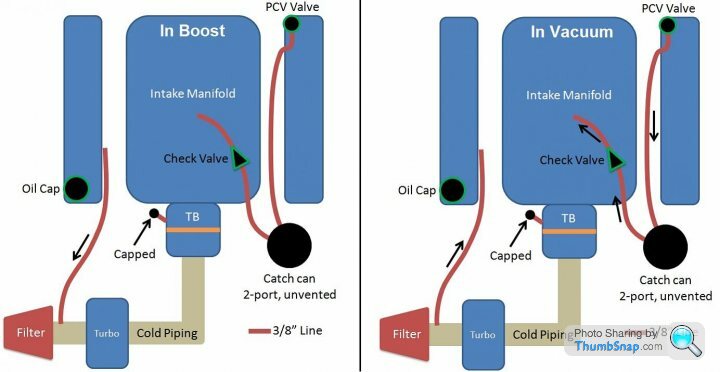
I would have thought that you would need the catch tank between the engine and intake when on boost to prevent oil entering the air intake as that’s when the pressure created in the engine is likely to pump any oil and fumes out?

I just used this Provent 200 inline with the vacuum feed between the rocker and the turbo air intake. I didn’t see a reason to change the original PCN valve setup on the opposite rocker cover. But then I’m not an engineer nor is my engine is producing 573hp.
Here is a picture of the Provent 200. It’s the ultimate catch can.

I just used this Provent 200 inline with the vacuum feed between the rocker and the turbo air intake. I didn’t see a reason to change the original PCN valve setup on the opposite rocker cover. But then I’m not an engineer nor is my engine is producing 573hp.
Here is a picture of the Provent 200. It’s the ultimate catch can.
There's no way a 3/8inc line is going to flow all the blowby you're going to be generating.
How is it plumbed in right now?
Don't feed any gases or oil back into the inlet, it's a recipe for detonation.
All you need is 2 big pipes to atmosphere ie the same size as std or bigger if possible (via catch cans or whatever your race regs dictate). Do not route them to the same catch can unless that has a massive (ie twice the inlet pipe area) exit pipe.
If you still have issues then you need to look at your engine.
Simple rules : don't over complicate it, use more pipe area than you ever think you will need, don't put anything back into the inlet from the crankcase
How is it plumbed in right now?
Don't feed any gases or oil back into the inlet, it's a recipe for detonation.
All you need is 2 big pipes to atmosphere ie the same size as std or bigger if possible (via catch cans or whatever your race regs dictate). Do not route them to the same catch can unless that has a massive (ie twice the inlet pipe area) exit pipe.
If you still have issues then you need to look at your engine.
Simple rules : don't over complicate it, use more pipe area than you ever think you will need, don't put anything back into the inlet from the crankcase
That makes life easier for you Derek and sheep too!
That is exactly what I have fitted.
I have a flame trap on each rocker box without any restrictions below. A large diameter breather Hose running to the catch tank just behind the radiator. The pipe coming out of the top of the catch tank is a large diameter exit pipe which discharges into the atmosphere just below the radiator.
As I’m running without a turbo there is rarely anything but a bit of condensation water in the tank.
You can clearly see both breather pipes in this photograph running to the catch tank and the exit pipe at the top of the catch tank.
I took the other rocker box from a pair to my local engineering shop and they drilled and tapped it for the other flame trap.

That is exactly what I have fitted.
I have a flame trap on each rocker box without any restrictions below. A large diameter breather Hose running to the catch tank just behind the radiator. The pipe coming out of the top of the catch tank is a large diameter exit pipe which discharges into the atmosphere just below the radiator.
As I’m running without a turbo there is rarely anything but a bit of condensation water in the tank.
You can clearly see both breather pipes in this photograph running to the catch tank and the exit pipe at the top of the catch tank.
I took the other rocker box from a pair to my local engineering shop and they drilled and tapped it for the other flame trap.
The same advice not to route to inlet came from the very trusted man himself Dale Bladen.
So the above PCV idea is out. I will fit bigger breathers to 2 catch tanks (because I have 2) and to atmosphere as suggested.
First job is to inspect the plugs for signs of oil then to look at the exhaust from the turbo.
Then a compression test.
Ultimately I need to crack on with building a much more suitable bottom end and bringing the CR down to about 9:1 maybe even less
So the above PCV idea is out. I will fit bigger breathers to 2 catch tanks (because I have 2) and to atmosphere as suggested.
First job is to inspect the plugs for signs of oil then to look at the exhaust from the turbo.
Then a compression test.
Ultimately I need to crack on with building a much more suitable bottom end and bringing the CR down to about 9:1 maybe even less
Here's what I have - hope this helps.
It's a simple catch tank with a breather on top, in the middle of the pipe that goes from the top of the rocker to the air intake pre-turbo.
It is not part of the Whalley kit, but was inserted by Mat Smith to avoid putting loads of oil into the air intake.
FWIW, it is about half a pint in size, and was half full after a hot track day at Cadwell.
Image may be sideways on, sorry

It's a simple catch tank with a breather on top, in the middle of the pipe that goes from the top of the rocker to the air intake pre-turbo.
It is not part of the Whalley kit, but was inserted by Mat Smith to avoid putting loads of oil into the air intake.
FWIW, it is about half a pint in size, and was half full after a hot track day at Cadwell.
Image may be sideways on, sorry
I'd like clean restricted air being drawn into/through the engine. As sketched I think dirty air/oil can be pulsed into the compressor. When I had my turbo engine the pcv circuit was active only when off boost. When on boost it shut down and I never had pressurising of the sump. I think this was because peak cylinder pressure lasted only moments and even then it pushed the rings against the cylinder walls probably more forcefully then before.
You could put a small filtered restricter on that bank and disconnect the pipe to the turbo. Then the pcv could stay where it is. Downside is you may have fumes in the car if the engine has lots of blowbye.
You could put a small filtered restricter on that bank and disconnect the pipe to the turbo. Then the pcv could stay where it is. Downside is you may have fumes in the car if the engine has lots of blowbye.
Edited by Boosted LS1 on Thursday 4th July 09:08


Interesting that you have used BPR8ES if I have read the photo correctly.
I have read that you should use a colder plug with a turbo, a thought that is backed up by my Saab 9-5 turbo, which runs on 10 plugs.
I have kept my car running on BPR6EIX plugs, which of course are somewhat hotter. I will pop outside and take a plug out to photograph. I drove the car 8 miles this morning in town traffic, so it should be pretty sooty.
Back shortly.....
I have read that you should use a colder plug with a turbo, a thought that is backed up by my Saab 9-5 turbo, which runs on 10 plugs.
I have kept my car running on BPR6EIX plugs, which of course are somewhat hotter. I will pop outside and take a plug out to photograph. I drove the car 8 miles this morning in town traffic, so it should be pretty sooty.
Back shortly.....

QBee said:
Ok, I am running a turbo, but this morning was only at 2.5psi, and my drag strip was Barnby Road, Newark, not Santa Pod.....and only up to 70 mph, which was enough to burn off the BMW who had been slipstreaming me. 

Slip streaming, you cracks me up, I bet your mpg was better than his looking at that plug 
Trouble is 2.5 psi isn’t the area Derek runs in, contrary to what many might think Derek’s pushing the envelope with a Turbo is knowledge most of us would never dare gather

I’m loving it

Edited by Classic Chim on Friday 5th July 16:03
Gassing Station | Chimaera | Top of Page | What's New | My Stuff