
Discussion


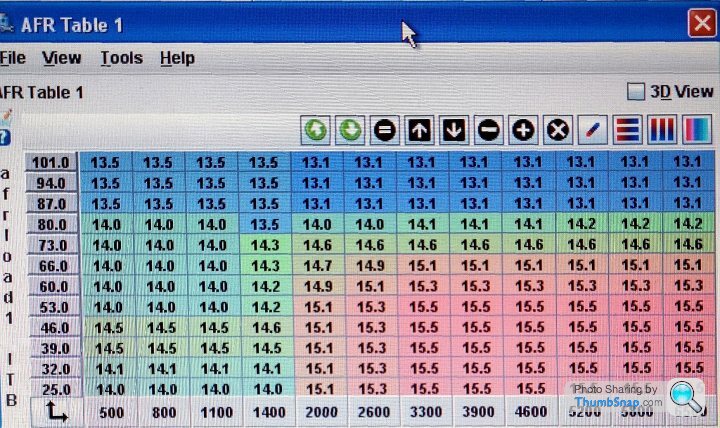
Im having a play with my Megasquirt in lockdown and wondered could anyone comment on my Afr table.
Ive been reading the very good Des Hammill book how to power tune rover V8 engines and in there there is a section on optimum fuel settings.
Any comments are appreciated.
Low/idle rpm 0.92 Lambda 13.5 A/F
Full throttle 0.88 Lambda 13.0 A/F
Acceleration, rising to 0.85 Lambda 12.5 A/F
Cruise 1.05 Lambda 15.4 A/F

Ive been reading the very good Des Hammill book how to power tune rover V8 engines and in there there is a section on optimum fuel settings.
Any comments are appreciated.
Low/idle rpm 0.92 Lambda 13.5 A/F
Full throttle 0.88 Lambda 13.0 A/F
Acceleration, rising to 0.85 Lambda 12.5 A/F
Cruise 1.05 Lambda 15.4 A/F

Dougal9887 said:
Don't forget even a wide band Lambda sensor isn't that fast acting, anything over 55kPa isn't really closed loop territory unless you've got angel toes, so the upper half of that table is largely irrelevant, saying that you need to put something logical in the cells 
I'd recommend disabling closed loop above 18% throttle position and above 3,350rpm, and the earliest you want closed loop to come in during the warm phase up is 65c coolant temp.
These are the settings that have worked very well for me.......

As you can see I run 14.3:1 AFR right in the shunting zone, she's super smooth driving like this even running 26 degrees BTDC on petrol, on gas she'll happily run 30 degrees of timing and is even smoother due to the more complete burn of LPG
Everything in yellow in the below table is actually largely irrelevant....

I would also avoid going any leaner that 15:1 at cruise, simply because after extensive testing I can confirm there is absolutely no fuel economy gain going leaner, all that happens is exhaust gas temps go up so you're just thermally stressing your exhaust valves for absolutely no MPG benefit.
ChimpOnGas said:
Dougal9887 said:
Don't forget even a wide band Lambda sensor isn't that fast acting, anything over 55kPa isn't really closed loop territory unless you've got angel toes, so the upper half of that table is largely irrelevant, saying that you need to put something logical in the cells I'd recommend disabling closed loop above 18% throttle position and above 3,350rpm, and the earliest you want closed loop to come in during the warm phase up is 65c coolant temp.
These are the settings that have worked very well for me.......
As you can see I run 14.3:1 AFR right in the shunting zone, she's super smooth driving like this even running 26 degrees BTDC on petrol, on gas she'll happily run 30 degrees of timing and is even smoother due to the more complete burn of LPG
Everything in yellow in the below table is actually largely irrelevant....
I would also avoid going any leaner that 15:1 at cruise, simply because after extensive testing I can confirm there is absolutely no fuel economy gain going leaner, all that happens is exhaust gas temps go up so you're just thermally stressing your exhaust valves for absolutely no MPG benefit.
Belle427 said:
ChimpOnGas said:
Dougal9887 said:
Don't forget even a wide band Lambda sensor isn't that fast acting, anything over 55kPa isn't really closed loop territory unless you've got angel toes, so the upper half of that table is largely irrelevant, saying that you need to put something logical in the cells I'd recommend disabling closed loop above 18% throttle position and above 3,350rpm, and the earliest you want closed loop to come in during the warm phase up is 65c coolant temp.
These are the settings that have worked very well for me.......
As you can see I run 14.3:1 AFR right in the shunting zone, she's super smooth driving like this even running 26 degrees BTDC on petrol, on gas she'll happily run 30 degrees of timing and is even smoother due to the more complete burn of LPG
Everything in yellow in the below table is actually largely irrelevant....
I would also avoid going any leaner that 15:1 at cruise, simply because after extensive testing I can confirm there is absolutely no fuel economy gain going leaner, all that happens is exhaust gas temps go up so you're just thermally stressing your exhaust valves for absolutely no MPG benefit.
Torque is everything of course as horsepower is just a function of torque, one horsepower being defined as 550ft/lbs per second, so as long as you know your engine speed in revolutions per minute you can mathematically calculate your horsepower from your torque number using the 5,252 rule.
For example my 4.0 Rover V8 on a V8D Stealth cam and burning LPG produces 250ft/lbs at 4,000rpm so the calculation looks like this [(250 x 4,000) / 5,252] 190.4 horsepower at 4,000rpm.
If I take the engine to 5,000rpm it actually only makes another 10ft/lbs, but the additional 1,000rpm changes the calculated horsepower number as follows.... [(260 x 5,000) / 5,252] = 247.52 horsepower at 5,000rpm at an AFR of 12.5:1 and 32 degrees of timing, although it'll make almost the same numbers at 13.5:1.
An engine is of course just a giant air pump, and all air pumps have a window of operation where they're most efficient, keep spinning the air pump faster and faster and eventually you'll reach a point where is actually starts shifting less and less air. A dyno helped me prove this maximum speed for my engine is 5,250 revolutions per minute, at 5,250rpm the torque is still flat-lined at 260ft/lbs but after that the engine's torque and horsepower starts to tail off as it simply can't shift any more air.
To get it shifting more air it would need bigger cylinder head ports, bigger valves or better still a secondary pump to help it along, ie a compressor driven either by exhaust gasses or the engine itself. However, in it's current configuration there's no point is spinning the old lump any faster than 5,250rpm or throwing anymore fuel at it, if I did throw more fuel down its neck all that would happen is the AFR would just go richer than 12.5:1 due to the lack of air to match the additional fuel, and that extra fuel will actually reduce the engine's output.
The peak power calculation on my engine therefore looks like this.... [(260 x 5,250) / 5,252] = 259.90 horsepower at 5,250rpm.
My point is the engine will actually make the above numbers within quite a wide AFR window of between 12.5:1 to 13.5:1, however things are far more influenced by adding and subtracting ignition timing, even by just a degree at a time. While my example is peak power it's the same throughout engine's effective operating range (idle to 5,250rpm), and when its under different loads throughout this operating range.
The takeaway here is if you're going to spend time and money on the dyno, use that valuable time to build a better ignition table. Yes timing can influence your AFRs and the best timing number will be different at different AFRs, but if you look to find your highest torque number at a group of given engine speed vs load sites at a realistic AFR you will be making better use of the expensive dyno time.
The way to choose the engine speed vs load sites you're going to work on is to be honest with yourself about where you genuinely spend most of the time when driving the car in the real world, you may well want to do some work at 100kPa at 5,250rpm but this shouldn't be your priority. I recommend focusing far more time on what timing number works best at 1,750rpm at 40kPa which is driving through town at 26mph on a light throttle in 3rd, 2,950rpm at 38kPa which is cruising on the motorway at 78mph in 5th..... ect ect ect.
After that go back on the road to polish your map using the best torque cells you found on the dyno as your fixed datum points, build your map populating all the other cells between these fixed value dyno cells, tune by feel ie engine smoothness and responsiveness to small medium and large throttle responses. Choose a known route where there are plenty of hills of varying gradients and run each hill at different engine speeds, throttle openings and at different engine loads by altering the gear you're in between runs.
A dyno is a really useful tool, indeed in the case of ignition timing it's essential, but once you've pinned your fixed datum point dyno proven cells joining them up effectively to build your final calibration must be done on the road, this is because you can only replicate the myriad of almost endless real world driving scenarios by actually driving the car on the road and under different climatic/barometric conditions.
Finally you need to accept even the very best calibration is a series of compromises, there is no such thing as the perfect map, just one that represents the best compromise across the board. However, the more sophisticated the ECU the more sensor inputs you tend to get and the more compensation strategies you can employ within the software. Saying that the Rover V8 is a very unsophisticated engine so there's little point trying to get too clever with it, you're far better off looking at physical changes to achieve your personal objectives, for example cam shaft and inlet manifold design will have a far bigger impact on the engine's characteristics than anything you can achieve with a fancy pants engine management system.
This is why a well tuned Rover V8 with the right cam running a distributor and a 4 barrel Holley (390cfm) carburetor sat on an Edelbrock performer inlet manifold can be the sweetest thing ever, it wont be as economical as the same engine running an engine management system but it may well be smoother with better transients. This is because when tuning a carb you seldom run an AFR gauge and tend to tune by feel and plug colour, so what you always end up doing is solving drivability and transient enrichment issues with the crude but very effective age old principle of 'Fix It With Fuel', throwing fuel at a crude old lump like the Rover V8 works really well every time.
As soon as you add an AFR gauge you start to become obsessed by the damn thing and the numbers it displays, in my opinion this is a bad thing as you end up forgetting about feel which is actually way more important. Tuning the engine to an AFR number you think is best is nearly always a mistake, I'd far rather have an engine that's smooth and enjoyable to drive with crisp throttle response than one that runs at 14.7:1 but is snatchy with poor transients.
If you tune by feel to get the engine to feel nice on the throttle then go back to see what AFR you're running you may be surprised to find you're running at 13.0:1 pretty much everywhere and some shockingly rich numbers on tip in, but fear not as you'll also find you've only dropped your average fuel economy from 23mpg to 21mpg. Like this you've got yourself a much nicer driving TVR that only costs you an extra 2p a mile to drive about in, if you drive 5,000 miles a year that's just £100 extra in fuel over that whole year, and for most of us the extra drivability/crisp throttle response will be well worth £100 a year!
In summary while closed loop is an interesting feature and AFRs can be helpful I wouldn't get too caught up with it all, build your foundation tables on the dyno and especially some key ignition timing datum points on the dyno by all means, but the real tuning starts there and must be done on the road. Try not to tune to an AFR gauge, put the damn thing away and tune by feel, get the car driving as smooth as possible and with the best transients you can achieve, then go back and see what the AFRs are, I guarantee what you'll see are numbers far richer than you ever would have excepted if you tunes to AFR.
An engine that's smoother with better throttle response is a happy engine, if you use the listen and feel technique an engine will always tell you when it's happy, this is how we tuned back in the day before lambda sensors and fancy pants engine management systems and it worked perfectly. So my advise is spend a little time on the dyno by all means, but then get it out in the real world and feel/listen to what your engine actually wants, then give it what makes it happy as this will make you happy too. Its a win win situation, the only downside being over an average 5,000 mile driving year you may have to spend £100 more on fuel which is nothing in the great scheme of things


The truth is it's far better to tune to lambda rather than AFR, this is especially important if you run two different fuel types as I do, so I created this reference table.

There's a reason its called a lambda sensor not an AFR sensor, AFR is of course just a calculation of lambda which is your true source data. If my AEM X-WiFi system is just calculating/displaying lambda 1 as 14.7:1, in theory when I see 14.7:1 on LPG the true AFR is really 15.5:1 (LPG Stoich). The trouble here is because all I'm seeing is a calculation against lambda 1, as the mixture shifts lean or rich either site of lambda 1 I'm relying on the same percentage calculation within the controller irrespective of fuel type.
Quite clearly as the controller is just using percentages to convert the lambda numbers to AFR, given the stoich AFR figure on LPG is 5.5% greater than petrol the petrol lambda conversion calculations built into the controller will not deliver exactly the right figure on gas, this is why it's far better to work with the true source data... ie lambda.
Things get more complex as while best enrichment and enleanment displayed in either AFR or lambda are well understood for petrol, there's no such information available for LPG. Of course lambda 1 is lambda 1 no matter what fuel type you burn, but even if you're tuning to lambda what number gives best economy at lean cruise and what number gives best torque under full load WOT acceleration is less clear.
So where do we go from here
The answer is exactly the same when tuning ignition timing, ie you'll only know where you need to be after much time and testing on a dyno. Also be aware an analogue 0-5v wide band installation is very susceptible to voltage offsets, if there are issues you will not be seeing or tuning to the true lambda/AFR figures, this is more common than you think so is something that needs checking.
Once the accuracy and validity of the data is confirmed the final challenge when running closed loop on two different fuel types is my Canems system uses the same one AFR target table irrespective of fuel type, the AFRs used in this table are really just a set of best compromise numbers, while not an issue at or close to lambda 1 this is why I come out of closed loop over18% TPS and above 3,350rpm at which point I fall back on the appropriate fuel type base map.
Like pretty much anything in life it's really just a series of calculated compromises to deliver the best results possible, nothing is perfect but of course the results our true measurement of success, and in this respect I have no complaints. What has really surprised me is how with the right tune on both fuels the engine in my Chimaera is actually nicer idling and smoother performing on gas. LPG is slower burning so you need to light the fire earlier (more ignition advance), but get the timing right and due to the fuel mixing better with air the burn is more complete, this is especially true at lower engine speeds and loads where Chimaeras and Griffs often tend to suffer what TVR owners like to call shunting. The more even and slower combustion event delivers more sustained cylinder pressures acting on the piston producing more torque, this directly translates to noticably smoother engine behavior.
The four key takeaways from my dual fuel learning is still relevant fo all you petrol sniffers:
1. Definitely watch those voltage offsets on your wide band lambda set up
2. Do check the lambda/AFR numbers displayed are actually correct
3. Consider tuning to lambda rather than AFR, AFR is just a calculated number against the true lambda source data
4. Do not rely on closed loop too much, its not a miracle replacement for correct base map calibration, far from it in fact!
There's a reason its called a lambda sensor not an AFR sensor, AFR is of course just a calculation of lambda which is your true source data. If my AEM X-WiFi system is just calculating/displaying lambda 1 as 14.7:1, in theory when I see 14.7:1 on LPG the true AFR is really 15.5:1 (LPG Stoich). The trouble here is because all I'm seeing is a calculation against lambda 1, as the mixture shifts lean or rich either site of lambda 1 I'm relying on the same percentage calculation within the controller irrespective of fuel type.
Quite clearly as the controller is just using percentages to convert the lambda numbers to AFR, given the stoich AFR figure on LPG is 5.5% greater than petrol the petrol lambda conversion calculations built into the controller will not deliver exactly the right figure on gas, this is why it's far better to work with the true source data... ie lambda.
Things get more complex as while best enrichment and enleanment displayed in either AFR or lambda are well understood for petrol, there's no such information available for LPG. Of course lambda 1 is lambda 1 no matter what fuel type you burn, but even if you're tuning to lambda what number gives best economy at lean cruise and what number gives best torque under full load WOT acceleration is less clear.
So where do we go from here
The answer is exactly the same when tuning ignition timing, ie you'll only know where you need to be after much time and testing on a dyno. Also be aware an analogue 0-5v wide band installation is very susceptible to voltage offsets, if there are issues you will not be seeing or tuning to the true lambda/AFR figures, this is more common than you think so is something that needs checking.
Once the accuracy and validity of the data is confirmed the final challenge when running closed loop on two different fuel types is my Canems system uses the same one AFR target table irrespective of fuel type, the AFRs used in this table are really just a set of best compromise numbers, while not an issue at or close to lambda 1 this is why I come out of closed loop over18% TPS and above 3,350rpm at which point I fall back on the appropriate fuel type base map.
Like pretty much anything in life it's really just a series of calculated compromises to deliver the best results possible, nothing is perfect but of course the results our true measurement of success, and in this respect I have no complaints. What has really surprised me is how with the right tune on both fuels the engine in my Chimaera is actually nicer idling and smoother performing on gas. LPG is slower burning so you need to light the fire earlier (more ignition advance), but get the timing right and due to the fuel mixing better with air the burn is more complete, this is especially true at lower engine speeds and loads where Chimaeras and Griffs often tend to suffer what TVR owners like to call shunting. The more even and slower combustion event delivers more sustained cylinder pressures acting on the piston producing more torque, this directly translates to noticably smoother engine behavior.
The four key takeaways from my dual fuel learning is still relevant fo all you petrol sniffers:
1. Definitely watch those voltage offsets on your wide band lambda set up
2. Do check the lambda/AFR numbers displayed are actually correct
3. Consider tuning to lambda rather than AFR, AFR is just a calculated number against the true lambda source data
4. Do not rely on closed loop too much, its not a miracle replacement for correct base map calibration, far from it in fact!
ChimpOnGas said:
The truth is it's far better to tune to lambda rather than AFR, this is especially important if you run two different fuel types as I do, so I created this reference table.
There's a reason its called a lambda sensor not an AFR sensor, AFR is of course just a calculation of lambda which is your true source data. If my AEM X-WiFi system is just calculating/displaying lambda 1 as 14.7:1, in theory when I see 14.7:1 on LPG the true AFR is really 15.5:1 (LPG Stoich). The trouble here is because all I'm seeing is a calculation against lambda 1, as the mixture shifts lean or rich either site of lambda 1 I'm relying on the same percentage calculation within the controller irrespective of fuel type.
Quite clearly as the controller is just using percentages to convert the lambda numbers to AFR, given the stoich AFR figure on LPG is 5.5% greater than petrol the petrol lambda conversion calculations built into the controller will not deliver exactly the right figure on gas, this is why it's far better to work with the true source data... ie lambda.
Things get more complex as while best enrichment and enleanment displayed in either AFR or lambda are well understood for petrol, there's no such information available for LPG. Of course lambda 1 is lambda 1 no matter what fuel type you burn, but even if you're tuning to lambda what number gives best economy at lean cruise and what number gives best torque under full load WOT acceleration is less clear.
So where do we go from here
The answer is exactly the same when tuning ignition timing, ie you'll only know where you need to be after much time and testing on a dyno. Also be aware an analogue 0-5v wide band installation is very susceptible to voltage offsets, if there are issues you will not be seeing or tuning to the true lambda/AFR figures, this is more common than you think so is something that needs checking.
Once the accuracy and validity of the data is confirmed the final challenge when running closed loop on two different fuel types is my Canems system uses the same one AFR target table irrespective of fuel type, the AFRs used in this table are really just a set of best compromise numbers, while not an issue at or close to lambda 1 this is why I come out of closed loop over18% TPS and above 3,350rpm at which point I fall back on the appropriate fuel type base map.
Like pretty much anything in life it's really just a series of calculated compromises to deliver the best results possible, nothing is perfect but of course the results our true measurement of success, and in this respect I have no complaints. What has really surprised me is how with the right tune on both fuels the engine in my Chimaera is actually nicer idling and smoother performing on gas. LPG is slower burning so you need to light the fire earlier (more ignition advance), but get the timing right and due to the fuel mixing better with air the burn is more complete, this is especially true at lower engine speeds and loads where Chimaeras and Griffs often tend to suffer what TVR owners like to call shunting. The more even and slower combustion event delivers more sustained cylinder pressures acting on the piston producing more torque, this directly translates to noticably smoother engine behavior.
The four key takeaways from my dual fuel learning is still relevant fo all you petrol sniffers:
1. Definitely watch those voltage offsets on your wide band lambda set up
2. Do check the lambda/AFR numbers displayed are actually correct
3. Consider tuning to lambda rather than AFR, AFR is just a calculated number against the true lambda source data
4. Do not rely on closed loop too much, its not a miracle replacement for correct base map calibration, far from it in fact!
I like your views on tuning by ear so to speak and i too agree, we used to set mini's up as they should then take a spanner with us and adjust the timing in on the road, get it warm get it to 'pink' then knock it back a tad and they were always happier for it. There's a reason its called a lambda sensor not an AFR sensor, AFR is of course just a calculation of lambda which is your true source data. If my AEM X-WiFi system is just calculating/displaying lambda 1 as 14.7:1, in theory when I see 14.7:1 on LPG the true AFR is really 15.5:1 (LPG Stoich). The trouble here is because all I'm seeing is a calculation against lambda 1, as the mixture shifts lean or rich either site of lambda 1 I'm relying on the same percentage calculation within the controller irrespective of fuel type.
Quite clearly as the controller is just using percentages to convert the lambda numbers to AFR, given the stoich AFR figure on LPG is 5.5% greater than petrol the petrol lambda conversion calculations built into the controller will not deliver exactly the right figure on gas, this is why it's far better to work with the true source data... ie lambda.
Things get more complex as while best enrichment and enleanment displayed in either AFR or lambda are well understood for petrol, there's no such information available for LPG. Of course lambda 1 is lambda 1 no matter what fuel type you burn, but even if you're tuning to lambda what number gives best economy at lean cruise and what number gives best torque under full load WOT acceleration is less clear.
So where do we go from here
The answer is exactly the same when tuning ignition timing, ie you'll only know where you need to be after much time and testing on a dyno. Also be aware an analogue 0-5v wide band installation is very susceptible to voltage offsets, if there are issues you will not be seeing or tuning to the true lambda/AFR figures, this is more common than you think so is something that needs checking.
Once the accuracy and validity of the data is confirmed the final challenge when running closed loop on two different fuel types is my Canems system uses the same one AFR target table irrespective of fuel type, the AFRs used in this table are really just a set of best compromise numbers, while not an issue at or close to lambda 1 this is why I come out of closed loop over18% TPS and above 3,350rpm at which point I fall back on the appropriate fuel type base map.
Like pretty much anything in life it's really just a series of calculated compromises to deliver the best results possible, nothing is perfect but of course the results our true measurement of success, and in this respect I have no complaints. What has really surprised me is how with the right tune on both fuels the engine in my Chimaera is actually nicer idling and smoother performing on gas. LPG is slower burning so you need to light the fire earlier (more ignition advance), but get the timing right and due to the fuel mixing better with air the burn is more complete, this is especially true at lower engine speeds and loads where Chimaeras and Griffs often tend to suffer what TVR owners like to call shunting. The more even and slower combustion event delivers more sustained cylinder pressures acting on the piston producing more torque, this directly translates to noticably smoother engine behavior.
The four key takeaways from my dual fuel learning is still relevant fo all you petrol sniffers:
1. Definitely watch those voltage offsets on your wide band lambda set up
2. Do check the lambda/AFR numbers displayed are actually correct
3. Consider tuning to lambda rather than AFR, AFR is just a calculated number against the true lambda source data
4. Do not rely on closed loop too much, its not a miracle replacement for correct base map calibration, far from it in fact!
It would be interesting to see on your vehicle how far advanced you can go on just Gas. Also on gas noting the effect of running no vac advance and just let the distributor run the one curve. Checked by ear of course, What are your thoughts do you have a number for the max advance?
O mage said:
I like your views on tuning by ear so to speak and i too agree, we used to set mini's up as they should then take a spanner with us and adjust the timing in on the road, get it warm get it to 'pink' then knock it back a tad and they were always happier for it.
It would be interesting to see on your vehicle how far advanced you can go on just Gas. Also on gas noting the effect of running no vac advance and just let the distributor run the one curve. Checked by ear of course, What are your thoughts do you have a number for the max advance?
No distributor for me..... To get the best from LPG, or any fuel for that matter, you really don't want to be handcuffed to a 2D timing curve It would be interesting to see on your vehicle how far advanced you can go on just Gas. Also on gas noting the effect of running no vac advance and just let the distributor run the one curve. Checked by ear of course, What are your thoughts do you have a number for the max advance?

What you need for LPG is to pile on the timing faster and much sooner than you would with petrol, but only really in the higher load sites, as engine speed increases eventually you actually end up with is less timing, under load below 2,000rpm I can run as much as 9 degrees more than petrol although this is the exception as even in this 'extreme difference' part of the map the difference is more like an average of 7 degrees more than petrol.
The best way to view the differences between the two fuel type ignition tables is to view them in 3D, here we can see LPG above petrol with the blue reference point showing the area of 'greatest difference'.

In low load cruise conditions in the motorway I'm only running a couple more degrees than petrol, at low loads of 40 kPa and less in the shunting zone of 1650 - 1800rpm again I am also only running a couple of degrees more than petrol, but overall I do run unfashionable high numbers in this area on both fuels.
With the Canems system you can run a maximum of 50 degrees, but even on LPG under low load cruise conditions at 3,000rpm the timing peaks at 45 degrees, it might get a maximum of two more based of atmospheric influences (air temp correction) but even running at speed on the motorway on the coldest winters day the LPG timing will never exceed 47 degrees in lowest 30 kPa load sites.
ChimpOnGas said:
O mage said:
I like your views on tuning by ear so to speak and i too agree, we used to set mini's up as they should then take a spanner with us and adjust the timing in on the road, get it warm get it to 'pink' then knock it back a tad and they were always happier for it.
It would be interesting to see on your vehicle how far advanced you can go on just Gas. Also on gas noting the effect of running no vac advance and just let the distributor run the one curve. Checked by ear of course, What are your thoughts do you have a number for the max advance?
No distributor for me..... To get the best from LPG, or any fuel for that matter, you really don't want to be handcuffed to a 2D timing curve It would be interesting to see on your vehicle how far advanced you can go on just Gas. Also on gas noting the effect of running no vac advance and just let the distributor run the one curve. Checked by ear of course, What are your thoughts do you have a number for the max advance?
What you need for LPG is to pile on the timing faster and much sooner than you would with petrol, but only really in the higher load sights, as engine speed increases eventually you actually end up with is less timing, under load below 2,000rpm I can run as much as 9 degrees more than petrol although this is the exception as even in this 'extreme difference' part of the map the difference is more like an average of 7 degrees more than petrol.
The best way to view the differences between the two fuel type ignition tables is to view them in 3D, here we can see LPG above petrol with the blue reference point showing the area of 'greatest difference'.
In low load cruise conditions in the motorway I'm only running a couple more degrees than petrol, at low loads of 40 kPa and less in the shunting zone of 1650 - 1800rpm again I am also only running a couple of degrees more than petrol, but overall I do run unfashionable high numbers in this area on both fuels.
With the Canems system you can run a maximum of 50 degrees, but even on LPG under low load cruise conditions at 3,000rpm the timing peaks at 45 degrees, it might get a maximum of two more based of atmospheric influences (air temp correction) but even running at speed on the motorway on the coldest winters day the LPG timing will never exceed 47 degrees in lowest 30 kPa load sites.
Just think it will be interesting to find out if lpg will pre ignite in this engine and if so when. And how does it run just before it gets to that point
O mage said:
Ok so 50 degrees and i take it no signs of pre ignition under load? but to stay true to tuning by ear how far could it go before it starts to pre ignite under load ? is the sweet spot (the spot just before pinking occurs) further up? and Canems have just gone with 50 max air on the safe side for some engines.
Just think it will be interesting to find out if lpg will pre ignite in this engine and if so when. And how does it run just before it gets to that point
The reality is you can't make a low compression like the Rover V8 suffer detonation on 100 Ron LPG no matter how hard you try, I'm confident you could run 60 degrees or more on gas and it still wouldn't pink! But I think you're assuming peak torque arrives at the point just before detonation, this is most definitely not the case, yes back in the day we kept advancing timing until we heard the engine start to pink on a hill then retarded the timing a fraction until the pinking sound disappeared, but this method is very flawed!Just think it will be interesting to find out if lpg will pre ignite in this engine and if so when. And how does it run just before it gets to that point
This old school practice tells us nothing about when the engine is producing best power, it just tells you when the fuel auto ignites before the spark occurs. You need to be careful too, because the human ear isn't a very accurate high frequency listening device at all, by the time you hear the onset of detonation it's already been going on long before and has already been damaging your engine.
What you need is a rolling road and some det cans or software to pick up the early onset of detonation, this knock sensing element is not needed on LPG as like I say you can't make old Rover knock on 110 Ron LPG no matter how hard you try. The rolling road is essential though, and when we tested my Chimaera on a hub dyno despite the max timing in the Canems software allowing 50 degrees it was found there was no increase in peak torque after 45 degrees, what happens is from 45 degrees to 50 degrees the torque figure remains flat but exhaust gas temps do increase slightly.
So in the interest of reducing thermal stress on the exhaust valves, and as LPG does not cool the valves as a liquid fuel will, you are better off running the lowest timing number that produces best mean torque, this is why I do not go beyond 45 degrees.
O mage said:
Well i guess im just too old school for these days but i can still tell if they're on song or not. Im not going to pretend that i understand the xbox 360 ignition systems some of you have bolted on especially now i know they are less adjustable anyway.
Not less adjustable, way more adjustable, and way more adaptable because unlike a distributor you can actually give the engine the timing number it wants, and most importantly where it wants it. There's a reason every single car maker in the world stopped using distributors some 40 years ago, and we never went back. The fact is most engines are indeed knock limited which is why you're not grasping the LPG thing, on a knock limited engine as you light the mixture earlier and earlier torque will continue to increase however you will eventually reach a point where detonation occurs, so this is where you must stop! The engine timing is limited by the detonation (knock)... it's knock limited! However, if you run a fuel that's incredibly resistant to auto ignition, detonation ceases to be an issue. LPG is 110 Ron so run the same engine on gas and suddenly its no longer knock limited, in the same way as you did on your knock limited engine running on petrol if you keep advancing the ignition timing, instead of reaching detonation you will actually find torque increases until it peaks. You can keep giving the engine more and more timing, but all that happens is eventually your peak torque figure will actually start to decline...... it's not knock limited any more, its timing limited!
The reality is LPG behaves very differently to petrol, no surprise really as its a very different fuel type, if you don't understand and accept this and continue to apply petrol tuning rules when running on gas the results will be poor. Its the same with what we used to call mixtures that are now expressed as air fuel ratios, for example there a misnomer that leaner mixtures burn hotter, this is not actually true at all.
The reason people say leaner mixtures burn hotter is when you burn a liquid fuel as you go richer than stioch the extra fuel being introduced that doesn't get burnt acts to cool the intake charge, its the exact same way water injection works and is why boosted engines are often run incredibly rich into the 12's and even 11's. With LPG there's absolutely no point it trying to apply the same strategy as it has absolutely no cooling effect, there's actually very little point going much richer than stioch (lambda 1) even under hard acceleration and high loads.
On any engine no matter what type of fuel you burn you're not going to make more power if you just keep throwing in more and more fuel, like the ignition timing example there is a sweet spot at which point after that more fuel will actually hurt power. If you just keep going richer and richer on LPG all that happens is you just end up throwing unburnt fuel out of the exhaust and the engine actually runs hotter, because if you remove the cooling effect of a liquid fuel the truth is richer mixtures actually burn hotter.... not leaner ones!
All this is why both the optimum fuel and ignition calibrations on petrol are very different to the optimum fuel and ignition calibrations on petrol, understand the unique behaviors and requirements of LPG and get the calibration right and all the old wives tales about running LPG hurting engine power and giving drivability issues go away, the only reason LPG has a bad reputation for such things is people administer it to their engine using very crude fuel metering systems, and distributors running petrol timing curves. Get rid of the crude mixer systems of old and the ancient distributor ignition system and replace both with ECU controlled injectors and 3D ignition and suddenly you can actually make the engine drive nicer of gas than it can ofn petrol because being a gas LPG mixes better with air than a liquid fuel can ever hope to.
Yes LPG is massively cheaper than petrol which is a fantastic thing in a V8 TVR, but a lot of the reason I really only ever drive on gas is because the car is so much nicer to drive on LPG than I could ever make if drive on petrol. The engine idles smoother, drives niceer and has better throttle response on gas, it's also the same as exchanging your best petrol average of 23mpg (if your lucky) to a petrol cost equivalent of 48mpg average on LPG.
What's not to like?
You just need to understand the fuel, how it behaves, and have an engine management system that's flexible enough to put an LPG specific calibration together and switching to gas suddenly becomes an absolute no brainer

Gassing Station | Chimaera | Top of Page | What's New | My Stuff