
still having timing problems.
Discussion


hi folks, please help me! i'm still having so much hassle with this timing. when i set it to 10* btdc on tickover it runs like a sack of crap then konkes out and will not start. i'll turn my dizzy whilst someone tries to start the car. if i turn it so far anti-clockwise it will start and run o.k but when i put the timing light on it, it's running at 50* btdc at idol and the vacumme pipe disconnected. cheers for your help. adam.
adam459 said:
hi folks, please help me! i'm still having so much hassle with this timing. when i set it to 10* btdc on tickover it runs like a sack of crap then konkes out and will not start. i'll turn my dizzy whilst someone tries to start the car. if i turn it so far anti-clockwise it will start and run o.k but when i put the timing light on it, it's running at 50* btdc at idol and the vacumme pipe disconnected. cheers for your help. adam.
Probably a stupid question - but have you got the leads connected to the distributor cap in the correct sequence?
Check that you have cylinder 1 at TDC and check the rotor arm is pointing to 1 on the distributor cap, then follow the leads away from the cap to the cylinders working clockwise around the cap 1,8,4,3,6,5,7,2
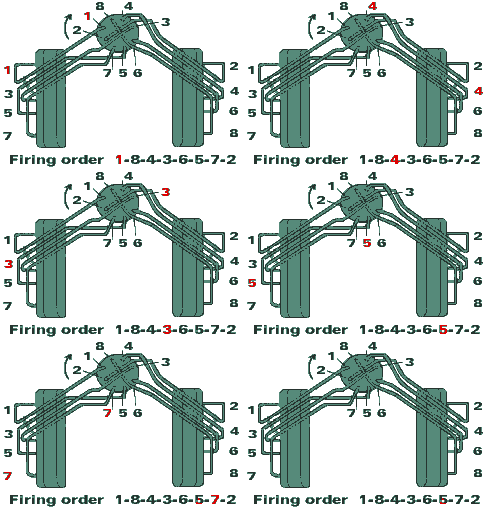
If all seems well then you might want to check if you have dislodged the weights that control the ignition advance. These can become detached without realising and then are useless.
Edited to add "make sure that you really are at top dead center on the compression stroke not the exhaust stroke i.e. rockers on the cylinder in question are slack on both inlet and exhaust valves indicating the point in the cycle when compression has ended and ignition occurs. Don't try to set up the distributor when you're at the top of the exhaust stroke which is also TDC"
Edited to add "the source of the diagram is Paul Burgess on the NSRA site"
If all seems well then you might want to check if you have dislodged the weights that control the ignition advance. These can become detached without realising and then are useless.
Edited to add "make sure that you really are at top dead center on the compression stroke not the exhaust stroke i.e. rockers on the cylinder in question are slack on both inlet and exhaust valves indicating the point in the cycle when compression has ended and ignition occurs. Don't try to set up the distributor when you're at the top of the exhaust stroke which is also TDC"
Edited to add "the source of the diagram is Paul Burgess on the NSRA site"
Edited by hut49 on Sunday 17th September 21:46
Edited by hut49 on Sunday 17th September 21:48
Unless you've already checked that the timing marks on the front pulley are accurate, don't trust them. You need to get an accurate TDC reference point. The best way to do this is to take the #1 plug out and put a stop in to the plug hole. The stop is just something that sticks into the cylinder and stop the piston before it reaches top dead center. Mark the position on the front pulley where the engine stops, spin the engine back the other way until it hits the stop from the other side and mark that position too, mid way between your two marks is #1 TDC. Then you need to find #1 TDC on the firing stroke. The safest way to find this is to take off the offside (even bank) rocker cover and turn the engine over until the two rockers for cylinder #6 are both moving (one opening, one closing). This is TDC on the exhaust/induction stroke for cylinder #6, which is also TDC on the compression/power stroke for cylinder #1. (You can also find this by looking at the rockers for #1, but taking the nearside (odd bank) rocker cover off is more work.)
Having got the engine at TDC on the compression/power stroke, you need to take the dizzy cap off and see which terminal the rotor arm is pointing to. Put a mark on the outside of the distributor body and also on the distributor cap marking that as cylinder #1. Ensure that the corresponding HT lead is connected to cylinder #1, and mark both ends of the lead with a '1'. While you have the dizzy cap off, make sure the rotor arm is secure, that there's no backlash and that the mech advance allows the rotor arm to be turned clockwise by about 30 degrees and springs back when you let go. Also double check that the carbon brush in the center of the dizzy cap is in place, and the electrodes all look in good condition before you refit the cap.
Work clockwise round the distributor cap making sure the leads are connected to the correct cylinder and labelling both ends of each HT lead as you go. The order is 1843 6572.
Disconnect the vacuum line to the vac advance unit and plug the port into the throttle body.
Put a strobe on and confirm that you can see a consistent spark at somewhere close to TDC. If not, swing the dizzy until you can. Once you have the ignition within about 20 degrees of TDC the engine will fire up if there are no other faults. Bear in mind that if it's had ignition problems you may have fouled one or more plugs so if your strobe shows good steady ignition timing and your engine fires but has a misfire, replace all the plugs before you go any further. If you still have a misfire after that you may have a faulty HT lead or plug extender.
Having got the engine at TDC on the compression/power stroke, you need to take the dizzy cap off and see which terminal the rotor arm is pointing to. Put a mark on the outside of the distributor body and also on the distributor cap marking that as cylinder #1. Ensure that the corresponding HT lead is connected to cylinder #1, and mark both ends of the lead with a '1'. While you have the dizzy cap off, make sure the rotor arm is secure, that there's no backlash and that the mech advance allows the rotor arm to be turned clockwise by about 30 degrees and springs back when you let go. Also double check that the carbon brush in the center of the dizzy cap is in place, and the electrodes all look in good condition before you refit the cap.
Work clockwise round the distributor cap making sure the leads are connected to the correct cylinder and labelling both ends of each HT lead as you go. The order is 1843 6572.
Disconnect the vacuum line to the vac advance unit and plug the port into the throttle body.
Put a strobe on and confirm that you can see a consistent spark at somewhere close to TDC. If not, swing the dizzy until you can. Once you have the ignition within about 20 degrees of TDC the engine will fire up if there are no other faults. Bear in mind that if it's had ignition problems you may have fouled one or more plugs so if your strobe shows good steady ignition timing and your engine fires but has a misfire, replace all the plugs before you go any further. If you still have a misfire after that you may have a faulty HT lead or plug extender.
Edited by GreenV8S on Sunday 17th September 22:58
The pulley can also slip as the rubber damper bit splits. End result is a set of timing marks that change everytime the engine is run as the pulley slips around the crank mount. Put a line of paint across the whole crank pulley and see if it seperates. The section on using a rolling road in the bible gives the whole gory detail.
Gassing Station | Chimaera | Top of Page | What's New | My Stuff