
Discussion


people of vast Jaguar knowledge,
i have just acquired a very tidy XJ coupe of '77 vintage and will need to put a "bit" of petrol in it, could anyone tell me if it can run on unleaded? it has been laid up for 10 years and has only just been woken from its coma. The vendor has done the tank and filters but i am unsure what to feed it.
It runs fine on whats in it now, presumably unleaded but i dont want to risk any long term damage by using the wrong fuel.
thanks in advance
Darren
i have just acquired a very tidy XJ coupe of '77 vintage and will need to put a "bit" of petrol in it, could anyone tell me if it can run on unleaded? it has been laid up for 10 years and has only just been woken from its coma. The vendor has done the tank and filters but i am unsure what to feed it.
It runs fine on whats in it now, presumably unleaded but i dont want to risk any long term damage by using the wrong fuel.
thanks in advance
Darren
The XK engine was designed for 4 or 5 star fuel. What we buy now is two star.
I would take advice from an XK engine expert - the valve seats are inserts in the head so don't require the additional lead for lubrication but you may need to retard the ignition timing from the factory setting to avoid detonation.
I would take advice from an XK engine expert - the valve seats are inserts in the head so don't require the additional lead for lubrication but you may need to retard the ignition timing from the factory setting to avoid detonation.
My breathed on 4.2 engine has always seemed very happy of Tesco's 99 Octane stuff, other than that super unleaded is fine. As Jaguar Steve says, the head is alloy so it always had hardened inserts for the valve seats. Is most cars where the valve seat is just cut into cast iron than have a problem with unleaded.
It's not the octane rating or valve seat problem that you need to consider these days but ethanol content.
I've read somewhere that all Shell petrol contains ethanol. A nuisance as most of the petrol stations in my area are Shell. However I understand that BP Super Unleaded does not contain ethanol so that's what I use in my 70's Jag.
I've read somewhere that all Shell petrol contains ethanol. A nuisance as most of the petrol stations in my area are Shell. However I understand that BP Super Unleaded does not contain ethanol so that's what I use in my 70's Jag.
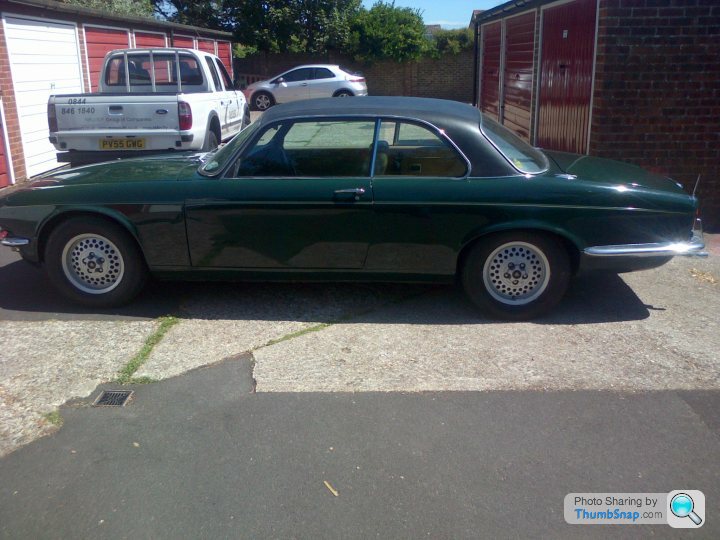

 to me...
Cheers Steve,
MoT report back today, fundamentally solid though some welding required to the seatbelt anchorage points, floor needs plating up a bit though it hasn't spread out to the sills so a relatively easy repair. Windscreen washer doesn't deliver enough water, hey ho! All in all not too bad
Anyone know a good welder local to Hayling?
Darren
MoT report back today, fundamentally solid though some welding required to the seatbelt anchorage points, floor needs plating up a bit though it hasn't spread out to the sills so a relatively easy repair. Windscreen washer doesn't deliver enough water, hey ho! All in all not too bad
Anyone know a good welder local to Hayling?
Darren
a8hex said:
My breathed on 4.2 engine has always seemed very happy of Tesco's 99 Octane stuff, other than that super unleaded is fine. As Jaguar Steve says, the head is alloy so it always had hardened inserts for the valve seats. Is most cars where the valve seat is just cut into cast iron than have a problem with unleaded.
I'd be worried about the ethanol content in that stuff.Yes Ethanol content in fuel needs investigating too as you may end up with component failure in the fuel systems of some older cars due to incompatibility with the higher ethanol content of modern fuels. All you need is a failed seal leading to a fuel leak in the wrong place and your P&J will be no more.
I'd be just as concerned about octane rating. 99 Octane fuel is roughly equivalent to 4 star which most later versions of the XK engine will run on, but it lacks the lead content that used to be added to reduce detonation so you'll still have the possibility of pre ignition which is ruinious.
You'll need to get the engine timing spot on and possibily set the fuel mixture slightly richer under lighter loads than the factory settings and make sure the vacuum advance on the distributor is not over advancing under high vacuum conditions. Ideally I'd bin the AED and fit a manual choke conversion, make sure everything on the fuel/ignition systems are working correctly then go for a full diagnostic or even rolling road session with somebody who really knows what they are doing with the XK lump just to optimise everything.
You won't always hear the classic pinking under lightish load if something is not quite right, detonation can be silent and lead to burnt valves and melted piston crowns. Don't ask me how I know this I just do
I'd be just as concerned about octane rating. 99 Octane fuel is roughly equivalent to 4 star which most later versions of the XK engine will run on, but it lacks the lead content that used to be added to reduce detonation so you'll still have the possibility of pre ignition which is ruinious.
You'll need to get the engine timing spot on and possibily set the fuel mixture slightly richer under lighter loads than the factory settings and make sure the vacuum advance on the distributor is not over advancing under high vacuum conditions. Ideally I'd bin the AED and fit a manual choke conversion, make sure everything on the fuel/ignition systems are working correctly then go for a full diagnostic or even rolling road session with somebody who really knows what they are doing with the XK lump just to optimise everything.
You won't always hear the classic pinking under lightish load if something is not quite right, detonation can be silent and lead to burnt valves and melted piston crowns. Don't ask me how I know this I just do


Jaguar steve said:
I'd be just as concerned about octane rating. 99 Octane fuel is roughly equivalent to 4 star which most later versions of the XK engine will run on, but it lacks the lead content that used to be added to reduce detonation so you'll still have the possibility of pre ignition which is ruinious.
I'm very sorry JS, but I really don't think that is how octane ratings work.The old star rating system of BS4040 rated 5star as 100 Octane and 4 star at 98 Octane. These ratings have nothing to do with their chemical composition and instead based on the knock resistance of fuel used in a standardised engine running at a defined temperature, pressure and engine speed. The standard engine is a funny looking single cylinder jobby I seem to recall.
In the UK we normally measure the octane rating using a RON figure, a "Research Octane Number".
So a 98 octane leaded fuel has exactly the same knock resistance as 98 octane unleaded fuel. Under the standardised test conditions.
The ethanol issue is entirely separate. It alters the chemical composition of the fuel which means it interacts differently with other parts of the fuel system in a different way. Potential dissolving things that are aren't soluble in traditional petrol. But petrol is a damn good solvent. Discussing this with US based owners of XKs who've been forced into using ethanol infected gasoline for much longer than we have in the UK, they don't seem to report any issues. The biggest fear seems to be with fuel "ageing" over winter. Traditional petrol naturally repels water, whilst adding ethanol to the petrol means that it will absorb some water.
a8hex said:
Jaguar steve said:
I'd be just as concerned about octane rating. 99 Octane fuel is roughly equivalent to 4 star which most later versions of the XK engine will run on, but it lacks the lead content that used to be added to reduce detonation so you'll still have the possibility of pre ignition which is ruinious.
I'm very sorry JS, but I really don't think that is how octane ratings work.The old star rating system of BS4040 rated 5star as 100 Octane and 4 star at 98 Octane. These ratings have nothing to do with their chemical composition and instead based on the knock resistance of fuel used in a standardised engine running at a defined temperature, pressure and engine speed. The standard engine is a funny looking single cylinder jobby I seem to recall.
In the UK we normally measure the octane rating using a RON figure, a "Research Octane Number".
So a 98 octane leaded fuel has exactly the same knock resistance as 98 octane unleaded fuel. Under the standardised test conditions.
No need to apologise.

Yes, I know about the variable compression single cylinder engine used to determine the point at which detonation or knock occurs to determine the RON number for any batch of fuel. I made the point - possibily not very well - about octane ratings to highlight the fact that normal unleaded fuel is both a lower octane rating than most variants of the XK engine were designed for and does not have the lead added to increase the point at which detonation occurs. Detonation can be silent - it's not always just a little audible pinking and needs to be taken seriously as it can result in significant engine damage.
The ethanol issue is entirely separate. It alters the chemical composition of the fuel which means it interacts differently with other parts of the fuel system in a different way. Potential dissolving things that are aren't soluble in traditional petrol. But petrol is a damn good solvent. Discussing this with US based owners of XKs who've been forced into using ethanol infected gasoline for much longer than we have in the UK, they don't seem to report any issues. The biggest fear seems to be with fuel "ageing" over winter. Traditional petrol naturally repels water, whilst adding ethanol to the petrol means that it will absorb some water.
BTW it's my understanding most piston engined light aircraft run on 100 octane leaded fuel - perhaps that'd be the best diet of all for an XK engine

It may have changed, but when posted on PH some time back, SHELL was the only supplier who would not answer the question about Ethanol.
I suspect that SHELL has added it to all their grades of fuel??
But ESSO super does NOT have any Ethanol in it here in the South Eastern part of the country.
Same for Texaco and Total and BP.
ALL 95 fuel across the whole country has ethanol added!
So use Esso, Texaco, Total or BP super as it all comes from the same place apparently.
I would also suggest that at that age, any soft fuel lines are suspect and that you replace them with ethanol tolerant alternatives anyway.
However, when asked Jaguar said all thier cars can run ethanol based fuels (no age was given though) and I believe this is because they have been exporting to the USA for a long time and the USA has had ethanol fuel also for a very long time.
Good luck with the car, it certainly looks nice!
I suspect that SHELL has added it to all their grades of fuel??
But ESSO super does NOT have any Ethanol in it here in the South Eastern part of the country.
Same for Texaco and Total and BP.
ALL 95 fuel across the whole country has ethanol added!
So use Esso, Texaco, Total or BP super as it all comes from the same place apparently.
I would also suggest that at that age, any soft fuel lines are suspect and that you replace them with ethanol tolerant alternatives anyway.
However, when asked Jaguar said all thier cars can run ethanol based fuels (no age was given though) and I believe this is because they have been exporting to the USA for a long time and the USA has had ethanol fuel also for a very long time.
Good luck with the car, it certainly looks nice!
thanks Steve, i have an ESSO local to me so im sure i can feed it copious amounts of Super from there. She's coming along nicely, in for some welding on wednesday then i can start tidying her up. Leather has cleaned up ok, though i need the headlining replaced. i can get get a carpet set online quite reasonably so interior not too much of a problem. Chrome and paint renovation will be a longer term project!!
D
D

Gassing Station | Jaguar | Top of Page | What's New | My Stuff