
Rover gauge readings
Discussion


Hi all
been trying to trace an very lumpy idle fault and poor light throttle running, I now have rovergauge and all readings look good except the long term trim which even after 20 mins idle reads 100% + the short term is around 0 to -25% and very stable, Can someone give me an idea if this is wrong and if so where to look next. Also with Lamda disconnected the low speed running is vastly improved and the idle is better but not as it used to be.
Mark
been trying to trace an very lumpy idle fault and poor light throttle running, I now have rovergauge and all readings look good except the long term trim which even after 20 mins idle reads 100% + the short term is around 0 to -25% and very stable, Can someone give me an idea if this is wrong and if so where to look next. Also with Lamda disconnected the low speed running is vastly improved and the idle is better but not as it used to be.
Mark
100 % positive trim means its removing fuel, or the ECU thinks the mixture is rich. First check the plug colours- are they sooty? Then try introducing a bit of air to the plenum- assuming you have a blanking plug you can unscrew (?). Just loosen it to see if the idle improves. Most likley cause of an over rich mixture is AFM voltgae is high, temp sensor is wrong, or fuel pressure is high- has the vac' pipe come of the regulator?
Hi Mark thanks for your response the AFM is at 32% or 1.75v measured at ecu plug fuel pressure is 1.9 bar at idle and I have introduced air to the system with no change. tried a working afm with no change, tried coil, leads,plugs,ecu change, checked injector resistance, I suspect an air leak or faulty injectors. The performance is fine and smooth above 10-15% throttle input. even if you raise the rpm upto say 3000 in neutral it is running very poor which does lead me towards an air leak? but as you say it sounds as if the car is running rich looking at the long term trim. I will check the plugs and report back.
Mark
Mark
You could try running on the non cat map if you can get a 470 ohm resistor and pop it in the tune resistor socket and reset the ECU. This will remove the lambda feedback control completely. You can then have a play with the CO trim on the side of the AFM to see if you can get a stable idle. It c an be difficult to fault find with the feedback in place as the ECU will simply try and correct the mixture whatever is wrong.
Removed the plugs this evening and they are black and sooty, is there any thing else I can look into which may be causing a rich running fault. will get hold of resistor and give it ago. Can a bad air leak cause a rich running symptom, is it worth looking into earth leak to the injector circuit? and what should the fuel pressure be at idle, I have tried a working afm but only for a few mins so the long term trim may not have had time to stabilise? thanks for your help.
Mark
Mark
The long term trim takes at least 2.5 mins on a hot engine, so you cant simply do a quick swap of a part- you need to do an ecu reset to clear the trim to zero, with the new part and then see what the trim does when its hot. The idle fuel pressure is difficult to define due to the variable inlet vacuume, so you need to disconnect the vac' feed to the regulator, and user RoverGauge to turn the pump on and measure the pressure (engine still). You should have around 37 PSI.
Hi Mark
Mark I have tried running a non cat map and can adjust the mixture from 0 volts to 3.5 with no change and if anything the running is worse, the fuel pressure is spot on engine not running, what is interesting is if I hold the rpm at 2000 when running map 5 the short term trim on the right is always about 50% positive where as the left jumps around 0 +/- 20% this to me indicates a misfire? also which way is the right bank viewed from the front of the car or from the drivers seat? I will get to the bottom of this problem and what do you recommend next?
cheers for your help
Mark
Mark I have tried running a non cat map and can adjust the mixture from 0 volts to 3.5 with no change and if anything the running is worse, the fuel pressure is spot on engine not running, what is interesting is if I hold the rpm at 2000 when running map 5 the short term trim on the right is always about 50% positive where as the left jumps around 0 +/- 20% this to me indicates a misfire? also which way is the right bank viewed from the front of the car or from the drivers seat? I will get to the bottom of this problem and what do you recommend next?
cheers for your help
Mark
The correct one is the one thats swinging around the mid point, plus or minus 20%. If the other side is stuck at + 50 the ECU cant pull the mixture to its mid point (ie 0 %). The ECU will simply try adding more and more fuel until the lambda probes start to switch, but if it never switches (ie 0 lambda volts) eventually the ECU should throw a lambda error. It wont do this however if the probes switch again at different RPMs. The Lambda readings you get with RoverGauge are the ECU response to the Lambda voltages, not the physical voltage from the probe.
So things to try:
Unplug the probes one at a time- see the effect. This will prove which bank is left and right- Ive not checked this although I think left and right is looking forward over the engine.
Get a voltmeter on the black / white wires on probe connectors and look at the voltages - it should cycling 0 to about 1.2 volts DC at around 1/2 - 1 second interval at tick over or above on a warm engine. O volts is lean reading / misfire or a dead probe so swap the probes, left to right, does the fault shift?
If you can prove which bank is at fault and the probes are OK, then let the engine cool completely and then start it and let it run for 20 seconds or so the get the manifolds warm, and turn off. Then quickly dab each exhaust header with some water (on a paint brush or even a finger if you are careful), so it leaves a damp patch. The hot headers will dry quickly. If one is misfiring it will be slower to dry. Beyond this you need access to an old style Crypton tune or the like to look at HT voltages, or simply replace all the HT components from the coil on wards- it probably cheaper.
So things to try:
Unplug the probes one at a time- see the effect. This will prove which bank is left and right- Ive not checked this although I think left and right is looking forward over the engine.
Get a voltmeter on the black / white wires on probe connectors and look at the voltages - it should cycling 0 to about 1.2 volts DC at around 1/2 - 1 second interval at tick over or above on a warm engine. O volts is lean reading / misfire or a dead probe so swap the probes, left to right, does the fault shift?
If you can prove which bank is at fault and the probes are OK, then let the engine cool completely and then start it and let it run for 20 seconds or so the get the manifolds warm, and turn off. Then quickly dab each exhaust header with some water (on a paint brush or even a finger if you are careful), so it leaves a damp patch. The hot headers will dry quickly. If one is misfiring it will be slower to dry. Beyond this you need access to an old style Crypton tune or the like to look at HT voltages, or simply replace all the HT components from the coil on wards- it probably cheaper.
Edited by blitzracing on Sunday 15th September 22:07
Guys, just popped over from the Wedge forum, Rovergauge newbie here.... After my 500i conversion to my Wedge I have been trying out the software on the car. Two quick questions:
Where is the default location for the logged files as I cannot seem to find them?
Second I have got the following read out on a warm engine on tick over, should one bank lambda be showing s full amount of trim and a slight amount of trim on the other bank? Engine is running fine and good idle at 800 rpm
Test with ECUMate shows no lambda faults should I worry?
Chris
Where is the default location for the logged files as I cannot seem to find them?
Second I have got the following read out on a warm engine on tick over, should one bank lambda be showing s full amount of trim and a slight amount of trim on the other bank? Engine is running fine and good idle at 800 rpm
Test with ECUMate shows no lambda faults should I worry?
Chris
The log files are written into the log folder that resides along side the RoverGauge program, where ever you put that on the hard drive. The RoverGauge is streets ahead of ECUmate on Lambda readings, as it shows both long and short term (ECUmate only shows short term) so you can get a much better picture of whats really going on. With bad fueling conditions you can get 100% long term fuel trim, yet the short term will keep cycling, so you dont get any error codes. 100% long term fuel trim means the ECU has hit the correction limit due to something being out of tolerance or bad mapping, yet the old 14CUX still keeps the short term cycling with the remaining short term trim so error codes are not logged. In a perfect world with perfect mapping, long term trim would be at 0 % (mid point) and the short term would cycle equally and rapidly around a mid point a few percent on each side of zero. In the real world you will see different values for long term trim between left and right bank, ( though 100% is not good- typically anything less than + /- 50% is good) and ideally the short term will cycle around the mid point. If its bouncing one side more than the other, the long term should slowly shift until the short term cycles evenly. Its all pretty crude on the TVR ( Chim and Griff anyway) as the lambda sensors are a long way down the exhausts and past the pre cats so there is a time delay between combustion and sensing, so the feed back is slow and tends to over shoot the correction. A high performance cam does not help either as the low speed gas flows are a bit choppy. Its pretty amazing it works at all.....
Edited by blitzracing on Sunday 17th November 17:47
Edited by blitzracing on Sunday 17th November 17:52
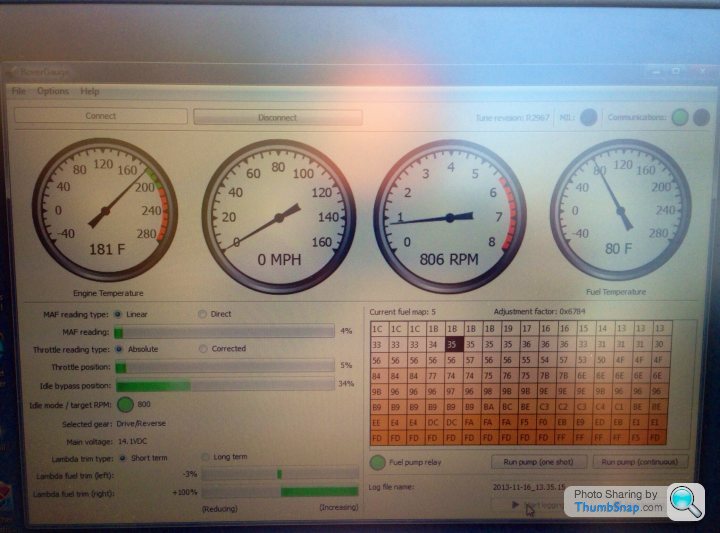
Hell- you have got me confused now!. On the early versions of RoverGauge adding fuel trim meant removing fuel (ie adding more trim) but you are showing +100 on the scale, alongside the increasing fuel scale, so thats the other way around now..Maybe I missed something here, but anyway if the ECU is adding fuel, it means the lambda voltage is at 0 volts, or open circuit, so the ECU is adding fuel. It should throw an error code eventually if the probe never switches, but if it does switch occasionally it wont error. Its likely to be a failing probe, but the best bet is to measure the physical voltages on the probe connector to be sure, between the white (earth) and black (signal) wire. 0 volts means a dead probe or very lean mixture, 1-1.2 volts means a rich mixture and the probes fine.
This is worth a read:
http://www.g33.co.uk/images/PDFS/14cux%20faulot%20...
The latest version of RG is marked a little better:
https://code.google.com/p/rovergauge/downloads/det...
This is worth a read:
http://www.g33.co.uk/images/PDFS/14cux%20faulot%20...
The latest version of RG is marked a little better:
https://code.google.com/p/rovergauge/downloads/det...
Edited by blitzracing on Sunday 17th November 18:40
Hi Mark
I still have the same readings as above but on both sensors the long-term trim 100%+ if I disconnect 1 lambda sensor it runs fine I still suspect a major air leak and I do intend removing my plenum spacer to see if this helps. what about cam timing? but the car drives perfect with one sensor disconnected????? still very stuck.
Thanks again Mark
I still have the same readings as above but on both sensors the long-term trim 100%+ if I disconnect 1 lambda sensor it runs fine I still suspect a major air leak and I do intend removing my plenum spacer to see if this helps. what about cam timing? but the car drives perfect with one sensor disconnected????? still very stuck.
Thanks again Mark
So you have black and sooty plugs, plus 100% fuel trim. That would lead me to think that you have no output from the probes, so the ECU keeps putting in more and more fuel to try and get the probes to switch. As above it should however have thrown a fault code either un-switching probes or if you run them disconnected, you should get the same results. You really need to get a test meter on the probes as above and see if you are getting a voltage in the first place. I can loan you a test cable that plugs into the Lambda connectors if you need one as it makes life easier. As already said a misfire will also soot the plugs but it wont be an air leak sooting the plugs, the ECU wont over compensate. A bad cam does lead to some slow Lambda switching, but its not that obvious.
Hi Mark
Just a quick update fella, changed the other lambda sensor on the Gredge and all is well! Thanks for the advice, the car is running much better and normal service is resumed. As you said ECUMate still did not report a lambda error so it must have been intermittant faults from the sensor.
Chris
Just a quick update fella, changed the other lambda sensor on the Gredge and all is well! Thanks for the advice, the car is running much better and normal service is resumed. As you said ECUMate still did not report a lambda error so it must have been intermittant faults from the sensor.
Chris
Hi Mark
Borrowing a pair of Lambda probes today so when I can get round to fitting I will update, I can see the probes doing something with my digital meter (not ideal I know) when probed at the ecu plug. I will compare the results with the replacements. I have noticed my long term trim does start to reduce to about 60% increasing after a run but less than 10 mins of idle will see it at 100% on both banks. as I am borrowing the sensors is it worth me borrowing any other parts to try?. Thanks again for your help in this on going problem
Mark
Borrowing a pair of Lambda probes today so when I can get round to fitting I will update, I can see the probes doing something with my digital meter (not ideal I know) when probed at the ecu plug. I will compare the results with the replacements. I have noticed my long term trim does start to reduce to about 60% increasing after a run but less than 10 mins of idle will see it at 100% on both banks. as I am borrowing the sensors is it worth me borrowing any other parts to try?. Thanks again for your help in this on going problem
Mark
Im surprised the long term reduces as it runs- I was under the impression that it only sets itself at idle when all engine sensors are stable. Having said that there must be some fairly clever mathematics analysing the Lambda wave form to see if it averaging rich or lean, so there could be a bigger picture. Its average is certainly nothing you can see with a test meter or even a data logger on the lambda output unless its very extreme. I did manage to replicate an over rich or lean signal with with an electronic timer that I could set precisely, and I could see the long term trim move bit by bit.
If the trim is showing 100% adding fuel, then its down to too much air, a misfire or a non switching probe. Small air leaks in the plenum area have a marked affect at idle, as the vacuum is high in the plenum as the throttle plate is shut, so the air draw is high around any leaks. Add to this the ECU is only metering a small amount of fuel as the car is at idle, and that extra air leans the mixture right off and the ecu will try and compensate. They are pretty difficult to detect, as you have all the various pipes feeding into the plenum, the seal between the plenum base and the trumpet base, the joint to the inlet manifold, the manifold to the head, and the preheat plate under the plenum The screws on this plate this extend into the plenum chamber so if one is missing or loose it lets in air. I do believe on high mileage setups the seals around the throttle spindle can leak as well. Its pretty much impossible to hear air leaks over the engine noise. I heard it said that you can spray Easy Start around all the joints on an engine at idle and wait for the idle to change as the Easy Start gets drawn in. Cant say I fancy spraying a highly volatile liquid around a hot engine if you fancy keeping your hair however. Air leaks have much less effect as the throttle is opened as you have more fuel to play with and the air draw is much lower around the leak, so you dont get the sharp shift in mixture.
If the trim is showing 100% adding fuel, then its down to too much air, a misfire or a non switching probe. Small air leaks in the plenum area have a marked affect at idle, as the vacuum is high in the plenum as the throttle plate is shut, so the air draw is high around any leaks. Add to this the ECU is only metering a small amount of fuel as the car is at idle, and that extra air leans the mixture right off and the ecu will try and compensate. They are pretty difficult to detect, as you have all the various pipes feeding into the plenum, the seal between the plenum base and the trumpet base, the joint to the inlet manifold, the manifold to the head, and the preheat plate under the plenum The screws on this plate this extend into the plenum chamber so if one is missing or loose it lets in air. I do believe on high mileage setups the seals around the throttle spindle can leak as well. Its pretty much impossible to hear air leaks over the engine noise. I heard it said that you can spray Easy Start around all the joints on an engine at idle and wait for the idle to change as the Easy Start gets drawn in. Cant say I fancy spraying a highly volatile liquid around a hot engine if you fancy keeping your hair however. Air leaks have much less effect as the throttle is opened as you have more fuel to play with and the air draw is much lower around the leak, so you dont get the sharp shift in mixture.
Edited by blitzracing on Sunday 1st December 20:22
Just thought I would update where I am with my on going idle problem. The Lambda probes have been swapped and made no difference I then borrowed an ECU from a friend with a identical spec and modifications but his ECU had a Tornado chip, The car ran terrible especially low end and long term trim was 100% increasing within 20 seconds. Next I refitted my ECU and nicked his air mass meter not expecting much as I have replaced mine already and have 3 at home, shockingly the car ran perfect with no shunt and the long term fuel trim is about 15-20%..... put my air mass on runs very lumpy with 100% increasing long term, swapped back and forth 4 times same result, However I have checked the voltages on both when running and they are identical and seem to respond the same?? I have 2 used genuine air mass and an ebay £60 special for curiosity, I have just bought a used jaguar xj with the same lucas part number as they have a far easier life under the bonnet of a jag and failing this I may need to order a new genuine at big bucks. A point to note my lambdas on both banks and both sets of sensors will stop reading after about 3 mins of idle they seem to lean out raising to about 0 to 1.1 volts up and down nicely then slowing until goes no higher than .4volts then stops until you give the throttle a blip then they will run for about a min then freeze again. Checked for heater voltage and resistance all fine?
Thanks again
Mark
Thanks again
Mark
It only takes a few hundred milli volts to throw the fueling out- from memory about 150 mv stops the probes switching at 1700 rpm- so you simply may not be seeing the small differences. Im not sure about the Jag unit being the same- I thought the CO trim adjustment was missing at least? Ive not seen the probes settle at .4 volts, but this is very near the point lambda one is reached, so would be very near perfect fueling- it would be an interesting one to data log to see if the ECU was still cycling the trim?
I've just been searching for an explanation for getting -100% long therm trim reported with rover gauge, the closest is this thread but for +100%. Could any of you chaps in the know help explain my -100%? I've reset the ECU and with a warm engine the long term trim starts to move after about 2.5 minutes, but just goes steadily to -100%. The sort therm trim then flicks around -40% to -20%, never goes close to 0%. The engine is a standard '98 serp 400.
Thanks.
Thanks.
Gassing Station | Griffith | Top of Page | What's New | My Stuff