
Armstrong Whitworth Whitley
Discussion


I've always had great respect for the men of RAF Bomber Command, especially those who had to fly missions in the original aircraft that equipped the Command in the period from 1939 to 1942. With the exception of the Wellington, many of these aircraft were very limited in their capability and this, coupled with poor night navigational training and lack of navigational aids made missions in these aircraft quite traumatic - and that was before anyone started shooting at you.
One of these early stalwarths of Bomber Command was the Whitley which sometimes found itself, due to having a decent range, on missions that took it over the Alps all the way to Italy.
Limited pictures as yet (due to my memory card being full) but I will post up some progress reports as the project moves along.
The model is the very old (1970 ish) 1/72 FROG kit as re-boxed in the 2000s by Maquette.
It is typical of the era with raised panel lines and a fairly basic interior. Although most of the main cockpit bits are there, I have decided to use the Airwaves etched brass set for the Whitley as it shows far more finesse than the clunky kit parts.
As the original moulds are 40 plus years old, the whole model is festooned (I like that word) with flash so a massive amount of cleaning up is required.
Other problem areas is the fact that some of the window apertures in the fuselage are represented in the kit as simple panel lines, so these need drilling out and opening up.
I have an Xtradecal sheet which features a Mark V, T4284/ZG-E, which was operated by No.10 OTU (Operational Training Unit) from RAF Abingdon in 1942/43 and retained its basic night bombing colours.


One of these early stalwarths of Bomber Command was the Whitley which sometimes found itself, due to having a decent range, on missions that took it over the Alps all the way to Italy.
Limited pictures as yet (due to my memory card being full) but I will post up some progress reports as the project moves along.
The model is the very old (1970 ish) 1/72 FROG kit as re-boxed in the 2000s by Maquette.
It is typical of the era with raised panel lines and a fairly basic interior. Although most of the main cockpit bits are there, I have decided to use the Airwaves etched brass set for the Whitley as it shows far more finesse than the clunky kit parts.
As the original moulds are 40 plus years old, the whole model is festooned (I like that word) with flash so a massive amount of cleaning up is required.
Other problem areas is the fact that some of the window apertures in the fuselage are represented in the kit as simple panel lines, so these need drilling out and opening up.
I have an Xtradecal sheet which features a Mark V, T4284/ZG-E, which was operated by No.10 OTU (Operational Training Unit) from RAF Abingdon in 1942/43 and retained its basic night bombing colours.
Oh Eric you are going to have fun with the Whitley. Not been a great fan of etched parts in the past, but lately I've cast off the blonkers. They will make this look very good when you have done with it
Very nice
(I do like the "look" of a Frog sprue, with its curved sections and separators, makes lovely round section stretched sprue aerials and struttery)

Very nice
(I do like the "look" of a Frog sprue, with its curved sections and separators, makes lovely round section stretched sprue aerials and struttery)
I'm finishing mine in Bomber Copmmand colours - so it will have black undersides and fuselage sides. The white colours were carried by the radar equipped MkVIIs of Coastal Command (as shown on the box art). The Airwaves set provides some nice etched radar aerials which are miles better than those in the kit - but I won't be using them.
My hunch is that most of the cockpit detail will not be that visible through the transparancies so I am not going to go overboard with the etched interior - just get it bent into shape and painted up without some of the really fiddly bits, like throttle levers.
When I was in the mood for "Whitley Spending" I also bought the resin MkII conversion set from Flight Path. I've always liked the Tiger powered early variants. However, that project is for another day.
My hunch is that most of the cockpit detail will not be that visible through the transparancies so I am not going to go overboard with the etched interior - just get it bent into shape and painted up without some of the really fiddly bits, like throttle levers.
When I was in the mood for "Whitley Spending" I also bought the resin MkII conversion set from Flight Path. I've always liked the Tiger powered early variants. However, that project is for another day.

SlipStream77 said:
This is going to be a nice model, I'm looking forward to the progress shots.
I will be interested in the paint that you choose for the underside, it can be difficult to get a good finish with white sometimes.
Halfords white plastic primer, plus the white model paint of your choice?I will be interested in the paint that you choose for the underside, it can be difficult to get a good finish with white sometimes.
dr_gn said:
SlipStream77 said:
This is going to be a nice model, I'm looking forward to the progress shots.
I will be interested in the paint that you choose for the underside, it can be difficult to get a good finish with white sometimes.
Halfords white plastic primer, plus the white model paint of your choice?I will be interested in the paint that you choose for the underside, it can be difficult to get a good finish with white sometimes.
Eric Mc said:
dr_gn said:
SlipStream77 said:
This is going to be a nice model, I'm looking forward to the progress shots.
I will be interested in the paint that you choose for the underside, it can be difficult to get a good finish with white sometimes.
Halfords white plastic primer, plus the white model paint of your choice?I will be interested in the paint that you choose for the underside, it can be difficult to get a good finish with white sometimes.
About 5 chuffing bottles of it.
That was the typical atitude of the aircraft in flight.
The RAF had a major problem in the 1930s. As these new all metal monoplane bombers were being specified, it was obvious that they were going to be quite a bit faster and heavier than their biplane predecessors, such as the Fairey Hendon or the Handley Page Hinaidi. This meant that the new aircraft would require much longer take-off runs than the old biplanes which in turn would require much bigger airfields - which would be costly and in the early 1930s defence expenditure was still being heavilly sat on by the Treasury (nothing new there).
In an effort to mitigate this problem, Handley Page, on their Hampden design, came up with a system of leading edge slats and trailing edge flaps which helped shorten the take off.
Armstrong Whitworth opted for placing the entire wing at a fairly sharp angle of incidence (8.5 degrees) to the fuselage. This gave the Whiley its characteristic nose-down flight atitude.
Of course, with war looming, the RAF did get their bigger airfields which eventually allowed much larger and heavier aircraft to operate out of them relatively safely.
The RAF had a major problem in the 1930s. As these new all metal monoplane bombers were being specified, it was obvious that they were going to be quite a bit faster and heavier than their biplane predecessors, such as the Fairey Hendon or the Handley Page Hinaidi. This meant that the new aircraft would require much longer take-off runs than the old biplanes which in turn would require much bigger airfields - which would be costly and in the early 1930s defence expenditure was still being heavilly sat on by the Treasury (nothing new there).
In an effort to mitigate this problem, Handley Page, on their Hampden design, came up with a system of leading edge slats and trailing edge flaps which helped shorten the take off.
Armstrong Whitworth opted for placing the entire wing at a fairly sharp angle of incidence (8.5 degrees) to the fuselage. This gave the Whiley its characteristic nose-down flight atitude.
Of course, with war looming, the RAF did get their bigger airfields which eventually allowed much larger and heavier aircraft to operate out of them relatively safely.
Eric Mc said:
Armstrong Whitworth opted for placing the entire wing at a fairly sharp angle of incidence (8.5 degrees) to the fuselage. This gave the Whiley its characteristic nose-down flight atitude.
Thanks; I thought they'd just guessed the AoA on the drawing board and got it wrong...I guess they were not confident enough to design a flap system for the aircraft. Flaps were quite an innovation in the early 1930s and there seemed to be certain companies who specialised in fitting their own unique designs to their aircraft - such as Handley Page or Lockheed.
The Whitley borrowed a lot from the one-off AW23 - which was a proposed bomber/transport but which never entered production.
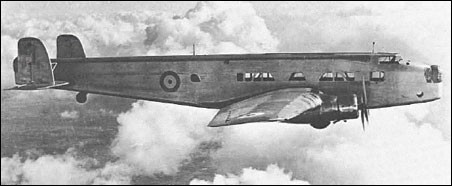
The Whitley borrowed a lot from the one-off AW23 - which was a proposed bomber/transport but which never entered production.
Just an aside regarding "nose down" flying atitudes - the B-52 also flies in a similar manner due to its wing being attached at a steep angle of incidence. In this case, this is due to the fact that the aircraft has a bicycle undercarriage and therefore cannot rotate in the more normal manner of a tricycle undercarriage aircraft. The wing is already set on the fusleage at the take off atitude.
Eric Mc said:
Just an aside regarding "nose down" flying atitudes - the B-52 also flies in a similar manner due to its wing being attached at a steep angle of incidence. In this case, this is due to the fact that the aircraft has a bicycle undercarriage and therefore cannot rotate in the more normal manner of a tricycle undercarriage aircraft. The wing is already set on the fusleage at the take off atitude.
I wonder why they didn't do something like that with the Stirling - because of the span issue they ended up with a massively tall undercarriage. I suppose the drag penalties from the fuselage not being parallel to the airflow might be a reason.
Eric Mc said:
dr_gn said:
SlipStream77 said:
This is going to be a nice model, I'm looking forward to the progress shots.
I will be interested in the paint that you choose for the underside, it can be difficult to get a good finish with white sometimes.
Halfords white plastic primer, plus the white model paint of your choice?I will be interested in the paint that you choose for the underside, it can be difficult to get a good finish with white sometimes.
I've no doubt your model will be great, but my God is it an ugly aircraft

Negative Creep said:
Eric Mc said:
dr_gn said:
SlipStream77 said:
This is going to be a nice model, I'm looking forward to the progress shots.
I will be interested in the paint that you choose for the underside, it can be difficult to get a good finish with white sometimes.
Halfords white plastic primer, plus the white model paint of your choice?I will be interested in the paint that you choose for the underside, it can be difficult to get a good finish with white sometimes.
I've no doubt your model will be great, but my God is it an ugly aircraft
They were very much hand made, these aircraft, and I think more craftsmanship went into their design than ease of mass production.
Still working on the fuselage at the moment which is pretty much covered in model filler. I wish I had an original FROG moulding rather than one of these more recent re-pops.
Still working on the fuselage at the moment which is pretty much covered in model filler. I wish I had an original FROG moulding rather than one of these more recent re-pops.
At last some progress shots. Matters have veen moving along very slowly, mainly due to work and holidays etc. Also, the model is a real b h in that EVERY joint needs filling, sanding and blending. Just look at the gaps in the wing roots. I filled them with strips of plastic card and stretched sprue. I have since added copious amounts of filletr and begun the sanding process.
Still, it's beginning to look like a Whitley.


h in that EVERY joint needs filling, sanding and blending. Just look at the gaps in the wing roots. I filled them with strips of plastic card and stretched sprue. I have since added copious amounts of filletr and begun the sanding process.Still, it's beginning to look like a Whitley.
Edited by Eric Mc on Saturday 25th June 09:12
Gassing Station | Scale Models | Top of Page | What's New | My Stuff