
I don't usually blow my own trumpet
Discussion


Thats interesting. Are you going to shorten them when you glue them back in or leave it stock.
You can take 15mm to 25mm with out changing the tourque to much in the rev range.
When i did mine i pinched the bottom of the trumpets to make then a tight fit them a rather strong locktite and they havent moved in over 6 years.
Im sure your car is going to run a lot better once your done...
Cambelt
I'm not sure about the shortening bit. I reckon I'll take a stock set and shorten them, then try it out.
The end game with the SX is maximising low-end torque as the s/c revs out at around 5300 on the engine.
I suppose a rolling road session is in order next...
Anyhoo I've glued the bugg***chimp**ers back in and we''ll see the result in the morning.
Hopefully some tyres will be tortured!
The end game with the SX is maximising low-end torque as the s/c revs out at around 5300 on the engine.
I suppose a rolling road session is in order next...
Anyhoo I've glued the bugg***chimp**ers back in and we''ll see the result in the morning.
Hopefully some tyres will be tortured!
Edited by adam quantrill on Friday 29th July 00:21
To be honest Alan I couldn't hear it above the exhaust and supercharger.
Well first impressions driving today - much more responsive, and revs properly too, up to 5k at least. I am going on a slightly longer run later so let's see what happens when it's properly hot.
Well that's sorted - long run today proved that the hot misfire has gone away too. The bit where I found the misfire kicked in when I jinked right must have been one of the trumpets moving about, drastically shortening the airway.
I think mine might be prone to the trumpets coming loose because very occasionally - about 1 start in 200 - there is a bit of unburnt fuel in the plenum and it front-fires popping off the inlet hose. This probably also loosens the trumpets.
Now I just have a slight flat spot at around 4k revs to sort out and I'll be back to full power ;^)
Edited by adam quantrill on Saturday 30th July 12:10
adam quantrill said:
I'm not sure about the shortening bit. I reckon I'll take a stock set and shorten them, then try it out.
Shortening stock trumpets does nothing...regardless of any lore to the contrary. If you want more air (aka more power) consider flared trumpets, or a machined base with bigger trumpets, coupled with a larger AFM.Edited by adam quantrill on Friday 29th July 00:21


I should imagine to pull air into the intake..The more RPM the more direct air supply..Squeezing air down a tube has the same effect as water..It becomes higher pressure..I believe thats why forced air induction gives more power...Also found this if of any use..Ziga
http://www.google.co.uk/url?sa=t&source=web&am...
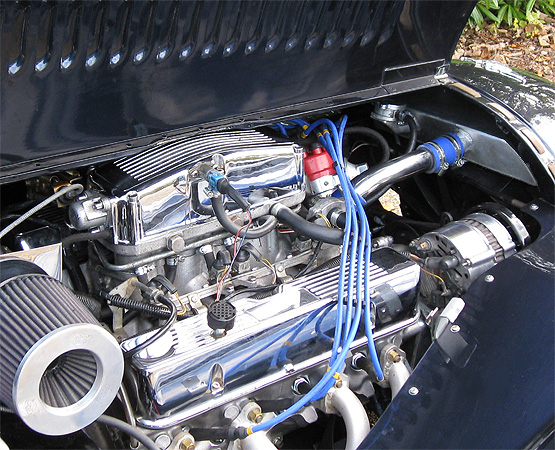
PS; I have to say.."That engine is a work of art"..
http://www.gomog.com/phoenix/enginebay.jpg
http://www.google.co.uk/url?sa=t&source=web&am...
PS; I have to say.."That engine is a work of art"..
http://www.gomog.com/phoenix/enginebay.jpg
Edited by mrzigazaga on Monday 1st August 09:50

I think the idea is so the tube going into the cylinder has a cylinder's worth of air sitting in it, and therefore the injector sticking fuel in near the bottom doesn't bleed mixture into the plenum, which would then get mixed up with the other cylinders and cause some to run too rich or lean.
Widening them does seem to be one way to go to improve the airflow.
Widening them does seem to be one way to go to improve the airflow.
The function of the trumpets is to improve low end torque. As an intake valve closes there's a pressure wave generated which travels back up the length of the trumpet at the speed of sound. This pressure wave then 'echoes' off the open trumpet end and bounces back down towards the valve - if the valve then re-opens at exactly the moment the pressure wave arrives more air is forced into the cylinder than would otherwise be the case.
The length of the trumpet determines the length of time it takes for the pressure wave to bounce back; therefore determines the engine speed that the effect is most pronounced. This is normally tuned to be around 1500 to 2500 rpm.
So... reducing the trumpet length will not affect peak power but will affect low down torque (ie the shape of the torque/power curve). Never forget that it's torque that accelerates the car not peak power, so tuning an engine on a dyno to increase peak power can (and often does) reduce low end torque and make the car slower to accelerate...
This is interesting - so what happens in a Supercharged situation where the boost means that air pressure is around 20 p.s.i and the temperature is also raised?
I would expect the speed of sound to be altered too - it would probably increase but I'd have to check my formulae.
So the resonant frequency of the tube may increase leading to a torque boost higher up? Time for some research.
I would expect the speed of sound to be altered too - it would probably increase but I'd have to check my formulae.
So the resonant frequency of the tube may increase leading to a torque boost higher up? Time for some research.


mrzigazaga said:
PS; I have to say.."That engine is a work of art"..
http://www.gomog.com/phoenix/enginebay.jpg
(BLUSH!) Thank you. That is my Plus 8 at home in Canada. We have another we keep in the UK (West Midlands).http://www.gomog.com/phoenix/enginebay.jpg
P.S. Hope you fellows don't mind me peaking into your forum. I am a nut for these engines.

P.P.S. The Hatter is spot on. Trumpets are more accurately called intake runners (but I call them "trumpets" too!). They smooth the flow of air and their length, diameter and shape is an important criteria in determining the torque and horsepower. Think of it this way, an intake system is similar to the exhaust side. They both have pressure waves which travel back and forth along their expanse. The pressure waves coming out of the intake reverse direction at the trumpet entrance. So by altering the length of the trumpets one is also changing the timing of the returning pressure pulse to the intake valve. That doesn't mean it will increase power or torque..it could very well do the opposite. I have dynoed the difference with Superflares and machined intakes with fat trumpets. Changes the torque curve.
Edited by plushuit on Tuesday 2nd August 17:31
Adam,
A supercharged engine will see some benefits from pulse tuning but as ever there's a compromise to be considered; and in the case of a boosted engine it's more important to minimise the total volume of air in the intake system than it is to optimise the tract lengths. You'll get much better throttle response with a smaller volume of air to be compressed between the supercharger and the intake valves.
The total captive air volume of the plenum and the intake trumpets is pretty huge on an RV8, the logical thing to do on a boosted RV8 is to junk the trumpets completely; put big entry raidii on the trumpet base and then make the plenum as small as possible. The throttle plate entry into the plenum would be a bit clumsy but again with a boosted engine that's not so critical.
The shape of the reduced volume plenum would be critical to get even distribution of air into the cylinders with a small pressure drop. Unfortunately guessing an ideal shape would be very hard; air behaves in very strange ways under these types of conditions. Much as I hate to admit it as a 'hands-on' engineer, computer analysis would be the best way to define the shape of the plenum.
Oh and another point; not only do the trumpets improve low end torque but they are also crucial to the sound of the engine. The trumpets are made so that each individual cylinder has the same length of inlet tract; so the sound of the engine inlet is in synch with the firing of the engine, giving the melodious wail we all love. The speed of sound is much faster than the velocity of the air rushing through the engine so when an engine's on full throttle there's often more noise coming out of the inlet system (two foot long with no silencers) than there is out of the exhaust (several yards long with silencers). The other point with inlet noise is that you can play tunes with the throttle pedal (ie the throttle plate blocks the noise at idle and part load); you can't do that with exhaust noise.
Edited by The Hatter on Wednesday 3rd August 11:17
Gassing Station | Wedges | Top of Page | What's New | My Stuff