
Mazda Rotary: Coming Back, But Not Until 2017
Mark the date in your diaries, Mazda fans...
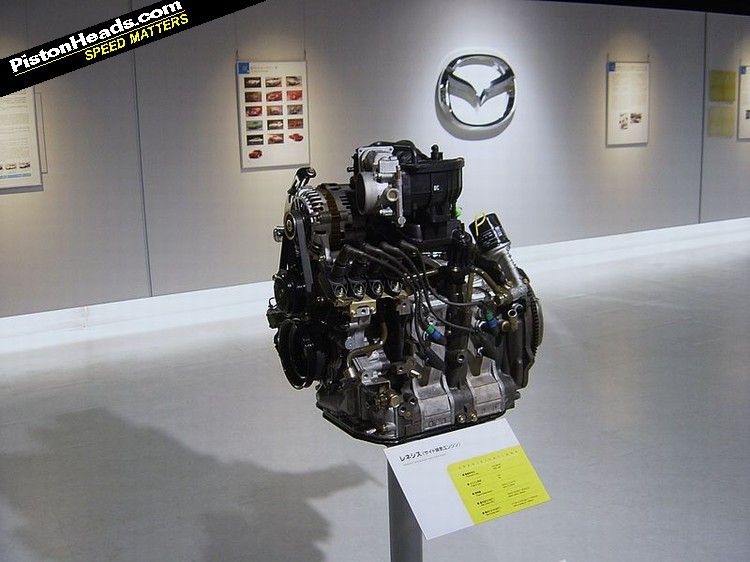
It looks like we'll have to wait a while for it, however. Mazda has been working on a successor to the RX-8's engine, dubbed the Renesis 16X, since 2007, but with no successor to the RX-8 and plenty of technical challenges to overcome, this new engine isn't likely to find a home before 2017.
Part of the solution will be a radical new ignition system, using powerful yet tiny (11mm) lasers in place of traditional spark plugs. A laser ignition system will, it is claimed, be more fuel-efficient, since it can be run leaner and the timing of the ignition can be timed more finely.
All of which sounds most interesting - it's just a shame we'll have to wait so long to see it. Mind you, 2017 is an apt moment for the rotary motor's reappearance - it will mark 50 years since the Wankel Rotary system made its debut in the NSU Ro80.
Image: Taisyo


Sometimes I wish they'd just give up the whole rotary thing and say enough is enough, time to start pouring money into mainstream engine design.
Ideally, from the point of view of combustion, an engine would have a spherical combustion chamber with the spark plug in the middle. Over-simplistic statement I know, and ignores the need for swirl, and other things. But still, it's hard to design an efficient combustion chamber in a rotary engine, hence the high fuel consumption.
Interesting piece of engineering but in the 'real world' horribly compromised. Unless they can reinvent the laws of physics I don't see how they will ever get round the inherent rotary shortcomings.
In a kit car though...hmmm.

Sometimes I wish they'd just give up the whole rotary thing and say enough is enough, time to start pouring money into mainstream engine design.

Laser damage is really all about power density.... how much energy is focused in that beam. I imagine such a system could use a simple optical element to focus the beam at a particular depth (a focusing system and galvanometers could be used to focus the beam at different depths, different locations to ensure optimum combustion).
the beam will spread out from the focus point and the power density will be much much lower before it reaches anything it can damage. Besides for most metallic surfaces you need quite a decent size laser and you need to coat the surface in a dark colour to allow the laser to couple else it its mostly reflected and scattered.
I mean we did experiments at uni using a 1.5kW infra-red CO2 laser to cut/weld 1.5mm plate.
I imagine these will be much lower power, diode or fibre lasers... they will get the required power density to get to ignition temperature by focusing the beam. Maybe they can over drive... you can for instance massively over drive an LED if you do so for only a minuscule time. like micro seconds.

At the very least sounds costly to service. Modern ignition systems are already expensive to service/replace. Ever had to replace the coil pack/wiring harness on a VW VR6? Imagine how expensive it will be when you have to replace laser tech.
Gassing Station | General Gassing | Top of Page | What's New | My Stuff