
Earthing the AFM Body - (from another thread).
Discussion


Seen on another thread.
"------ the mounting of the AFM, which in both systems is mounted on rubber bushes to isolate it electically from the vehicle body/chassis -------"
Piston Heads already discussed this very issue in June of this year.
And yes, it quite possible that an average owner/enthusiast might not notice any performance difference when driving but one has to have a BEFORE/AFTER comparison and measurements, not just a subjective opinion.
Then again, in the whole scheme of things it probably wont amount to a hill of beans anyway!
But what if - for example - the flow of air through the AFM can set up a static electrical charge in the metal body of the AFM, which, if being earthed directly to the chassis/engine, discharges and sets up a small variable offset voltage that affects the sensor signals to the ECU?
Who knows what can be the effect, except the design EXPERTS at Bosch/Lucas/Rover who decided NOT to earth the body of the AFM on the original SD1 and other Rover installations.
That is a plain fact, The AFM body was not earthed.
Personally, I don't know what the effect would be, I've never taken the opportunity to measure it, but then I'm not an expert either.
By the same token, I do take the general view that if the designers of a complex system do something that is well engineered and follows popular electronic protocols, its probably best to keep things as designed.
plushuit said:
Live and learn! Never heard of a caution against earthing the AFM.
I knew I had seen this written down somewhere - In "Tuning Rover V8" book you will find the following:"------ the mounting of the AFM, which in both systems is mounted on rubber bushes to isolate it electically from the vehicle body/chassis -------"
Piston Heads already discussed this very issue in June of this year.
And yes, it quite possible that an average owner/enthusiast might not notice any performance difference when driving but one has to have a BEFORE/AFTER comparison and measurements, not just a subjective opinion.
Then again, in the whole scheme of things it probably wont amount to a hill of beans anyway!
But what if - for example - the flow of air through the AFM can set up a static electrical charge in the metal body of the AFM, which, if being earthed directly to the chassis/engine, discharges and sets up a small variable offset voltage that affects the sensor signals to the ECU?
Who knows what can be the effect, except the design EXPERTS at Bosch/Lucas/Rover who decided NOT to earth the body of the AFM on the original SD1 and other Rover installations.
That is a plain fact, The AFM body was not earthed.
Personally, I don't know what the effect would be, I've never taken the opportunity to measure it, but then I'm not an expert either.
By the same token, I do take the general view that if the designers of a complex system do something that is well engineered and follows popular electronic protocols, its probably best to keep things as designed.
If the AFM (and casing) is properly earthed through the wiring loom back to the ECU (I haven't checked this yet) then it would be reasonable to keep it isolated from the chassis. This is because an earth to the casing would set up an earth loop, and quite high currents could flow down the AFM earth wires into the ECU, depending on the state of various earth straps, corrosion on the contacts, etc.
These currents could easily interfere with the AFM signals. I'll check a spare AFM to see if the casing is earthed through the loom.
These currents could easily interfere with the AFM signals. I'll check a spare AFM to see if the casing is earthed through the loom.
honestjohntoo said:
I knew I had seen this written down somewhere - In "Tuning Rover V8" book you will find the following:
"------ the mounting of the AFM, which in both systems is mounted on rubber bushes to isolate it electically from the vehicle body/chassis -------"
Maybe you have cut the sentance short when you have quoted it,?? but it doesn't mention about earthing on the engine. "------ the mounting of the AFM, which in both systems is mounted on rubber bushes to isolate it electically from the vehicle body/chassis -------"
Car body and chassis sometimes produce large amounts of static electricity. Shoot that into the AFM through its earth point and I can quite see where there is scope for wrong doings.
So looking at it from the other side, the AFM is just a potentiometer, there are other other PTs and electrical componants mounted on the engine which are just as important to fueling/running of the engine and they are not isolated. So maybe it is just the body/chassis it has to be seperated from
honestjohntoo said:
But what if - for example - the flow of air through the AFM can set up a static electrical charge in the metal body of the AFM, which, if being earthed directly to the chassis/engine, discharges and sets up a small variable offset voltage that affects the sensor signals to the ECU?
Fundamental flaw in that argument is that any static charge that tried to build-up on the AFM would be taken directly to earth and dissipated. There's a greater risk of static causing an issue with the case being isolated, as it would build a potential difference which would then try to find a way to earth via the internal electronics (spark jumping air gap etc.).You could equally argue that the static charge built-up on the vehicles carpets by the stockinged feet of your leggy passenger could dissipate through the ECU chassis and cause problems...
adam quantrill said:
If the AFM (and casing) is properly earthed through the wiring loom back to the ECU (I haven't checked this yet) then it would be reasonable to keep it isolated from the chassis. This is because an earth to the casing would set up an earth loop, and quite high currents could flow down the AFM earth wires into the ECU, depending on the state of various earth straps, corrosion on the contacts, etc.
These currents could easily interfere with the AFM signals. I'll check a spare AFM to see if the casing is earthed through the loom.
It's not, as I said on the other thread.These currents could easily interfere with the AFM signals. I'll check a spare AFM to see if the casing is earthed through the loom.

adam quantrill said:
If the AFM (and casing) is properly earthed through the wiring loom back to the ECU (I haven't checked this yet) then it would be reasonable to keep it isolated from the chassis. This is because an earth to the casing would set up an earth loop, and quite high currents could flow down the AFM earth wires into the ECU, depending on the state of various earth straps, corrosion on the contacts, etc. These currents could easily interfere with the AFM signals. I'll check a spare AFM to see if the casing is earthed through the loom.
This is fascinating. I had been taught that a good earth was a good earth. And more were better than one...after all, they are all to the same chassis. But now I am learning that more than one ground to the same chassis can cause an earth loop and transfer unwanted high currents from one earth to another earth and disturb AFM signals.
Wow.
P
Yeah - and the trouble with earth loops is the thicker you make the earth straps, the higher the currents can be ;^)
If the casing really is isolated from the internals (as said above) and pin 9 then there shouldn't be a problem, unless an internal fault caused the casing to get connected internally.
So we must be looking for some other explanation.... engineering like this isn't done for no reason.
I note that all the other ECU sensors are similarly isolated (floating) from engine earth, TPS, Engine Temp sensor....
adam quantrill said:
So we must be looking for some other explanation.... engineering like this isn't done for no reason.
I note that all the other ECU sensors are similarly isolated (floating) from engine earth, TPS, Engine Temp sensor....
Observations in reverse order!I note that all the other ECU sensors are similarly isolated (floating) from engine earth, TPS, Engine Temp sensor....
The common point for all the electronic Efi earths is the stud at the rear of the engine behind and below the LH rocker cover.
The ECU innards are earthed there via the Efi loom, as is one terminal - the Black/White (BW) wire - of the Coolant Temp Sensor. There are two ring connections to make this happen on the SD1 and they are seen as the two ground symbols on the LH side of this diagram. Although shown separately they go to the same place on the engine.
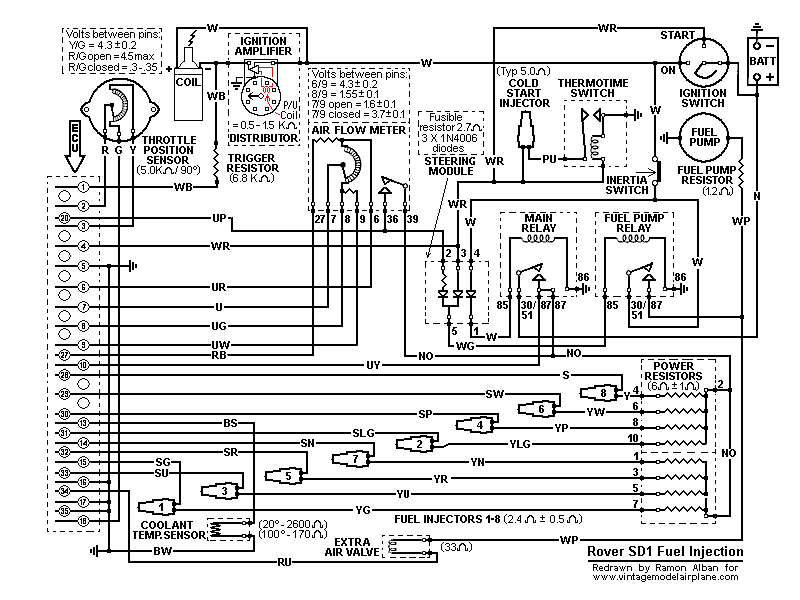
As to your first point, the explanation you are looking for may be down to the proximity of the AFM body to the HT King Lead and four Spark Plug leads where they pass en route from the Distributor to their respective destinations - at least on the SD1, perhaps also on the TVR.
As is already known with the subject of ignition "crossfiring", the cause of that phenomenon is that a current in one connector can induce a voltage (or interference) in an adjacent connector. Consequently we are are advised not to allow plug leads 5 and 7 to be adjacent en route to their plugs.
So it is equally likely that the adjacent high voltage pulses will induce interference signals into the body of the AFM, but they cannot go anywhere to create a pulsing voltage (hence interference) if the AFM Body is NOT earthed.
Perhaps in the same way that birds can alight on high voltage (pylon) transmission cables without being killed because there is no path to earth.
Like you say, engineering like this isn't done for no reason.
It's entirely feasible that the reason the AFM case isn't earthed is because it wouldn't serve any purpose. The rubber mounting would be there purely for anti-vibration purposes; the internal electronics are connected to the relevant points within the ECU and that's all it needs.
As I said, if the case was grounded, any voltage presenting itself to the case (from whatever source) would go to DC ground (effectively the case would be acting in the same way as the screen on an audio or RF cable, preventing unwanted signals from getting in or out). With the case ungrounded, any voltage high enough to start jumping gaps from the HT cables would have no problem at all jumping across to the internal circuitry as well - in which case a grounded case would have made more sense; I don't think Lucas saw it as an issue.
As I said, if the case was grounded, any voltage presenting itself to the case (from whatever source) would go to DC ground (effectively the case would be acting in the same way as the screen on an audio or RF cable, preventing unwanted signals from getting in or out). With the case ungrounded, any voltage high enough to start jumping gaps from the HT cables would have no problem at all jumping across to the internal circuitry as well - in which case a grounded case would have made more sense; I don't think Lucas saw it as an issue.
Wedg1e said:
With the case ungrounded, any voltage high enough to start jumping gaps from the HT cables would have no problem at all jumping across to the internal circuitry as well - in which case a grounded case would have made more sense; I don't think Lucas saw it as an issue.
You appear to have a misunderstanding of how induction cross-firing occurs.The phenomenon is due to induction where the charge on one conductor can induce a charge in an adjacent conductor.
It has nothing to do with sparks jumping anywhere. Neither was it suggested thataway.
By the same token induction can occur in any nearby conducting material.
This will help you.
http://www.jasperengines.com/pdf/SparkPlugCross-Fi...
Like I said, no spark jumping involved.
Edited by honestjohntoo on Tuesday 1st November 21:23
Wedg1e said:
I don't think Lucas saw it as an issue.
Neither did BMW, Alpha Romeo or any of the companies using the L-Jetronic. In fact, even Bosch makes no mention of it in any of their manuals. Try this. Test the continuity between the AFM body and any known chassis earth you want..engine, frame, anything.
honestjohntoo said:
You appear to have a misunderstanding of how induction cross-firing occurs.
I really don't know how I've made money for thirty years in electronics, I guess I'll never make it as a lecturer though. If Lucas had thought that enough current could be induced to cause a problem, whether by close-coupling of conductors (I think that's what you meant when you said connectors earlier) or by the air rushing through the meter, they'd have earthed the AFM case to form a Faraday cage to prevent it. Equally, if that much current could be induced in the case, it could as well be induced in the adjacent wiring loom which would then have to be run in a braided screen connected to ground. It's not. So there would appear to not be a problem. Is that clear enough?honestjohntoo said:
I knew I had seen this written down somewhere - In "Tuning Rover V8" book you will find the following:
"------ the mounting of the AFM, which in both systems is mounted on rubber bushes to isolate it electically from the vehicle body/chassis -------"
Egawd! You are not referring to Hardcastle??!!.(P117) "------ the mounting of the AFM, which in both systems is mounted on rubber bushes to isolate it electically from the vehicle body/chassis -------"
 He seems like a nice enough reporter-type but his mechanical expertise and hands on experience is non-existent. Believe me, many of the guys he interviewed for his books are still trying to live it down. Why not read Bosch literature, they are the people who designed the system and made its components (specifically this AFM!)?
I do not have the deep faith in Lucas that you do. They often did things they never completely understood..citing "just in case" to themselves as a reason. For example, in this case Bosch recommends that the AFM be cushioned from the effects of vibration to the AFM. That also isolated electrically from an earth. Best to provide one through the plug.
An earth is and earth is an earth. The AFM (which sends its signals in ohms aka resistance) needs to be earthed. It is earthed through the 'puter. If it has a second earth directly from the AFM body would seem to be irrelevant as my long trouble-free mileage in two cars shows.
I also have two earths from the engine to the chassis for the last 15 years...(like so many cars do these days).
P
Gassing Station | Wedges | Top of Page | What's New | My Stuff