
Handling wise - long or short wheel base?
Discussion


What do people think would be a better or preferred setup for a sporting road car (2 seater)?
Option 1:
Total length of 162" with a wheelbase of 95"
Option 2:
Total length of 162" with a wheelbase of 85"
Both vehicles weigh the same (1050kg) and use the same weight engine/gearbox (2.o I4 and 5 speeder with 160hp). They also are the same height (50"), width (65.5") with the same track f/r (55"), and have the same size and type of wheels/tyres. They also use exactly the same suspension, MacPherson front and IRS rear. The vehicle is RWD with a longitudinally mounted engine.
For arguments sake lets say the only differences would be the wheelbase and the overhangs.
Bad drawing to show idea:
Updated pictures to try and add a bit more detail and specifics.
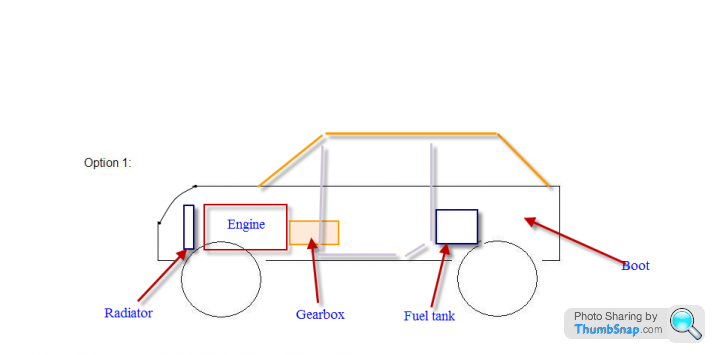
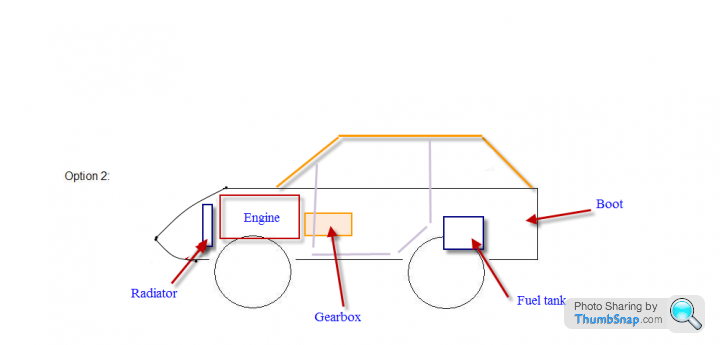
Option 1:
Total length of 162" with a wheelbase of 95"
Option 2:
Total length of 162" with a wheelbase of 85"
Both vehicles weigh the same (1050kg) and use the same weight engine/gearbox (2.o I4 and 5 speeder with 160hp). They also are the same height (50"), width (65.5") with the same track f/r (55"), and have the same size and type of wheels/tyres. They also use exactly the same suspension, MacPherson front and IRS rear. The vehicle is RWD with a longitudinally mounted engine.
For arguments sake lets say the only differences would be the wheelbase and the overhangs.
Bad drawing to show idea:
Updated pictures to try and add a bit more detail and specifics.
Edited by 300bhp/ton on Friday 4th November 09:16
Yes, if the length is fixed, the shorter wheelbase can only mean longer overhangs.
If you have overhang it means weight that will impact turn in (on the front anyway) - Sure someone will explain the physics I don't have a clue
If you can shorten the car overall, then the question is whether you want something nimble and quick at direction change or something stable on the sweeping bends (generally speaking).
M
PS You'll also find the front spoiler will scrape on the ground! Biggest problem with the Mk1 Octavia, which otherwise manages its overhang fairly well...
If you have overhang it means weight that will impact turn in (on the front anyway) - Sure someone will explain the physics I don't have a clue
If you can shorten the car overall, then the question is whether you want something nimble and quick at direction change or something stable on the sweeping bends (generally speaking).
M
PS You'll also find the front spoiler will scrape on the ground! Biggest problem with the Mk1 Octavia, which otherwise manages its overhang fairly well...
Edited by marcosgt on Thursday 3rd November 15:44
Snowboy said:
I'd agree with this.
That said – it would depend on the car.
An E type is supposed to handle well and the bodywork overhangs more than a Edwardian ball gown.
That's partly my thinking, many 60's cars/designs often cited for great handling and feel had fairly large overhangs.That said – it would depend on the car.
An E type is supposed to handle well and the bodywork overhangs more than a Edwardian ball gown.
Many modern cars today don't in a stark comparison.

Snowboy said:
Liquid Knight said:
A wheel in the corners would in my opinion handle better than a square platform with overhangs.
I'd agree with this.That said – it would depend on the car.
An E type is supposed to handle well and the bodywork overhangs more than a Edwardian ball gown.
The long wheelbase picture looks like an MR2, X-1/9 or Stratos set up the short wheelbase looks like a Fiat 600 camper van and would handle accordingly.

Did you add the engines later?
That's your answer (or maybe MY answer ) there. With the long wheelbase the weight of the engine is inside the wheelbase, with the short more is over and ahead of the wheels causing understeer.
An old Audi coupe (like the Quattro) is a prime example of the short wheelbase, long overhang with the engine out ahead of the front wheels.
Few would claim a Quattro derived its superiority on rally stages to its format, although to stay competitive they shortened the wheelbase, presumably to make it repond to direction changes more quickly (and save a bit of weight too perhaps?).
M
That's your answer (or maybe MY answer
) there. With the long wheelbase the weight of the engine is inside the wheelbase, with the short more is over and ahead of the wheels causing understeer.An old Audi coupe (like the Quattro) is a prime example of the short wheelbase, long overhang with the engine out ahead of the front wheels.
Few would claim a Quattro derived its superiority on rally stages to its format, although to stay competitive they shortened the wheelbase, presumably to make it repond to direction changes more quickly (and save a bit of weight too perhaps?).
M
I always thought it was a longer wheel bass gave you higher stability at speed, shorter wheel bass made the car more maneuverable (at the expense of it being more difficult). I cite the WRC program i watched years ago discussing the Impreza WRC vs the 206 WRC and why the 206 was so successful.
I dont think overhangs are a major problem as long as there isnt much weight in there (i.e. mainly plastic bumpers).
I dont think overhangs are a major problem as long as there isnt much weight in there (i.e. mainly plastic bumpers).
I'm saying option A, but for a slightly different reason to the other replies I have read.
In diagram A, the engine is mounted behind the front axle, so think latest MX-5 and RX-8, both cars which have 50/50 weight distribution, due in the main to the engine being mounted as far back in the chassis as possible
Then think about the Audi RS4, a car that when reviewed is normally noted to be prone to understeer, a trait which is normally put down to the fact that engine is so far ahead of the front axle....
Then you have the Porsche 911, a car that is suppossed to be tricky on the limit, as its engine is so far behind the rear axle....
Or something like that anyway.
In diagram A, the engine is mounted behind the front axle, so think latest MX-5 and RX-8, both cars which have 50/50 weight distribution, due in the main to the engine being mounted as far back in the chassis as possible
Then think about the Audi RS4, a car that when reviewed is normally noted to be prone to understeer, a trait which is normally put down to the fact that engine is so far ahead of the front axle....
Then you have the Porsche 911, a car that is suppossed to be tricky on the limit, as its engine is so far behind the rear axle....
Or something like that anyway.
Overhangs don't necessarily mean much if there's not much weight in them.
The biggest problem I see with drawing number 2 is the position of the engine in relation to the front axle line.
Apart from that it's as outlined above - short wheelbase for low-speed corner agility, long wheelbase for straight line/high speed corner stability. Basically.
The biggest problem I see with drawing number 2 is the position of the engine in relation to the front axle line.
Apart from that it's as outlined above - short wheelbase for low-speed corner agility, long wheelbase for straight line/high speed corner stability. Basically.
Gassing Station | General Gassing | Top of Page | What's New | My Stuff