
100 million small block V8's
Discussion


That's how many GM has built in the last 56 years.
http://www.autoblog.com/2011/11/29/gm-marks-100-mi...
Still the best engine in the world... long may it continue to be built.
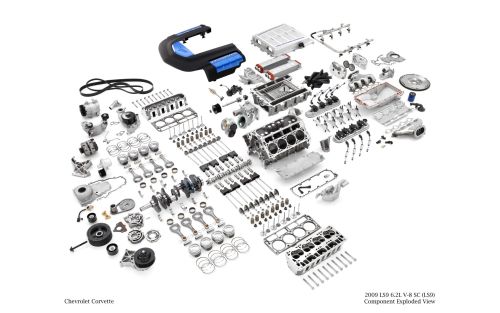
The 100 millionth engine will be an LS9 with 638 horsepower
http://www.autoblog.com/2011/11/29/gm-marks-100-mi...
Still the best engine in the world... long may it continue to be built.
The 100 millionth engine will be an LS9 with 638 horsepower




Finlandia said:
williamp said:
yes well done. Shame it still has pushrods and rockers. Still old-tech
If it aint broken, don't try to fix it 
williamp said:
Yes I know. The same idea Porshce does with the engine location in the 911. But if you were start6ing afresh, you wouldnt start with an engine back there. And ou would start again with pushrods
There must be some version of Godwin's Law for this, "As an online discussion grows longer, the probability of someone claiming the 911 has its engine in the 'wrong' place approaches 1."williamp said:
yes well done. Shame it still has pushrods and rockers. Still old-tech
How about considering this as a bit of de-evolution. Let’s assume we are designing a brand new spiffing V8 engine, and we want maybe 400-500bhp and maybe more in the future. We naturally want to put on 2 x 16 valve heads and twin cams. Immediately we’ve got a big tall and wide engine that won’t fit below a low bonnet line. I have just such a motor in the Masser (4.2, quad cam, 420bhp), and they’ve done a pretty good job of disguising the bonnet bulge but it’s not exactly a low car. But our new engine will be OK in saloons with a deep-ish bonnet; or sporty cars when stuck in the back – but we wouldn’t get our quad cam motor under the bonnet of say a Corvette without a far bigger bulge. But I digress – we’re designing this new engine…
Twin cams sitting right over the valves is nice and simple, and if we use bucket and shims to adjust clearances then the only reciprocating mass is the valve, part of the spring and the bucket and shim. So high revs are our friend
 No wonder it’s used on motorcycles that will rev to 12000 plus.
 But of course we’re building a big motor, and the limitation will be the lumps of metal flying about at the bottom end, not the valves. So if we limit the revs to 7500rpm say, then that particular ‘advantage’ of quad cams goes…so all we have left is simplicity with few moving parts – but the costs associated with 4 cams, 32 valves, long chains or belts or gears – and PITA setting valve clearances.
OK, so if we don’t need the high rev-ability we probably instead want some real radical cam profile. Oh yes. Only we’re limited by the cam acting directly on the bucket. There comes a point where the can profile cannot be any more aggressive as the lobe would just ‘slap’ on the bucket/follower, and of course the maximum valve lift is limited by the height of the cam lobe. So let’s add a rocker or finger follower (and not the chocolate TVR S6 ones
 ). Then if we run a roller or a small contact point on the cam we can go much more aggressive on opening and closing. We can build in a leverage ratio like 1.6:1 – so for ever mm on the cam lobe the valve opens 1.6mm. This is better now on the big engine – great breathing, and easier valve adjustment too as we can but an adjuster on the rocker/follower. This motor is getting better already with just a bit of development
 But if we’re using rockers/followers, why do we actually need 2 cams at all per head? Why not just run the same cam profile off one cam – we’ve lost absolutely nothing in performance terms but made the whole thing simpler. Let's do it.
Should we keep the 4-valve heads? Well they’ve all very efficient and all that, but with our big motor we don’t actually lose much by just living with 2 valve heads; we’ve capacity to spare. If we’re down say 30BHP, then let’s just add another 500cc to the design – no-one’s counting and it will be cheaper and simpler. OK, lets keep it simple - drop 8 valves in total and put in a few more cubes. Motor will drive nicer too with all that bottom-end grunt. I'm starting to like this engine we're designing.
But wait – if we could run 16 valves in a single head off a single can, I wonder if we could run 16 valves across 2 heads from a single cam? That would be a real neat solution, but where would be put the cam? It’d have to be between the heads somewhere – wait, I have it! If we put it in the block at the base of the V, it’s real close to the crank so all the drive problems for the cam go at once; and it makes the oil feed easier too.
So now we’ve got a cam in the block with roller followers going up and down, and the end of a rocker in the heads maybe 6 inches above that also wants to go up and down. How could we connect them?
I know – a light strong hollow rod, and if we make the ends spherical to fit into spherical cups then there can be no possibility of side loads – hey this rod thingy is going to be pretty robust.
And we’ve just solved our packaging problems as the motor is a whole lot shorter, narrower and lighter. Hey, this thing will fit under even the lowest bonnet line - count me in for one.
Yup I think we’ll go with this ‘ideal’ motor – 6 litres or so, cam in block, rock….oh wait, Chevrolet’s done it already.

Gassing Station | General Gassing | Top of Page | What's New | My Stuff