
Electric brake vacuum pump?
Discussion


Can anyone point me at a make/model that uses an electric vacuum pump for the brakes?
Background...we have a car with very low vacuum due to (A)the idle air valve is passing lots of air (B)the engine has a performance cam.
If we run a pipe from another car we can get the servo working but are not able to test if this has actually solved the braking issue. (we discounted the idea of a 'formation test drive' but it is still on the 'Plan B' list).
If I can pick one up from the breakers we can prove the principle and justify the expense of buying a nice new shinny one.
Many thanks
Steve
Background...we have a car with very low vacuum due to (A)the idle air valve is passing lots of air (B)the engine has a performance cam.
If we run a pipe from another car we can get the servo working but are not able to test if this has actually solved the braking issue. (we discounted the idea of a 'formation test drive' but it is still on the 'Plan B' list).
If I can pick one up from the breakers we can prove the principle and justify the expense of buying a nice new shinny one.
Many thanks
Steve
you are going to struggle a little with this one, as no car i know of uses a low voltage electric vaccuum pump (due to the possible safety issue with any failure of said pump) Most modern cars use a mechanical vane pump (usualy driven by the cam shaft, or from a FEAD belt etc). (these pumps are a PITA to use on another engine as they often require an oil pressure feed and drain to lubricate them (although they would work for a short period test if you greased it up initally)
The Eco mod'ers fit 12v vaccuum pumps designed for trailer brake systems etc, but these are quite expensive to buy.
Best bet imo, would be to buy a cheap 240v vaccuum pump on ebay, and use a 12v to 240v inverter to drive it for a trial run in the car etc.
You might also be able to bodge something using a P38/Disco2 air suspension pump (availible for about £50 on ebay). These would not be able to keep up with the flow requirements of multiple fast brake applications (so are not a permanent solution) but it would prove that the "lack of vaccuum" is the issue etc
The Eco mod'ers fit 12v vaccuum pumps designed for trailer brake systems etc, but these are quite expensive to buy.
Best bet imo, would be to buy a cheap 240v vaccuum pump on ebay, and use a 12v to 240v inverter to drive it for a trial run in the car etc.
You might also be able to bodge something using a P38/Disco2 air suspension pump (availible for about £50 on ebay). These would not be able to keep up with the flow requirements of multiple fast brake applications (so are not a permanent solution) but it would prove that the "lack of vaccuum" is the issue etc
This one is looking a possibility unless someone can tell me that it is incorrectly described.
http://www.ebay.co.uk/itm/BMW-E93-M3-3-SERIES-POWE...
Steve
http://www.ebay.co.uk/itm/BMW-E93-M3-3-SERIES-POWE...
Steve
http://bmwfans.info/parts/catalog/E93/Cabrio/Europ...
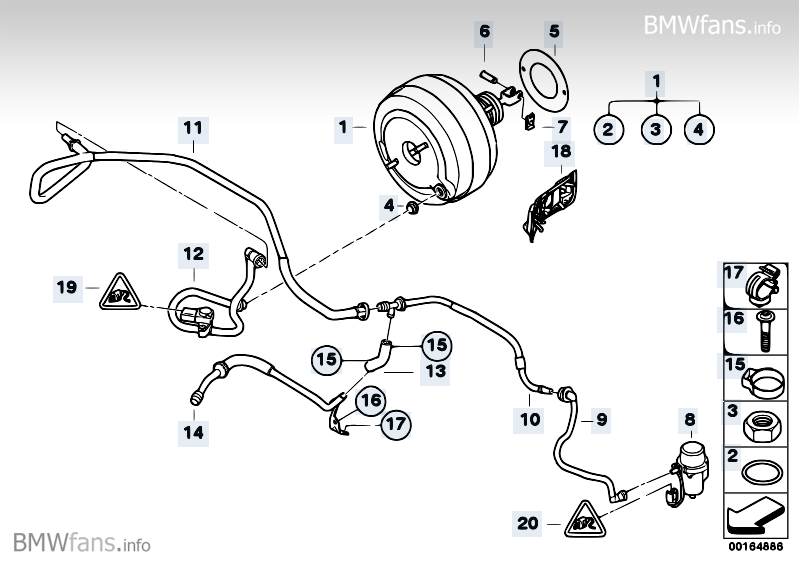
Number 8.
Seems like a vacuum pump to me.
Steve
Number 8.
Seems like a vacuum pump to me.
Steve
Steve_D said:
This one is looking a possibility unless someone can tell me that it is incorrectly described.
http://www.ebay.co.uk/itm/BMW-E93-M3-3-SERIES-POWE...
Steve
http://www.ebay.co.uk/itm/BMW-E93-M3-3-SERIES-POWE...
Steve
Steve_D said:
Can anyone point me at a make/model that uses an electric vacuum pump for the brakes?
Background...we have a car with very low vacuum due to (A)the idle air valve is passing lots of air (B)the engine has a performance cam.
If we run a pipe from another car we can get the servo working but are not able to test if this has actually solved the braking issue. (we discounted the idea of a 'formation test drive' but it is still on the 'Plan B' list).
If I can pick one up from the breakers we can prove the principle and justify the expense of buying a nice new shinny one.
Many thanks
Steve
What car is it ? Could you fit a Sierra style electric booster ?Background...we have a car with very low vacuum due to (A)the idle air valve is passing lots of air (B)the engine has a performance cam.
If we run a pipe from another car we can get the servo working but are not able to test if this has actually solved the braking issue. (we discounted the idea of a 'formation test drive' but it is still on the 'Plan B' list).
If I can pick one up from the breakers we can prove the principle and justify the expense of buying a nice new shinny one.
Many thanks
Steve
stevieturbo said:
What car is it ? Could you fit a Sierra style electric booster ?
It's a very early kitcar with a mix of different brake components. The major parts fitted should work without the servo and just result in a heavy pedal effort but that seems not to be the case.We may still need to change the master cylinder size to improve the ratio but for now we need to resolve the servo not working due to lack of vacuum.
It looks like that pump should work.
What arrangement does the Sierra have then as i've not seen that? Do you have any links?
Steve
I don't get this problem at all. Whether the air goes through the idle air valve or the butterfly makes not a jot of difference to the actual mass airflow further downstream in the manifold at a given rpm/load and I've never seen an engine with a performance cam that couldn't operate a brake servo.
I suggest your mix of components and/or where they are plumbed in is the problem and you'd do better to sort the underlying issues out properly than try and reinvent the wheel.
I suggest your mix of components and/or where they are plumbed in is the problem and you'd do better to sort the underlying issues out properly than try and reinvent the wheel.
Pumaracing said:
I don't get this problem at all. Whether the air goes through the idle air valve or the butterfly makes not a jot of difference to the actual mass airflow further downstream in the manifold at a given rpm/load and I've never seen an engine with a performance cam that couldn't operate a brake servo.
I suggest your mix of components and/or where they are plumbed in is the problem and you'd do better to sort the underlying issues out properly than try and reinvent the wheel.
As I have already said having a working servo or not the brakes should work better than they do so there is still perhaps an underlying issue with the master cylinder size/ratio.I suggest your mix of components and/or where they are plumbed in is the problem and you'd do better to sort the underlying issues out properly than try and reinvent the wheel.
With the current setup the servo does not work but give it a vacuum source from another car and it appears to work fine but it has not been possible to road test this.
The Vacuum is being provided by a 1.8 K series, non VVC (purportedly 190BHP) A pipe is connected to two ports on the inlet. The other end of the pipe has the Idle Air Valve the servo it tee'd from this pipe. If you block the idle valve there is still not enough vacuum to operate the servo.
Steve
Steve_D said:
As I have already said having a working servo or not the brakes should work better than they do so there is still perhaps an underlying issue with the master cylinder size/ratio.
With the current setup the servo does not work but give it a vacuum source from another car and it appears to work fine but it has not been possible to road test this.
The Vacuum is being provided by a 1.8 K series, non VVC (purportedly 190BHP) A pipe is connected to two ports on the inlet. The other end of the pipe has the Idle Air Valve the servo it tee'd from this pipe.
I can't parse this last sentence in any meaningful way. Are you actually saying the idle air valve is tee'd into the same pipe that feeds the servo? So the servo is basically tee'd to fresh air? No frigging wonder there's no vacuum.With the current setup the servo does not work but give it a vacuum source from another car and it appears to work fine but it has not been possible to road test this.
The Vacuum is being provided by a 1.8 K series, non VVC (purportedly 190BHP) A pipe is connected to two ports on the inlet. The other end of the pipe has the Idle Air Valve the servo it tee'd from this pipe.
The idle air valve should connect from just upstream to just downstream of the butterfly so it bypasses it with whatever amount of idle air is needed. The servo should tee into the manifold runners as close to the head as possible. Ideally with a hot cam, highly tuned engine tee into all 4 runners although usually 2 that don't fire consecutively will do.
Steve_D said:
If you block the idle valve there is still not enough vacuum to operate the servo.
Steve
Steve
Pumaracing said:
I can't parse this last sentence in any meaningful way. Are you actually saying the idle air valve is tee'd into the same pipe that feeds the servo? So the servo is basically tee'd to fresh air? No frigging wonder there's no vacuum.
Pipe starts at the manifold close to the head. The throttle bodies are paired so the pipe is teed into each pair. The pipe then runs forward and terminates at the IAV. The servo is teed off half way down the pipe.Pumaracing said:
The idle air valve should connect from just upstream to just downstream of the butterfly so it bypasses it with whatever amount of idle air is needed. The servo should tee into the manifold runners as close to the head as possible. Ideally with a hot cam, highly tuned engine tee into all 4 runners although usually 2 that don't fire consecutively will do.
If we ignore the IAV for the moment the servo is in effect connected as you say feeding off all 4 runners and close to the head. If you block the IAV completely there is still not enough vacuum.Question...the engine requires X amount of air at idle. Would there be any benefit in opening the butterflys a little and reducing the amount the IAV passes? Can't see that it would myself.
Steve
Not my photo, but you can see a guy fitting one here. Quite a few people use them. Just some minor wiring involved to power the electric booster pump. You'll have seen this on pretty much any old Sierra or granada/scorpio that had ABS, so they should be plentiful
http://passionford.com/forum/restorations-rebuilds...
And some more here
http://passionford.com/forum/restorations-rebuilds...
http://passionford.com/forum/restorations-rebuilds...
And some more here
http://passionford.com/forum/restorations-rebuilds...
The issue is not one of massflow, but the throttle restriction required to provide a sufficient mass flow to produce enough torque to allow the engine to idle. With a "hot" cam, its design is optimised to provide a high manifold volumetric efficiency at high rpm, hence, at very low rpm (like idle) the ability of each cylinder to ingest the necessary volume of air will be limited. Therefore, in order to provide enough massflow to make sufficient torque to idle the engine, the throttle plates must be opened further to increase the intake air charge density. This of course reduces the post throttle manifold depression.
You might find that checking what the idle ignition angle is and perhaps advancing it a bit could help. (if the idle ignition is not very optimium, you need more air (and hence less vaccuum) to provide the necessary torque. In either case it is irrelevant whether the air is sourced to the runner via the throttle plates or the idle air valve.
You might find that checking what the idle ignition angle is and perhaps advancing it a bit could help. (if the idle ignition is not very optimium, you need more air (and hence less vaccuum) to provide the necessary torque. In either case it is irrelevant whether the air is sourced to the runner via the throttle plates or the idle air valve.
Steve_D said:
Pumaracing said:
I can't parse this last sentence in any meaningful way. Are you actually saying the idle air valve is tee'd into the same pipe that feeds the servo? So the servo is basically tee'd to fresh air? No frigging wonder there's no vacuum.
Pipe starts at the manifold close to the head. The throttle bodies are paired so the pipe is teed into each pair. The pipe then runs forward and terminates at the IAV. The servo is teed off half way down the pipe.Gassing Station | Engines & Drivetrain | Top of Page | What's New | My Stuff