
Prolonging battery life
Discussion


I haven't been out in her for nearly 2 weeks now and am concerned about the battery running dead.
I don't want to drive in this weather, I tried last year in the snow and wasn't a nice experience. Couldn't get the car back in the garage and had to leave her on the street (uninsured!)
Anyway, is there anything I can do to prolong the battery? Would leaving the car unlocked help? Or maybe take out a fuse?
The read out in the dash is showing the battery is at 11.7 volts. How low can it go before the battery won't turn the engine over?
I don't want to drive in this weather, I tried last year in the snow and wasn't a nice experience. Couldn't get the car back in the garage and had to leave her on the street (uninsured!)
Anyway, is there anything I can do to prolong the battery? Would leaving the car unlocked help? Or maybe take out a fuse?
The read out in the dash is showing the battery is at 11.7 volts. How low can it go before the battery won't turn the engine over?
In my experience, once you get down near 11.1/11.2 volts, it will turn over for one attempt to start. If it doesn't catch and fire up, that's your lot till you get the battery charged.
Get a conditioner and an extension cable... I leave mine plugged in on the drive if I know I won't drive it for two weeks or more.
Get a conditioner and an extension cable... I leave mine plugged in on the drive if I know I won't drive it for two weeks or more.
The car lives in a garage en block about 30meters away from my house so an extension cable isn't really practical.
My garage is really tight and have to park really close to walk on the passanger side just to get out. So can't take the wheel off to get to the battery.
Would leaving the car unlocked in the garage not prolong the battery life as the alarm won't be activated and might save some juice?
My garage is really tight and have to park really close to walk on the passanger side just to get out. So can't take the wheel off to get to the battery.
Would leaving the car unlocked in the garage not prolong the battery life as the alarm won't be activated and might save some juice?
For all those that use their TVR infrequently but have no mains power supply, I hope this helps?
First off, we need to accept all cars have parasitic drains to one degree or another & TVR's do seem to be worse than most.
Essentially you have three options.
1) Locate the parasitic drain and try to minimise it
In an ideal world this is clearly the best approach, but in reality it's not really practical
2) Completely remove the drain by disconnecting the battery
Probably your best option, a completely disconnected fully charged battery in good condition will retain enough power to still start the car after 6 months
3) Forget locating the drain & replace whats lost by using some sort of charging device
Easy if you have a mains power supply but a little more involved if you don't
A belt and braces approach would be a combination of options 2 & 3.
Looking at disconnecting the battery, you basically have two choices.
A) Mechanical disconnection ie a physical switch like this

A battery master switch is a completely foolproof way of eliminating the drain on your battery but fitting it in an accessible location on a TVR can be a challenge.
If you want to lock the car where you leave it then obviously you will need to do so before disconnecting the battery.
Your battery master switch will therefore need to be located somewhere thats accessible after the doors have been locked.
Some choose an under bonnet location but you will need to make sure the bonnet is not on the latch so you can get to your master switch when returning to the car.
B) A device that either disconnects the battery automatically or offers disconnection via an infra red remote control
The PriorityStart device will automatically disconnect the battery when the voltage falls to a given level so you will always retain enough power in the battery to start the car.

The PriorityStart works well but if you want to lock the car you need to be aware you will get locked out when the battery is disconnected.
To reconnect the battery a PriorityStart unit must detect a spike in battery demand, this is normally provided by putting your foot on the brake pedal to activate the brake lights.
If you cant get in the car to create such a spike the battery will remain disconnected, & with the battery disconnected you cant get in the car. Catch 22!
So if you need to lock the car when you leave it, the solution is to forget the PriorityStart and fit a BatteryBrain.

BatteryBrain offer a range of models with different methods of activation & deactivation, the one you need is the BatteryBrain Gold model.
Just like the PriorityStart the BatteryBrain Gold offers automatic disconnection when the voltage falls to a given level, but also gives you two remote controls.
Using the infra red remote control you have the option to disconnect & reconnect the battery from outside the car.
So the technique should be:
Assuming your battery is in good condition and was in a fully charged state when you activated the BatteryBrain, you should have no problem starting the car as much as 6 months later.
Just remember when you disconnect the battery certain settings will be lost, in my case (Chimaera) this is no more irksome than resetting the clock and Aux function on the stereo.
In a "T" car with a pod this could be more of an issue?
If you do want to provide a maintenance charge to your battery but have no mains power supply your only practical & cost effective option is a solar panel.
This is a whole topic on it's own but put simply you will need a panel that is rated at 20w as a minimum, you will also need a charge controller.
Everything you need to set up your own effective solar maintenance charging system is available for from Ebay for about £50.00.
Just make sure you don't waste your money on a panel of a lower rating of 20w, it simply wont generate enough amps to keep up with the drain.
I hope this helps, believe me with no mains power at my council garage I have suffered this problem myself.
There are good solutions out there, but it took me a while to settle on the best options.
I now have a BatteryBrain and a 20w solar panel maintaining a fully disconnected battery through a decent charge controller, so I now know my Chimaera will always start even after a very extended period of inactivity.
However, the truth is the real solution is to drive the car more frequently.
After all driving the thing is why we all bought a TVR
First off, we need to accept all cars have parasitic drains to one degree or another & TVR's do seem to be worse than most.
Essentially you have three options.
1) Locate the parasitic drain and try to minimise it
In an ideal world this is clearly the best approach, but in reality it's not really practical
2) Completely remove the drain by disconnecting the battery
Probably your best option, a completely disconnected fully charged battery in good condition will retain enough power to still start the car after 6 months
3) Forget locating the drain & replace whats lost by using some sort of charging device
Easy if you have a mains power supply but a little more involved if you don't
A belt and braces approach would be a combination of options 2 & 3.
Looking at disconnecting the battery, you basically have two choices.
A) Mechanical disconnection ie a physical switch like this
A battery master switch is a completely foolproof way of eliminating the drain on your battery but fitting it in an accessible location on a TVR can be a challenge.
If you want to lock the car where you leave it then obviously you will need to do so before disconnecting the battery.
Your battery master switch will therefore need to be located somewhere thats accessible after the doors have been locked.
Some choose an under bonnet location but you will need to make sure the bonnet is not on the latch so you can get to your master switch when returning to the car.
B) A device that either disconnects the battery automatically or offers disconnection via an infra red remote control
The PriorityStart device will automatically disconnect the battery when the voltage falls to a given level so you will always retain enough power in the battery to start the car.
The PriorityStart works well but if you want to lock the car you need to be aware you will get locked out when the battery is disconnected.
To reconnect the battery a PriorityStart unit must detect a spike in battery demand, this is normally provided by putting your foot on the brake pedal to activate the brake lights.
If you cant get in the car to create such a spike the battery will remain disconnected, & with the battery disconnected you cant get in the car. Catch 22!
So if you need to lock the car when you leave it, the solution is to forget the PriorityStart and fit a BatteryBrain.
BatteryBrain offer a range of models with different methods of activation & deactivation, the one you need is the BatteryBrain Gold model.
Just like the PriorityStart the BatteryBrain Gold offers automatic disconnection when the voltage falls to a given level, but also gives you two remote controls.
Using the infra red remote control you have the option to disconnect & reconnect the battery from outside the car.
So the technique should be:
- Park up and lock the car as normal
- With the car safely locked use the BatteryBrain remote to disconnect the battery
- When returning to the car use the BatteryBrain remote to reconnect the battery
- Then with the battery now reconnected you can simply unlock the car as normal
Assuming your battery is in good condition and was in a fully charged state when you activated the BatteryBrain, you should have no problem starting the car as much as 6 months later.
Just remember when you disconnect the battery certain settings will be lost, in my case (Chimaera) this is no more irksome than resetting the clock and Aux function on the stereo.
In a "T" car with a pod this could be more of an issue?
If you do want to provide a maintenance charge to your battery but have no mains power supply your only practical & cost effective option is a solar panel.
This is a whole topic on it's own but put simply you will need a panel that is rated at 20w as a minimum, you will also need a charge controller.
Everything you need to set up your own effective solar maintenance charging system is available for from Ebay for about £50.00.
Just make sure you don't waste your money on a panel of a lower rating of 20w, it simply wont generate enough amps to keep up with the drain.
I hope this helps, believe me with no mains power at my council garage I have suffered this problem myself.
There are good solutions out there, but it took me a while to settle on the best options.
I now have a BatteryBrain and a 20w solar panel maintaining a fully disconnected battery through a decent charge controller, so I now know my Chimaera will always start even after a very extended period of inactivity.
However, the truth is the real solution is to drive the car more frequently.
After all driving the thing is why we all bought a TVR
Thanks for that chimpandtonic, some good suggestions there and food for thought.
The battery brain sounds like my best option. I wouldn't need it all the time and the TVR is my only car so usually gets driven at least once a week. It's only when we have bad weather like recently when she stays couped up.
It doesn't help me at the minute, maybe I'll just have to take her out for a careful drive at the weekend to re-charge the battery.
I'm not sure if it'll work but could I connect a fully charged spare battery via the cigarette socket, would extra juice in the spare battery trickle down to the car battery? Hope that makes sense?
The battery brain sounds like my best option. I wouldn't need it all the time and the TVR is my only car so usually gets driven at least once a week. It's only when we have bad weather like recently when she stays couped up.
It doesn't help me at the minute, maybe I'll just have to take her out for a careful drive at the weekend to re-charge the battery.
I'm not sure if it'll work but could I connect a fully charged spare battery via the cigarette socket, would extra juice in the spare battery trickle down to the car battery? Hope that makes sense?
Diablos-666 said:
Thanks for that chimpandtonic, some good suggestions there and food for thought.
The battery brain sounds like my best option. I wouldn't need it all the time and the TVR is my only car so usually gets driven at least once a week. It's only when we have bad weather like recently when she stays couped up.
It doesn't help me at the minute, maybe I'll just have to take her out for a careful drive at the weekend to re-charge the battery.
I'm not sure if it'll work but could I connect a fully charged spare battery via the cigarette socket, would extra juice in the spare battery trickle down to the car battery? Hope that makes sense?
Options to get you started.The battery brain sounds like my best option. I wouldn't need it all the time and the TVR is my only car so usually gets driven at least once a week. It's only when we have bad weather like recently when she stays couped up.
It doesn't help me at the minute, maybe I'll just have to take her out for a careful drive at the weekend to re-charge the battery.
I'm not sure if it'll work but could I connect a fully charged spare battery via the cigarette socket, would extra juice in the spare battery trickle down to the car battery? Hope that makes sense?
1) Get someone to bump start you
2) Get someone with some jump leads and a working car to offer you a jump start (not a pathetic Smart car or Prius, try and find someone with a Diesel or 4x4)
3) Buy a power pack (you need one rated at 400 amps or more) & use it to jump start the car yourself
4) Remove the battery, bring it inside and charge it using a decent mains charger
Option 4 is the most hassle, but it's also by far the best option & kindest on your battery.
Jumping or bumping the car into life can cause spike in the current supplying the ECU with expensive consequences.
Bumping the car into life can also introduce significant amounts of unburnt fuel into the exhaust with disaterous consequences for the catalytic converters.
Once started from a jump or bump start you are strongly advised to take the car for a 30 minute drive at reasonable speed to bring the battery up to a fully charged state.
Doing so is significantly more aggressive when compared with the gentle 12 hour charge offered by a mains battery charger.
AS YOU CAN TELL I AM NOT AN ADVOCATE OF JUMP STARTING OR BUMP STARTING!
A really well maintained battery can easily last 12 years, what kills a starter battery is repeated fully discharged situations, cold weather will increase the like likelihood of this.
Fully discharging a starter battery will significantly shorten it's life, recharging it aggressively via the car's alternator will reduce it's service life even further.
The slower the charge the better, many more sophisticated chargers have pulse modes that can really help when you are attempting to recover a heavily discharged battery.
Good luck with it, Dave.
How about you get some jump leads permanently fitted to the battery/car which you can dangle out the car somewhere, or even just tuck safely in the passenger footwell. Then have a spare battery in the house which you can keep charged up? Then if the battery in the car is dead just connect the second battery to fire it up?
Diablos-666 said:
Would leaving the car unlocked in the garage not prolong the battery life as the alarm won't be activated and might save some juice?
Is your garage secure ? Would that invalidate your insurance ?
It will drain the batetry less if the alarm is not enabled.
http://compare.ebay.co.uk/like/200705458045?var=lv...
Solar powered battery charger, job jobed!
Mine isn't water proof but a bike owning friend of mine got around this problem by drilling a hole in the roof, poking the wire through and waterproofing the panel with a sheet of plastic and silicone
Solar powered battery charger, job jobed!
Mine isn't water proof but a bike owning friend of mine got around this problem by drilling a hole in the roof, poking the wire through and waterproofing the panel with a sheet of plastic and silicone
DanCat said:
http://compare.ebay.co.uk/like/200705458045?var=lv...
Solar powered battery charger, job jobed!
Mine isn't water proof but a bike owning friend of mine got around this problem by drilling a hole in the roof, poking the wire through and waterproofing the panel with a sheet of plastic and silicone
People should be aware the panel in this link would be completely ineffectual at keeping up with the typical parasitic drain on a TVR.Solar powered battery charger, job jobed!
Mine isn't water proof but a bike owning friend of mine got around this problem by drilling a hole in the roof, poking the wire through and waterproofing the panel with a sheet of plastic and silicone
I bought just such a panel and found this out to my cost, it is now used as a doorstop for my shed.
After this bad experience I decided to do some propoer research into solar panels and what they can and can't do.
It's all about how many amps a panel can deliver & how long it can deliver them, you also need to factor in the amp hour capacity of your battery & understand the true magnitude of the drain.
After that it's just some simple maths, my calculations led to the conclusion that a 20w panel would be needed.
Remember a solar panel is only effective for 5 hours in 24, you've got 5 hours to bring the battery up before the drain takes over again for the next 19 hours.
So in the battle to keep the battery at full charge the drain is at a huge advantage over any solar panel.
Even a 20w panel will only deliver a true 1.3 amps for the 5 hour window after your charge controller had robbed a bit, so even this is marginal.
A charge controller is essential by the way as any 12v panel will deliver up to 20v! & that will cook your battery very quickly.
A decent charge controller will bring the volts down to 13-14.5 volts while still sending the majority of the available amps to the battery.
Anything less than 20w panel will be like urinating into a force 10 gale!, the 2.4w panel shown in the link will be lucky to deliver 200-300 miliamps during your 5 hour window, so in reality it will be a complete waste of money.
Edited by Chimpandtonic on Friday 10th February 23:32
Went to take the car for a spin today as it was a bit warmer and I've got a flat battery.
I've read the suggestions above and was wondering if this would work...
I believe my car already has an Anderson connector on the battery. I have a spare battery so if I bought some jump leads with an Anderson connector attached and hook it to the spare battery would it fire up?
I'm reluctant to take the battery out as I have about a 15inches of space between the car and the garage wall.
In halfords I saw a cable that connects via the cig lighter, would this work on the car? Seems an easier option rather than searching for the Anderson connector under the car.
I've read the suggestions above and was wondering if this would work...
I believe my car already has an Anderson connector on the battery. I have a spare battery so if I bought some jump leads with an Anderson connector attached and hook it to the spare battery would it fire up?
I'm reluctant to take the battery out as I have about a 15inches of space between the car and the garage wall.
In halfords I saw a cable that connects via the cig lighter, would this work on the car? Seems an easier option rather than searching for the Anderson connector under the car.
Edited by Diablos-666 on Sunday 12th February 19:53
You may be lucky linking the two batteries but it's not a recommended technique, your primary discharged battery will add resistance as will the jump leads.
What you are attempting is in effect the same as putting a powerpack on the dead battery, but a powerpack is designed to dump big amps through the discharged battery during cranking.
Your fully charged second battery needs to be a very fit one rated at 500 cold cranking amps or more, even then it will take quite a pounding during the cranking phase.
If you attempt this method with a regular car battery rated at say 330 cranking amps you will likely warp the plates in both batteries when the starter is engaged.
If you are going to attempt it, please make sure you are connecting the two batteries in parallel.
Connecting two batteries in parallel keeps the volts at 12.5, but will have the effect of doubling the amps.
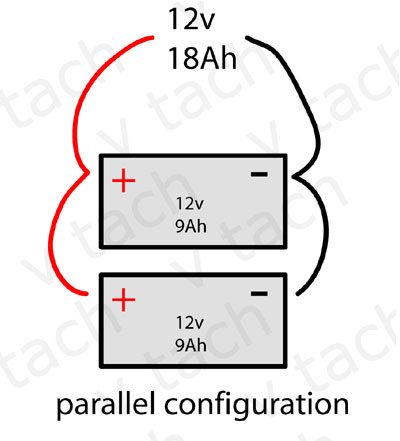
You will also need to complete your starting attempt fairly quickly after connecting the fully charged battery to the discharged one, or they will balance.
Simply put the discharged battery will very quickly suck the useful life out of your fully charged one, what you will end up with is both batteries incapable of starting the car.
WARNING: If you get it wrong (unlikely) and connect two batteries in series the current (amps) will remain the same, but you will double the volts to 24v.

Sending 24 volts through the system wouldn't be a good idea at all
Good luck with it.
What you are attempting is in effect the same as putting a powerpack on the dead battery, but a powerpack is designed to dump big amps through the discharged battery during cranking.
Your fully charged second battery needs to be a very fit one rated at 500 cold cranking amps or more, even then it will take quite a pounding during the cranking phase.
If you attempt this method with a regular car battery rated at say 330 cranking amps you will likely warp the plates in both batteries when the starter is engaged.
If you are going to attempt it, please make sure you are connecting the two batteries in parallel.
Connecting two batteries in parallel keeps the volts at 12.5, but will have the effect of doubling the amps.
You will also need to complete your starting attempt fairly quickly after connecting the fully charged battery to the discharged one, or they will balance.
Simply put the discharged battery will very quickly suck the useful life out of your fully charged one, what you will end up with is both batteries incapable of starting the car.
WARNING: If you get it wrong (unlikely) and connect two batteries in series the current (amps) will remain the same, but you will double the volts to 24v.
Sending 24 volts through the system wouldn't be a good idea at all
Good luck with it.
Edited by Chimpandtonic on Monday 13th February 13:02
I'm pretty sure the secondary battery is not rated very high, it's from a rover 25.
My plan was to leave my current battery where it is and to connect the second battery via the Anderson connector lead.
Not sure it that's in parellel or series?
Maybe I should just call out my breakdown guys and let them sort it out.
My plan was to leave my current battery where it is and to connect the second battery via the Anderson connector lead.
Not sure it that's in parellel or series?
Maybe I should just call out my breakdown guys and let them sort it out.
Gassing Station | Tamora, T350 & Sagaris | Top of Page | What's New | My Stuff