
dehumidifiers/carcoon/storage
Discussion


after some advice/experience from anyone who has used the carcoon type storage devices to protect your pride n joy.
having just bought a 31yr old car thats had an extensive 7yr restoration (bare metal) i would like to try and keep it in this sort of condition. its a summer toy, so will be offroad for long periods in a normal brick single garage.
i've stuck a humidty meter in the garage for now and its been between 40-65% rh so far, but we are in a dryish spell. my other garage has my kit car in and is fairly well sealed, so i dont use any form of carcoon, i do run a desicant dehumidifier that keeps the garage bang on 40-55% rh max. it does however cost on average £7 a month at least in electric (metered) to run that unit alone. without the dehumidifier the garage can get damp in winter as much as 80%rh. nuts have furred up (!) hence the dehumidifier.
so, question is do i stick a similar unit in the single garage to keep it dry, or invest in a carcoon type bad/unit to store it in at the end of summer?
from what i gather lots of people use them, but they just recirculate air using a fan from what i gather? how do people control the humidity inside, or does it remain stable just by air movement?
looking for some practical experiences please of what the humidity is kept at with these storage systems, any problems you've had, best one to get etc? have seen one system where the car goes into the bag along with stainless dehumidifier (chemical) tubs to control moisture, the type you dry out in an oven to replenish the desicant.
both garages have the usual up n over doors/drafts etc, i could also fit an extractor fan to the single garage quite easily to change the air in there.
any help appreciated thanks
having just bought a 31yr old car thats had an extensive 7yr restoration (bare metal) i would like to try and keep it in this sort of condition. its a summer toy, so will be offroad for long periods in a normal brick single garage.
i've stuck a humidty meter in the garage for now and its been between 40-65% rh so far, but we are in a dryish spell. my other garage has my kit car in and is fairly well sealed, so i dont use any form of carcoon, i do run a desicant dehumidifier that keeps the garage bang on 40-55% rh max. it does however cost on average £7 a month at least in electric (metered) to run that unit alone. without the dehumidifier the garage can get damp in winter as much as 80%rh. nuts have furred up (!) hence the dehumidifier.
so, question is do i stick a similar unit in the single garage to keep it dry, or invest in a carcoon type bad/unit to store it in at the end of summer?
from what i gather lots of people use them, but they just recirculate air using a fan from what i gather? how do people control the humidity inside, or does it remain stable just by air movement?
looking for some practical experiences please of what the humidity is kept at with these storage systems, any problems you've had, best one to get etc? have seen one system where the car goes into the bag along with stainless dehumidifier (chemical) tubs to control moisture, the type you dry out in an oven to replenish the desicant.
both garages have the usual up n over doors/drafts etc, i could also fit an extractor fan to the single garage quite easily to change the air in there.
any help appreciated thanks
loaaaaads of threads on subject on here alone, just do a PH Search
I had a Carcoon in a concrete garage many years ago, concreate garages get very damp Carcoon kept car dry
cut the damp down by throwing out any carpet on the floor, putting blinds or whatever on windows that let in direct sun and to reduce cold coming in
depending on how sheltered the garage is you could also install a permantely open vent(s)
if you have a metal door think of it as a giant radiator when/if the sun gets on it so think of what colour it's painted on the outside
you can also get Carcoons with rigid frames now so that you can drive the car in and out for more car use - taking the car out of the garage and driving it will help with damp problems too
with a dehumidifer you're treating the whole garage with the Carcoon you're sectioning down the garage to concentrate on the car
I had a Carcoon in a concrete garage many years ago, concreate garages get very damp Carcoon kept car dry
cut the damp down by throwing out any carpet on the floor, putting blinds or whatever on windows that let in direct sun and to reduce cold coming in
depending on how sheltered the garage is you could also install a permantely open vent(s)
if you have a metal door think of it as a giant radiator when/if the sun gets on it so think of what colour it's painted on the outside
you can also get Carcoons with rigid frames now so that you can drive the car in and out for more car use - taking the car out of the garage and driving it will help with damp problems too
with a dehumidifer you're treating the whole garage with the Carcoon you're sectioning down the garage to concentrate on the car
Hi,
I have a Carcoon, older model without the frame, and checked the RH inside and outside in my garage several years ago. I had two meters, one inside the Carcoon and one outside, and found that the RH was near enough the same inside the Carcoon or in the main garage. In fact, the Carcoon was slightly worse overall because it didn't 'react' as quickly to drier overall conditions.
Personally, I think the Carcoon (or similar) is very good for where rodents may be a nuisance (setting up home in your P&J), or for keeping dust away, but I now use dehumidifiers in the garage and the Carcoon is folded away unused.
Regards,
Dom
I have a Carcoon, older model without the frame, and checked the RH inside and outside in my garage several years ago. I had two meters, one inside the Carcoon and one outside, and found that the RH was near enough the same inside the Carcoon or in the main garage. In fact, the Carcoon was slightly worse overall because it didn't 'react' as quickly to drier overall conditions.
Personally, I think the Carcoon (or similar) is very good for where rodents may be a nuisance (setting up home in your P&J), or for keeping dust away, but I now use dehumidifiers in the garage and the Carcoon is folded away unused.
Regards,
Dom
Rather unhelpfully for the OP I've had the exact opposite experience to the post above.
Since completing the restoration of my Citroen I've kept it in an Airchamber, one with a frame.
It has been absolutely terrific. 70's French cars can rust in the desert and the Airchamber keeps it pristine. I believe it is all to do with the airflow over the car created by the tiny fans fore and aft.
When I store it I always prop open the boot (with a couple of sponges) and leave all windows down a couple of inches. 6 months in the car still looks (and smells) perfect.
A serious thumbs up from me for the Airflow product.
Since completing the restoration of my Citroen I've kept it in an Airchamber, one with a frame.
It has been absolutely terrific. 70's French cars can rust in the desert and the Airchamber keeps it pristine. I believe it is all to do with the airflow over the car created by the tiny fans fore and aft.
When I store it I always prop open the boot (with a couple of sponges) and leave all windows down a couple of inches. 6 months in the car still looks (and smells) perfect.
A serious thumbs up from me for the Airflow product.
Dom,
did you open and close the zip vent as required?
I know you can put a wet car into the Carcoon and it will dry the car - not that I'd recommend it - so I'm surprised with you findings but it's like retaining heat (or reducing loss really) you need to control as much as possible the area both of the Carccon and where it is situated in the garage and of course best of all control the garage
remember those that used to leave cassete tapes on the dash in a closed up car on a hot sunny day our worst an animal or child
did you open and close the zip vent as required?
I know you can put a wet car into the Carcoon and it will dry the car - not that I'd recommend it - so I'm surprised with you findings but it's like retaining heat (or reducing loss really) you need to control as much as possible the area both of the Carccon and where it is situated in the garage and of course best of all control the garage
remember those that used to leave cassete tapes on the dash in a closed up car on a hot sunny day our worst an animal or child
i'd be disapointed if the humidity wasnt controlled, its their main claim to faim. i'd assume the humidity is purely controlled due to the temperature being fairly static, so no condensation. if anyone has some findings from humidity sensors/recorders within these type units i'd be interested to hear. checked my single garage yesterday and then today, went as high as 78% yesterday with snow/rain cold outside, and today back to 45%. thats without any control or chambers etc as yet.
Carcoon would get a big thumbs up from me.
I've just taken my TR6 out of one after three years and there is no perceptible corrosion. Keep the car windows partially open and the boot lid ajar and it seems you can store a car indefinitely...but you must keep the rear zip partially open to create the necessary air flow.
The point about rodents is a really good one too...they get everywhere and there are signs of them having been in the garage, but the car has been OK. I can believe the fact that a damp meter will show similar humidity inside and outside the chamber...it's the same air! The point is that moving air will not condense and will actually 'dry' a surface that is damp.
Frame units are great if you have the space. If the car is almost as big as the garage and you have an up and over door you might need the original sort so it can be squished to get the door shut!
I've just taken my TR6 out of one after three years and there is no perceptible corrosion. Keep the car windows partially open and the boot lid ajar and it seems you can store a car indefinitely...but you must keep the rear zip partially open to create the necessary air flow.
The point about rodents is a really good one too...they get everywhere and there are signs of them having been in the garage, but the car has been OK. I can believe the fact that a damp meter will show similar humidity inside and outside the chamber...it's the same air! The point is that moving air will not condense and will actually 'dry' a surface that is damp.
Frame units are great if you have the space. If the car is almost as big as the garage and you have an up and over door you might need the original sort so it can be squished to get the door shut!
OP I can't and don't dispute Dom's findings on his meters in his garage, I do wonder about possible variances that could be of influence to those findings
I can't give you any meter readings all I can tell you is my car was garaged in a loaned concrete garage for a month, that garage caused a lot of condensation inside the car and inside the engine bay, when I lifted the bonnet I got dripped on from water dipping off the underside of the bonnet, I didn't realise it would be that bad when I accepted the loan of the garage
a few years later when I rented the same garage I installed a permantly open vent to combat the damp I now knew about but this made little difference so I bought and used a Carccon - the Carcoon worked, the car was no longer damp and would even dry out if I'd just driven in from the rain and left it in the Carcoon
I read and followed the simple Carcoon instructions - I know loads, of usually men, either don't bother reading and following instructions or consider it some grave insult against ther manhood to do so or are too lazy or know too much already to do so, the last type, installers at where I worked, who when totally stuck we'd have tell to "RTfM"
it's from the Carcoon instructions I learnt about carpet in the garage holding damp and the garage door's affect on the garage
I can't give you any meter readings all I can tell you is my car was garaged in a loaned concrete garage for a month, that garage caused a lot of condensation inside the car and inside the engine bay, when I lifted the bonnet I got dripped on from water dipping off the underside of the bonnet, I didn't realise it would be that bad when I accepted the loan of the garage
a few years later when I rented the same garage I installed a permantly open vent to combat the damp I now knew about but this made little difference so I bought and used a Carccon - the Carcoon worked, the car was no longer damp and would even dry out if I'd just driven in from the rain and left it in the Carcoon
I read and followed the simple Carcoon instructions - I know loads, of usually men, either don't bother reading and following instructions or consider it some grave insult against ther manhood to do so or are too lazy or know too much already to do so, the last type, installers at where I worked, who when totally stuck we'd have tell to "RTfM"
it's from the Carcoon instructions I learnt about carpet in the garage holding damp and the garage door's affect on the garage
good idea to reduce the area you want to dehumidfy (or heat or insulate) your zoning down, or creating a room or boxed area but it does need to be reasonably sealed
your house is on a plot of land but you heat the house, the fridge and oven have sealed doors to reduce loss or gain of heat
I hope you're going to actually use this car as well as pamper it
your house is on a plot of land but you heat the house, the fridge and oven have sealed doors to reduce loss or gain of heat
I hope you're going to actually use this car as well as pamper it
I used an external Carcoon for 3 years, extremely impressed with it. Mine was outside for the first year.
Even after 4 months over winter, the discs on the TVR were showing no corrosion. Carcoon is a great bit of kit.
The battery conditioner was also good and kept the carcoon inflated in the event of a power cut. I continued to use it even when we had a nice snug garage.
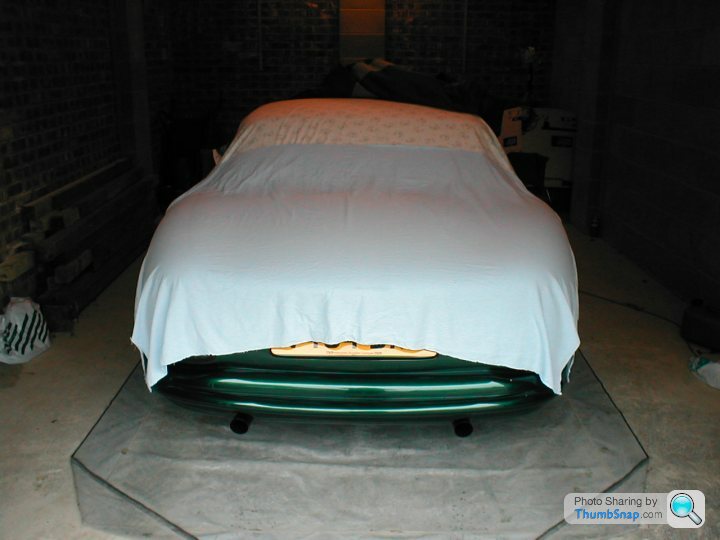

Even after 4 months over winter, the discs on the TVR were showing no corrosion. Carcoon is a great bit of kit.
The battery conditioner was also good and kept the carcoon inflated in the event of a power cut. I continued to use it even when we had a nice snug garage.
On the basis that you only put it up and take it down once a year, I wouldn't trouble yourself too much over the framed version, which is more expensive. what I have done is to unzip the unit in the spring, and since the Carcoon has loops on both sides I've put hooks in the walls and hang the top part up for the summer. The base I roll up to the back of the garage. So simple to reverse the procedure when winter arrives.
This article may help http://www.rentdh.com/about-dh-tech/technology-rev...
I gather that the point is that in the usual UK atmosphere with hard to influence sulphate and chloride contents (salted roads very relevant) the most accessible area to try to change is the relative humidity, to get it between 45-50%. This can be achieved either by dehumidifying the air, or by increasing the temperature of the car steel - which is where the reaction takes place, and which may not change much just by increasing garage air temperature. Putting a car in a plastic bag and blowing air over it won't make any difference if the air is at normal humidity levels, although it will superficially dry off any puddles or drips. Blowing (my) garage air at 70-80% humidity will have little anti-rusting effect. However I read that a Carcoon allows the plastic bag to be sealed and the air inside to be just blown around inside, which then allows the possibility of dehumidifying the air inside the bag down to the levels needed to prevent rusting by using a dehumidifier or silica gel packs within the Carcoon. Obviously a hygrometer will be needed to get to the right level. I believe that Permabag does something similar using an airtight bag to contain the car, and desiccant cylinders containing something like silica gel.
I gather that the point is that in the usual UK atmosphere with hard to influence sulphate and chloride contents (salted roads very relevant) the most accessible area to try to change is the relative humidity, to get it between 45-50%. This can be achieved either by dehumidifying the air, or by increasing the temperature of the car steel - which is where the reaction takes place, and which may not change much just by increasing garage air temperature. Putting a car in a plastic bag and blowing air over it won't make any difference if the air is at normal humidity levels, although it will superficially dry off any puddles or drips. Blowing (my) garage air at 70-80% humidity will have little anti-rusting effect. However I read that a Carcoon allows the plastic bag to be sealed and the air inside to be just blown around inside, which then allows the possibility of dehumidifying the air inside the bag down to the levels needed to prevent rusting by using a dehumidifier or silica gel packs within the Carcoon. Obviously a hygrometer will be needed to get to the right level. I believe that Permabag does something similar using an airtight bag to contain the car, and desiccant cylinders containing something like silica gel.
My cars are in a wooden garage in a Carcoon but I always put several kilos of silica bags in. Had the Carcoon six years now and it has protected the cars fine. But as I get older I wish it was a framed permanent chamber. Would save the hassle, and one never knows when a fine spell in winter might make you want to get the car out. For example, they are saying 15C next week here.
Have kept the TR3a in a carcoon for the past two winters, but also use a MEACO dehumidifier in the garage. - This allows dehumidified air into the carcoon and also stops my tools going rusty in the garage.
I have been so impressed with it, that I am just ordering another carcoon for the SL I bought last week.

I have been so impressed with it, that I am just ordering another carcoon for the SL I bought last week.
Gassing Station | Classic Cars and Yesterday's Heroes | Top of Page | What's New | My Stuff