
Discussion


Sorry if this has been covered before but I can't find anything and the search is down as usual. Im currently sitting in the ad freezing my parts off waiting for a low loader!
Having just finished putting new spark plugs in and aligning the bonnet today, both which went very well with no issues, I went to start the car to drive it home. All that happens though is the engine crams but it doesn't fire.
I can smell fuel so I know that's getting in but a strobe on the spark plug shows they aren't firing. I've traced it back to the coil which isnt firing. I get +12 volts on both the LT wires running into the coil (0 volts between them) which doesn't change when i crank. Is tha correct?
It seems that the coil isn't being triggered to fire but I have no idea why.
The car ran fine when I drove it into the garage 6 months ago and I haven't touched the initial system. All (and I mean all) the components in the ignition are less than a year old.
Any hints would be much appreciated!
Tom
Having just finished putting new spark plugs in and aligning the bonnet today, both which went very well with no issues, I went to start the car to drive it home. All that happens though is the engine crams but it doesn't fire.
I can smell fuel so I know that's getting in but a strobe on the spark plug shows they aren't firing. I've traced it back to the coil which isnt firing. I get +12 volts on both the LT wires running into the coil (0 volts between them) which doesn't change when i crank. Is tha correct?
It seems that the coil isn't being triggered to fire but I have no idea why.
The car ran fine when I drove it into the garage 6 months ago and I haven't touched the initial system. All (and I mean all) the components in the ignition are less than a year old.
Any hints would be much appreciated!
Tom
Thanks for the replies. Just got home in this

Must admit the first time it didn't start it was down to the rotor arm being in the glove box. Once that was put back though it still wouldn't start. I made sure the arm was attached properly and turning with the dissy (it had changed position the second time I removed it). HT leads are all fine. I checked and there isn't any spark from the coil so I'm thinking it's not being triggered.
Inertial cut out thingy. I have no idea about this. Where is it, what does it do, how do I reset it!
I'm not sure how to test the ignition module. It is pretty much brand new though so it shouldn't have conked out.
As the car is now on my drive I can trace the ignition system and see if I can find the root cause. I hate electrical gremlins.
Must admit the first time it didn't start it was down to the rotor arm being in the glove box. Once that was put back though it still wouldn't start. I made sure the arm was attached properly and turning with the dissy (it had changed position the second time I removed it). HT leads are all fine. I checked and there isn't any spark from the coil so I'm thinking it's not being triggered.
Inertial cut out thingy. I have no idea about this. Where is it, what does it do, how do I reset it!
I'm not sure how to test the ignition module. It is pretty much brand new though so it shouldn't have conked out.
As the car is now on my drive I can trace the ignition system and see if I can find the root cause. I hate electrical gremlins.
Hi Tom,
sorry to hear about your woes - I've got a similar picture of F133 somewhere (when the alarm went into meltdown a few years ago).
Not much help but I could never find an inertia switch on the car : I think they came later.
Dodgy relay? Oh, and I always used to struggle to get the car to start after extended periods of inactivity unless the battery was absolutely A1.
sorry to hear about your woes - I've got a similar picture of F133 somewhere (when the alarm went into meltdown a few years ago).
Not much help but I could never find an inertia switch on the car : I think they came later.
Dodgy relay? Oh, and I always used to struggle to get the car to start after extended periods of inactivity unless the battery was absolutely A1.
Well having done some searching it seems that the inertia switch kills the fuel as well as other things. The fuel is still flowing so I'm pretty sure it isn't the problem even if it is fitted.
I found this website which I've seen mentioned but never been able to find before. It gives a really good step by step guide to ignition problem diagnosis on the Ford EEC/TFI IV ignition.
It looks though the coil is ok as it is doing what it should just isn't getting triggered. I read that if the fuel pump runs when the engine is cranked then the ignition module is working so either the wiring, ECU or hall sensor is knackered.
Did I mention I hate electrical gremlins!
I found this website which I've seen mentioned but never been able to find before. It gives a really good step by step guide to ignition problem diagnosis on the Ford EEC/TFI IV ignition.
It looks though the coil is ok as it is doing what it should just isn't getting triggered. I read that if the fuel pump runs when the engine is cranked then the ignition module is working so either the wiring, ECU or hall sensor is knackered.
Did I mention I hate electrical gremlins!
Just a thought. Have taken our 3000M out for the first time over the weekend (Donington Historic). On the way there on Saturday, the temperature gauge didn't work. Started working on way back. But then the lights had stopped working. Checked fuses - all OK. Hoping it wasn't the switch (git to get at) but jiggled the feed wiring and everything was working again.
My point - older cars left standing for a while seem to develop strange gremlins & iffy connections. I'd suggest jiggling the wiring to the coil, ignition etc. especially around any connectors. Could be something really simple - I hope!
My point - older cars left standing for a while seem to develop strange gremlins & iffy connections. I'd suggest jiggling the wiring to the coil, ignition etc. especially around any connectors. Could be something really simple - I hope!
Yellow connector? A bit obvious but you never know.  Another thought...were there any mouse droppings in the car anywhere? One got into my glove box the other winter but luckily all it did was eat the insurance documents. I never did find the little bugger, but it's no claims discount would have gone if I had.
Another thought...were there any mouse droppings in the car anywhere? One got into my glove box the other winter but luckily all it did was eat the insurance documents. I never did find the little bugger, but it's no claims discount would have gone if I had. Edited by v8s4me on Monday 7th May 17:39
Thanks for everyones help, I've had another poke around this morning.
I checked the rotor arm and it's the shape it should be and definitely turns (cranked the engine whilst looking this time).
I've been waggling wires but not whilst cranking. I handily have Mike's Star tester at the moment so need to run the waggle test on that, didn't have time this morning.
Yellow connector has been replaced with solder by a previous owner. As for the mouse droppings, very original thought! Haven't found any though or evidence of nibbled wires, just the same old corroded wires that are everywhere in that car!
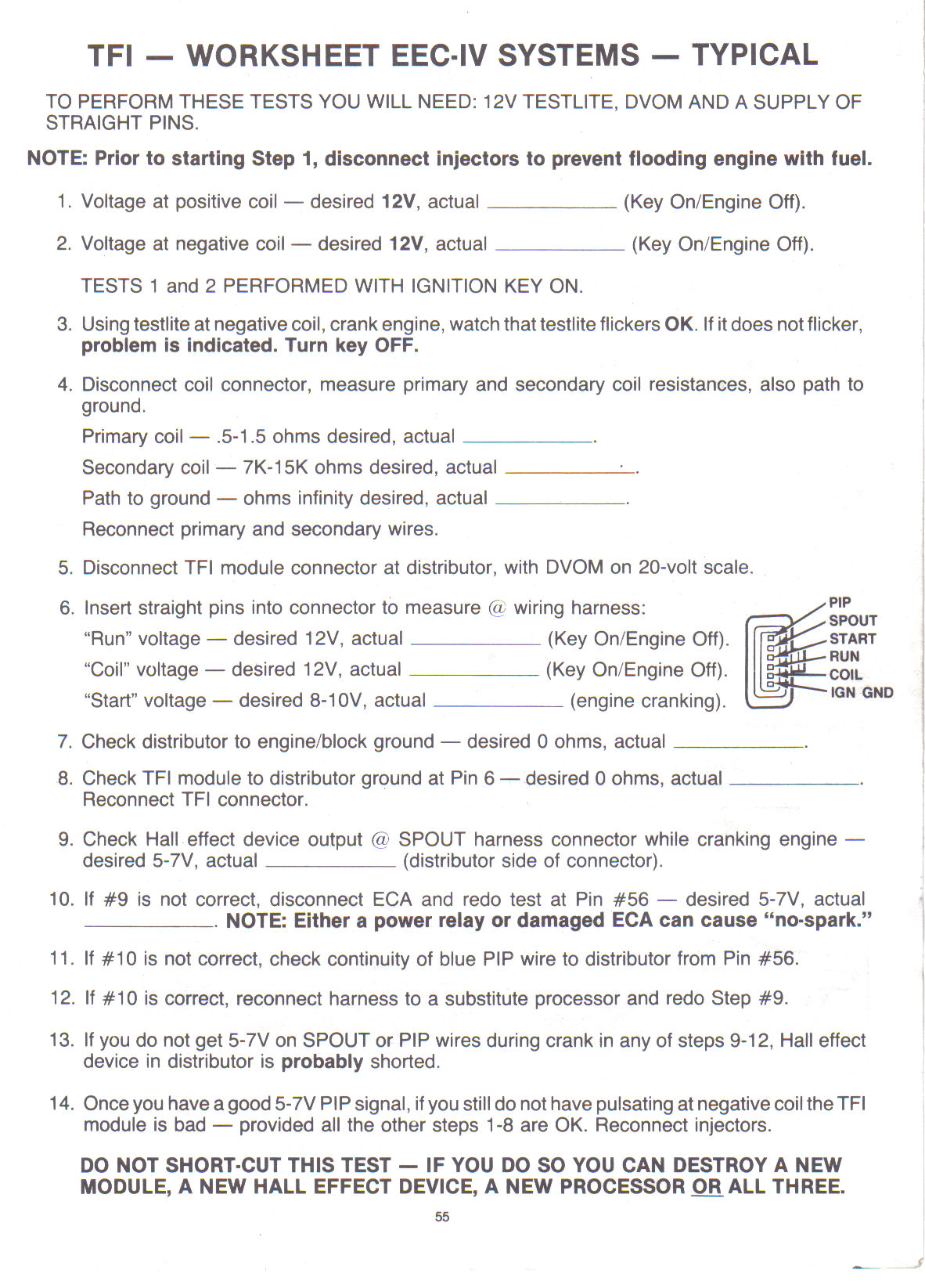
I have been working through the sheet below. Everything checks out apart from tests 3 and 9.
Test 3 I guessed the negative coil is the yellow and white wire to my coil. Putting a test lamp between that and earth (with the lead still connected to the coil) the lamp sort of flickered but mainly just got duller. If I put the lamp between the 2 terminals on the coil I would expect it to flicker on when the coil was triggered but that doesn't happen so I decided it failed this test. No idea what to do though as "problem is indicated" isn't very useful as i have no idea what the problem is!
Test 9 SPOUT signal drops to 9V not 5-7V. Now does this mean something is wrong (i.e. is the SPOUT signal not dropping enough to trigger the ignition module) or is it just because my multimeter is measuring the voltage a little slowly. I understand it is trying to measure a 12-0-12-0 V cycle and so I'm getting the RMS voltage but without an oscilloscope I can't tell if there really is a problem.
I checked the rotor arm and it's the shape it should be and definitely turns (cranked the engine whilst looking this time).
I've been waggling wires but not whilst cranking. I handily have Mike's Star tester at the moment so need to run the waggle test on that, didn't have time this morning.
Yellow connector has been replaced with solder by a previous owner. As for the mouse droppings, very original thought! Haven't found any though or evidence of nibbled wires, just the same old corroded wires that are everywhere in that car!
I have been working through the sheet below. Everything checks out apart from tests 3 and 9.
Test 3 I guessed the negative coil is the yellow and white wire to my coil. Putting a test lamp between that and earth (with the lead still connected to the coil) the lamp sort of flickered but mainly just got duller. If I put the lamp between the 2 terminals on the coil I would expect it to flicker on when the coil was triggered but that doesn't happen so I decided it failed this test. No idea what to do though as "problem is indicated" isn't very useful as i have no idea what the problem is!
Test 9 SPOUT signal drops to 9V not 5-7V. Now does this mean something is wrong (i.e. is the SPOUT signal not dropping enough to trigger the ignition module) or is it just because my multimeter is measuring the voltage a little slowly. I understand it is trying to measure a 12-0-12-0 V cycle and so I'm getting the RMS voltage but without an oscilloscope I can't tell if there really is a problem.
At the moment I'm testing with the fuel relay unplugged and a spark tester attached so wet plugs shouldn't be a problem.
Right as I understand it when the engine turns the vaned thingy in the distributor turns and is detected by the Hall effect sensor. This signal is passed to the ignition module which amplifies it and sends it out to the ECU (this is the PIP signal). The ECU then uses this to calculate the spark timing and sends this signal out back to the ignition module (this is the SPOUT signal). The ignition module then uses the SPOUT signal as a cue to fire the coil by earthing the coil negative wire.
Now I tested the coil and when I short it manually it fires fine. All the various signals described above vary when they are meant to when the engine is cranked (or I detach then manually spin the hall sensor vanes) but the coil doesn't fire.
The only thing I can think of is the coil negative isn't going low enough to trigger the coil to fire but I don't know if that is a realistic problem if you see what I mean.
Everything works but it doesn't.....WTF!


Right as I understand it when the engine turns the vaned thingy in the distributor turns and is detected by the Hall effect sensor. This signal is passed to the ignition module which amplifies it and sends it out to the ECU (this is the PIP signal). The ECU then uses this to calculate the spark timing and sends this signal out back to the ignition module (this is the SPOUT signal). The ignition module then uses the SPOUT signal as a cue to fire the coil by earthing the coil negative wire.
Now I tested the coil and when I short it manually it fires fine. All the various signals described above vary when they are meant to when the engine is cranked (or I detach then manually spin the hall sensor vanes) but the coil doesn't fire.
The only thing I can think of is the coil negative isn't going low enough to trigger the coil to fire but I don't know if that is a realistic problem if you see what I mean.
Everything works but it doesn't.....WTF!
If I had reached the stage you have I think I would retire from the problem gracefully and call the best I have found in my area. Sometimes an hour of the best is the best way to crack a fault and for me, definately no shame in being helped by one of the best in britain.
One expensive hour = plenty of mine!
http://www.enginetuning.net/ - clive atthowe, award winning top technician himself and now one of best guys Dan has reached the final for this year.
He may even help you on the phone - or be able to recommend other top guys in your area? He may even remember my TVR S (blue) that he recently.
One expensive hour = plenty of mine!
http://www.enginetuning.net/ - clive atthowe, award winning top technician himself and now one of best guys Dan has reached the final for this year.
He may even help you on the phone - or be able to recommend other top guys in your area? He may even remember my TVR S (blue) that he recently.
IT'S ALIVE!!!


Finally got the car running, how I missed that sound!
The oscilloscope I was counting on went bang (well 'pfzzt' anyway) before we could use it which was annoying so fell back on an LED to check out the PIP, SPOUT and COIL signals. The LED was much better than the bulb as it reacts far faster and allows you to see the square wave clearly.
PIP and SPOUT were fine but it turns out the coil negative wasn't actually pulsing as it should which is why the coil wasn't firing.
A few days ago I had measured the coil negative wire resistance from the ignition module (second wire from bottom, should be green) and the coil (smaller of the 2 wires) and it was up around 5 Ohms. Now the circuit diagram shows the 2 should be directly connected with an offshoot going to the fuel pump relay to indicate the engine is running and that the pump should run. Thing is the wire goes from the coil, down to the passenger side, and just before it enters the footwell there is a solder joint where the wire runs in to the footwell and back to the ignition module. To reduce the resistance I cut the wire so there was one from the ignition module to the coil, and a second wire from the coil to the fuel pump relay.
So today we were just going to take the ignition module out when I thought I'd see if I got a spark with the coil connected to the ignition module alone and not the fuel pump relay. So I disconnected the wire going down to the passenger footwell and he presto I got a spark! So I plugged everything back together and tried starting it. As I understand it the engine should have run for a second or so until the fuel rail depressurised then the engine would stop as the fuel pump wouldn't run as it wouldn't know the engine was running.
It turned out though that the engine did run fine! I have no idea where that wire going into the footwell goes but it sure as hell isn't required for the fuel pump to work! Currently it is disconnected so the coil negative is directly connected to the ignition module and nothing else and the car runs perfectly.
Finally got the car running, how I missed that sound!
The oscilloscope I was counting on went bang (well 'pfzzt' anyway) before we could use it which was annoying so fell back on an LED to check out the PIP, SPOUT and COIL signals. The LED was much better than the bulb as it reacts far faster and allows you to see the square wave clearly.
PIP and SPOUT were fine but it turns out the coil negative wasn't actually pulsing as it should which is why the coil wasn't firing.
A few days ago I had measured the coil negative wire resistance from the ignition module (second wire from bottom, should be green) and the coil (smaller of the 2 wires) and it was up around 5 Ohms. Now the circuit diagram shows the 2 should be directly connected with an offshoot going to the fuel pump relay to indicate the engine is running and that the pump should run. Thing is the wire goes from the coil, down to the passenger side, and just before it enters the footwell there is a solder joint where the wire runs in to the footwell and back to the ignition module. To reduce the resistance I cut the wire so there was one from the ignition module to the coil, and a second wire from the coil to the fuel pump relay.
So today we were just going to take the ignition module out when I thought I'd see if I got a spark with the coil connected to the ignition module alone and not the fuel pump relay. So I disconnected the wire going down to the passenger footwell and he presto I got a spark! So I plugged everything back together and tried starting it. As I understand it the engine should have run for a second or so until the fuel rail depressurised then the engine would stop as the fuel pump wouldn't run as it wouldn't know the engine was running.
It turned out though that the engine did run fine! I have no idea where that wire going into the footwell goes but it sure as hell isn't required for the fuel pump to work! Currently it is disconnected so the coil negative is directly connected to the ignition module and nothing else and the car runs perfectly.
Edited by orange_dodo on Saturday 12th May 22:46


Gassing Station | S Series | Top of Page | What's New | My Stuff