
Controlling boost - wastegate springs and boost controllers
Discussion


Hi,
I have a kit car with an rx7 turbo II engine installed in it. It has an external wastegate and a boost controller installed.
I'm struggling to understand the relationship between how the spring combined with the boost controller controls the minimum/maximum boost.
I've recently had all of the exhaust/turbo dismantled to replace a gasket between the manifold and the turbo. I've reassembled all of this and there are now no leaks. As part of this I also replaced all of the hoses from the turbo to the boost controller and from the boost controller to the wastegate. I did this because on inspection the hoses were in a bad way. Also, before I bought the car, the previous owner put a new wastegate on the car.
After I put it all back together the car is making more boost than it previously was. With the boost controller turned off the car was making about 0.7 bar boost. This doesn't sound like a lot but this engine makes about 400bhp with 0.8 bar boost which is what the car is mapped for. Previously the 4 settings on the boost gauge gave varying maximum boost levels which were 0.2, 0.4, 0.65 and 0.8 bar boost and this is the state I'm trying to get back to.
I can program the level of boost with the controller by adjusting a level on the controller. This is a value between 1 (lowest) and 100 (highest). With the system rebuilt with no leaks and the controller set to level 1 I get 0.7 bar boost. With the controller set to level 2 I get 0.85 bar boost. This clearly doesn't give me much control over the boost levels, certainly not the level of control I'm after.
I read that a boost controller helps control boost but the minimum level of boost is controlled by the spring. Therefore I swapped the spring out for a weaker one. Now, with the boost controller in the off position I'm getting 0.5 bar boost which is more like it. Then I programmed the boost controller to level 2 (out of 100) and this gives me 0.6 bar boost. Encouraged I then start to increase the boost controller level but I can't now increase the boost level past 0.6 bar even by going up to level 40 on the controller.
At that point rain stopped play as I was getting wheel spin in 2nd under boost and the tests started to get a little dangerous.
Is my understanding of how these components work together correct? If it isn't can someone let me know where I'm wrong. If it is correct can someone give me an idea what might be happening based on the testing detailed above?
I understand that a conclusion may be that I've plumbed the new hoses in incorrectly and while I agree that there is a chance it should be unlikely as I took off one hose, cut a new one to size and replaced that hose. That is I didn't take them all off but did them one at a time.
The other potential issue is that I definitely have an earthing issue somewhere which I need to resolve and this could, I guess, be affecting the way the boost controller is working. This manifests itself as the engine speed dropping when extra electrical load is placed on the engine such as the lights, the radiator fans and so on. I believe this to be an earthing fault which results in the alternator being loaded up causing the engine to run slow.
Anyway, enough of the ramble... any comments or pointers regarding controlling the boost with the system I have would be most welcome.
Thanks,
Mark
I have a kit car with an rx7 turbo II engine installed in it. It has an external wastegate and a boost controller installed.
I'm struggling to understand the relationship between how the spring combined with the boost controller controls the minimum/maximum boost.
I've recently had all of the exhaust/turbo dismantled to replace a gasket between the manifold and the turbo. I've reassembled all of this and there are now no leaks. As part of this I also replaced all of the hoses from the turbo to the boost controller and from the boost controller to the wastegate. I did this because on inspection the hoses were in a bad way. Also, before I bought the car, the previous owner put a new wastegate on the car.
After I put it all back together the car is making more boost than it previously was. With the boost controller turned off the car was making about 0.7 bar boost. This doesn't sound like a lot but this engine makes about 400bhp with 0.8 bar boost which is what the car is mapped for. Previously the 4 settings on the boost gauge gave varying maximum boost levels which were 0.2, 0.4, 0.65 and 0.8 bar boost and this is the state I'm trying to get back to.
I can program the level of boost with the controller by adjusting a level on the controller. This is a value between 1 (lowest) and 100 (highest). With the system rebuilt with no leaks and the controller set to level 1 I get 0.7 bar boost. With the controller set to level 2 I get 0.85 bar boost. This clearly doesn't give me much control over the boost levels, certainly not the level of control I'm after.
I read that a boost controller helps control boost but the minimum level of boost is controlled by the spring. Therefore I swapped the spring out for a weaker one. Now, with the boost controller in the off position I'm getting 0.5 bar boost which is more like it. Then I programmed the boost controller to level 2 (out of 100) and this gives me 0.6 bar boost. Encouraged I then start to increase the boost controller level but I can't now increase the boost level past 0.6 bar even by going up to level 40 on the controller.
At that point rain stopped play as I was getting wheel spin in 2nd under boost and the tests started to get a little dangerous.
Is my understanding of how these components work together correct? If it isn't can someone let me know where I'm wrong. If it is correct can someone give me an idea what might be happening based on the testing detailed above?
I understand that a conclusion may be that I've plumbed the new hoses in incorrectly and while I agree that there is a chance it should be unlikely as I took off one hose, cut a new one to size and replaced that hose. That is I didn't take them all off but did them one at a time.
The other potential issue is that I definitely have an earthing issue somewhere which I need to resolve and this could, I guess, be affecting the way the boost controller is working. This manifests itself as the engine speed dropping when extra electrical load is placed on the engine such as the lights, the radiator fans and so on. I believe this to be an earthing fault which results in the alternator being loaded up causing the engine to run slow.
Anyway, enough of the ramble... any comments or pointers regarding controlling the boost with the system I have would be most welcome.
Thanks,
Mark
In short form:
1) the maximum boost curve (it's a relationship with engine intake/exhaust massflow, and that changes with engine rpm) is set by the wastegate spring. This spring holds the wastegate shut. It is opened by both the pressure applied to the wasetgate capsule (via the boost control solenoid) AND by pre turbine exhaust back pressure. As a result for a given wastegate capsule control pressure you WILL get more boost pressure at say 3000rpm (where EBP is lower as exhaust massflow is lower) than at say 6000rpm. This leads to a system that naturally "tails off" boost as engine speed rises.
2) the minimum boost curve is when the wastegate capsule has "Full" manifold presssure applied to it by the boost control solenoid, and hence is being opened by both the EBP and the control pressure.
Generally speaking you need to do the following.
a) directly connect the wastegate capsule to the plenum (no control solenoid) so that it gets full plenum pressure all the time. Now change springs or adjust spring preload until you get the minimum acceptable boost pressure curve.
b) ideally using a fixed duty cycle, slowly reduce the wastegate capsule control pressure until you reach a maximum acceptable boost pressure. if you cannot get to enough boost this is for 2 possible reasons, 1) your boost control solenoid is incapable of bleeding off the boost pressure supplied to it, and even at 100% some pressure is being applied to the capsule (easy, but dangerous to check, just pull the pipe of the capsule and run with just EBP opening the wastegate (caution! tip in the throttle slowly at say 4000rpm to ensure you don;t get a massive unexcpected boost overshoot, ideally have your EMS with a sensible "fuel/spark cut" threshold for overpressure). Or 2) you have too low a spring load, and even with no pressure applied your system cannot reach the boost you require.
With a unipolar spring / pressure system, because you cannot use pressure to help hold the wastegate shut, their is a necessarily limited range of boost pressure between max and min boost.
Most control solenoids will have a small restrictor upstream of the boost control solenoid to ensure it is capable of bleeding off a suitable amount of pressure to attain max boost required.
1) the maximum boost curve (it's a relationship with engine intake/exhaust massflow, and that changes with engine rpm) is set by the wastegate spring. This spring holds the wastegate shut. It is opened by both the pressure applied to the wasetgate capsule (via the boost control solenoid) AND by pre turbine exhaust back pressure. As a result for a given wastegate capsule control pressure you WILL get more boost pressure at say 3000rpm (where EBP is lower as exhaust massflow is lower) than at say 6000rpm. This leads to a system that naturally "tails off" boost as engine speed rises.
2) the minimum boost curve is when the wastegate capsule has "Full" manifold presssure applied to it by the boost control solenoid, and hence is being opened by both the EBP and the control pressure.
Generally speaking you need to do the following.
a) directly connect the wastegate capsule to the plenum (no control solenoid) so that it gets full plenum pressure all the time. Now change springs or adjust spring preload until you get the minimum acceptable boost pressure curve.
b) ideally using a fixed duty cycle, slowly reduce the wastegate capsule control pressure until you reach a maximum acceptable boost pressure. if you cannot get to enough boost this is for 2 possible reasons, 1) your boost control solenoid is incapable of bleeding off the boost pressure supplied to it, and even at 100% some pressure is being applied to the capsule (easy, but dangerous to check, just pull the pipe of the capsule and run with just EBP opening the wastegate (caution! tip in the throttle slowly at say 4000rpm to ensure you don;t get a massive unexcpected boost overshoot, ideally have your EMS with a sensible "fuel/spark cut" threshold for overpressure). Or 2) you have too low a spring load, and even with no pressure applied your system cannot reach the boost you require.
With a unipolar spring / pressure system, because you cannot use pressure to help hold the wastegate shut, their is a necessarily limited range of boost pressure between max and min boost.
Most control solenoids will have a small restrictor upstream of the boost control solenoid to ensure it is capable of bleeding off a suitable amount of pressure to attain max boost required.

Thom said:
dern said:
Encouraged I then start to increase the boost controller level but I can't now increase the boost level past 0.6 bar even by going up to level 40 on the controller
You may have to try with duty cycle figures quite higher than 40% to reach a higher peak boost.Level 40, is probably just setting the target boost pressure to a maximum value, then the PI control modifies the output as necessary to achieve the target pressure. It is more likely that the control valve needs a smaller restrictor in front of it to enable it to reduce the wastegate capsule pressure further.
Max_Torque said:
Thom said:
dern said:
Encouraged I then start to increase the boost controller level but I can't now increase the boost level past 0.6 bar even by going up to level 40 on the controller
You may have to try with duty cycle figures quite higher than 40% to reach a higher peak boost.Level 40, is probably just setting the target boost pressure to a maximum value, then the PI control modifies the output as necessary to achieve the target pressure. It is more likely that the control valve needs a smaller restrictor in front of it to enable it to reduce the wastegate capsule pressure further.
Next time I have spare time when it isn't raining I'll try and progressively increase the setting to see what effect it has on the resulting peak boost levels.
Thanks very much.
Regards,
Mark
I ignore what ECU is used here but in my humble experience the DC % is directly related to peak boost, even if peak boost and DC % are not linearly related.
P & D settings will adjust how quickly peak boost is reached and I helps avoiding MAP oscillating around peak boost, which remains directly dependant on DC %.
In fact, running with zero PID settings should equate to running boost control in open loop.
P & D settings will adjust how quickly peak boost is reached and I helps avoiding MAP oscillating around peak boost, which remains directly dependant on DC %.
In fact, running with zero PID settings should equate to running boost control in open loop.
Edited by Thom on Thursday 12th July 20:56
Thought I'd follow this up as I'm pretty sure I've figured out what's going on.
With the weaker spring in setting the boost controller to 100 (maximum) makes no difference. I stripped the wastegate down and the diaphragm has had it and fell apart when I took it out. What control I was getting out of the boost controller has essentially gone down to nothing in a short space of time as the diaphragm fell to bits inside the wastegate.
I wonder if the gasket failing between the turbo and the manifold exposed the outside of the wastegate to very high levels of heat which would explain why all the hoses were brittle at the wastegate ends. Maybe that knackered the diaphragm. It definitely looks heat damaged.
I have a new diaphragm and will fit it this weekend along with some new springs of various ratings so I should be able to get it back where I wanted. There is a possibility that the play between the piston stem and the wastgate body is excessive and is letting heat through which is damaging the diaphragm. If so the diaphragm will go again and I'll fit a new wastegate.
Thanks,
Mark
With the weaker spring in setting the boost controller to 100 (maximum) makes no difference. I stripped the wastegate down and the diaphragm has had it and fell apart when I took it out. What control I was getting out of the boost controller has essentially gone down to nothing in a short space of time as the diaphragm fell to bits inside the wastegate.
I wonder if the gasket failing between the turbo and the manifold exposed the outside of the wastegate to very high levels of heat which would explain why all the hoses were brittle at the wastegate ends. Maybe that knackered the diaphragm. It definitely looks heat damaged.
I have a new diaphragm and will fit it this weekend along with some new springs of various ratings so I should be able to get it back where I wanted. There is a possibility that the play between the piston stem and the wastgate body is excessive and is letting heat through which is damaging the diaphragm. If so the diaphragm will go again and I'll fit a new wastegate.
Thanks,
Mark
Are you not getting Wastegate confused with actuator? The wastegate is the part within the turbo that diverts the exhaust gas from the turbine, the actuator is the unit that the boost pressure pipes connect to that operates the wastegate by means of the actuator rod.
Wastegate shown within turbo housing
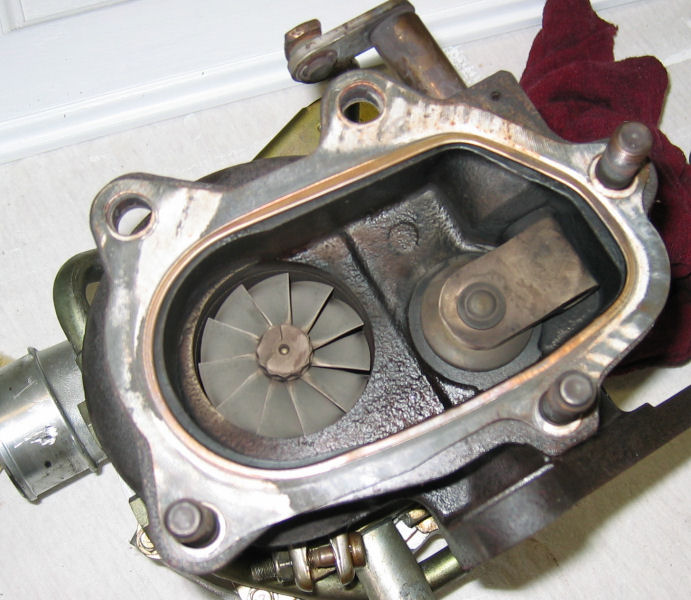
Actuator

Wastegate shown within turbo housing
Actuator
Edited by S1_RS on Sunday 29th July 16:54
MQ~~60_12.JPG)

dern said:
I wonder if the gasket failing between the turbo and the manifold exposed the outside of the wastegate to very high levels of heat which would explain why all the hoses were brittle at the wastegate ends. Maybe that knackered the diaphragm. It definitely looks heat damaged.
That's odd - do you have a picture showing where the wastegate is connected to the exhaust pipe pre turbine inlet?Thom said:
That's odd - do you have a picture showing where the wastegate is connected to the exhaust pipe pre turbine inlet?
No but I'll take one for you next time I'm working on the car.Thom said:
Do you have the wastegate plugged in single or dual port?
If I understand the terms correctly it's single port.Thanks,
Mark
Gassing Station | Engines & Drivetrain | Top of Page | What's New | My Stuff