
Cylinder Heads 4.2
Discussion


Hi all
I have a spare set of heads that are complete and in good order. Is there much work to be done in the porting and gas flowing department to see any more gains out of the heads or did TVR do as much as they could?
I have had my 4.2 inlets ported and gas flowed as well.
I intended to fit new valve guides and seats to these heads while i am at it and change out the standard heads and head gaskets when the time comes. Just wondering if there is any point to modding them before I re-build them.
Cheers Scotty
I have a spare set of heads that are complete and in good order. Is there much work to be done in the porting and gas flowing department to see any more gains out of the heads or did TVR do as much as they could?
I have had my 4.2 inlets ported and gas flowed as well.
I intended to fit new valve guides and seats to these heads while i am at it and change out the standard heads and head gaskets when the time comes. Just wondering if there is any point to modding them before I re-build them.
Cheers Scotty
scotty_d said:
Hi all
I have a spare set of heads that are complete and in good order. Is there much work to be done in the porting and gas flowing department to see any more gains out of the heads or did TVR do as much as they could?
I have had my 4.2 inlets ported and gas flowed as well.
Cheers Scotty
I got a full set of flow bench figures for my 4.5 heads that were gas flowed and tested before and after modification. Can post up the results if you wish but basically I had them Gas flowed with 3 angle valve seats and new guides.I have a spare set of heads that are complete and in good order. Is there much work to be done in the porting and gas flowing department to see any more gains out of the heads or did TVR do as much as they could?
I have had my 4.2 inlets ported and gas flowed as well.
Cheers Scotty
Inlet Before 113.8cfm at 12mm lift
Inlet After 122.3cfm at 12mm lift 7.4% increase
Exhaust Before 65.2cfm at 12mm lift
Exhaust After 81.0cfm at 12mm lift 24% increase
Cost of all work including fitting guides, gas flowing and assembly £500
im planning on doing the same with my heads off the old engine ive got sitting here.
when andy fitted the new lump i was chatting to him about it and he said there is very little valve tolerance between combustion chamber and piston, so as said you will need to take this into account when skimming the head or decking block.
i guess another way round it would be to fit a thicker h/g (if they make them for the ajp) not looked into it, if not i guess you could fit 2 head gaskets (we do this with big power pulsars) but it makes them laggy as hell off boost so maybe no good with an na cerb.
also if porting and flowing the head
is there any benefit of doing the intake side or just the exhaust ports?
once again (not cerb related) ive found when inlet ports are opened up and flowed you can end up with a real lumpy lump at idle, so has anyone done this?
when andy fitted the new lump i was chatting to him about it and he said there is very little valve tolerance between combustion chamber and piston, so as said you will need to take this into account when skimming the head or decking block.
i guess another way round it would be to fit a thicker h/g (if they make them for the ajp) not looked into it, if not i guess you could fit 2 head gaskets (we do this with big power pulsars) but it makes them laggy as hell off boost so maybe no good with an na cerb.
also if porting and flowing the head
is there any benefit of doing the intake side or just the exhaust ports?
once again (not cerb related) ive found when inlet ports are opened up and flowed you can end up with a real lumpy lump
at idle, so has anyone done this?a1rak said:
I got a full set of flow bench figures for my 4.5 heads that were gas flowed and tested before and after modification. Can post up the results if you wish but basically I had them Gas flowed with 3 angle valve seats and new guides.
Inlet Before 113.8cfm at 12mm lift
Inlet After 122.3cfm at 12mm lift 7.4% increase
Exhaust Before 65.2cfm at 12mm lift
Exhaust After 81.0cfm at 12mm lift 24% increase
Has anyone else on here ever had their heads measured on a flow bench?Inlet Before 113.8cfm at 12mm lift
Inlet After 122.3cfm at 12mm lift 7.4% increase
Exhaust Before 65.2cfm at 12mm lift
Exhaust After 81.0cfm at 12mm lift 24% increase
I strongly doubt the figures posted above or perhaps they were not measured at the usual 28" of water column.
With a standard inlet valve (45mm OD with an 8mm valve stem) I would expect the inlet port of a standard Cerbera head to flow around 200 cfm @28" H20 with 12mm of lift.
Anyone?
Edited by Thom on Friday 26th April 08:54
Thom said:
Has anyone else on here ever had their heads measured on a flow bench?
I strongly doubt the figures posted above or perhaps they were not measured at the usual 28" of water column.
With a standard inlet valve (45mm OD with an 8mm valve stem) I would expect the inlet port of a standard Cerbera head to flow around 200 cfm @28" H20 with 12mm of lift.
Anyone?
Yep.. I have.. I strongly doubt the figures posted above or perhaps they were not measured at the usual 28" of water column.
With a standard inlet valve (45mm OD with an 8mm valve stem) I would expect the inlet port of a standard Cerbera head to flow around 200 cfm @28" H20 with 12mm of lift.
Anyone?
Edited by Thom on Friday 26th April 08:54
Just curious to know if the actual flow figure is closer to 200 than 100 cfm.
While the engine was apparently designed as a rev-hungry unit using a flat plane crank I find it odd it uses 2V heads that may choke above 6000 rpm pretty much regardless of inlet length between the trumpets and the inlet ports, at least according to all the dyno sheets I have seen so far.
While the engine was apparently designed as a rev-hungry unit using a flat plane crank I find it odd it uses 2V heads that may choke above 6000 rpm pretty much regardless of inlet length between the trumpets and the inlet ports, at least according to all the dyno sheets I have seen so far.
OK, whats the other half?
I should add, I'm all ears while my engine is in bits. I've smoothed off the short side radius of the ports and removed the casting marks as well as beginning to smooth off/polish the exhaust port. Whats the other 50% to do?
I should add, I'm all ears
while my engine is in bits. I've smoothed off the short side radius of the ports and removed the casting marks as well as beginning to smooth off/polish the exhaust port. Whats the other 50% to do?Edited by CerbWill on Friday 26th April 11:52
Assuming the figures posted earlier were measured at 10" H2O, the corresponding values at 28" H2O turn out to be close to the 200 cfm I expected.
Inlet @12mm lift
Before : 113.8 / 190.4 cfm
After : 122.3 / 204.6 cfm
Exhaust @12mm lift
Before : 65.2 / 109.1 cfm
After : 81.0 / 135.5 cfm
The size and position of the inlet valve in the combustion chamber suggest a significant shrouding issue and the standard 45mm inlet valve may even be too large to flow - dynamically - as much as the head/bore combination may allow, at least on a 4.2L (88mm bore) block. A 4.5L (91mm bore) block may allow a little better flow but I hear that the heads are the same between the 2 engine sizes which means the combustion chamber should be enlarged to make any proper use of the larger 91mm bore of the 4.5L block and reduce shrouding.
Is it ok to discuss this publically with disinterested folks or are we in 2019 all about inserting a coin somewhere to get even just insignificant fragments of information?
Inlet @12mm lift
Before : 113.8 / 190.4 cfm
After : 122.3 / 204.6 cfm
Exhaust @12mm lift
Before : 65.2 / 109.1 cfm
After : 81.0 / 135.5 cfm
The size and position of the inlet valve in the combustion chamber suggest a significant shrouding issue and the standard 45mm inlet valve may even be too large to flow - dynamically - as much as the head/bore combination may allow, at least on a 4.2L (88mm bore) block. A 4.5L (91mm bore) block may allow a little better flow but I hear that the heads are the same between the 2 engine sizes which means the combustion chamber should be enlarged to make any proper use of the larger 91mm bore of the 4.5L block and reduce shrouding.
Is it ok to discuss this publically with disinterested folks or are we in 2019 all about inserting a coin somewhere to get even just insignificant fragments of information?
Edited by Thom on Friday 26th April 12:41
Thom, you clearly know more than me, however I've gone for a 4.7L (so 93mm piston diameter). What effect will that have on the cylinder heads? Is it worth considering removing material to de-shroud the valves? I'm also confused at the disparity between intake and exhaust flow rates. I know its explained by the exhaust valve being smaller, but surely what goes in to the cylinder must come out so whats the point of the vastly superior intake flow? Is it because the rising piston on the exhaust strike ejects the exhaust air much more efficiently than the suction created by the falling piston on the intake stroke draw air in?
Deshrouding the valves by widening the combustion chambers from 88 to 93mm will decrease the static compression ratio. This should be compensated with more material on the pistons.
A side theoretical issue with increasing bore size without enlarging the combustion chamber is increasing the squish area, but 93mm pistons such as the ones below suggest they were designed accordingly.
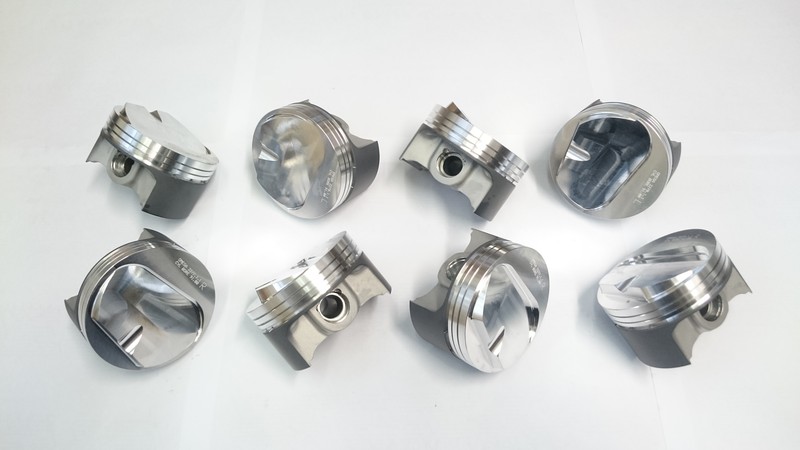
On paper it feels wrong to me not to open up the combustion chamber to deshroud the valves but this is theoretical consideration and in the real world it is certainly possible to get away without it and still get good results, if not optimum.
As for the difference in flow between the inlet and exhaust I imagine that the standard camshafts, which specs I ignore, have a low enough overlap and that the exhaust manifolds help well enough with scavenging.
For the sake of science it would still be interesting to increase the flow potential by deshrouding the valves, if someone ever bothers designing suitable pistons.
A side theoretical issue with increasing bore size without enlarging the combustion chamber is increasing the squish area, but 93mm pistons such as the ones below suggest they were designed accordingly.
On paper it feels wrong to me not to open up the combustion chamber to deshroud the valves but this is theoretical consideration and in the real world it is certainly possible to get away without it and still get good results, if not optimum.
As for the difference in flow between the inlet and exhaust I imagine that the standard camshafts, which specs I ignore, have a low enough overlap and that the exhaust manifolds help well enough with scavenging.
For the sake of science it would still be interesting to increase the flow potential by deshrouding the valves, if someone ever bothers designing suitable pistons.
Thom said:
Deshrouding the valves by widening the combustion chambers from 88 to 93mm will decrease the static compression ratio. This should be compensated with more material on the pistons.
Or weld some back into the heads.. Depending on piston clearances/how much is needed etc.. It might be you can only do it in the pistons. Jhonno said:
Or weld some back into the heads..
If the closed valves end up recessed into a filled-up area of the combustion chamber roof it may mess up with flame front propagation.... Perhaps it remains simpler to just spec new pistons? Either option should require new pistons anyway.Gassing Station | Cerbera | Top of Page | What's New | My Stuff