
Discussion


Why are the still made out of rubber? Why aren't they made from kevlar or some modern material?
Replacement is normally expensive and they are quite short lived, especially Alfas for some reason. Surely there must be a better solution?
Once a car gets old it's not worth the expense to bother and just carry on till catastrophic fail. My elderly Passat being a case in point, overdue cambelt now, but worth little more than the cost of replacing. At last MOT service i asked and they said they wouldn't bother, just run till it dies.
Replacement is normally expensive and they are quite short lived, especially Alfas for some reason. Surely there must be a better solution?
Once a car gets old it's not worth the expense to bother and just carry on till catastrophic fail. My elderly Passat being a case in point, overdue cambelt now, but worth little more than the cost of replacing. At last MOT service i asked and they said they wouldn't bother, just run till it dies.

 makes me cringe when I hear of new belts going on and then scrimping on new tensioners...
V88Dicky said:
Car manufacturers could use a chain perhaps?

Primary reason for cambelts is reduced cost (unsurprisingly). For the manufacturer(equally unsurprisingly). Cambelts are also quieter. Bur much less reliable. Car manufacturers like cheap parts. Customers suffer in consequence. Usual story: cost is the primary interest.4key][cough said:
A timing belt is typically rubber with high-tensile fibres (e.g. fiberglass or Twaron/Kevlar) running the length of the belt as tension members[/cough]
That's a nasty cough have some Benylin. Yes i know there is inner stuff like you mention. The teeth are still rubber or similar though. No teeth and it doesn't matter the belt stays belt shaped.
Chains stretch and rattle badly, which i believe is why they moved to belts in the first place.
Gears would be great, do car engines have such things? In bikes gear cams were / are fairly common, bikes such as the Honda VFR range all use gears and the whine sounds great too.
4key said:
As said, it's cost. Fairly certain that a car could be produced that could last a few million miles by now, but how much do you want to pay?
How much more though, Kevlar belt for my scooter, (Gilera 180 2 stroke), is about £5 dearer.So overall about 25% more which would be sod all on a car.
Maybe Alfa should try fitting them as OEM, might do their rep some serious good!
Enclosing a chain partially immersed in oil in a multi-part sealed housing on the end of the engine is no mean feat. There is absolutely nothing wrong with belts if they are replaced at the correct intervals. Chains stretch too, and tensioners fail, and the parts are more costly- and the lack of attention to the pulley end of the engine means the water pump gets overlooked.
The_Burg said:
How much more though, Kevlar belt for my scooter, (Gilera 180 2 stroke), is about £5 dearer.
So overall about 25% more which would be sod all on a car.
Maybe Alfa should try fitting them as OEM, might do their rep some serious good!
Increase belt service intervals and the belt will just out-last it's tensioner/idler/water pump. Show me a sealed roller element bearing which will last indefinitely in those conditions and I'll re-consider.So overall about 25% more which would be sod all on a car.
Maybe Alfa should try fitting them as OEM, might do their rep some serious good!
ETA: I'm fully aware your Gilera lacks these parts. I'm talking cars here. Bikes may as well be brain surgery to me as I have very little experience with them!
Edited by HustleRussell on Thursday 27th December 22:37
Engineering is all about compromise. There is no perfect soloution.
I don't mind changing the belts and tensioners at around 30k, and it IS a consideration I include when I buy a car. I accept this is not a viable option for everyone.
Chains do not last forever, and are generally harder to get to to examine thoroughly. They are also more complex, with a 'live' tensioning system, shoes that wear etc. so the overall treatment of the engine comes into effect here, moreso than with a belt.
I would expect gears to maybe inflict issues with higher rev limits maybe?
Personally, I like the typical setup of a belt, with metal rollers and a water pump driven by the belt. The metal rollers generally outlast the belt easily, and the water pump is normally replaced as a given. As a result, I've not suffered a premature water pump failure yet.
Guy I know with a BMW, a 330 chain driven engine has just suffered a catastrophic water pump failure which may have cost him his engine, and therefore the car, due to the pump not being driven by the timing gear hence no so important, so has probably just been ignored over the 110k or so miles the engine's covered.
Saabs seem to be very good with their chains longevity, but during my ownership I also wondered about the water pump life (and location!). But then you get to the 200k mark and then the life of the chain does start to be a factor. And instead of a ~£100 kit kept on the shelf in most places, it's a ~£200 special order and a lot more labour.
All about compromise.
I don't mind changing the belts and tensioners at around 30k, and it IS a consideration I include when I buy a car. I accept this is not a viable option for everyone.
Chains do not last forever, and are generally harder to get to to examine thoroughly. They are also more complex, with a 'live' tensioning system, shoes that wear etc. so the overall treatment of the engine comes into effect here, moreso than with a belt.
I would expect gears to maybe inflict issues with higher rev limits maybe?
Personally, I like the typical setup of a belt, with metal rollers and a water pump driven by the belt. The metal rollers generally outlast the belt easily, and the water pump is normally replaced as a given. As a result, I've not suffered a premature water pump failure yet.
Guy I know with a BMW, a 330 chain driven engine has just suffered a catastrophic water pump failure which may have cost him his engine, and therefore the car, due to the pump not being driven by the timing gear hence no so important, so has probably just been ignored over the 110k or so miles the engine's covered.
Saabs seem to be very good with their chains longevity, but during my ownership I also wondered about the water pump life (and location!). But then you get to the 200k mark and then the life of the chain does start to be a factor. And instead of a ~£100 kit kept on the shelf in most places, it's a ~£200 special order and a lot more labour.
All about compromise.
HustleRussell said:
There is absolutely nothing wrong with belts if they are replaced at the correct intervals.
It is needless maintenance. Engine service interval are getting stretched all the time and yet they persist in driving the timing gear with a rubber band than needs changing. Then they cram the engine into smaller and smaller engine compartments making the the labour on the belt change more expensive. I can't see why they do use light weight gears, even if it did use a drop more fuel, the would be more than recovered in savings on servicing cam belts.
However decided to use cam belts should have one thrust up his arse.
Many cars are an easy DIYer Camshaft Belt replacement fix. Cost of belt say 20-30 quid, leisurely hour or so and job's a good'n.
Those that are not an easy DIYer fix are best avoided unless you like throwing lots of money at repair shops. Yes, cars requiring major strip down or even engine out jobs to replace simple stuff are best avoided.
Thirty plus years ago when Rubber Timing Belts became commonplace on cars, I changed one on my car. Took about thirty minutes. First one I've ever replaced and found it was surprisingly easy. DOHC 16v engines usually need rather more time but, still easy for someone like me with limited or no access to pro-tools and other kit.
First such "rubber" Timing Belt I saw on an engine was on a Vauxhall Viva GT back around 1969.
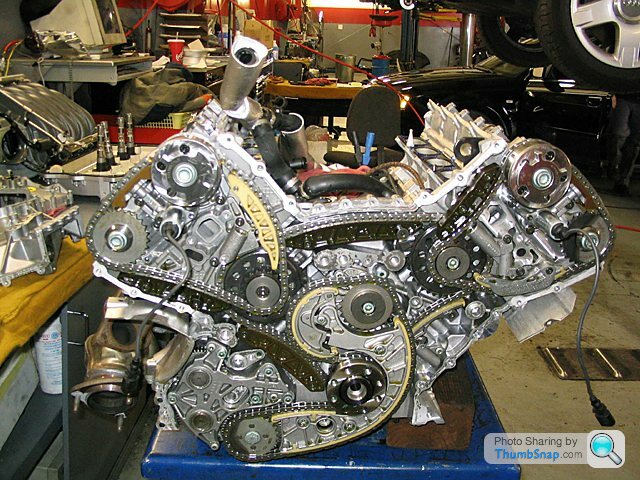
Timing Chains are NOT the bullet proof answer as anyone reading even some of the threads on this car enthusiasts' site can see for themselves. When they let go and the do, they cause mayhem.
Those that are not an easy DIYer fix are best avoided unless you like throwing lots of money at repair shops. Yes, cars requiring major strip down or even engine out jobs to replace simple stuff are best avoided.
Thirty plus years ago when Rubber Timing Belts became commonplace on cars, I changed one on my car. Took about thirty minutes. First one I've ever replaced and found it was surprisingly easy. DOHC 16v engines usually need rather more time but, still easy for someone like me with limited or no access to pro-tools and other kit.
First such "rubber" Timing Belt I saw on an engine was on a Vauxhall Viva GT back around 1969.
Timing Chains are NOT the bullet proof answer as anyone reading even some of the threads on this car enthusiasts' site can see for themselves. When they let go and the do, they cause mayhem.
HustleRussell said:
The_Burg said:
How much more though, Kevlar belt for my scooter, (Gilera 180 2 stroke), is about £5 dearer.
So overall about 25% more which would be sod all on a car.
Maybe Alfa should try fitting them as OEM, might do their rep some serious good!
Increase belt service intervals and the belt will just out-last it's tensioner/idler/water pump. Show me a sealed roller element bearing which will last indefinitely in those conditions and I'll re-consider.So overall about 25% more which would be sod all on a car.
Maybe Alfa should try fitting them as OEM, might do their rep some serious good!
They could all be made to last longer, but regular servicing and replacement is normally a better compromise for the price.
Willy Nilly said:
HustleRussell said:
There is absolutely nothing wrong with belts if they are replaced at the correct intervals.
It is needless maintenance. Engine service interval are getting stretched all the time and yet they persist in driving the timing gear with a rubber band than needs changing. Then they cram the engine into smaller and smaller engine compartments making the the labour on the belt change more expensive. I can't see why they do use light weight gears, even if it did use a drop more fuel, the would be more than recovered in savings on servicing cam belts.
However decided to use cam belts should have one thrust up his arse.
Willy Nilly said:
HustleRussell said:
There is absolutely nothing wrong with belts if they are replaced at the correct intervals.
It is needless maintenance. Engine service interval are getting stretched all the time and yet they persist in driving the timing gear with a rubber band than needs changing. Then they cram the engine into smaller and smaller engine compartments making the the labour on the belt change more expensive. I can't see why they do use light weight gears, even if it did use a drop more fuel, the would be more than recovered in savings on servicing cam belts.
However decided to use cam belts should have one thrust up his arse.
Gassing Station | General Gassing | Top of Page | What's New | My Stuff