
Squish grooves
Discussion


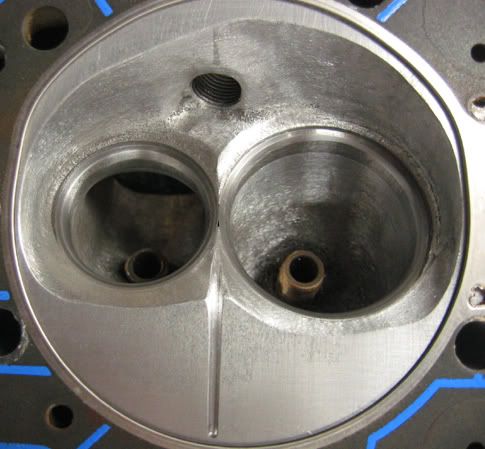
It sort of works, in very specific situations, but not made like that. Most engines for a long time have a similar effect actually designed into the chamber/piston which gives the same result but with much less chance of causing preignition/crack propagation. It can be made to work on old tech 2 valve heads sometimes though.
More commonly known as 'Singh grooves'.
I've used them, but never tried to record any change.
Facts that are for certain:
They don't fill with soot
They don't cause cracks
Some people say they work
There has never been a recorded downside to using them.
They are the kind of thing that you might as well put in, but unless you do an accurate before and after test you'll never know if there were any advantages....
I've used them, but never tried to record any change.
Facts that are for certain:
They don't fill with soot
They don't cause cracks
Some people say they work
There has never been a recorded downside to using them.
They are the kind of thing that you might as well put in, but unless you do an accurate before and after test you'll never know if there were any advantages....
Evoluzione said:
More commonly known as 'Singh grooves'.
I've used them, but never tried to record any change.
Facts that are for certain:
They don't fill with soot
They don't cause cracks
Some people say they work
There has never been a recorded downside to using them.
They are the kind of thing that you might as well put in, but unless you do an accurate before and after test you'll never know if there were any advantages....
I spent some time looking into this, and couldn't find a single before and after test. So no-one knows if there's an upside or downside really. The fact that the inventor has never done such a test does rather detract from his claims IMO.I've used them, but never tried to record any change.
Facts that are for certain:
They don't fill with soot
They don't cause cracks
Some people say they work
There has never been a recorded downside to using them.
They are the kind of thing that you might as well put in, but unless you do an accurate before and after test you'll never know if there were any advantages....
The Black Flash said:
I spent some time looking into this, and couldn't find a single before and after test. So no-one knows if there's an upside or downside really. The fact that the inventor has never done such a test does rather detract from his claims IMO.
I think they are probably application dependent and if they work maybe need a specific conditions to be most effective, there is no downside. Any advantages may be slight and quite difficult to record unless you have very precise equipment to do so.Google 'Automotive Breath', this is a chap who has done some tests and used them (positively) for years, you will also find lots of banter about them on Speedtalk.
A test here: http://www.revsearch.com/grooves/grooves.html
Consider this, if you put a lot of time and money into something and found a distinct advantage over anyone else you probably wouldn't go and tell everyone...
From Singh's viewpoint I can understand that this may well improve combustion on very old moped engine designs running on sacred cow piss, thus struggling against detonation even for normal engine operation.
I have been looking into this in a possible way to get around the fact that some old design heads using 2 (large) valves per chamber have valve seats very close to the edge of the squish area, which prevents pretty much modfying the squish into a ramp on the whole flat area, which I'm sure would help against detonation on engines pretending to run high boost while keeping a decent amount of ignition timing... Has anyone any tip regarding a way to proceed correctly?
I have not been able to find a source mentioning a way to properly dimension the depth and width of Singh grooves in function of a head's characteristics, as it seems most people who use them seem to be sizing them by guess...
Evoluzione, how did you make them? Would you mind sharing pics please? I went through automotivebreath's posts on most forums he has posted on but have not found much info apart that the groove should point towards the exhaust side of the tip of the spark plug...
I have been looking into this in a possible way to get around the fact that some old design heads using 2 (large) valves per chamber have valve seats very close to the edge of the squish area, which prevents pretty much modfying the squish into a ramp on the whole flat area, which I'm sure would help against detonation on engines pretending to run high boost while keeping a decent amount of ignition timing... Has anyone any tip regarding a way to proceed correctly?
I have not been able to find a source mentioning a way to properly dimension the depth and width of Singh grooves in function of a head's characteristics, as it seems most people who use them seem to be sizing them by guess...
Evoluzione, how did you make them? Would you mind sharing pics please? I went through automotivebreath's posts on most forums he has posted on but have not found much info apart that the groove should point towards the exhaust side of the tip of the spark plug...
Edited by Thom on Saturday 5th January 13:59
I'm afraid I don't have any pics, but as they were 4vpc heads they wouldn't have been much use.
A three cornered file is the only tool you'll need, well, apart from a rule and scribe for marking out, but I doubt the gasses will be to a mm.
Click here:
https://www.google.co.uk/search?num=10&hl=en&a...
Right in the centre, second line down are some shapes and a discussion.
I'm unsure why you think you need to try and stave off potential det' and how the squish band will help? Keep it as tight as you can.
A three cornered file is the only tool you'll need, well, apart from a rule and scribe for marking out, but I doubt the gasses will be to a mm.
Click here:
https://www.google.co.uk/search?num=10&hl=en&a...
Right in the centre, second line down are some shapes and a discussion.
I'm unsure why you think you need to try and stave off potential det' and how the squish band will help? Keep it as tight as you can.
Edited by Evoluzione on Saturday 5th January 16:47
I attach a link to a site my mate sent me showing some 'threaded' port mods...lower down the page the author shows his Singh grooves.
http://www.allpar.com/fix/holler/head-porting2.htm...
Personally I am not interested in trying the grooves, I cannot see them being more effective than having the piston close to the head and creating good squish. The only way to tell would be whip off head, mod then refit. I wouldnt skim the head to get cr back as too many other variables would change such as rocker geometry(I play on pushrod stuff mainly). But, as I haven't tried it I cannot really comment, what do folk think about the threaded ports? (I havent tried those either!).
Peter
http://www.allpar.com/fix/holler/head-porting2.htm...
Personally I am not interested in trying the grooves, I cannot see them being more effective than having the piston close to the head and creating good squish. The only way to tell would be whip off head, mod then refit. I wouldnt skim the head to get cr back as too many other variables would change such as rocker geometry(I play on pushrod stuff mainly). But, as I haven't tried it I cannot really comment, what do folk think about the threaded ports? (I havent tried those either!).
Peter
PeterBurgess said:
I attach a link to a site my mate sent me showing some 'threaded' port mods...lower down the page the author shows his Singh grooves.
http://www.allpar.com/fix/holler/head-porting2.htm...
what do folk think about the threaded ports? (I havent tried those either!).
Peter
Well you wouldn't want to do a Merlin head would you? I think doing a two valve single cylinder bike head like that would be enough to put me off for life....http://www.allpar.com/fix/holler/head-porting2.htm...
what do folk think about the threaded ports? (I havent tried those either!).
Peter
Inlet port finish is important though and the rougher the better if it's carrying fuel, that's one of the reasons DI petrol is good as it deals with fuel and air totally separately so you can channel it how you like.
I think that Holler bloke did a PQ head, no results published, he just showed pics and talked about it....
Instead of Singh grooves, I've used simple Von Karman 'dimples' for many a year. I run .040"-.045" quench/squish clearance on my 2.0L Pinto engines. I place the dimples atop the quench area of the piston. Both the plug & opposite sides. One thing I immediately noticed..... the 'burn' pattern across the piston top improved considerably. And on the engine dyno, the BSFC decreased from .480 down to .435. That idicates to me a more efficient burn. As best we could measure over (6) dyno 'pulls', over a 14 hour work day, the HP increased very near 5-6. Dimples work! -84Dave-
84Dave said:
Instead of Singh grooves, I've used simple Von Karman 'dimples' for many a year. I run .040"-.045" quench/squish clearance on my 2.0L Pinto engines. I place the dimples atop the quench area of the piston. Both the plug & opposite sides. One thing I immediately noticed..... the 'burn' pattern across the piston top improved considerably. And on the engine dyno, the BSFC decreased from .480 down to .435. That idicates to me a more efficient burn. As best we could measure over (6) dyno 'pulls', over a 14 hour work day, the HP increased very near 5-6. Dimples work! -84Dave-
Interesting, do you know how the work?The use of dimples, anywhere, highly activates a boundary-layer region. The dimple in the surface forms very small high-to-low-to-high eddies and vortices. Therefore making the surface very 'active' as air/air-fuel/spent exhaust flows across surfaces. If a race engine tends to have low swirl into the head chamber/cylinder, dimples can 'activate' the metal surfaces to improve swirl characteristics. And any 'inactive' areas within the head chamber/piston top can be activated with dimples to mitigate the tendancy of fuel-air separation. For those that may have heard of Jim McFarland, former chief engineer @ Edlebrock,he's the author of (24) chapters in a book entitled "Stock Car Racing Engine Technology - Advanced Engine Theory" (ISBN:978-1-55788-506-7). Dimples are covered in Chapter 9. The book covers racing V-8's,primarily. But his writings certainly also apply to 4 & 6 cylinder racing also. -84Dave-
It's pretty simple really. If you are claiming some combustion improvement from any particular tweek or technique, then you'll have to just back it up with industry std burn rate and combustion data from industry std measurement equipment. Funnily enough, there is an almost perfect correlation between claiming something improves combustion and never having heard of an AVL indimaster etc...............
So, lets see an A-B-A controlled engine dyno test, with 10-90% burn rate and mass fraction heat release data from the effects of these groooves?
So, lets see an A-B-A controlled engine dyno test, with 10-90% burn rate and mass fraction heat release data from the effects of these groooves?
Evoluzione said:
I think they are probably application dependent and if they work maybe need a specific conditions to be most effective,there is no downside.
Any advantages may be slight and quite difficult to record unless you have very precise equipment to do so.
Google 'Automotive Breath', this is a chap who has done some tests and used them (positively) for years, you will also find lots of banter about them on Speedtalk.
A test here: http://www.revsearch.com/grooves/grooves.html
Consider this, if you put a lot of time and money into something and found a distinct advantage over anyone else you probably wouldn't go and tell everyone...
...which is basically what I found before. Anecdotes by people who've done it and reckon it's better (well, they would say that wouldn't they? Any advantages may be slight and quite difficult to record unless you have very precise equipment to do so.
Google 'Automotive Breath', this is a chap who has done some tests and used them (positively) for years, you will also find lots of banter about them on Speedtalk.
A test here: http://www.revsearch.com/grooves/grooves.html
Consider this, if you put a lot of time and money into something and found a distinct advantage over anyone else you probably wouldn't go and tell everyone...
).A test which shows gains of ~1% at one point in the rev range, and losses of <1% at another. And it appears that variability between the tests was at least that big. All that tells me is that it probably does nothing noticable.
I think that by now, if there was anything in it, the major manufacturers would be doing it, and they're not.
I think it was A Graham Bell who said to look at what F1 and the top rally engine builders do . . . if they don't do it then it's not worth thinking about. Obviously not necessarily always true if you are designing for a specific non-power/non-racing purpose but I suspect he's right.
George111 said:
I think it was A Graham Bell who said to look at what F1 and the top rally engine builders do . . . if they don't do it then it's not worth thinking about. Obviously not necessarily always true if you are designing for a specific non-power/non-racing purpose but I suspect he's right.
I'm looking forward to your pics and specifications of current WRC, F1 heads and combustion chambers. Evoluzione said:
George111 said:
I think it was A Graham Bell who said to look at what F1 and the top rally engine builders do . . . if they don't do it then it's not worth thinking about. Obviously not necessarily always true if you are designing for a specific non-power/non-racing purpose but I suspect he's right.
I'm looking forward to your pics and specifications of current WRC, F1 heads and combustion chambers. DVandrews said:
Whereas I agree in principle , the objectives from an F1 or WRC engine might be different from what you require, it's not uncommon for torque to be sacrificed a little for work done, that may not be ideal for a road engine.
Dave
Quite true but the book was about building high performance turbo engines if I remember correctly and it was a general point which I found to be very useful to keep in mind . . . perhaps more for what you ignore from other sources than what you choose to do.Dave
Gassing Station | Engines & Drivetrain | Top of Page | What's New | My Stuff