
Complexity of modern classics
Discussion


I'm sure this has been discussed before but felt it may be worth another airing.
Recently my Bro's RangeRover P38 model has developed an electrical fault which he himself is unable to fix. Took the car to two local garages that I know from personal experience are both top rate garages. Both declined to take on the job of identifying and fixing the electrical gremlin.
From this experience it signals to me that modern classics to be are just far to complex for the average enthusiast to take on. What do you say?
Recently my Bro's RangeRover P38 model has developed an electrical fault which he himself is unable to fix. Took the car to two local garages that I know from personal experience are both top rate garages. Both declined to take on the job of identifying and fixing the electrical gremlin.
From this experience it signals to me that modern classics to be are just far to complex for the average enthusiast to take on. What do you say?
Thanks for replies, agreed about his Rangi although its a tricky fault to live with. Its the temp' gauge fluctuating into the red over heat, yet the engine is fine when we open the bonnet for a look. I think he may fit an aux' temp gauge to monitor the temp' now.
But what of the other classics in the making like some of the BMW, Pokers, merc and so on. They can be complex to fix so good cars destined, through their complexity to be scrap.?
But what of the other classics in the making like some of the BMW, Pokers, merc and so on. They can be complex to fix so good cars destined, through their complexity to be scrap.?
crankedup said:
Thanks for replies, agreed about his Rangi although its a tricky fault to live with. Its the temp' gauge fluctuating into the red over heat, yet the engine is fine when we open the bonnet for a look. I think he may fit an aux' temp gauge to monitor the temp' now.
But what of the other classics in the making like some of the BMW, Pokers, merc and so on. They can be complex to fix so good cars destined, through their complexity to be scrap.?
It probably depends on the exact make and model of car concerned - and the age line you draw to define a 'modern classic'. But what of the other classics in the making like some of the BMW, Pokers, merc and so on. They can be complex to fix so good cars destined, through their complexity to be scrap.?
Range-Rovers do have a reputation for difficult electrics - I don't have any experience of them, so I don't know whether it is justified.
I have a Jaguar XJ40 though which is fairly easy to work on and fix - electrically or otherwise, though it does help that the XJ40 has excellent online forum help available. It has modules certainly, but these are all fairly simple and fully repairable. I don't think the Jaguar XJ40 is difficult to fix - it is just that the cars are now so cheap that many owners cannot be bothered to repair them.
More recent 'modern classics' may be too complex, but I have no experience of them.
A P38 Range Rover isn't all that complicated. Each system has its own ecu. Engine, gearbox, hevac, seats. windows etc. So that makes diagnosis ok. I've never had any problem fixing my P38 or any of my customers.
Your problem is probably a poor connection somewhere. Big advantage of a P38 is the number of them being broken. Why not try a s/h coolant sensor for a start? Then perhaps a gauge?
Have you actually measured the temp of the engine/water?
Your problem is probably a poor connection somewhere. Big advantage of a P38 is the number of them being broken. Why not try a s/h coolant sensor for a start? Then perhaps a gauge?
Have you actually measured the temp of the engine/water?
The P38 Range Rover is a demonstration of how to take a fantastic idea and ruin it. The vast array of electrical gremlins makes ownership such a stressful affair that any journey is tainted by systems that do not work coupled with endless beeping from the alert system. The diesel is an uneconomical and underpowered unit, the petrol has a weak core.
Because of all of the above, unlike the Range Rover Classic and Discovery 1, the P38 will never deserve any kind of classic status, it is simply a cheap old barge. A four wheel drive Citroen XM.
Because of all of the above, unlike the Range Rover Classic and Discovery 1, the P38 will never deserve any kind of classic status, it is simply a cheap old barge. A four wheel drive Citroen XM.
crankedup said:
Its the temp' gauge fluctuating into the red over heat, yet the engine is fine when we open the bonnet for a look....
Isn't that one if the first warning signs for the slipped liner problem?I agree with you about the annoying complexity of modern vehicles. I do as much as I can myself, but find it more and more challenging, and also one of the reasons why I prefer to run older vehicles.
I Googled for a picture of this sensor, and sure enough, apart from the connector it looks exactly like the sensor for my much older classic (70s Triumph). The sensors that are being supplied today are often very substandard and go 'off' quickly. And if it's still the OE sensor it has had time to become faulty.
Suggest you take it out and test it, in a water bath that you can heat from cold to boiling, while measuring the resistance of the sensor and the temperature of the water. There should be a smooth curve of response - see pic. If it's all over the place you know the problem.
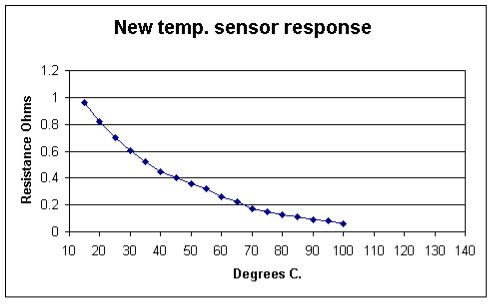
Because the sensor uses change of resistance with temperature, it is sensitive to voltage, which will change with the speed of the engine and the state of the battery. So my classic uses a "voltage stabiliser" to keep the voltage at the sensor to an average of 10V. I know that some older Landies use exactly the same part, but not if a later one such as yours does. If it uses a cheap old bimetallic strip one (little metal box, with a brown plastic back) then those can go off eventually too. Modern solid state versions (black plastic box) are more reliable.
For images, see: http://www.ebay.co.uk/sch/i.html?_trksid=p3872.m57...
JOhn
Suggest you take it out and test it, in a water bath that you can heat from cold to boiling, while measuring the resistance of the sensor and the temperature of the water. There should be a smooth curve of response - see pic. If it's all over the place you know the problem.
Because the sensor uses change of resistance with temperature, it is sensitive to voltage, which will change with the speed of the engine and the state of the battery. So my classic uses a "voltage stabiliser" to keep the voltage at the sensor to an average of 10V. I know that some older Landies use exactly the same part, but not if a later one such as yours does. If it uses a cheap old bimetallic strip one (little metal box, with a brown plastic back) then those can go off eventually too. Modern solid state versions (black plastic box) are more reliable.
For images, see: http://www.ebay.co.uk/sch/i.html?_trksid=p3872.m57...
JOhn
tapkaJohnD said:
The sensors that are being supplied today are often very substandard and go 'off' quickly.
take that for many parts, some electric parts got so bad that they had to be improved and were - even some tight-fisted classic owners realised that no matter how cheap they want the parts to cost them occasional these parts needed to work, not often of course as the most of the classic cars are barely usedGassing Station | Classic Cars and Yesterday's Heroes | Top of Page | What's New | My Stuff