
Are you torquing to me?
Discussion


Cut out of the 'Stupid things non-petrolheads say' thread. Interesting (to engineers) chat about torque production...
"Aw jeez, not this s t again" etc etc..
You can adjust boosted engines by multiplying the capacity by the absolute boost pressure to get similar figures also.
That's what I meant - maybe 'pretty-much fixed' wasn't a good phrase to use 
Tim
"Aw jeez, not this s
t again" etc etc..Kozy said:
"VTECs have no torque"
No, of course not. They're obviously rubbish managing a measly 70lbft/litre+...
I can understand it coming from owners of diesels and turbocharged cars, but this one always sounds retarded coming from the owner of another small capacity NASP engined car, usually which makes less power AND torque.
No, of course not. They're obviously rubbish managing a measly 70lbft/litre+...
I can understand it coming from owners of diesels and turbocharged cars, but this one always sounds retarded coming from the owner of another small capacity NASP engined car, usually which makes less power AND torque.
EDLT said:
Torque/litre gets on my nerves. At least its not as popular as hp/litre.
I also drive a Honda, but not a fast one.
GroundEffect said:
It makes me just think that the person who states it has no comprehension of engine design. Torque/litre is pretty much fixed for a naturally aspirated engine.
Captain Muppet said:
What figure is NA torque/litre fixed at?
I tried working backwards from published data but the results were not consistent. I got figures from 62 Nm/litre to 111 Nm/litre.
I tried working backwards from published data but the results were not consistent. I got figures from 62 Nm/litre to 111 Nm/litre.
Hugo a Gogo said:
I thought torque depended more on the stroke, rather than the displacement
doogz said:
M(Torque)=F*d.
The F is more dependant on head design, and bore, the d is dependant on stroke.
Very simply.
The F is more dependant on head design, and bore, the d is dependant on stroke.
Very simply.
Snowboy said:
I guess you could measure that this 2l engine produces that much torque, but that 2l engune produces that much torque.
So you could compare torque per litre of engine size.
Horsepower is a measurement based on lifting 30lbs 30cm (or something).
So you could put 3l of fuel through an engine and attach the engine to a winch and measure that.
Maybe usefull for lift motors?
So you could compare torque per litre of engine size.
Horsepower is a measurement based on lifting 30lbs 30cm (or something).
So you could put 3l of fuel through an engine and attach the engine to a winch and measure that.
Maybe usefull for lift motors?
JREwing said:
33,000 lbf/minute, I seem to remember.
And yes, I understand that it was devised to measure steam engines employed in place of horses to lift loads from mines, so you'd be bang on there.
And yes, I understand that it was devised to measure steam engines employed in place of horses to lift loads from mines, so you'd be bang on there.
Hugo a Gogo said:
what is the d?
I would have thought that simply a longer crankshaft is a longer lever therefore more torque
I would have thought that simply a longer crankshaft is a longer lever therefore more torque
doogz said:
D is distance.
Not sure what you mean though, unless you meant conrod, in which case I agree.
The crankshaft isn't the lever though.
Not sure what you mean though, unless you meant conrod, in which case I agree.
The crankshaft isn't the lever though.
Hugo a Gogo said:
sorry, very badly written - I mean the throw of the crank, from the middle of the main bearing to the middle of the big end bearing sort of thing
doogz said:
Sorry, you're right. Obviously the throw of the crank is related to the stroke, therefore con rod length.
Anyway, kinda off topic a bit now.
Anyway, kinda off topic a bit now.
xRIEx said:
You're confusing me now: surely con rod length is independent of stroke/crank throw (within certain limits), but dependent on cylinder height (and required compression ratio)? Shorter con rod = lower compression ratio; longer con rod = higher compression ratio; both for a given piston stroke.
doogz said:
But what is your given piston stroke?
If you fitted both of these proposed con rods to the same crank arrangement, to alter the compression ratio, you'd also alter the stroke. The shorter rod may mean lower CR, but it'll also end up further away from the head when at BDC, than your other, longer rod would.
If you fitted both of these proposed con rods to the same crank arrangement, to alter the compression ratio, you'd also alter the stroke. The shorter rod may mean lower CR, but it'll also end up further away from the head when at BDC, than your other, longer rod would.
xRIEx said:
The stroke is completely dependent on the crank pin distance from the crank centre, it is the diameter of the circle the crank pin travels through. A longer conrod (for example) just means the piston is physically higher up the cylinder at TDC and BDC than with a shorter con rod.
Edited by xRIEx on Monday 21st January 13:51
scarble said:
I'm also a powertrain design engineer and I thought it was a bit more complex than just X L = Y Nm.
With head angle, lift, valve timing, port and manifold design and compression ratio having effects, and stroke.. I think it's a long list tbh. Then there's the question of gross vs. net, cos you know, different cars (or even different variants) will have different parasitic loads.
With head angle, lift, valve timing, port and manifold design and compression ratio having effects, and stroke.. I think it's a long list tbh. Then there's the question of gross vs. net, cos you know, different cars (or even different variants) will have different parasitic loads.
GroundEffect said:
Okay, maybe I phrased what I meant wrong (and I see a massive discussion followed). What I did mean is that peak torque directly dictated by thermal efficiency (or the other way around, really). For any well-designed engine - one with low parasitic losses - this will be around the same so your BMEP should be the same, theoretically. You do get some crappy ones as you'll probably find by looking at stats but the BMEP of a naturally aspirated petrol engine has a pretty well-defined limit. An obvious example of this is the difference between a NASCAR V8 and a current F1 V8. They both do what they do in completely different ways (the F1 being 2.4 litres, pneumatic valves and 18,000rpm whereas the NASCAR is pushrob and carb-fed and revs to 9,000rpm) but they both have pretty much the same BMEP. I.e, their specific torque is very similar.
Horsepower/litre is a game with more opportunity for improvement. To do that, you want to improve your volumetric efficiency to get more torque as-high up the rev range that you can...but then it gets interesting to not sacrifice lower-end performance
Horsepower/litre is a game with more opportunity for improvement. To do that, you want to improve your volumetric efficiency to get more torque as-high up the rev range that you can...but then it gets interesting to not sacrifice lower-end performance
scarble said:
Yes but they're both big-money pushed-to-the-limits race engines and both aimed at top end power not torque, so you'd expect them to be close.
Kozy said:
GroundEffect said:
It makes me just think that the person who states it has no comprehension of engine design. Torque/litre is pretty much fixed for a naturally aspirated engine.
It's directly linked to BMEP, how is that showing no comprehension of engine design? It's not fixed either. Agreed, it's a narrow window, but it's not fixed.Captain Muppet said:
What figure is NA torque/litre fixed at?
You'll not see better than 90lbft/litre. 70-80 is good. Anything below about 60 is a bit rubbish.You can adjust boosted engines by multiplying the capacity by the absolute boost pressure to get similar figures also.
Edited by Kozy on Monday 21st January 14:27
GroundEffect said:
Kozy said:
GroundEffect said:
It makes me just think that the person who states it has no comprehension of engine design. Torque/litre is pretty much fixed for a naturally aspirated engine.
It's directly linked to BMEP, how is that showing no comprehension of engine design? It's not fixed either. Agreed, it's a narrow window, but it's not fixed.catman said:
Kozy said:
Torque is dependant on displacement.
If you've got a 500cc cylinder of 86mm x 86mm , with 1000psi in it, then you'll have an 'F' of 1000 x 9.02 (area of piston in inches) = 9025lbf
The instantaneous torque is then 9025lbf x 1.695 'd' (crank radius) = 15297lb/in, or 1274 lbft.
Now, take the same capacity, but with a 72mm stroke and a 94mm bore:
Same 1000psi over a 10.75sqin piston is 10750lbf.
Multiplied over a 1.415" crank radius is 10750 x 1.415 = 15211lbs/in or 1267lbft. The difference is just rounding errors.
The stroke is largely irrelevant in the peak figure compared to the displacement, though it does affect the rpm it is made at.
If you don't know, why not just say so...If you've got a 500cc cylinder of 86mm x 86mm , with 1000psi in it, then you'll have an 'F' of 1000 x 9.02 (area of piston in inches) = 9025lbf
The instantaneous torque is then 9025lbf x 1.695 'd' (crank radius) = 15297lb/in, or 1274 lbft.
Now, take the same capacity, but with a 72mm stroke and a 94mm bore:
Same 1000psi over a 10.75sqin piston is 10750lbf.
Multiplied over a 1.415" crank radius is 10750 x 1.415 = 15211lbs/in or 1267lbft. The difference is just rounding errors.
The stroke is largely irrelevant in the peak figure compared to the displacement, though it does affect the rpm it is made at.
Tim
Kozy said:
You think that's wrong? It's grossly simplified, I'll give you that. I could expand, but it would be so far off topic, the hubble telescope would struggle to pick it up.
As you were...havoc said:

Kozy, displacement is a function of bore and stroke. So there's the first error in your logic.
Second you've assumed constant peak pressure regardless of bore, which is nonsense - the same combustive force applied over a larger bore area will result in a lower peak pressure.
Second, what you said would be correct if we were converting a force into a pressure, but we're not, we're converting a pressure into a force. A 500cc charge when ignited will produce amount of pressure according to how efficiently the energy is extracted, there'll be slight variations depending on flame speed vs bore etc, but generally, the pressures will be similar. That pressure applied over a larger bore equals more force on the crankshaft.
Edited by Kozy on Tuesday 22 January 10:31
Captain Muppet said:
Excellent multiquote OP.
The trouble with discussing engineering on a forum is you can't tell what's been simplified to make a point and what's been simplified because someone's simple.
Well, that's what this thread is for. Let's see who's bluffing... The trouble with discussing engineering on a forum is you can't tell what's been simplified to make a point and what's been simplified because someone's simple.
I am fully prepared to accept I am wrong if someone can prove it, but I do have a lot more to back up my theory than the simple example given.
Kozy said:
Captain Muppet said:
Excellent multiquote OP.
The trouble with discussing engineering on a forum is you can't tell what's been simplified to make a point and what's been simplified because someone's simple.
Well, that's what this thread is for. Let's see who's bluffing... The trouble with discussing engineering on a forum is you can't tell what's been simplified to make a point and what's been simplified because someone's simple.
Well my degree isn't in automotive engineering, so I'm out.


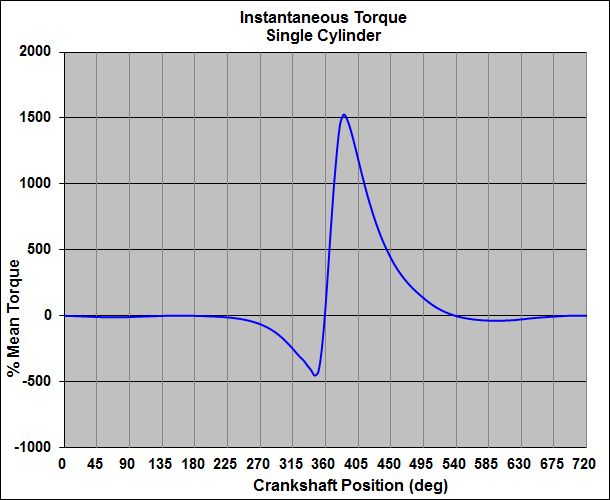
doogz said:
I'd also like to point out that I was coming down from a 3 day bender yesterday, and my comment about stroke being dependant on conrod length was utter horsest, as pointed out by someone (much more politely than that)
Just to mix it up, start an argument, whatever, 'torque is nothing without revs'

Just to save your bacon - conrod length does change the stroke, if your cylinder is offset from your crank centre line. t, as pointed out by someone (much more politely than that)Just to mix it up, start an argument, whatever, 'torque is nothing without revs'
Which it is on some engines.
kambites said:
Given the unit of that graph is "percentage of mean torque" I'd say the answer is "100" for all engines, then. 
The graph shape is true for single cylinder output, the units up the x axis could be lbft or Nm. 'Torque' as we understand it is the average of that, multiplied across however many cylinders you have.Kozy said:
kambites said:
Given the unit of that graph is "percentage of mean torque" I'd say the answer is "100" for all engines, then.
The graph shape is true for single cylinder output, the units up the x axis could be lbft or Nm. 'Torque' as we understand it is the average of that, multiplied across however many cylinders you have.I'd be interested to see one with the actual units on it for a typical cylinder, but I guess one can extrapolate that from the graph and known mean torque figure examples.
ETA: Makes you realise how much work the flywheel is doing on twins and single cylinder engines, though.
Edited by kambites on Tuesday 22 January 10:53
kambites said:
I know, I was just laughing at the uselessness of the units on that particular graph.
I'd be interested to see one with the actual units on it for a typical cylinder, but I guess one can extrapolate that from the graph and known mean torque figure examples.
Yes I'm not really sure what that is supposed to demonstrate really.I'd be interested to see one with the actual units on it for a typical cylinder, but I guess one can extrapolate that from the graph and known mean torque figure examples.
Here's one I made earlier (no really, I did) for the 94m x 72mm 500cc cylinder I used as an example.
Sorry about the crappy quality screen grab. Units are in Nm.

It averages out at 51Nm, over four cylinders that's 150lbft, a decent figure for a 2 litre engine.
Edited by Kozy on Tuesday 22 January 10:56
The Wookie said:
Given equal piston speed (and thus let's assume gas flow) and cylinder pressure through the cycle, a longer throw engine will produce more torque at a lower rotational speed.
Only because it cannot rev as high. If you cannot rev to 8000rpm, then there's no point speccing the head, cams etc to cope with that. A longer stroke engine will have lower limits, and will be designed around that.Conversely, if your geometry allows for 8000rpm, you'd not be doing the engine justice in speccing everything else for maximum torque at 4000rpm.
The point is that theoretically at least, you should be able to get the same torque at low speed from either configuration, but with a shorter stroke, why would you?
doogz said:
How does the actual mass of a dual mass flywheel compare with that of a regular flywheel? It's something I've never quite fully understood. Is the trade off that you have lower inertia on the engine side, effectively a lighter flywheel, whilst having better vibration characteristics?
What is a dual mass flywheel? I'd always assumed it was just a flywheel with a set of weights that could be moved towards and away from the crank shaft to change the rotational inertia at a given engine speed. If that's the case, I'd imagine it weighs about the same as a normal flywheel?
I've never owned a car with one, as far as I know.
Edited by kambites on Tuesday 22 January 11:05
Snowboy said:
Prof Prolapse said:
Can someone else please explain torque to me. Clearly you people have no idea.
The Torque is all around us.It's what holds the universe together.
―Qui-Gon Jinn
Supplement the word "torque" and we have our answer.
Gassing Station | General Gassing | Top of Page | What's New | My Stuff