
C-130 landing on carrier
Discussion


Don't know if this is a well known story, but I came across it the other day.
http://www.theaviationzone.com/factsheets/c130_for...
http://www.youtube.com/watch?v=ar-poc38C84
http://www.theaviationzone.com/factsheets/c130_for...
http://www.youtube.com/watch?v=ar-poc38C84

They operated at between 85,000 to 121,000 lbs AUW which is pretty limited in terms of C130 operations (the APS weight, ie no load, no fuel, of the C130K was of the order of 77,000 lbs).
What they also don't tell you there is that max reverse was being selected at some 45 ft off the deck. This is fine right up until you have a prop hang up on the Fine Pitch Stop - then it's all over.
Aside from the limitations in weight, it was probably the latter that caused the USN to bin the idea.
What they also don't tell you there is that max reverse was being selected at some 45 ft off the deck. This is fine right up until you have a prop hang up on the Fine Pitch Stop - then it's all over.
Aside from the limitations in weight, it was probably the latter that caused the USN to bin the idea.
Ginetta G15 Girl said:
What they also don't tell you there is that max reverse was being selected at some 45 ft off the deck. This is fine right up until you have a prop hang up on the Fine Pitch Stop - then it's all over.
What do you mean by the 'prop hang' as in a runaway situation?
Brother D said:
What do you mean by the 'prop hang' as in a runaway situation?
Each prop on a Herc has a number of protection systems built in, specifically to prevent a large rise in drag should an engine fail during a Tactical Take Off, where you are rotating well below VMCa1, ie three engine (airborne) safety speed.One of the most important is the Fine Pitch Stop(s). This is a series of 3 pins that engage in the spinner as the engine is accelerated from Normal Ground Idle to Flight Idle - the engagement of the pins being a result of centripetal force. Whilst the pins are engaged they physically prevent the prop pitch from fining off below +23 degrees.
To remove the Fine Pitch Stop pins, hydraulic oil is routed to them through a valve as the power levers are brought back through the Flight Idle gate during the landing run. The normal cadence being: Flight Idle - PAUSE - Ground Idle - PAUSE - Reverse - this allows you to catch the a/c if a prop hangs up at the Fine Pitch Stop (ie a pin or pins didn't release). If a prop hangs then you are going to get asymmetric thrust, if you whack the power levers into Max Reverse you are going to get serious asymmetric thrust; so much so that you will lose directional control of the a/c.
Edited by Ginetta G15 Girl on Monday 15th April 23:25
Ginetta G15 Girl said:
Each prop on a Herc has a number of protection systems built in, specifically to prevent a large rise in drag should an engine fail during a Tactical Take Off, where you are rotating well below VMCa1, ie three engine (airborne) safety speed.
One of the most important is the Fine Pitch Stop(s). This is a series of 3 pins that engage in the spinner as the engine is accelerated from Normal Ground Idle to Flight Idle - the engagement of the pins being a result of centripetal force. Whilst the pins are engaged they physically prevent the prop pitch from fining off below +23 degrees.
To remove the Fine Pitch Stop pins, hydraulic oil is routed to them through a valve as the power levers are brought back through the Flight Idle gate during the landing run. The normal cadence being: Flight Idle - PAUSE - Ground Idle - PAUSE - Reverse - this allows you to catch the a/c if a prop hangs up at the Fine Pitch Stop (ie a pin or pins didn't release). If a prop hangs then you are going to get asymmetric thrust, if you whack the power levers into Max Reverse you are going to get serious asymmetric thrust; so much so that you will lose directional control of the a/c.
Was that autofeather or a variation on the theme?.One of the most important is the Fine Pitch Stop(s). This is a series of 3 pins that engage in the spinner as the engine is accelerated from Normal Ground Idle to Flight Idle - the engagement of the pins being a result of centripetal force. Whilst the pins are engaged they physically prevent the prop pitch from fining off below +23 degrees.
To remove the Fine Pitch Stop pins, hydraulic oil is routed to them through a valve as the power levers are brought back through the Flight Idle gate during the landing run. The normal cadence being: Flight Idle - PAUSE - Ground Idle - PAUSE - Reverse - this allows you to catch the a/c if a prop hangs up at the Fine Pitch Stop (ie a pin or pins didn't release). If a prop hangs then you are going to get asymmetric thrust, if you whack the power levers into Max Reverse you are going to get serious asymmetric thrust; so much so that you will lose directional control of the a/c.
Edited by Ginetta G15 Girl on Monday 15th April 23:25
There was no Autofeather on the Allison T56-16 as fitted to the C130K (and the US H Model)
There was an NTS (Negative Torque Sensing) System that would act on the Feather Valve at -1260 +/-60 in.lbs torque. Basically a piston acting on the valve (thus porting hydraulic oil) that would cause the prop to coarsen (as long as you had prop hydraulics). Ultimately, if the negative torque built up too much the prop would 'de-couple' from the reduction gearbox at -6000 in.lbs torque.
Feathering was either Manual via the Engine Condition Levers (Manual control of the feather valve(s)), or electrical via the 'T Handles' (electrical control of the feather valve plus routing of the fire extinguishant path).
There was an NTS (Negative Torque Sensing) System that would act on the Feather Valve at -1260 +/-60 in.lbs torque. Basically a piston acting on the valve (thus porting hydraulic oil) that would cause the prop to coarsen (as long as you had prop hydraulics). Ultimately, if the negative torque built up too much the prop would 'de-couple' from the reduction gearbox at -6000 in.lbs torque.
Feathering was either Manual via the Engine Condition Levers (Manual control of the feather valve(s)), or electrical via the 'T Handles' (electrical control of the feather valve plus routing of the fire extinguishant path).
Edited by Ginetta G15 Girl on Tuesday 16th April 01:24
Chuck328 said:
Ginetta G15 Girl said:
Each prop on a Herc has a number of protection systems built in, specifically to prevent a large rise in drag should an engine fail during a Tactical Take Off, where you are rotating well below VMCa1, ie three engine (airborne) safety speed.
One of the most important is the Fine Pitch Stop(s). This is a series of 3 pins that engage in the spinner as the engine is accelerated from Normal Ground Idle to Flight Idle - the engagement of the pins being a result of centripetal force. Whilst the pins are engaged they physically prevent the prop pitch from fining off below +23 degrees.
To remove the Fine Pitch Stop pins, hydraulic oil is routed to them through a valve as the power levers are brought back through the Flight Idle gate during the landing run. The normal cadence being: Flight Idle - PAUSE - Ground Idle - PAUSE - Reverse - this allows you to catch the a/c if a prop hangs up at the Fine Pitch Stop (ie a pin or pins didn't release). If a prop hangs then you are going to get asymmetric thrust, if you whack the power levers into Max Reverse you are going to get serious asymmetric thrust; so much so that you will lose directional control of the a/c.
Was that autofeather or a variation on the theme?.One of the most important is the Fine Pitch Stop(s). This is a series of 3 pins that engage in the spinner as the engine is accelerated from Normal Ground Idle to Flight Idle - the engagement of the pins being a result of centripetal force. Whilst the pins are engaged they physically prevent the prop pitch from fining off below +23 degrees.
To remove the Fine Pitch Stop pins, hydraulic oil is routed to them through a valve as the power levers are brought back through the Flight Idle gate during the landing run. The normal cadence being: Flight Idle - PAUSE - Ground Idle - PAUSE - Reverse - this allows you to catch the a/c if a prop hangs up at the Fine Pitch Stop (ie a pin or pins didn't release). If a prop hangs then you are going to get asymmetric thrust, if you whack the power levers into Max Reverse you are going to get serious asymmetric thrust; so much so that you will lose directional control of the a/c.
Edited by Ginetta G15 Girl on Monday 15th April 23:25
Ginetta G15 Girl said:
Each prop on a Herc has a number of protection systems built in, specifically to prevent a large rise in drag should an engine fail during a Tactical Take Off, where you are rotating well below VMCa1, ie three engine (airborne) safety speed.
One of the most important is the Fine Pitch Stop(s). This is a series of 3 pins that engage in the spinner as the engine is accelerated from Normal Ground Idle to Flight Idle - the engagement of the pins being a result of centripetal force. Whilst the pins are engaged they physically prevent the prop pitch from fining off below +23 degrees.
To remove the Fine Pitch Stop pins, hydraulic oil is routed to them through a valve as the power levers are brought back through the Flight Idle gate during the landing run. The normal cadence being: Flight Idle - PAUSE - Ground Idle - PAUSE - Reverse - this allows you to catch the a/c if a prop hangs up at the Fine Pitch Stop (ie a pin or pins didn't release). If a prop hangs then you are going to get asymmetric thrust, if you whack the power levers into Max Reverse you are going to get serious asymmetric thrust; so much so that you will lose directional control of the a/c.
One small point of accuracy...The only pins in the spinner locate it on the back plate, otherwise it's just a large lump of fibreglass. One of the most important is the Fine Pitch Stop(s). This is a series of 3 pins that engage in the spinner as the engine is accelerated from Normal Ground Idle to Flight Idle - the engagement of the pins being a result of centripetal force. Whilst the pins are engaged they physically prevent the prop pitch from fining off below +23 degrees.
To remove the Fine Pitch Stop pins, hydraulic oil is routed to them through a valve as the power levers are brought back through the Flight Idle gate during the landing run. The normal cadence being: Flight Idle - PAUSE - Ground Idle - PAUSE - Reverse - this allows you to catch the a/c if a prop hangs up at the Fine Pitch Stop (ie a pin or pins didn't release). If a prop hangs then you are going to get asymmetric thrust, if you whack the power levers into Max Reverse you are going to get serious asymmetric thrust; so much so that you will lose directional control of the a/c.
Edited by Ginetta G15 Girl on Monday 15th April 23:25

EdBarrett said:
I posted about an RV8 build before, didn't get any replies at all =[, I really want one...
Me too. How far did you get with it? Im really still at the planning stage. I have the preview plans, but its like a foreign language. Although the more I go over them the more they are starting to make sense. Also try here: http://www.vansairforce.net/index.htm
I helped build the one in my profile a couple of years ago now. Great kits with 90% of it spot on and the other 10% is covered by various forums and build blogs.
We've just finished building an RV7. It's done it's first two flights and more are planned for this weekend.
Most people tend to start with an empennage kit as it relatively cheap and if you decide building a metal aircraft is not for you then you can sell the bits on a relatively little loss. The empennage covers most of the skills you'll need building the rest of the aircraft so it's a good starting point.
A large shed or garage is essential preferably with a compressor and good lighting. Most of the air tools can be picked up second hand off ebay and the instructions you get from Vans list most of what you need.
Build times vary, the one in my profile to about 2 years to build (flat pack wings, quick build fuselage), but the chap who does our test flying took 7 or 8 years to build his RV8 (all flat pack). The RV7 we've just done took about 2 years, but that was mostly quick build.
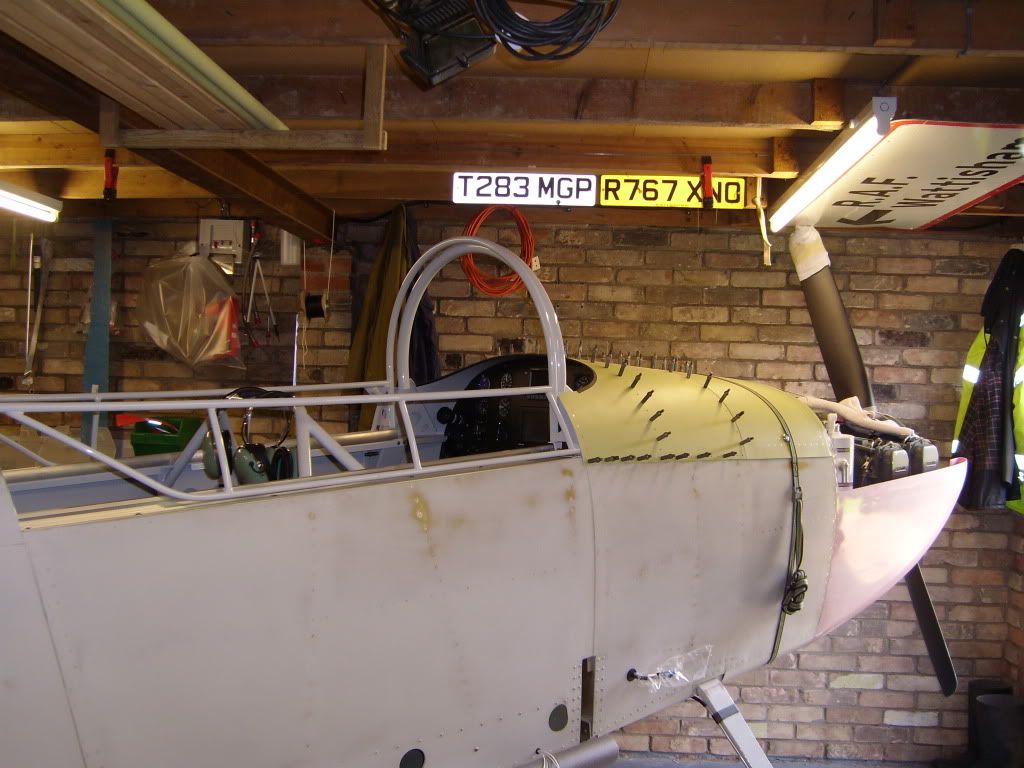
I've only got a few pictures of the build on my computer but here's a couple to go on with......
Just getting ready to fit the last skin and the baggage door...
Trial fit of the wings....

Final fit of the wings...

Later on that year at the LAA rally, Sywell

And to really wet your appetite here's a bit of on board footage (please excuse the music!)
http://www.youtube.com/watch?v=glNZ4EZHIJg
We've just finished building an RV7. It's done it's first two flights and more are planned for this weekend.
Most people tend to start with an empennage kit as it relatively cheap and if you decide building a metal aircraft is not for you then you can sell the bits on a relatively little loss. The empennage covers most of the skills you'll need building the rest of the aircraft so it's a good starting point.
A large shed or garage is essential preferably with a compressor and good lighting. Most of the air tools can be picked up second hand off ebay and the instructions you get from Vans list most of what you need.
Build times vary, the one in my profile to about 2 years to build (flat pack wings, quick build fuselage), but the chap who does our test flying took 7 or 8 years to build his RV8 (all flat pack). The RV7 we've just done took about 2 years, but that was mostly quick build.
I've only got a few pictures of the build on my computer but here's a couple to go on with......
Just getting ready to fit the last skin and the baggage door...
Trial fit of the wings....
Final fit of the wings...
Later on that year at the LAA rally, Sywell
And to really wet your appetite here's a bit of on board footage (please excuse the music!)
http://www.youtube.com/watch?v=glNZ4EZHIJg
Gassing Station | Boats, Planes & Trains | Top of Page | What's New | My Stuff