
HDDs - IDE or SATA?
Discussion


Just go with whatever your motherboard supports. If your motherboard supports SATA then go for that, otherwise IDE.
One thing to note about IDE is that if the motherboard supports ATA-133 then to get the full bandwidth you need ATA-133 cables which have the same connector as an ordinary IDE cable but have twice as many wires. The cables are around £4 so won't break the bank if you need to buy one.
(Of course, your HDD may come with one if you're buying a retail box. I tend to buy OEM bare drives which are much cheaper but come with nothing)
One thing to note about IDE is that if the motherboard supports ATA-133 then to get the full bandwidth you need ATA-133 cables which have the same connector as an ordinary IDE cable but have twice as many wires. The cables are around £4 so won't break the bank if you need to buy one.
(Of course, your HDD may come with one if you're buying a retail box. I tend to buy OEM bare drives which are much cheaper but come with nothing)
docevi1 said:
the only thing been you need to have either a motherboard supporting SATA, or an extra card.
does that mean by adding an additional (PCI?) card that there is a way to use a SATA drive with an IDE mobo? If so, what make, where from, etc etc. I assume that the SATA drive would only work at IDE speeds?
squirrelz said:
SATA is a fatter pipe than IDE.
Oh no it's not! its a faster pipe.
Drives with the 40 pin connector are Parallel ATA, whereas SATA stands for Serial ATA.
Yes, I'm just being pedantic, and you meant a fatter pipe in terms of bandwidth
SATA is still limited though, due to the speed of the bus… but if you're buying new get SATA.
Getting techy, you need to consider the speed of the drive (spin rate) and seek and write times, as well as the cache on the drive. IDE has a theoretical max transfer of 133… whereas SATA is only rated at 150… not much in it for most home users...
Podie said:
IDE has a theoretical max transfer of 133… whereas SATA is only rated at 150… not much in it for most home users...
Especially given no drive techology can come close to those speeds yet.
last I saw drives were pushing 60mb/s to thier interfaces.
Dont forget, alot of the 'SATA' drives are just PATA drives with a SATA controller card on them.
Same physical drives!
JamieBeeston said:
IDE has a theoretical max transfer of 133… whereas SATA is only rated at 150… not much in it for most home users...
Especially given no drive techology can come close to those speeds yet.
last I saw drives were pushing 60mb/s to thier interfaces.
Dont forget, alot of the 'SATA' drives are just PATA drives with a SATA controller card on them.
Same physical drives!
 now we're getting techy!
  :geek:
There's naff all in it between PATA and SATA IMHO. If you want speed look at the seek time, platter rpm and capacity of the drive with capacity making the biggest difference.
My new PC came with a single 400GB SATA HDD (biggest I could get - couldn't afford to stripe two ). On higher capacity disks, because more data is stored on the same sized platters, the data desity is higher. This means that a 7,200rpm drive of 400GB capacity reads and writes way faster than a 7,200rpm drive of, say 120GB capacity because the heads are moving over a greater amount of data per second on the bigger drive due to the higher density. In home use, you'll never hit the capacity of an ATA bus let alone SATA. SATA does have nice neat connectors and cabling though instead of those fat ribbons.
My new PC came with a single 400GB SATA HDD (biggest I could get - couldn't afford to stripe two
). On higher capacity disks, because more data is stored on the same sized platters, the data desity is higher. This means that a 7,200rpm drive of 400GB capacity reads and writes way faster than a 7,200rpm drive of, say 120GB capacity because the heads are moving over a greater amount of data per second on the bigger drive due to the higher density. In home use, you'll never hit the capacity of an ATA bus let alone SATA. SATA does have nice neat connectors and cabling though instead of those fat ribbons.If there is a long thin connector with about 40 little pins on the board thats IDE
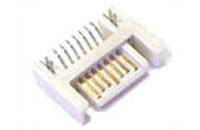
If there are small orangey type connectors thats SATA
If the mobo is more than 12 months old its almost certain to be IDE.
SCSI is quicker but a LOT more expensive so not really worth bothering with for home use IMHO.
If there are small orangey type connectors thats SATA
If the mobo is more than 12 months old its almost certain to be IDE.
SCSI is quicker but a LOT more expensive so not really worth bothering with for home use IMHO.
Gassing Station | Computers, Gadgets & Stuff | Top of Page | What's New | My Stuff