
Shin splints on outside of leg?
Discussion


I started running around 3 months ago following a training plan to run a half marathon. I did one last year and had a couple of aches and pains, nothing worth mentioning, though.
A few weeks ago I noticed a bump on the outside of my shins whilst stretching my legs. The bump is absolutely symmetrical on both legs in position and size and they're soft to touch, almost gel like.
After my long Sunday runs I experience a little discomfort in walking the following day, it feels as if my legs are bruised in that area.
Does anyone have any experience of this? The lumps don't move with skin movement and are positioned pretty much where the red arrow ends in the picture below.
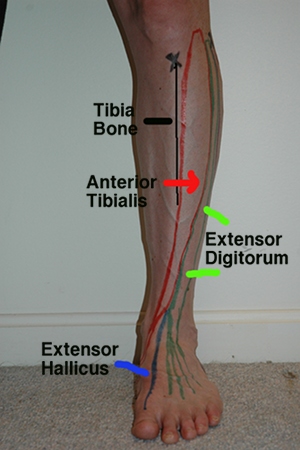
Researching shin splints all seem to indicate pains on the inner shins, near the calf muscle, or the outer which is pretty central. Just seems odd to have it in the same position on both legs, which indicates an injury of some sort?
Found a better picture on the internet. Lumps aren't as protruded as these, but similar location etc. Website indicates a hernia, nice.

http://www.obesityhelp.com/forums/amos/4073430/Var...
A few weeks ago I noticed a bump on the outside of my shins whilst stretching my legs. The bump is absolutely symmetrical on both legs in position and size and they're soft to touch, almost gel like.
After my long Sunday runs I experience a little discomfort in walking the following day, it feels as if my legs are bruised in that area.
Does anyone have any experience of this? The lumps don't move with skin movement and are positioned pretty much where the red arrow ends in the picture below.
Researching shin splints all seem to indicate pains on the inner shins, near the calf muscle, or the outer which is pretty central. Just seems odd to have it in the same position on both legs, which indicates an injury of some sort?
Found a better picture on the internet. Lumps aren't as protruded as these, but similar location etc. Website indicates a hernia, nice.
http://www.obesityhelp.com/forums/amos/4073430/Var...
Edited by Teddye4687 on Monday 2nd September 13:55
Edited by Teddye4687 on Monday 2nd September 13:56
Sounds pretty much what I have - Compartment Syndrome (google it - simply holes in the fuscias where the muscles underneath pushes through the holes). Little bumps in both shins and pain on exertion.
After suffering with it for 20 years, I opted to have the operation but only on one leg as the other isn't too bad. The op doesn't "cure" or fix the problem. The surgeon simply slit open my fascia to enable the muscles more "breathing space" as oppossed to pushing through the tiny existing holes.
End result, after a few painful weeks of recovery (was signed off work for 2 months), I no longer feel any pain in my leg. I'm lifting weights, brisk walking and jogging with absolutely no pain. It can be a strange sensation to "feel" the slits "flapping" slightly buy you become acumstomed to it.
Get a referral from your GP to get this looked at. The consultant essentially said it was a case of living with the pain, or not. I didn't want it done but having tried everything after 20 years, I found the simple things like walking become unbearable and found my leg used to "give way" on simple walks!
After suffering with it for 20 years, I opted to have the operation but only on one leg as the other isn't too bad. The op doesn't "cure" or fix the problem. The surgeon simply slit open my fascia to enable the muscles more "breathing space" as oppossed to pushing through the tiny existing holes.
End result, after a few painful weeks of recovery (was signed off work for 2 months), I no longer feel any pain in my leg. I'm lifting weights, brisk walking and jogging with absolutely no pain. It can be a strange sensation to "feel" the slits "flapping" slightly buy you become acumstomed to it.
Get a referral from your GP to get this looked at. The consultant essentially said it was a case of living with the pain, or not. I didn't want it done but having tried everything after 20 years, I found the simple things like walking become unbearable and found my leg used to "give way" on simple walks!
Teddye4687 said:
You made it out to be a lot less serious 
I suppose there may be different severity levels. I think the more severa cases occur in, for example, car accidents where the legs can suffer severe trauma. I was told by the consultant that the injury can be suffered by people involved in car accidents. Technically, the injury I had is the same as those suffered by people who suffered severe trauma in their legs, but as mentioned, there has to be different classification of severity.Hope this reassures you!
This is the operation (fasciotomy) I had although it was not a medical emergency.
Wikipedia quote =
Acute compartment syndrome[edit source]
Acute compartment syndrome is a medical emergency requiring immediate surgical treatment, known as a fasciotomy, to allow the pressure to return to normal. Although only one compartment is affected, fasciotomy is done to release all compartments. For instance, if only the deep posterior compartment of a leg is affected, the treatment would be fasciotomy (with medial and lateral incisions) to release all compartments of the leg in question, namely the anterior, lateral, superficial posterior and deep posterior.[12] An acute compartment syndrome has some distinct features such as swelling of the compartment due to inflammation and arterial occlusion. Decompression of the nerve traversing the compartment might alleviate the symptoms (Rorabeck, 1984).
Gassing Station | Health Matters | Top of Page | What's New | My Stuff