
Discussion


Hope this is a) in the right section and b) not deemed a stupid question?
I've been doing some track days and speed events over the past 2 years and have had some instruction, when funds have allowed. My most recent instruction was at Brands Hatch, where I was deemed to be doing pretty well, however I have a problem with my braking technique. I am braking initially and then increasing brake pressure progressively, to the point where I would come off the brakes and turn in, instead of vice versa. I realise I want to be braking as hard as possible but is there a particular track / race technique I should be looking to apply?
Did anyone else have similar driving habits to overcome?
I went out as a passenger in a friends E30 M3 and his braking seemed overly aggressive to me, to the point where he was just stamping on the pedal. Is this how I should be looking to brake myself? I thought it would be better to drive with an element of mechanical sympathy and not unsettle the car with such aggressive braking input?
Any help and/or advice in improving my track driving technique would be much appreciated.
I've been doing some track days and speed events over the past 2 years and have had some instruction, when funds have allowed. My most recent instruction was at Brands Hatch, where I was deemed to be doing pretty well, however I have a problem with my braking technique. I am braking initially and then increasing brake pressure progressively, to the point where I would come off the brakes and turn in, instead of vice versa. I realise I want to be braking as hard as possible but is there a particular track / race technique I should be looking to apply?
Did anyone else have similar driving habits to overcome?
I went out as a passenger in a friends E30 M3 and his braking seemed overly aggressive to me, to the point where he was just stamping on the pedal. Is this how I should be looking to brake myself? I thought it would be better to drive with an element of mechanical sympathy and not unsettle the car with such aggressive braking input?
Any help and/or advice in improving my track driving technique would be much appreciated.
I brake as you describe, starting off lightly and then progressively increasing the pressure, the heaviest braking just before turn in, and then roll off the brakes as you roll on the lock. The progression is pretty rapid but is by no means a stamp.
The reason, when you start to brake weight transfer pushes the front tyres into the track, you therfore have more grip available and therefore you can brake harder, the harder you brake the more weight is transferred and therfore more grip is available, this cycle continues up to the limit of Weight transfer and therfore your grip, then you lock up if you ask for more.
The stamp method grabs at the brakes, asking for a rapid deceleration but without the extra grip of the weight transfer to help, therefore lock up tends to happen a lot easier. In addition the stamp method introduces a large amount of instability due to the car diving rapidly and tends to destabilise the rear.
You don't want to take 300yds to complete braking that could be done in 100 by being too progressive, but neither do you want to stamp at the last second.
I know some drivers prefer the stamp, but I like to try and drive as smooth as possible and the progressive method achieves this better.
Trail braking is also a lot easier to achieve with the progressive method as the car is more stable.
In addition the stamp method is practically useless in the wet, progressive is the only way to find the limit of grip.
The reason, when you start to brake weight transfer pushes the front tyres into the track, you therfore have more grip available and therefore you can brake harder, the harder you brake the more weight is transferred and therfore more grip is available, this cycle continues up to the limit of Weight transfer and therfore your grip, then you lock up if you ask for more.
The stamp method grabs at the brakes, asking for a rapid deceleration but without the extra grip of the weight transfer to help, therefore lock up tends to happen a lot easier. In addition the stamp method introduces a large amount of instability due to the car diving rapidly and tends to destabilise the rear.
You don't want to take 300yds to complete braking that could be done in 100 by being too progressive, but neither do you want to stamp at the last second.
I know some drivers prefer the stamp, but I like to try and drive as smooth as possible and the progressive method achieves this better.
Trail braking is also a lot easier to achieve with the progressive method as the car is more stable.
In addition the stamp method is practically useless in the wet, progressive is the only way to find the limit of grip.
Edited by scotty_dog on Sunday 29th September 16:30
Edited by scotty_dog on Sunday 29th September 16:33
Thanks for the reply.
I guess I was just braking as came naturally to me and I hadn't really considered my method, till it was pointed out to me. My car is pretty light at well under 950kgs and I was conscious of locking up, if I was too aggressive. Corners I struggle being consistent with are Paddock Hill bend and Druids. Obviously I try and carry as much speed through Paddock as I can and capitalise on the fact I'm going uphill at Druids, so can brake that bit later. I guess I could also be a bit more aggressive with the pedal there too? The reason I found myself questioning my braking was the instructors comments, that I should be exerting maximum braking immediately, then progressively coming off the pedal, instead of which I was doing the opposite.
I intend on having some more instruction next year, as it was probably the single most improvement to my lap times. I also want to lose some weight now that the car is about as light as I can get it.
You mention trail braking. When is that a method I should employ?
I guess I was just braking as came naturally to me and I hadn't really considered my method, till it was pointed out to me. My car is pretty light at well under 950kgs and I was conscious of locking up, if I was too aggressive. Corners I struggle being consistent with are Paddock Hill bend and Druids. Obviously I try and carry as much speed through Paddock as I can and capitalise on the fact I'm going uphill at Druids, so can brake that bit later. I guess I could also be a bit more aggressive with the pedal there too? The reason I found myself questioning my braking was the instructors comments, that I should be exerting maximum braking immediately, then progressively coming off the pedal, instead of which I was doing the opposite.
I intend on having some more instruction next year, as it was probably the single most improvement to my lap times. I also want to lose some weight now that the car is about as light as I can get it.
You mention trail braking. When is that a method I should employ?
Hitting the brakes hard and then rolling off is the wrong way around, progressively build up the pressure so that maximum braking and therefore grip is just before turn in, brake pressure is then decreased as lock is applied.
Use the friction circle to visualise the brake pressure roll off and lock increase ratio, ie if 100% of grip is used for braking then there is nothing for turning, reduce braking grip requirement by 10% you can use that for turning, so as you wind lock on you need to provide the grip for that by reducing brake pressure. This is the principal for trail braking.
If you stamp on the brakes and then reduce the pressure as you approach turn in you have less weight over the front of the car and therefore grip.
Use the friction circle to visualise the brake pressure roll off and lock increase ratio, ie if 100% of grip is used for braking then there is nothing for turning, reduce braking grip requirement by 10% you can use that for turning, so as you wind lock on you need to provide the grip for that by reducing brake pressure. This is the principal for trail braking.
If you stamp on the brakes and then reduce the pressure as you approach turn in you have less weight over the front of the car and therefore grip.
I'm surprised the instructor didn't show you how to trail brake. I could try and explain it but I would just be explaining what happens in this video:
http://m.youtube.com/watch?v=xQRmYMlmdqM
http://m.youtube.com/watch?v=xQRmYMlmdqM
Trail braking is normally best applied to the slower tighter corners, such as Druids, Graham Hill and clearways, paddock is too fast for it to be useful, it tends to induce oversteer.
Your technique is correct, it may require a little refining for it to be spot on, but from your explanation I wouldn't be changing anything radically.
If I can be of any use with coaching, please get in touch.
Your technique is correct, it may require a little refining for it to be spot on, but from your explanation I wouldn't be changing anything radically.
If I can be of any use with coaching, please get in touch.
scotty_dog said:
Hitting the brakes hard and then rolling off is the wrong way around, progressively build up the pressure so that maximum braking and therefore grip is just before turn in, brake pressure is then decreased as lock is applied.
That's all very good in theory but it very much depends on the car, weight distribution, tyres used, etc. Some cars you need to get on the brakes hard and fast to transfer the weight the quickly or the car won't brake efficiently.Dan
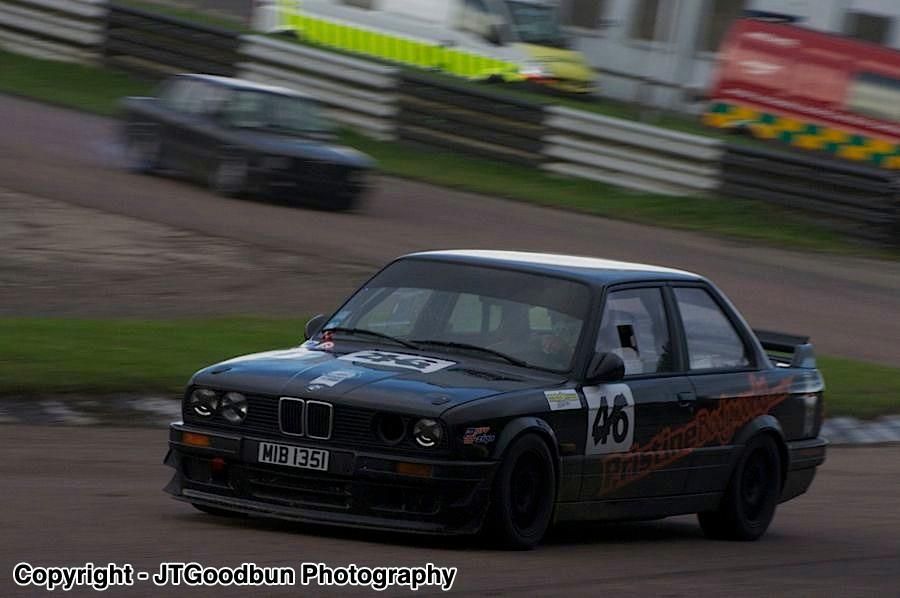
Till recently I drove an E30 BMW 320is with 300bhp, that was stripped and prepared for sprints and hillclimb events. I had uprated the brakes with Wilwood 4 pots and Hawk pads. The tyres were 15'' 888's in medium compound. Next year I will be in an E21 Group 2 replica of similar spec.
Edited by e21Mark on Sunday 29th September 23:08
There are three things to consider (all assuming straight line braking).
Initial brake
- Hit the pedal hard and fast. As load transfers onto the front axle there is a momentary deceleration rate that cannot be achieved with progressive braking. (This is considering a track car, not a downforce race car!)
Mid brake
- Try not to get into ABS as you'll not be achieving the best possible decel, but want to use the most brake pressure as possible.
Into the corner
- Ease off the pedal and you roll the car into the corner smoothly. The smoother you are with the steering and brake the more you will get out of the car.
Initial brake
- Hit the pedal hard and fast. As load transfers onto the front axle there is a momentary deceleration rate that cannot be achieved with progressive braking. (This is considering a track car, not a downforce race car!)
Mid brake
- Try not to get into ABS as you'll not be achieving the best possible decel, but want to use the most brake pressure as possible.
Into the corner
- Ease off the pedal and you roll the car into the corner smoothly. The smoother you are with the steering and brake the more you will get out of the car.
Not sure, as in all the things I've raced and coached in over the years, the hard and fast method destabilises the car and loses way more than you could gain from it.
As I said originally it is important to differentiate between stamping on the brakes and squeezing them progressively over a short period.
As I said originally it is important to differentiate between stamping on the brakes and squeezing them progressively over a short period.
I think the confusion here is that you must press the brakes hard and you must do so as quickly as possible without de-stabilising the car. To most people with little track experience that is far faster and harder than they expect. It's not stamping on the brakes, but it could often be described as that in comparison to what you'd do on the road.
From some karting (I know totally different but still..), tutition I had some years ago- the guy teaching me was adament that stamping on the brakes for a really short dab deep into the corners was the way to go.
I spent the entire day trying to get the hang of it, and just could not get on with it. I kept turning in with little weight transfer, and found trail braking non-existent.
Anyway, we both went out in the kart at different times and achieved exactly the same times.
Horses for course me thinks.
Guessing in racing, the deep late brakers who stamp might be better placed for track position?
Kam
I spent the entire day trying to get the hang of it, and just could not get on with it. I kept turning in with little weight transfer, and found trail braking non-existent.
Anyway, we both went out in the kart at different times and achieved exactly the same times.
Horses for course me thinks.
Guessing in racing, the deep late brakers who stamp might be better placed for track position?
Kam
Henry Fiddleton said:
From some karting (I know totally different but still..), tutition I had some years ago- the guy teaching me was adament that stamping on the brakes for a really short dab deep into the corners was the way to go.
I spent the entire day trying to get the hang of it, and just could not get on with it. I kept turning in with little weight transfer, and found trail braking non-existent.
Anyway, we both went out in the kart at different times and achieved exactly the same times.
Horses for course me thinks.
Guessing in racing, the deep late brakers who stamp might be better placed for track position?
Kam
What you aren't taking account of there, is a Kart doesn't have suspension, whereas a car does, and therefore trailbraking is far more appropriate to turning a car in, than a kart!! It is the only tool you have in the box to manage and control weight transfer!!I spent the entire day trying to get the hang of it, and just could not get on with it. I kept turning in with little weight transfer, and found trail braking non-existent.
Anyway, we both went out in the kart at different times and achieved exactly the same times.
Horses for course me thinks.
Guessing in racing, the deep late brakers who stamp might be better placed for track position?
Kam
Thanks for the posts guys.
I, like a few people I imagine, started off on a few track days thinking that I knew how to drive quickly. I soon came to the conclusion that thinking and being were poles apart. My problem has been just not knowing the correct method of driving a car quickly on a circuit. I have improved though. I am 6 seconds a lap quicker around Brands Hatch Indy, than I was that first day. I could do a consistent 59.8 in a 325 e30. I just seem to be at a point where I can't improve. I have a Qstarz data logger and my 3 best sectors make a 59.1 but it feels unachievable.
I, like a few people I imagine, started off on a few track days thinking that I knew how to drive quickly. I soon came to the conclusion that thinking and being were poles apart. My problem has been just not knowing the correct method of driving a car quickly on a circuit. I have improved though. I am 6 seconds a lap quicker around Brands Hatch Indy, than I was that first day. I could do a consistent 59.8 in a 325 e30. I just seem to be at a point where I can't improve. I have a Qstarz data logger and my 3 best sectors make a 59.1 but it feels unachievable.
Gassing Station | UK Club Motorsport | Top of Page | What's New | My Stuff