
What plane did I just see?
Discussion


On Monday I was out in the garden and heard a plane go overhead. Nothing unusual. Sounded like a small plane.
However, as I looked up at it, it didn't look anything like a conventional plane. I can only describe that instead of having wings in the "middle", it had the wings right at the back.
I didn't think much of it, but then it came back overhead a hour or so later, this time my Dad was with me. He also hadn't seen anything like it before.
Any ideas?
It was lear jet size.
Sorry for the non-technical words. Just intrigued as to what it was...
However, as I looked up at it, it didn't look anything like a conventional plane. I can only describe that instead of having wings in the "middle", it had the wings right at the back.
I didn't think much of it, but then it came back overhead a hour or so later, this time my Dad was with me. He also hadn't seen anything like it before.
Any ideas?
It was lear jet size.
Sorry for the non-technical words. Just intrigued as to what it was...


No - it is a valid alternative to conventional aircraft design and has some superior characteristics - such as difficulty to stall.
However, Rutan also uses composites rather than metals - his company is called Scaled Composites Inc - and that was the downfall of the Starship. The composite structure used wan;t considered robust enough for insurers.
However, Rutan also uses composites rather than metals - his company is called Scaled Composites Inc - and that was the downfall of the Starship. The composite structure used wan;t considered robust enough for insurers.
I thought you were asking about the ethos behind the whole canard concept as that is the main design feature of many Rutan aircraft.
The Rutan Voyager, the first aeroplane to fly non-stop and unrefuelled around the globe, followed Rutan's canard principles. It had both a pusher AND a puller propeller -
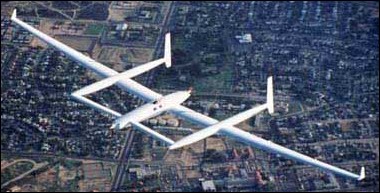
The Rutan Voyager, the first aeroplane to fly non-stop and unrefuelled around the globe, followed Rutan's canard principles. It had both a pusher AND a puller propeller -
Eric Mc said:
Almost impossible to be a Beech Starship as they are effectively retired now (apart from a couple operated by Rutan in the US).
However, it could have been one of the many other Burt Rutan canard designs - of which a reasonable number are based in the UK.
I assumed it would be the Piaggio, but I'd thought i'd through in a gratuitous picture of the Starcraft! However, it could have been one of the many other Burt Rutan canard designs - of which a reasonable number are based in the UK.
I do like these two aircraft, its good to see something different
doogz said:
That was fitted with a pair of piston engines, wasn't it?
Does fitting a turboprop in a pusher arrangement have any drawbacks over a conventional tractor arrangement?
It was.Does fitting a turboprop in a pusher arrangement have any drawbacks over a conventional tractor arrangement?
It's not been tried that often as far as I can recall so there must not be any perceived advantages.

I would think with an aeroplane like the Cessna it wouldn't make an awful lot of difference. The front propeller is probably more efficient when both props are working due to the rear prop working turbulent air coming back from the front prop. If the front prop failed, maybe the rear prop becomes slightly more efficient.
The push/pull layout is actually considered safer than a traditional twin in the case of a single engine failure because there is no swing.
The push/pull layout is actually considered safer than a traditional twin in the case of a single engine failure because there is no swing.
Eric Mc said:
I would think with an aeroplane like the Cessna it wouldn't make an awful lot of difference. The front propeller is probably more efficient when both props are working due to the rear prop working turbulent air coming back from the front prop. If the front prop failed, maybe the rear prop becomes slightly more efficient.
The push/pull layout is actually considered safer than a traditional twin in the case of a single engine failure because there is no swing.
Considerably safer. In some twins as I understand it if an engine fails say at takeoff it is game over. The push/pull layout is actually considered safer than a traditional twin in the case of a single engine failure because there is no swing.
Some twins need both engines in order to function - recently here in Panama a secret US mission was compromised because their rented twin suffered an engine failure during the final approach and the plane - a variant of the BN Islander - could not continue on one engine. It had to crash land on a small island at the entrance to the canal.
Gassing Station | Boats, Planes & Trains | Top of Page | What's New | My Stuff