
Minimum brake pad thickness (MOT) - for VW Golf
Discussion


Evening ladies and gents,
Quick question for you guys.
I had my MOT in May, which had an advisory on the front brake pads (close to limits). I thought I would wait till the brake warning light comes on before I change them, however nothing yet. I've looked at the pad thickness through the wheel and they look the same as in May, bearing in mind I am light braker.
Therefore my question is, what is the MOT thickness limit and what will be first, the MOT limit or the wear indicator light limit?
Thanks,
Sav
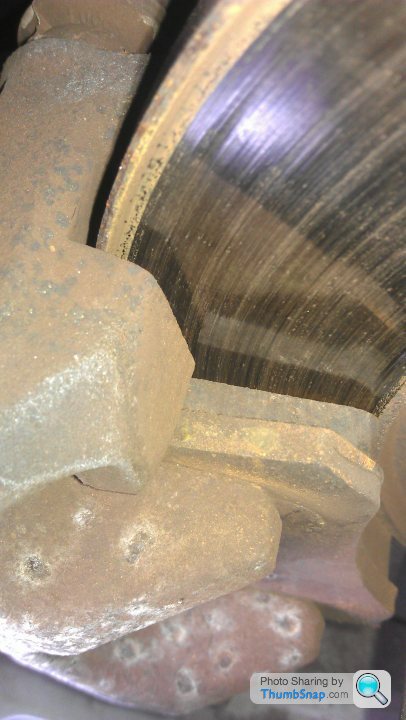
1.5mm is not the minimum thickness.
IIRC it's 2mm on the front pads of The Beast. That said, the wear indicator 'switch' is set at about 5mm. Additionally, I've always had problems getting the pistons back in when the pads are worn to 3mm or less. ETA: also the calliper pistons pop out really easily when you get down to the minimum levels - as I found out at Oulton Park.
ECP did have genuine Bosch pads on offer at 60% off recently - which was handy as I'd worn out a set at Oulton Park. Should have bought two sets!
Edited by mk1fan on Sunday 15th December 21:04
mk1fan said:
1.5mm is not the minimum thickness.
IIRC it's 2mm on the front pads of The Beast. That said, the wear indicator 'switch' is set at about 5mm. Additionally, I've always had problems getting the pistons back in when the pads are worn to 3mm or less. ETA: also the calliper pistons pop out really easily when you get down to the minimum levels - as I found out at Oulton Park.
ECP did have genuine Bosch pads on offer at 60% off recently - which was handy as I'd worn out a set at Oulton Park. Should have bought two sets!
Already bought the pads. I am keeping an eye on the pads every now and then, but will make sure they don't go into the MOT in May anywhere near 2mm.IIRC it's 2mm on the front pads of The Beast. That said, the wear indicator 'switch' is set at about 5mm. Additionally, I've always had problems getting the pistons back in when the pads are worn to 3mm or less. ETA: also the calliper pistons pop out really easily when you get down to the minimum levels - as I found out at Oulton Park.
ECP did have genuine Bosch pads on offer at 60% off recently - which was handy as I'd worn out a set at Oulton Park. Should have bought two sets!
Edited by mk1fan on Sunday 15th December 21:04
TBH I will probably find that they start squeaking when they hit circa 2mm I imagine.

DocArbathnot said:
MOT will not fail you on thickness only efficiency.
REALLY?See this bothers me on Pistonheads. Someone who "thinks" they know and then posts as it they DO know. When a quick search reveals!
http://www.motinfo.gov.uk/htdocs/m4s03000501.htm
Third column.
Point G

ViperDave said:
That pic is nice but what about the inside pad, could easily be down to the backing plate for all we know, and chances are if your not regularly servicing them they wont be wearing out evenly, The MOT tester will have looked at both not just the outside one through the wheel.
I'm an MOT tester. Very often you can't see with any degree of accuracy the thickness of inner brake pads which makes the 1.5mm rule a bit awkward. ViperDave said:
That pic is nice but what about the inside pad, could easily be down to the backing plate for all we know, and chances are if your not regularly servicing them they wont be wearing out evenly, The MOT tester will have looked at both not just the outside one through the wheel.
I was thinking the same, the pad in the shot has plenty of meat but sliding calipers do tend to do the inner pads first.Rich_W said:
DocArbathnot said:
MOT will not fail you on thickness only efficiency.
REALLY?See this bothers me on Pistonheads. Someone who "thinks" they know and then posts as it they DO know. When a quick search reveals!
http://www.motinfo.gov.uk/htdocs/m4s03000501.htm
Third column.
Point G
Spangles said:
ViperDave said:
That pic is nice but what about the inside pad, could easily be down to the backing plate for all we know, and chances are if your not regularly servicing them they wont be wearing out evenly, The MOT tester will have looked at both not just the outside one through the wheel.
I'm an MOT tester. Very often you can't see with any degree of accuracy the thickness of inner brake pads which makes the 1.5mm rule a bit awkward. Never had a problem over the years testing/servicing,a small telescopic mirror with a pencil led torch are allowed !
But If the mot tester cant see a particular pad on test he should not instinctively say its close to the minimum allowed.
pmjg66 said:
Spangles said:
ViperDave said:
That pic is nice but what about the inside pad, could easily be down to the backing plate for all we know, and chances are if your not regularly servicing them they wont be wearing out evenly, The MOT tester will have looked at both not just the outside one through the wheel.
I'm an MOT tester. Very often you can't see with any degree of accuracy the thickness of inner brake pads which makes the 1.5mm rule a bit awkward. Never had a problem over the years testing/servicing,a small telescopic mirror with a pencil led torch are allowed !
But If the mot tester cant see a particular pad on test he should not instinctively say its close to the minimum allowed.
Also I agree its possible the MOT tester may not have been able to observe the inner pad, but given they have issued an advisory it would indicate that they could see that at least one of the pads in the system was in need of particular attention and we have been shown only 1 out of the 4 pads that could have a potential issue, as such it would seem prudent to me to at least remove the wheels and make an inspection of all pads rather than just the easily visible one.
Should this inspection reveal 4 pads that look like the photo the OP can probably deduce the MOT station was trying it on. If on the other hand one or more are significantly more worn, then checks should be undertaken to find out why they are wearing unevenly, It may just be the nature of the calliper design but it could indicate a problem, so checks to ensure nothing has seized and everything is functioning properly for maximum braking efficiency would seem wise, also depending on the attitude and capability of the OP and if they are doing the work themselves or paying someone else, it may be cost effective once the system is dismantled, that replacing the relatively cheap pads may be prudent at this stage rather re-assembling and repeating the work in a few months when the final bit of pad has been used up.
Its also a fact of life that not all pads will wear out together and you will inevitably throw some good pad away because another has reached end of life and its best practice to replace all pads on an axle together.
So back to my original much shorter post, that picture is all very nice but only represents 25% of the pads in question, so what are the others like?
Gassing Station | Audi, Seat, Skoda & VW | Top of Page | What's New | My Stuff