
wideband O2 vs narrowband
Discussion


stevieturbo said:
SO basically DTM power are posting a video showing how completely useless their product and narrowband setup is !!!
Now that's weird !
Is that a statement or a question ?Now that's weird !
If it's a statement then it is entirely wrong.
Are you suggesting that a wideband setup is better ?
tottacrolla said:
Is that a statement or a question ?
If it's a statement then it is entirely wrong.
Are you suggesting that a wideband setup is better ?
It's fairly clear it is a statement of their stupidity.. And is that a serious question you're asking ?If it's a statement then it is entirely wrong.
Are you suggesting that a wideband setup is better ?
There isnt even a suggestion a wideband is better. It is fact.
Of course it does depend on what "better" means to you.
If Better = totally useless AFR display then no, a wideband is not better.
If Better = a functional AFR display covering all normal mixtures seen and used by most engines, then it's pretty apparent narrowband is useless, even if you do light up some LED's with it in a £5 kit.
stevieturbo said:
It's fairly clear it is a statement of their stupidity.. And is that a serious question you're asking ?
There isnt even a suggestion a wideband is better. It is fact.
Of course it does depend on what "better" means to you.
If Better = totally useless AFR display then no, a wideband is not better.
If Better = a functional AFR display covering all normal mixtures seen and used by most engines, then it's pretty apparent narrowband is useless, even if you do light up some LED's with it in a £5 kit.
So in your opinion what do you consider is the difference between the two units in the video and what do you call normal mixtures ?There isnt even a suggestion a wideband is better. It is fact.
Of course it does depend on what "better" means to you.
If Better = totally useless AFR display then no, a wideband is not better.
If Better = a functional AFR display covering all normal mixtures seen and used by most engines, then it's pretty apparent narrowband is useless, even if you do light up some LED's with it in a £5 kit.
Edited by tottacrolla on Saturday 15th February 22:13
https://www.youtube.com/watch?v=Zzn3-ygH-v8
see 2:20 >
And your screen shot shows that the narrowband unit acts quicker than the Innovate WB as 1 second later the Innovate catches up.... watch again.
p.s I'm not trying to prove anything here I have both units and wanted to do a comparison between the two.
I thought people may be interested in the results.
My personal opinion is that an engine should be set up and mapped properly on an engine dyno and an afr meter if required should be used in the same way that you would use an oil pressure gauge.
see 2:20 >
And your screen shot shows that the narrowband unit acts quicker than the Innovate WB as 1 second later the Innovate catches up.... watch again.
p.s I'm not trying to prove anything here I have both units and wanted to do a comparison between the two.
I thought people may be interested in the results.
My personal opinion is that an engine should be set up and mapped properly on an engine dyno and an afr meter if required should be used in the same way that you would use an oil pressure gauge.
Edited by tottacrolla on Saturday 15th February 23:07
Edited by tottacrolla on Saturday 15th February 23:16
tottacrolla said:
So in your opinion what do you consider is the difference between the two units in the video and what do you call normal mixtures ?
I'm struggling to believe these are serious questions ? OK you may be either naive or clueless, so maybe I'll try and entertain you.Edited by tottacrolla on Saturday 15th February 22:13
Narrowband is for one purpose only and is reflects mixture accurately at one AFR only...ie stioch, 14.7:1 or whatever you want to call it
It isnt opinion, it is fact. Narrowband is useless anywhere other than the above.
And normal mixtures vary depending on engine and what you're trying to achieve. They are certainly not always 14.7:1
tottacrolla said:
https://www.youtube.com/watch?v=Zzn3-ygH-v8
see 2:20 >
And your screen shot shows that the narrowband unit acts quicker than the Innovate WB as 1 second later the Innovate catches up.... watch again.
p.s I'm not trying to prove anything here I have both units and wanted to do a comparison between the two.
I thought people may be interested in the results.
My personal opinion is that an engine should be set up and mapped properly on an engine dyno and an afr meter if required should be used in the same way that you would use an oil pressure gauge.
No, it shows the NB is inaccurate and their display is ssee 2:20 >
And your screen shot shows that the narrowband unit acts quicker than the Innovate WB as 1 second later the Innovate catches up.... watch again.
p.s I'm not trying to prove anything here I have both units and wanted to do a comparison between the two.
I thought people may be interested in the results.
My personal opinion is that an engine should be set up and mapped properly on an engine dyno and an afr meter if required should be used in the same way that you would use an oil pressure gauge.
 t, although largely because it can never be accurate for what you're trying to do because the sensor isnt appropriate for anything other than rich/lean
And you're "max power" AFR would see almost every turbo engine destroyed in a very short time. N/A may survive ok, but again, NB isnt accurate at those claimed mixtures to start with so the display is useless.
As for interested....amused might be a better word, or flabbergasted that someone might think a cheap s
t £5 display is better than a wideband.And I guess you could make a comparison to an oil pressure gauge...if it only had one single reading say 50psi and nothing else and the needle only moved left/right of this.
So 0-50 and 50-infinity ? Not very practical as you could have 1psi or 49psi and could never tell the difference.
You may have both units, the NB is a cheap piece of turd and nothing more than a novelty and of almost no use whatsoever to anyone tuning an engine.

stevieturbo said:
Holy F !!! Asking almost £150 for that !!!!!!!!!!!!!!!!!!!!!!
One born every minute, but it is horrible to see shops ripping people off with crap like that
You do appear to be extremely opinionated about what is essentially two harmless videos uploaded for the benefit of the readers of this forum.One born every minute, but it is horrible to see shops ripping people off with crap like that
Generally people with such opinions either have the necessary qualifications to back up their opinions or they have some other vested interest in 'dissing' another product.
I'm struggling here to decide which it is ?
I'd like to think that you sell wideband AFR meters but who would buy one form someone so opinionated ?
So should I go with qualified.......... ?
yep I'm going with qualified !
Mikey G said:
tottacrolla, do you work for DTM power or something?
Listen to the above, they have had more first hand experience with these things than many others on this forum, Wideband is better than Narrow, that's a fact...
I do not work For the manufacturer of either products.Listen to the above, they have had more first hand experience with these things than many others on this forum, Wideband is better than Narrow, that's a fact...
I had access to both products and decided to do a comparison for the benefit of the community.
That's it.
I could care less which is better or worse I don't ever remember advocating that one product was better than the other.
It is what it is.
Don't like the result ?
Sorry 'bout that.....
tottacrolla said:
It is what it is.
Don't like the result ?
Sorry 'bout that.....
Yes it is. It clearly shows the NB is useless to anyone with more than 2 brain cells who even has the slightest bit of tuning knowledge.Don't like the result ?
Sorry 'bout that.....
The result is clear to see, although once again it is baffling why you cant see it or understand it. It is clear that you have no understanding of how lambda sensors work. No biggie, but do not go around telling people that a NB sensor will do what a wideband can, or worse still suggest it might be better for tuning with, and even more so do not recommend people buy that horrendously overpriced DTM NB display unit which is only a novelty for people who want flashing lights in their car.
The same of which can be built with component parts for about £5 or in kit form for about £10
I am "opinionated" as you call it because I absolutely hate companies ripping people off even if the buyers are clueless to it happening.
But just as your version of "better" is rather skewed to say the least, equally is what you think "opinionated" means.
What I am telling you is fact.
Maybe some of these articles will explain it better to you, if that is possible. The author is excellent at explaining things in simple terms for those who have no real knowledge of such things.
And these articles relate only to NB and do explain their shortcomings.
http://www.autospeed.com/cms/A_0217/article.html
http://www.autospeed.com/A_110624/hDg34uLtp_1/cms/...
http://www.autospeed.com/cms/A_110625/article.html
Edited by stevieturbo on Sunday 16th February 10:29
"The result is clear to see, although once again it is baffling why you cant see it or understand it. It is clear that you have no understanding of how lambda sensors work. No biggie, but do not go around telling people that a NB sensor will do what a wideband can, or worse still suggest it might be better for tuning with, and even more so do not recommend people buy that horrendously overpriced DTM NB display unit which is only a novelty for people who want flashing lights in their car."
Show me where I stated any of that on this forum.
You are patently confusing me with the person that uploaded the videos to Youtube.
You are also guilty of confusing me with someone who gives a damn.
I have no opinion on the subject.
I don't consider myself qualified to.............
Out of interest Steve what do you use to tune your engines ?
Show me where I stated any of that on this forum.
You are patently confusing me with the person that uploaded the videos to Youtube.
You are also guilty of confusing me with someone who gives a damn.
I have no opinion on the subject.
I don't consider myself qualified to.............
Out of interest Steve what do you use to tune your engines ?
For the benefit of completeness, i should point out that switching type sensors (narrow band) and Current driven type sensors (wide band) are not "better" or "worse" than each other, any more than the colour Blue is "worse" than the colour Yellow. They are simply completely different means to different ends.
The narrow band sensor, reliably and cheaply indicates the exact point of stoichometery (useful for getting catalytic converters to function effectively), whereas the wide band sensor aims to provide a proportional output in relation to exhaust streams oxygen content, useful for optimising an engines operating point across all speed an load conditions.
The wide band sensor (and conditioning electronics) are, by design, necessarily slower in terms of bandwidth due to the architecture required to make them operate (reference pump current cell).
As that video proves, with a simple voltage comparitor you can make a narrow band output look slightly like a "wide band" however, if you were to look carefully at the output across different sensors (even from the same manufacturer) and at different temperatures, vapour pressures and output currents you would see that there is a huge variation in output voltages resulting in highly eroneous readings away from Lambda1.
For OEM development, industry std is pretty much the ETAS "LA" series of lambda meters, but these are full range calibrated against, usually, a Horriba exhaust emissions bench.
LA-4 (~£6k with sensor):

Horriba Exhaust emissions suite (~£400k without installation/commissioning)
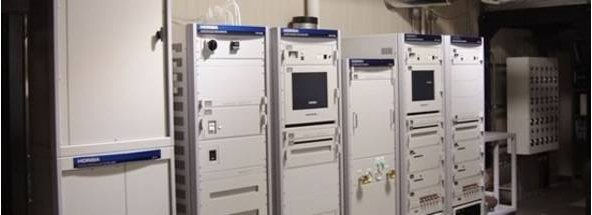
Any "comparative" test that doesn't reference either one of those^^^ is just guessing........
The narrow band sensor, reliably and cheaply indicates the exact point of stoichometery (useful for getting catalytic converters to function effectively), whereas the wide band sensor aims to provide a proportional output in relation to exhaust streams oxygen content, useful for optimising an engines operating point across all speed an load conditions.
The wide band sensor (and conditioning electronics) are, by design, necessarily slower in terms of bandwidth due to the architecture required to make them operate (reference pump current cell).
As that video proves, with a simple voltage comparitor you can make a narrow band output look slightly like a "wide band" however, if you were to look carefully at the output across different sensors (even from the same manufacturer) and at different temperatures, vapour pressures and output currents you would see that there is a huge variation in output voltages resulting in highly eroneous readings away from Lambda1.
For OEM development, industry std is pretty much the ETAS "LA" series of lambda meters, but these are full range calibrated against, usually, a Horriba exhaust emissions bench.
LA-4 (~£6k with sensor):
Horriba Exhaust emissions suite (~£400k without installation/commissioning)
Any "comparative" test that doesn't reference either one of those^^^ is just guessing........
Edited by anonymous-user on Sunday 16th February 13:21
stevieturbo said:
Once again, is this a joke or a serious question ?
Obviously I do not use a narrowband, because they are virtually useless for that task !
Not a joke. I assumed you would be using a wideband I just wondered which brand you use ?Obviously I do not use a narrowband, because they are virtually useless for that task !
Thank you Max Torque for your input of a balanced and well informed post, does it bring in the question of accuracy among wideband controllers ?
Edited by tottacrolla on Sunday 16th February 14:28
Bizarre. £150 for a piece of crap that can only ever indicate richer than stoich or leaner than stoich with any sort of accuracy.
My pet ferret also hated it. He's quite happy with music or tv program sounds coming out of the computer speakers which his cage is near but the sound of the engine burbling freaked him right out. He shot out of his sleeping box and stared fixedly at the nearest speaker all the way through both videos. I've had to put a Sarah Jarosz album on to calm him down again and now he's back to sleep Awwwwww.

My pet ferret also hated it. He's quite happy with music or tv program sounds coming out of the computer speakers which his cage is near but the sound of the engine burbling freaked him right out. He shot out of his sleeping box and stared fixedly at the nearest speaker all the way through both videos. I've had to put a Sarah Jarosz album on to calm him down again and now he's back to sleep
Awwwwww.The fact that many ECU's dont actually measure the output voltage of a narrowband should help you understand what a narrowband is doing.
If your AFR is at lambda (14.7), then generally your narrowband will rapidly oscilate high and low. The ECU is actually measuring or looking for the transitions or the mark / space ratio between high and low. If the mark/space ratio is the same (oscilating high and low) then the AFR is considered to be at lambda and therefore what the cat requires.
If its stuck high, the mixture is considered rich and if its low - the mixture is considered lean. So a narrowband is just a rich/lean detector switch (i.e. almost binary). Yes you can measure the output and use £5.0 worth of components to get an approximation of your AFR, which is certainly better than having nothing at all - but its not the same as a wideband.
If your AFR is at lambda (14.7), then generally your narrowband will rapidly oscilate high and low. The ECU is actually measuring or looking for the transitions or the mark / space ratio between high and low. If the mark/space ratio is the same (oscilating high and low) then the AFR is considered to be at lambda and therefore what the cat requires.
If its stuck high, the mixture is considered rich and if its low - the mixture is considered lean. So a narrowband is just a rich/lean detector switch (i.e. almost binary). Yes you can measure the output and use £5.0 worth of components to get an approximation of your AFR, which is certainly better than having nothing at all - but its not the same as a wideband.
Edited by eliot on Sunday 16th February 16:49
Gassing Station | Engines & Drivetrain | Top of Page | What's New | My Stuff