
Motorsport On Monday: 27/10/14
Money talks in F1; how to ensure its voice doesn't drown out the rest of the conversation?
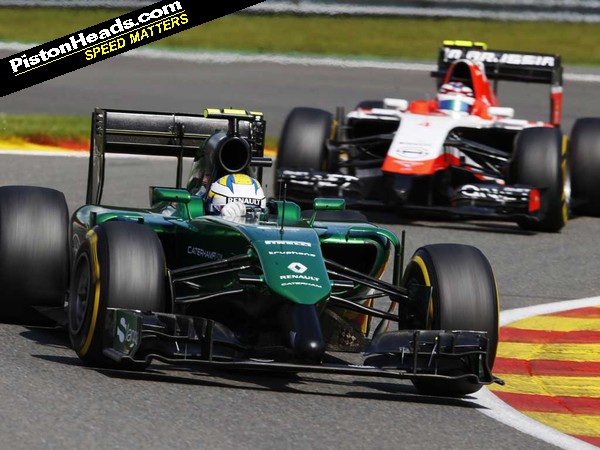
Now it's up for sale and set to miss the US Grand Prix, with Bernie waving his magic wand and granting the Leafield squad permission to dip out of Austin and Sao Paolo to get itself straight. Marussia, too, has encountered dosh issues this past week. Rumour has it the team is also set to file for administration - although a few hundred million outstanding pales into insignificance when lead driver Jules Bianchi is still in hospital.
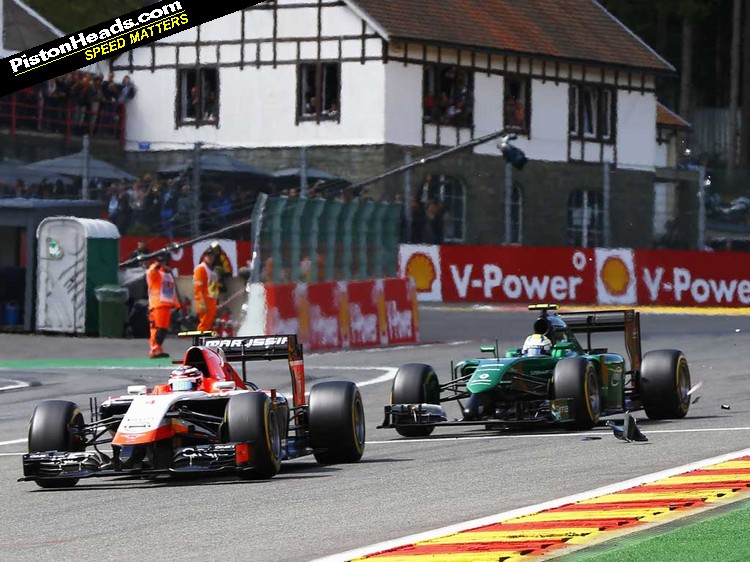
Life at the back of the grid has always been hard
This got me thinking. Money trouble has been endemic at the back of the Formula 1 grid for years, and it's a vicious circle of decline once that particular virus latches onto the immune system of a team. Poor performance means not much airtime, not much airtime means sponsors pull the plug or it's difficult to schmooze new ones. So its no surprise to see the two tail-end teams in financial strife.
Minardi, Arrows, Super Aguri and Spyker are just a few names from the modern era that spring to mind where money - or lack of it - had a bearing on the team's performance and subsequent health, with all making like Origami and folding (or being sold beforehand).
Can cost-capping work?
Cost-caps have been mooted for F1 many times in the past and indirectly implemented to greater or lesser degrees. Stricter rules governing engine and gearbox reliability have forced teams into using fewer engines per year, meaning the days of turning the wick up on a quali motor made of unobtanium for massive power went out with the cassette tape.
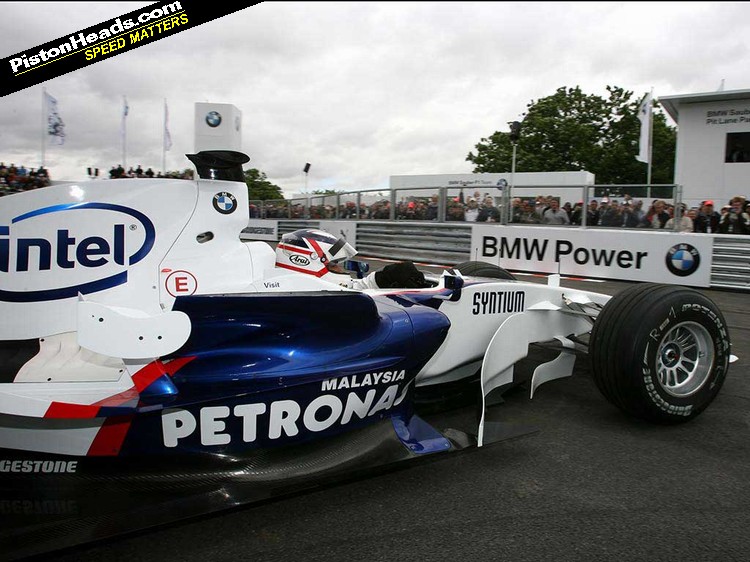
Williams suffered with loss of manufacturer support
It sort of worked. The 2.4s were all within a gnat's chaff of each other for power compared to turbo engines first time round and the 3.5-litre units that followed them; the V10s that preceded the V8 screamers and the newly introduced blown sixes. Only it meant all the money and resources the cash-rich teams possessed were diverted elsewhere. Aero, mainly, and to the salaries of the most innovative minds out there to exploit double diffuser and F-duct shaped loopholes in the rules.
So yet again the wealthiest teams won, the second-string minnows restricted by a lack of investment - observe the changing fortunes and performance of Red Bull as the Austrian energy drink pumped money into the team, and Williams, as the departure of BMW took with it a good chunk of funding.
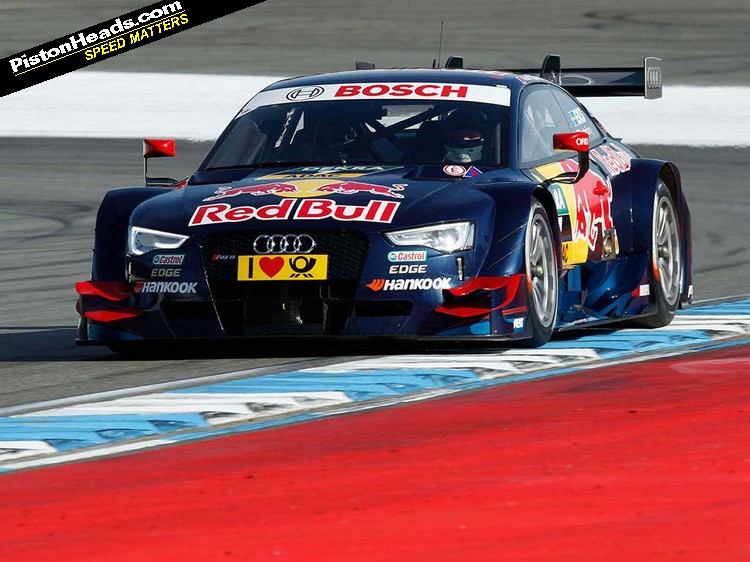
So is Audi going to sweep in and join F1?
In my opinion, three-car teams are also not the answer. That'd just be papering over the cracks, letting those with money spend even more, further squeezing the smaller teams. I think the current measures to level the playing field in a roundabout way work as well as they can and that F1 needs to either go back to the good old days when the rules and racing were pure, or look at being more sustainable.
That's a horrible buzzword uttered in 'thought showers' in Apprentice-style boardrooms each day, but the sport needs to be more relevant.Smaller engines and electric assistance is probably helping, but when you still burn up to 100kg of fuel in an hour and a half, is that really seen by the masses as efficient?
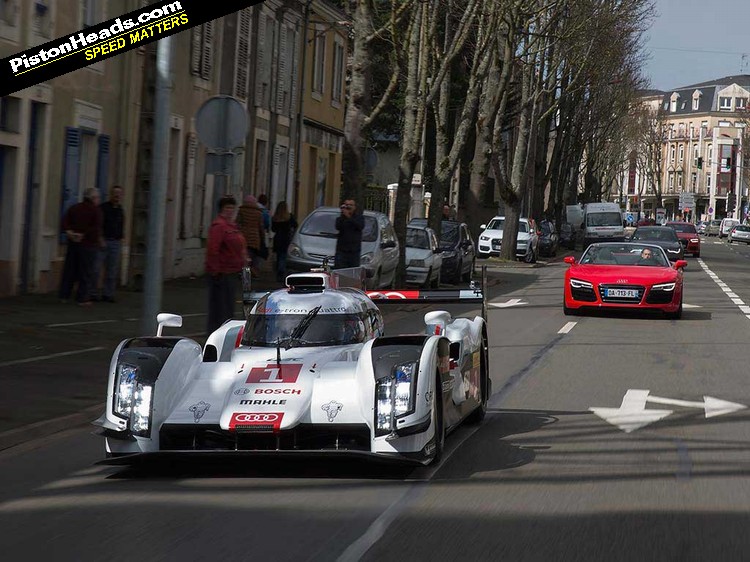
Not while it can trade on tech transfer to road cars
It was therefore interesting to last week see Audi - a manufacturer that has heavily linked its motorsport endeavours over the last 15 years to its road car business - chuck the notion of it quitting sportscars and DTM to go to F1 out of the window.
A short post on Audi Sport's Facebook page vaporised forum gossip everywhere:
"Audi in Formula 1? These rumours keep appearing with regularity since years. It's pure speculation again this time and without any foundation. We are committed to the FIA WEC, DTM and GT racing. In 2015 we will add the Audi Sport TT Cup to our program."
This is good news, because Audi's motorsport programme is sustainable - by that I mean easy to explain to the accountants.
Its RS5 DTM car might use a spec carbonfibre monocoque and a bespoke V8, but it looks like the road car. It's like Honda's BTCC Civic Tourer - a standard caravan dragger on growth hormone but similar in looks at least to one people can actually buy.
And endurance racing - Audi developed direct injection and pioneered fast diesels at Le Mans - is now doing that with hybrid technology that I'm sure we'll see on an A6 or an R8 soon. It's related to its core trade and therefore sustainable. Whatever you sell, it has to be about race on Sunday, sell on Monday. It's still a business.
F1 photos: LAT Photo


In all seriousness, I wouldn't want the headache of owning a mid-table Formula 1 team. All those massive costs to bear, and constantly having to ask Sponsors to dig a little deeper.
Simplify the rules and the cars.
F1 is about a spectacle to watch and listen too. No one gives a flying sh!t what relevance it has or will have to road cars in the future!!
If I was Bernie for a year, my new rules: Manual gearbox, no ABS or TC, 1000hp and 8 cylinder limit, 700kg minimum race weight and 100kg maximum downforce at 100mph.
We are told that F1 is a development formula. That does not square well with restrictions on the this, that and the other that you list. The restrictions in force this season on changes to the power unit has meant that Mercedes has had a relatively clear run given its initial head start. I am not convinced that this has been beneficial to the spectacle and the racing. Changes seem mostly to be related to the aerodynamics which require a microscope to be observed. So what else, exactly, has been developed this season?
As for Audi to F1 – I’ll believe it when I see it. Dr Ullrich constantly tells us Audi is all about road relevance & innovation. F1 doesn’t allow innovation. Saying that; one F1 race probably gives as much exposure as a full WEC season.
F1 is about a spectacle to watch and listen too. No one gives a flying sh!t what relevance it has or will have to road cars in the future!!
If I was Bernie for a year, my new rules: Manual gearbox, no ABS or TC, 1000hp and 8 cylinder limit, 700kg minimum race weight and 100kg maximum downforce at 100mph.
If you go down this route with the rules you would end up with something like nascar where everyone pushes to the limit of out of date technology and you end up with vehicles which look more and more out of date.
Having iron engine blocks and not allowing any electronics except the ignition system in formula 1 would certainly make cars more even. Part of formula one has to still be pushing the technology past it's limits.
F1 should be about serious skill and pace but its a tricky balancing act
luddite? maybe. but F1's unpredictability and excitement in the past largely arose from driver error and mechanical failure, allied to an excess of power over grip.
even so, many many F1 seasons dating right back to the dawn of the World Championship (and even earlier) were in fact pretty much a cakewalk for one (sometimes two) team(s) over the rest. e.g....
30s: MB + Auto Union
50s: Alfa, then Ferrari, then Merc
60s: Ferrari (in 61), Lotus (63,65)
70s: maybe least predictable era ever owing to arrival of the garagistes and consequently a lot of seat-of-the-pants design but even here there were a bunch of runaway seasons, with 78 Lotus being the most obvious. Ferrari 79 was pretty one-sided too.
80s: McLaren and Williams at different times
90s: Williams, McLaren
2000s: Ferrari then Red Bull
obviously not ever year was lopsided, but there have been whole bunch all the way through the history of F1. So not sure anything would really change things.
luddite? maybe. but F1's unpredictability and excitement in the past largely arose from driver error and mechanical failure, allied to an excess of power over grip.
even so, many many F1 seasons dating right back to the dawn of the World Championship (and even earlier) were in fact pretty much a cakewalk for one (sometimes two) team(s) over the rest. e.g....
30s: MB + Auto Union
50s: Alfa, then Ferrari, then Merc
60s: Ferrari (in 61), Lotus (63,65)
70s: maybe least predictable era ever owing to arrival of the garagistes and consequently a lot of seat-of-the-pants design but even here there were a bunch of runaway seasons, with 78 Lotus being the most obvious. Ferrari 79 was pretty one-sided too.
80s: McLaren and Williams at different times
90s: Williams, McLaren
2000s: Ferrari then Red Bull
obviously not ever year was lopsided, but there have been whole bunch all the way through the history of F1. So not sure anything would really change things.
None of it will ever happen though because the big teams call the shots and whatever suits them has to suit everyone else.
Regard to Audi into F1, is it not Audi who keep putting these rumours out there for all the free publicity!!! No they do not need F1 as they have le mans gtm etc that they race, support and do very well at. F1 needs them more
IMHO
Gassing Station | General Gassing | Top of Page | What's New | My Stuff