
Discussion


So ive been using the new Gunson eezi lap.
How long do we reckon this takes?
Ive got a neat even surface on the valve itself. Put the inlets back and filled the ports with water. Number 6 pissed out, 4 and 8 a constant drip and number 2 showed a couple of drops but didnt leak any.
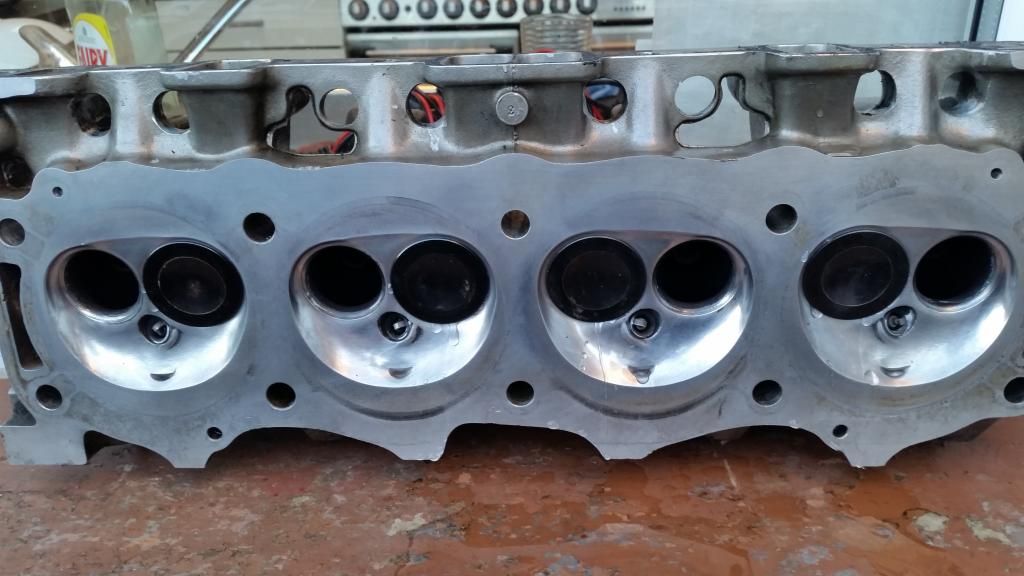

I guess my valve seats need some attention
How long do we reckon this takes?
Ive got a neat even surface on the valve itself. Put the inlets back and filled the ports with water. Number 6 pissed out, 4 and 8 a constant drip and number 2 showed a couple of drops but didnt leak any.


I guess my valve seats need some attention
Edited by db484bhpv8 on Friday 16th January 15:28
You need to do as little as possible to TBH, don't want to erode the seats and end up with different chamber volumes + stem heights all over the place....
I put the heads on stands and use a mackita with rubber tube over the stems... count to 5 forward, 10 reverse, 10 forward, 5 reverse kind of thing, at each reversal lifting the valve to rotate off the seat, and just applying a little pressure with my finger to press the valve into the seat as it is cutting (the tube will slip if you are being too aggressive which I find handy). After I clean, assemble the valves and still on the stands fill all the cambers with paraffin and stick kitchen roll up the ports (tells you which if any have any leaks). I don't pass the heads until every port can stand for a day without the slightest drip of paraffin
It can take a week of careful grinding, assembly, disassembly, testing, analysing.... to get them all perfect even with the minimum of work. Often most of the valves are fine after one or two passes, but the awkward ones seem to take several ~ at least you only have to process the ones that fail (strip / lap / build /test).
All depends on your patience & devotion vs impulse & rushing, but the first parts are the advantage DIY'ers have over professionals IMHO
I put the heads on stands and use a mackita with rubber tube over the stems... count to 5 forward, 10 reverse, 10 forward, 5 reverse kind of thing, at each reversal lifting the valve to rotate off the seat, and just applying a little pressure with my finger to press the valve into the seat as it is cutting (the tube will slip if you are being too aggressive which I find handy). After I clean, assemble the valves and still on the stands fill all the cambers with paraffin and stick kitchen roll up the ports (tells you which if any have any leaks). I don't pass the heads until every port can stand for a day without the slightest drip of paraffin
It can take a week of careful grinding, assembly, disassembly, testing, analysing.... to get them all perfect even with the minimum of work. Often most of the valves are fine after one or two passes, but the awkward ones seem to take several ~ at least you only have to process the ones that fail (strip / lap / build /test).
All depends on your patience & devotion vs impulse & rushing, but the first parts are the advantage DIY'ers have over professionals
IMHOOthers may not share my opinion on this, but here goes;
When grinding the point is to achieve a touch point between the valve and the seat by using two angles (normally 44 and 45 degrees) where the two surfaces meet. This is obviously a very fine (narrow) sealing point, but the ideal.
When you then lap the valves into the seat you widen this point, and to some minute degree, create an indentation or trough that can spoil the seal.
My father was an engineer (journeyman machinist) before training and qualifying also as a mechanic.
He taught me to never lap the valves after a grind as it would undo the good work done by the grind.
However; you clearly have valves/seats in a fairly poor condition.
If a light lapping in should solve this for you, so much the better I would presume. If it doesn't work, then off to have the grind freshened up.
Another factor to remember; if you have expensive multiple angle grinds (the famous 5 angle grind of legend), then lapping is even more likely to be counter productive.
Some others have posted here;
Valve lapping, for or against
When grinding the point is to achieve a touch point between the valve and the seat by using two angles (normally 44 and 45 degrees) where the two surfaces meet. This is obviously a very fine (narrow) sealing point, but the ideal.
When you then lap the valves into the seat you widen this point, and to some minute degree, create an indentation or trough that can spoil the seal.
My father was an engineer (journeyman machinist) before training and qualifying also as a mechanic.
He taught me to never lap the valves after a grind as it would undo the good work done by the grind.
However; you clearly have valves/seats in a fairly poor condition.
If a light lapping in should solve this for you, so much the better I would presume. If it doesn't work, then off to have the grind freshened up.
Another factor to remember; if you have expensive multiple angle grinds (the famous 5 angle grind of legend), then lapping is even more likely to be counter productive.
Some others have posted here;
Valve lapping, for or against
Edited by Goaty Bill 2 on Friday 16th January 16:02
Goaty Bill 2 said:
Others may not share my opinion on this, but here goes;
When grinding the point is to achieve a touch point between the valve and the seat by using two angles (normally 44 and 45 degrees) where the two surfaces meet. This is obviously a very fine (narrow) sealing point, but the ideal.
When you then lap the valves into the seat you widen this point, and to some minute degree, create an indentation or trough that can spoil the seal.
My father was an engineer (journeyman machinist) before training and qualifying also as a mechanic.
He taught me to never lap the valves after a grind as it would undo the good work done by the grind.
However; you clearly have valves/seats in a fairly poor condition.
If a light lapping in should solve this for you, so much the better I would presume. If it doesn't work, then off to have the grind freshened up.
Another factor to remember; if you have expensive multiple angle grinds (the famous 5 angle grind of legend), then lapping is even more likely to be more counter productive.
Some others have posted here;
Valve lapping, for or against
I've never felt quite happy with this.... When grinding the point is to achieve a touch point between the valve and the seat by using two angles (normally 44 and 45 degrees) where the two surfaces meet. This is obviously a very fine (narrow) sealing point, but the ideal.
When you then lap the valves into the seat you widen this point, and to some minute degree, create an indentation or trough that can spoil the seal.
My father was an engineer (journeyman machinist) before training and qualifying also as a mechanic.
He taught me to never lap the valves after a grind as it would undo the good work done by the grind.
However; you clearly have valves/seats in a fairly poor condition.
If a light lapping in should solve this for you, so much the better I would presume. If it doesn't work, then off to have the grind freshened up.
Another factor to remember; if you have expensive multiple angle grinds (the famous 5 angle grind of legend), then lapping is even more likely to be more counter productive.
Some others have posted here;
Valve lapping, for or against
Seems to me like 2 / 3 / 5 angle seat cuts are just the way mass production machining is applied to tuning?
Induction trumpets aren't a set of cones welded together at set of angles? If I was to suggest yo made them that way you'd laugh I'm sure, are the valve seat inserts that different once your past the seat?
spend said:
I've never felt quite happy with this....
Seems to me like 2 / 3 / 5 angle seat cuts are just the way mass production machining is applied to tuning?
Induction trumpets aren't a set of cones welded together at set of angles? If I was to suggest yo made them that way you'd laugh I'm sure, are the valve seat inserts that different once your past the seat?
Frankly, even for my own engines, I never bothered with multiple angles on the seats, or valves.Seems to me like 2 / 3 / 5 angle seat cuts are just the way mass production machining is applied to tuning?
Induction trumpets aren't a set of cones welded together at set of angles? If I was to suggest yo made them that way you'd laugh I'm sure, are the valve seat inserts that different once your past the seat?
I understood this should improve airflow over the valves and seats, and clearly that is the major pinch point in both the induction and exhaust cycles.
Apparently enough flow bench tests (in the 70s) proved this, but it's a lot of arsing about for a couple of HP in a 6.0 to 7.5 litre engine (never mind the cost of all the additional seat grinding stones for multiple sized seats etc) - all IMO of course.
It certainly upped the cost of doing a grind considerably when charging out.
Personally I think ensuring a good seal that would last was far more important.
It had become so ingrained into the North American psyche as being 'normal' for performance engines, that most hot rodders just expected it.
Probably more value as a bragging point than a performance enhancement (dons flame proof suit).
I also noted that the same people that demanded a '5 angle valve grind' often had a '3/4 race cam'. Whatever in God's name that is

db484bhpv8 said:
The inlets are all like this. The seat somehow looks wider in the pic than real life.

It might just be the photo, but zooming in as far as possible, that almost looks to be making contact across two points (lines) on the valve face? Or is it a very wide contact point from previous lapping?
How expensive is it to have a proper job done by an expert with 25 years experience? I bought some big valve heads and had them cleaned up and the valves lapped in by a race head engineering company outside Ely. I genuinely cannot remember, but vague memory is that it cost £60 for the pair to be done.
Just asking why Derek is doing it himself?
Just asking why Derek is doing it himself?
QBee said:
How expensive is it to have a proper job done by an expert with 25 years experience? I bought some big valve heads and had them cleaned up and the valves lapped in by a race head engineering company outside Ely. I genuinely cannot remember, but vague memory is that it cost £60 for the pair to be done.
Just asking why Derek is doing it himself?
First point is i like to have a go at almost everything myself. Got a 12.4 second NA car with 330 bhp that i created myself. Very proud. Just asking why Derek is doing it himself?
I find it hard to believe a proper engineering company would have gone to a lot of trouble for £60. Maybe i am wrong and you got a fantastic deal. Maybe you were lucky and the heads you bought were in fantastic condition and needed minimum work.
db484bhpv8 said:
QBee said:
How expensive is it to have a proper job done by an expert with 25 years experience? I bought some big valve heads and had them cleaned up and the valves lapped in by a race head engineering company outside Ely. I genuinely cannot remember, but vague memory is that it cost £60 for the pair to be done.
Just asking why Derek is doing it himself?
First point is i like to have a go at almost everything myself. Got a 12.4 second NA car with 330 bhp that i created myself. Very proud. Just asking why Derek is doing it himself?
I find it hard to believe a proper engineering company would have gone to a lot of trouble for £60. Maybe i am wrong and you got a fantastic deal. Maybe you were lucky and the heads you bought were in fantastic condition and needed minimum work.
The heads I bought came off DomV8's car. Needed a good clean and the valves lapping back in. The company who did the work was the one used by my TVR expert for such work. They were then going to be used by V8D on my car, but my plans changed and I sold them on to be used on a 430 engine that went in a Landrover without further work.
QBee said:
Absolutely right that you should try doing everything yourself. No slight intended. More a feeling that valves and porting were among the jobs that it paid to get done by an expert. But I am an amateur.
The heads I bought came off DomV8's car. Needed a good clean and the valves lapping back in. The company who did the work was the one used by my TVR expert for such work. They were then going to be used by V8D on my car, but my plans changed and I sold them on to be used on a 430 engine that went in a Landrover without further work.
Sorry if i appeared to over react but ive been burnt more than once by so called experts. I prefer the Burt Munro method anyway, much more 'fun'. The heads I bought came off DomV8's car. Needed a good clean and the valves lapping back in. The company who did the work was the one used by my TVR expert for such work. They were then going to be used by V8D on my car, but my plans changed and I sold them on to be used on a 430 engine that went in a Landrover without further work.
db484bhpv8 said:
QBee said:
Absolutely right that you should try doing everything yourself. No slight intended. More a feeling that valves and porting were among the jobs that it paid to get done by an expert. But I am an amateur.
The heads I bought came off DomV8's car. Needed a good clean and the valves lapping back in. The company who did the work was the one used by my TVR expert for such work. They were then going to be used by V8D on my car, but my plans changed and I sold them on to be used on a 430 engine that went in a Landrover without further work.
Sorry if i appeared to over react but ive been burnt more than once by so called experts. I prefer the Burt Munro method anyway, much more 'fun'. The heads I bought came off DomV8's car. Needed a good clean and the valves lapping back in. The company who did the work was the one used by my TVR expert for such work. They were then going to be used by V8D on my car, but my plans changed and I sold them on to be used on a 430 engine that went in a Landrover without further work.
 ).
). By the way, in your spirit of doing it yourself, since getting my TVR I have done my first soldering, first fibreglassing, first riveting, learnt all about wheel and tyre sizes and dismantled and rebuilt my own wingmirrors. And yes, all were really satisfying, even if the fiberglass could do with a bit more sanding and the mirrors wobble slightly

First thing is be sure the valves are true (especially the exhausts), it's very easy to tip one very slightly which will make lapping pretty much impossible unless they are refaced. Then, don't forget the pressure in the chamber with the valves closed will be helping the making of the seal - frankly, if you have a good even un-pitted grey band of appropriate width all the way round, I'd say job done even if the solvent test is not perfect.
Gassing Station | Chimaera | Top of Page | What's New | My Stuff