
The demise of the Boeing 747
Discussion


http://www.theguardian.com/business/2015/apr/29/de...
Interesting article, I thought. I've only ever been on one (I think), and I can't say I noticed any difference between it and any other big airliner.
Interesting article, I thought. I've only ever been on one (I think), and I can't say I noticed any difference between it and any other big airliner.
I've flown on a number of 747s over the years - mainly Aer Lingus (Series 100) and BA (series 200). I've never flown on a later Series 400 version.
The aircraft has had a long production run in its various guises - so it was probably about time that it would eventually come to an end.
But to say that large airliners in general are a thing of the past is nonsense. What has happened is that other wide bodied - more modern, cleaner and more efficient - have stolen a lot of the sales away from the 747.
When the 747 entered service in 1970, it was the world's first wide body airliner and was the first airliner capable of routinely carrying more than 300 people. Today there are quite a few aircraft in that category
The passenger experience in an airliner is mainly down to the seating, the inflight entertainment, the food and the staff.
The aircraft has had a long production run in its various guises - so it was probably about time that it would eventually come to an end.
But to say that large airliners in general are a thing of the past is nonsense. What has happened is that other wide bodied - more modern, cleaner and more efficient - have stolen a lot of the sales away from the 747.
When the 747 entered service in 1970, it was the world's first wide body airliner and was the first airliner capable of routinely carrying more than 300 people. Today there are quite a few aircraft in that category
The passenger experience in an airliner is mainly down to the seating, the inflight entertainment, the food and the staff.
That article is a little odd, to say the engines are the limiting factor on the 747 is surely incorrect as it can be adapted a lot easier say, than the wing which I'd have thought was the main factor. If you have seen a 747 or 380 disgorge it's passengers or even flown on one, there are not many empty seats
The wing is the 747's main problem now. Although it has been modified over the various versions, it is still a 1960s era wing which is not as efficient as more modern wings.
When the 747 was launched in 1966, Boeing expected that its production run as an airliner would expire in the early 1980s. In fact, they had assumed that it would be in the process of being replaced around that time by future supersonic airliners. As a result, Boeing built in two factors they thought would make it attractive in the longer term - a high cockpit to allow the aircraft to be used as a nose loading freighter and a fairly highly swept wing (37.5 degrees) to allow it to cruise at high subsonic speeds.
In the end, neither of these features were that instrumental in its popularity. The nose loading freighter versions were relatively few and the oil crisis of the early 1970s meant that airlines became far more interested in fuel efficiency than before - and 747 users didn't make use of the higher speeds possible with the 747.
And of course, the fleets of supersonic airliners that seemed likely in 1960s never materialised - so that element of competition never happened.
When the 747 was launched in 1966, Boeing expected that its production run as an airliner would expire in the early 1980s. In fact, they had assumed that it would be in the process of being replaced around that time by future supersonic airliners. As a result, Boeing built in two factors they thought would make it attractive in the longer term - a high cockpit to allow the aircraft to be used as a nose loading freighter and a fairly highly swept wing (37.5 degrees) to allow it to cruise at high subsonic speeds.
In the end, neither of these features were that instrumental in its popularity. The nose loading freighter versions were relatively few and the oil crisis of the early 1970s meant that airlines became far more interested in fuel efficiency than before - and 747 users didn't make use of the higher speeds possible with the 747.
And of course, the fleets of supersonic airliners that seemed likely in 1960s never materialised - so that element of competition never happened.
It was designed as both. The project emerged from the USAF competition for a military freighter aircraft. Boeing had teamed up with Pratt and Whitney for their proposal and Lockheed had teamed up with General Electric.
Lockheed won the contract and their design became the C-5A Galaxy.
Boeing decided to use the work and data they had acquired in the USAF bid to look at the potential of a large airliner. As I said, its potential as a freighter was part of the equation - but it wasn't the prime driver.
Lockheed won the contract and their design became the C-5A Galaxy.
Boeing decided to use the work and data they had acquired in the USAF bid to look at the potential of a large airliner. As I said, its potential as a freighter was part of the equation - but it wasn't the prime driver.
Edited by Eric Mc on Thursday 30th April 09:31


No - it wasn't designed SPECIFICALLY as a freighter. It was designed as a passenger airliner with a freighter alternative for customers who wanted a freighter. It was also designed with the intention that, when the supersonics arrived a decade later, existing 747 passenger models could be converted to freighters.
This scenario never really played out.
As I said, it had its roots in a military freighter project, but the 747 itself looked quite a bit different to Boeing's USAF freighter design.
The aircraft in the background is an approximation of what the Boeing proposal might have looked like

This scenario never really played out.
As I said, it had its roots in a military freighter project, but the 747 itself looked quite a bit different to Boeing's USAF freighter design.
The aircraft in the background is an approximation of what the Boeing proposal might have looked like

Mutley said:
Eric Mc said:
The aircraft in the background is an approximation of what the Boeing proposal might have looked like
You can see the 747 lineage in the 2nd model. I wonder if that design would have worked as a passenger aircraft, or would seeing under the wing been a negative??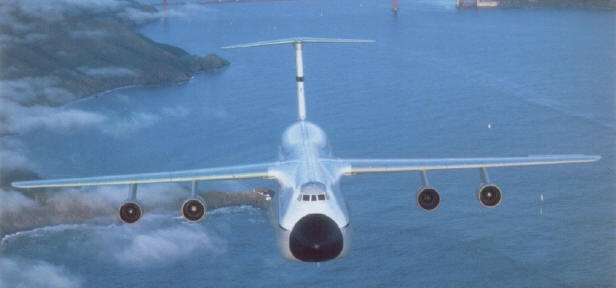
The area rule of the C5 upper rear fuselage can be seen above.
Gorgeous aircraft..as befits a Lockheed...
I love the 747, it's my favourite aircraft and I will be truly sad when production ends.
However Lufthansa or on their 18th 747-8 which shows there is still interest in the old girl, I personally think production will continue for a few more years yet.
All we need now is for BA to order some new ones! Their fleet is getting rather tired, thus why I'm going Virgin Atlantic to the U.S at the end of June, in which I fly out on a 747-400 in Business. I can't wait!!
The 747 certainly is the "Queen of the Skies"
However Lufthansa or on their 18th 747-8 which shows there is still interest in the old girl, I personally think production will continue for a few more years yet.
All we need now is for BA to order some new ones! Their fleet is getting rather tired, thus why I'm going Virgin Atlantic to the U.S at the end of June, in which I fly out on a 747-400 in Business. I can't wait!!
The 747 certainly is the "Queen of the Skies"
They had to shave a lot of weight from it when converting the design to civilian use. The design team were incentivised for every kilo saved. I remember fitting floor beams on the 1/200s and being surprised how flimsy they were and how much material had been removed. Still a great a/c but it doesn't really work anymore in todays climate. The 380 is much nicer to travel in but also a bit of a white elephant I reckon.
Gassing Station | Boats, Planes & Trains | Top of Page | What's New | My Stuff