
Lucas TR8 350i development car
Discussion


You could have asked Oliver Winterbottom at the wedge fest but I suspect the answer is that Peter Wheeler did an in house development to fit the BL 3.5 in place on the V6 that was not good for export at the time.
Later V8 engine developments were done first by Andy Rouse of touring car fame then later by NCK of Coventry.
Later V8 engine developments were done first by Andy Rouse of touring car fame then later by NCK of Coventry.
Adrian@ said:
Back on topic...I have seen a development hack that I'm sure is Triumph with TVR Tasmin-ish interior...
Adrian@
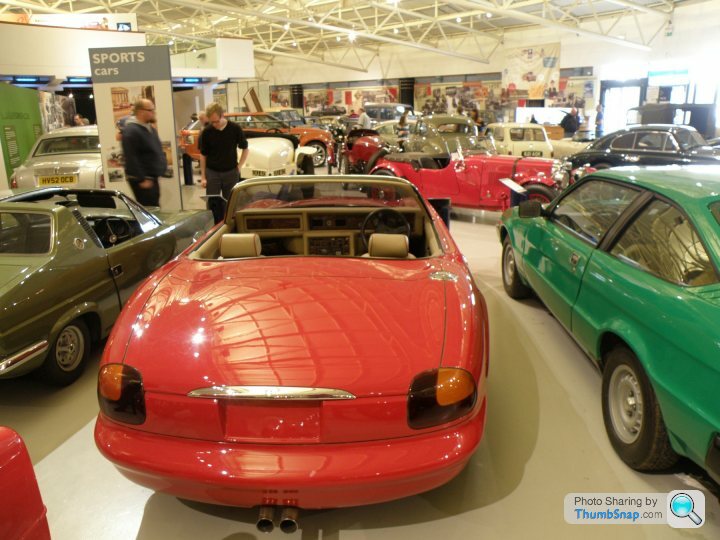
I'm not aware of a Triumph variant but the MG prototype at Gaydon is sat on a 350i chassis complete with dashboard.Adrian@
Edited by Adrian@ on Tuesday 14th July 18:25
Hi,
Does anyone have Oliver Winterbottom’s contact details they could email me.
I have a friend who recently purchased the Lucas development TR8 mentioned so is keen to discover any links.
It is also documented in TR8 circles that British Leyland gave a TR8 to TVR for development of the 350i does anyone know anything about this car or what happened to it.
Regards
Nick
Does anyone have Oliver Winterbottom’s contact details they could email me.
I have a friend who recently purchased the Lucas development TR8 mentioned so is keen to discover any links.
It is also documented in TR8 circles that British Leyland gave a TR8 to TVR for development of the 350i does anyone know anything about this car or what happened to it.
Regards
Nick
Edited by Nick Brough on Wednesday 15th July 08:34
Amusing link, I love the spelling of Chimera/Chimeria/Cimera whatever it is!
Didn't the TR8 have carbs? I wouldn't have thought that would have interested TVR unduly so it seems unlikely - unless Austin Rover did the EFi development with Lucas on a TR8. But that seems unlikely too, why would they when 3500s were plentiful back then?
Oh another thought - the TR8 was destined for the USA I think, so maybe Lucas did a load of work on that before the 3500. I'm not sure what the chronology is - we need an expert on late 1970's BL...
Didn't the TR8 have carbs? I wouldn't have thought that would have interested TVR unduly so it seems unlikely - unless Austin Rover did the EFi development with Lucas on a TR8. But that seems unlikely too, why would they when 3500s were plentiful back then?
Oh another thought - the TR8 was destined for the USA I think, so maybe Lucas did a load of work on that before the 3500. I'm not sure what the chronology is - we need an expert on late 1970's BL...
I have a feeling that this may of come from Stateside as a lot of guy's from that side of the pond call the 280i US model a "Triumph TVR"???...I have seen them advertised as a "Triumph" in the states...
There was an American chap in the park who stopped to look at the Wedges one morning and he asked if they were "Triumph"..I said.."No...TVR" and he replied..."Is that Triumph TVR"... ...Maybe i should of pointed at my switchgear and said.."Yes Triumph"....I should imagine the only dealings that TVR had with BL was the parts bin...Still love to know where the original ashtrays in the 350i came from...Please do not say MG metro cos i had a gta styled MG Metro and the ashtray was down by my left knee..And used to fall out a lot, Especially if i was dogging a fag out...That last bit just sounds so wrong....
 ..FFS
..FFS
There was an American chap in the park who stopped to look at the Wedges one morning and he asked if they were "Triumph"..I said.."No...TVR" and he replied..."Is that Triumph TVR"...
...Maybe i should of pointed at my switchgear and said.."Yes Triumph"....I should imagine the only dealings that TVR had with BL was the parts bin...Still love to know where the original ashtrays in the 350i came from...Please do not say MG metro cos i had a gta styled MG Metro and the ashtray was down by my left knee..And used to fall out a lot, Especially if i was dogging a fag out...That last bit just sounds so wrong......FFSBit off topic but love the engine on this TR8 http://www.britishv8.org/Triumph/OleLarsen.htm
US tr8's were federalised and had fuel injection. There were also some special build projects in the Uk. Maybe tvr got one of those to fiddle about with? I doubt tvr got a Pierburg to play about with as only a couple had that. The US engines had less power then the UK variants and we got just a handful of non restricted engines.
The TR7 was designed to take the rover from it's inception hence the wide chassis rails. The 2.0 engine was a concession to suit the times. ;-) That's cool, any big block chevy will fit, he he ;-)
Also, iirc there were only 20 or so UK spec TR8's manufactured. There were more TR7-V8's and always have been. Some independent firms used those for development.
The TR7 was designed to take the rover from it's inception hence the wide chassis rails. The 2.0 engine was a concession to suit the times. ;-) That's cool, any big block chevy will fit, he he ;-)
Also, iirc there were only 20 or so UK spec TR8's manufactured. There were more TR7-V8's and always have been. Some independent firms used those for development.
Edited by Boosted LS1 on Thursday 16th July 08:29
From my TR8 owning friend
The TR8’s had EFI from about 1979, mostly test cars, until production for USA, late 1980 through until 1981, they had a flat inlet manifold, mine is a UK spec EFI with about 180bhp, done by Lucas who did all the BL emissions development, and we know in the club that Leyland offered the 3.5 engines with efi to TVR, that’s well know, we know this from speaking to engineers who worked in development at Canley.
It is also thought that some very early 350i’s had the flat plenum before the later curved plenums
Regards
Nick
The TR8’s had EFI from about 1979, mostly test cars, until production for USA, late 1980 through until 1981, they had a flat inlet manifold, mine is a UK spec EFI with about 180bhp, done by Lucas who did all the BL emissions development, and we know in the club that Leyland offered the 3.5 engines with efi to TVR, that’s well know, we know this from speaking to engineers who worked in development at Canley.
It is also thought that some very early 350i’s had the flat plenum before the later curved plenums
Regards
Nick
I'm not sure how relevant this is but BL were probably unofficially backing race/rally teams here and in the US who were racing Tr7 V's.
There were track and rally cars in the hands of privateers to. Tullis and Group 44 spring to mind for the race cars and Buffum (I may have spelt that wrong) for the rally cars. The US guys would have been very familiar with BOP engine parts. In fact, imo a lot of RV8 development is copied over from the Buick v6. We didn't really develop this engine, the americans did it before us. We did, eventually redesign the block and internals to suit the 4.0/4.6.
There were track and rally cars in the hands of privateers to. Tullis and Group 44 spring to mind for the race cars and Buffum (I may have spelt that wrong) for the rally cars. The US guys would have been very familiar with BOP engine parts. In fact, imo a lot of RV8 development is copied over from the Buick v6. We didn't really develop this engine, the americans did it before us. We did, eventually redesign the block and internals to suit the 4.0/4.6.
From "Wiki"
3.9/4.0
The 3.9 L Rover V8, a bored-out version of the original 3.5 L engine, was used in several Land Rover vehicles, TVRs, and the MG RV8.
Land Rover used a 3,946 cc (240.8 cu in) version of the Rover V8 through the 1990s. Bore was increased to 94.0 mm (3.70 in) and stroke remained the same at 71.0 mm (2.80 in). The engine was revised in 1995 (and thereafter referred to as a 4.0 to differentiate it from the earlier version, although displacement remained the same at 3,946 cc) with a new intake and exhaust system, extra block ribbing, revised pistons, and larger cross-bolted main-bearings. The 1995 4.0 produced 190 hp (142 kW) and 236 lb·ft (320 N·m) .
Production of the 4.0 ended in 2003. The final version of the engine, used in the 2003 Land Rover Discovery, produced 188 hp (140 kW) at 4,750 rpm and 250 lb·ft (340 N·m) at 2,600 rpm.
Applications:
1990–2004 Morgan Plus 8
1991–1995 Ginetta G33
1992–1996 MG RV8
1986–1993 TVR S Series
1989–1995 Land Rover Range Rover (known as a 3.9 in this application)
1991–2000 TVR Griffith
1992–2001 TVR Chimaera
1995–1999 Land Rover Range Rover in SE trim
1994–1998 Land Rover Defender (only used as standard on USA-spec vehicles- available only to special order in other markets.)
1986–1991 Sisu NA-140 BT all-terrain transport vehicle
1998 Land Rover Defender 50th Anniversary Limited Edition
1996-2002 Land Rover Discovery Series I,II
In the early 1980s TVR approached Andy Rouse with a view to using his race-developed 3.9L variant of the V8 in their Rover-powered 350i 'wedge'; Rouse had successfully campaigned a Rover SD1 with a modified V8 on the track. For a number of reasons (primarily cost) Rouse's version was not used, but the concept was passed to alternative engineering firms which resulted in a rare variant of the 3.9. This unit has 93.5mm cylinder bores (instead of Rover's own 94mm that was introduced some years later) and thus has a capacity of 3,905cc. Flat-topped pistons and high-lift camshaft gave a compression ratio of 10.5:1. TVR claimed 275 bhp as the output and whilst this is generally disregarded by aficionados, a healthy 3,905 cc engine will produce in excess of 240 bhp. Once a reproducible specification had been determined, the bulk of engine production was undertaken by North Coventry Kawasaki (NCK), which company was subsequently purchased by TVR to become their in-house engine division known as TVR Power. About 100 cars (TVR 390SE) were built with the 3,905 cc engine; TVR's later '400' offering being based on the then-current Range Rover 4L of 3,946 cc.
3.9/4.0
The 3.9 L Rover V8, a bored-out version of the original 3.5 L engine, was used in several Land Rover vehicles, TVRs, and the MG RV8.
Land Rover used a 3,946 cc (240.8 cu in) version of the Rover V8 through the 1990s. Bore was increased to 94.0 mm (3.70 in) and stroke remained the same at 71.0 mm (2.80 in). The engine was revised in 1995 (and thereafter referred to as a 4.0 to differentiate it from the earlier version, although displacement remained the same at 3,946 cc) with a new intake and exhaust system, extra block ribbing, revised pistons, and larger cross-bolted main-bearings. The 1995 4.0 produced 190 hp (142 kW) and 236 lb·ft (320 N·m) .
Production of the 4.0 ended in 2003. The final version of the engine, used in the 2003 Land Rover Discovery, produced 188 hp (140 kW) at 4,750 rpm and 250 lb·ft (340 N·m) at 2,600 rpm.
Applications:
1990–2004 Morgan Plus 8
1991–1995 Ginetta G33
1992–1996 MG RV8
1986–1993 TVR S Series
1989–1995 Land Rover Range Rover (known as a 3.9 in this application)
1991–2000 TVR Griffith
1992–2001 TVR Chimaera
1995–1999 Land Rover Range Rover in SE trim
1994–1998 Land Rover Defender (only used as standard on USA-spec vehicles- available only to special order in other markets.)
1986–1991 Sisu NA-140 BT all-terrain transport vehicle
1998 Land Rover Defender 50th Anniversary Limited Edition
1996-2002 Land Rover Discovery Series I,II
In the early 1980s TVR approached Andy Rouse with a view to using his race-developed 3.9L variant of the V8 in their Rover-powered 350i 'wedge'; Rouse had successfully campaigned a Rover SD1 with a modified V8 on the track. For a number of reasons (primarily cost) Rouse's version was not used, but the concept was passed to alternative engineering firms which resulted in a rare variant of the 3.9. This unit has 93.5mm cylinder bores (instead of Rover's own 94mm that was introduced some years later) and thus has a capacity of 3,905cc. Flat-topped pistons and high-lift camshaft gave a compression ratio of 10.5:1. TVR claimed 275 bhp as the output and whilst this is generally disregarded by aficionados, a healthy 3,905 cc engine will produce in excess of 240 bhp. Once a reproducible specification had been determined, the bulk of engine production was undertaken by North Coventry Kawasaki (NCK), which company was subsequently purchased by TVR to become their in-house engine division known as TVR Power. About 100 cars (TVR 390SE) were built with the 3,905 cc engine; TVR's later '400' offering being based on the then-current Range Rover 4L of 3,946 cc.
I had one of those early 93.5 engines. Iirc the pistons were made by Cosworth. There were also a limited number of 'X' blocks which were produced by BL for racing purposes. I can't remember if they were on the 93.5 mm bore size though.
A good place to ask about this history might be the TR register as their early records for Tr7 and V8 's are quite comprehensive. I know because I was the keeper of those records for a number of years. There will also be history for 'unusual' projects which may mention any developments with TVR.
A good place to ask about this history might be the TR register as their early records for Tr7 and V8 's are quite comprehensive. I know because I was the keeper of those records for a number of years. There will also be history for 'unusual' projects which may mention any developments with TVR.
Gassing Station | Wedges | Top of Page | What's New | My Stuff