
Over wing missiles
Discussion


I'm sure I remember seeing a Lightning with missiles on top of the wing at the imperial war museum when I was a kid.
Googling a bit shows I wasn't mistaken but I'm wondering why it hasn't been adopted more?
Aerodynamics or simply down to the fact it must be easier to arm the aircraft with the hard points on the under side of the wing?
Googling a bit shows I wasn't mistaken but I'm wondering why it hasn't been adopted more?
Aerodynamics or simply down to the fact it must be easier to arm the aircraft with the hard points on the under side of the wing?

arch stant0n said:
I'm no aerodynamics expert
You can say that again!Angle of attack keeps you flying, no matter what the school textbooks say.
EDIT: Sorry, that reads like a knobhead comment. Being less of a smart-arse about it, the speed of air over and under the wings thing is a very common misconception, which is stated as fact in many, many textbooks. It's total nonsense.
Wings do not generate lift from the difference in speed over the top and bottom surfaces and this has nothing to do with the shape of the wing either. Otherwise inverted flight would be impossible. Angle of attack is the key. You can play with this effect by sticking your hand out the window of a moving car. Tilt the leading edge of your hand upwards and you'll feel a force on the underside of your hand lifting it. Tilt it downwards and your hand will be forced down. The faster you're moving, the less this angle has to be to have the same effect. So, forward thrust also keeps you flying. No angle of attack will matter if you've got no airspeed.

Edited by TartanPaint on Friday 15th January 09:54

TartanPaint said:
Wings do not generate lift from the difference in speed over the top and bottom surfaces
Yes they do. The difference in speeds is what causes the pressure differential! Lower pressure on the upper surface and higher pressure on the lower surface gives a net upward force - lift. The textbook misconception you're referring to is the equal transit time fallacy that states that the flow over the top of the wing has to travel further and therefore faster than that over the bottom. This is nonsense since the flow does not have to 'meet up' at the wing's trailing edge.Edited by TartanPaint on Friday 15th January 09:54
You're right that angle of attack is important. AoA is the reason why the speeds are different; it causes the streamlines to 'bunch up', leading to the velocity and pressure changes already mentioned. But even at 0 degrees AoA a wing can still generate lift, provided that it has camber. A cambered wing introduces a shape change in to the flow which has the same 'bunching' streamline effect.

DrTre said:
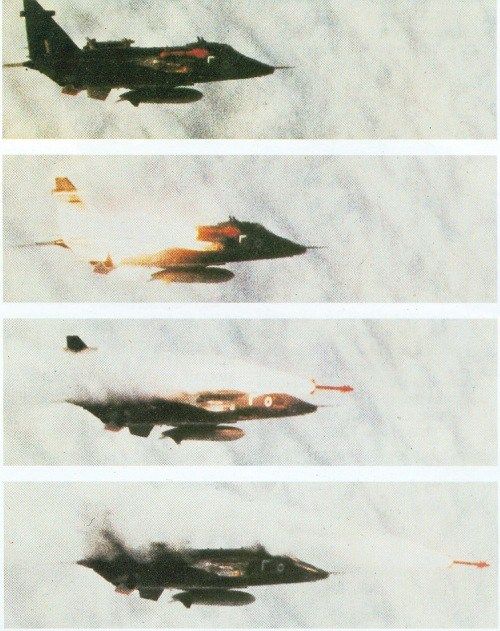
That photo shows the real reason why it makes sense to mount them on top of the wing. They just fall off the underside.
Ignore the tin foil hattery of the video title, missiles are designed to fall away before igniting:https://www.youtube.com/watch?v=9DYsYKFNSHo
Maikeeh said:
TartanPaint said:
Wings do not generate lift from the difference in speed over the top and bottom surfaces
Yes they do. The difference in speeds is what causes the pressure differential! Lower pressure on the upper surface and higher pressure on the lower surface gives a net upward force - lift. The textbook misconception you're referring to is the equal transit time fallacy that states that the flow over the top of the wing has to travel further and therefore faster than that over the bottom. This is nonsense since the flow does not have to 'meet up' at the wing's trailing edge.Edited by TartanPaint on Friday 15th January 09:54
You're right that angle of attack is important. AoA is the reason why the speeds are different; it causes the streamlines to 'bunch up', leading to the velocity and pressure changes already mentioned. But even at 0 degrees AoA a wing can still generate lift, provided that it has camber. A cambered wing introduces a shape change in to the flow which has the same 'bunching' streamline effect.
Prepared to be wrong... but aren't the facts:
- an 'normal' wing profile will generate lift at 0 AoA - due to the difference in fluid speed top to bottom, generated by the longer path of the fluid over the top of the profile
- The longer over the top comes mainly from the shape of the profile (not really from AoA)
- AoA will generate lift even if there's no profile to the thing going through the profile
Someone can come along and talk about Coanda vs Bernoulli - both of which are all about shape of flow not AoA
I'm no expert and was told many years ago when in the ATC (circa 1973 - 74) that the Lift was generated due to pressure differences above and below the wing.
Above the air moved faster due to the shape and reduced the pressure, below and the air was slower causing higher pressure, the difference resulted in lift.
Found this which was quite informative and aimed at my level of understanding ( i.e. not degree level ) NASA's Explanation
Above the air moved faster due to the shape and reduced the pressure, below and the air was slower causing higher pressure, the difference resulted in lift.
Found this which was quite informative and aimed at my level of understanding ( i.e. not degree level ) NASA's Explanation
Gassing Station | Boats, Planes & Trains | Top of Page | What's New | My Stuff