
Star Photography with a Telephoto
Discussion


If I take a long exposure with a telephoto (say, 5 seconds is about the max before I get trails) and run the image through PS, I get loads of different coloured blobs.
Is there anything to be read into these blobs? Or is it all just camera noise and the light misbehaving whilst traveling through the lens?
To be honest, I was happy just to see the sheer variation in star colours. But if there's anything else going on here, I'd love to know!

Is there anything to be read into these blobs? Or is it all just camera noise and the light misbehaving whilst traveling through the lens?
To be honest, I was happy just to see the sheer variation in star colours. But if there's anything else going on here, I'd love to know!

What camera/lens
Looks like you are shooting wide open, this gets you soft images, chromatic aberration, and coma.
Plus high ISO which means limited dynamic range and overexposing some stars so loosing detail.
Usually with these things ( small fov deep sky kind of stuff) you track the stars, shoot a bunch of shorter shutter speed/lower iso images and stack them.
Looks like you are shooting wide open, this gets you soft images, chromatic aberration, and coma.
Plus high ISO which means limited dynamic range and overexposing some stars so loosing detail.
Usually with these things ( small fov deep sky kind of stuff) you track the stars, shoot a bunch of shorter shutter speed/lower iso images and stack them.
Rather than take a single 5 sec exposure, which you have discovered means stars are starting to leave trails when using a telephoto lens, try taking several shorter exposures and stacking them together. 20 x 1 sec exposures, when stacked, in theory are the equivalent of a single 20 sec exposure. I find it also helps to minimise problems from light pollution. Stacking software can be downloaded for free.
As others have mentioned, stacking is the way to go, don't worry if the stars (blobs) are very faint in each image, the stacking should bring their brightness back up
Can't you get an app to solve it
Can't you get an app to solve it
Motorsport_is_Expensive said:
...
I whipped my iPhone out and, using a 59p app, did the exact same thing with a photo I took there and then.
....
I whipped my iPhone out and, using a 59p app, did the exact same thing with a photo I took there and then.
....
I've tried stacking applications but was wondering... if there's no information in the individual photos how does stacking bring the colours out? I mean Im thinking in fairly binary terms... if each photo is low in data surely you're just stacking 1s onto 1s onto 1s and getting... 1?
No in simple mono terms each pixel has a value between 0 and 255 (8 bit depth), so you first image might contribute 4, the second 5, the third 4, etc
In colour images you have a range for each channel, eg a 24 bit image has 0-255, red, 0-255 green and 0-255 blue giving up to 16.77 million possible colour combinations.
In colour images you have a range for each channel, eg a 24 bit image has 0-255, red, 0-255 green and 0-255 blue giving up to 16.77 million possible colour combinations.
I took this image using a standard telephoto lens (Canon 5D Mk2 + 70-200L F4).
However it was piggybacked on my telescope at the time which was in tracking mode - allowing me to take several exposures up to 30 seconds in length and stack them.
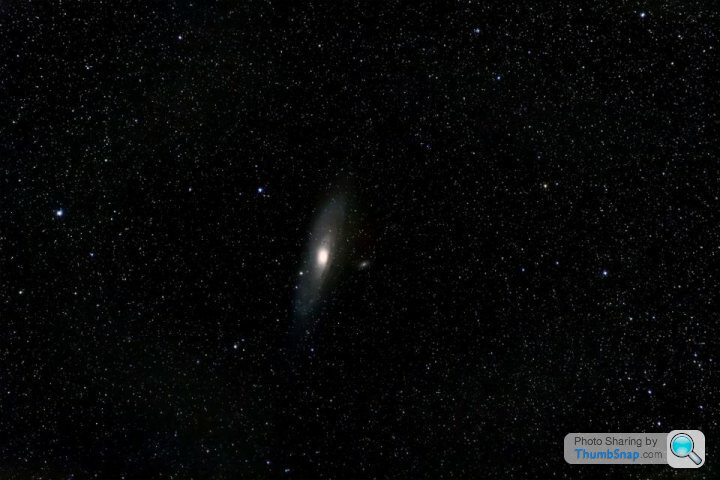
I have managed to take wide angle shots of up to about 20 seconds without the stars trailing - but for telephoto work - you really need a tracking mount.
However it was piggybacked on my telescope at the time which was in tracking mode - allowing me to take several exposures up to 30 seconds in length and stack them.
I have managed to take wide angle shots of up to about 20 seconds without the stars trailing - but for telephoto work - you really need a tracking mount.
leglessAlex said:
That's a great photo Moonhawk.
What mount do you use? Something like an Skywatcher EQ6? Or something even more high end?
I have a Meade LX90 - so piggybacked on that. That particular shot was taken before I had acquired a wedge - so was tracking in alt-az mode and hence why I was limited to around 30 seconds - to minimise field rotation.What mount do you use? Something like an Skywatcher EQ6? Or something even more high end?
Moonhawk said:
I took this image using a standard telephoto lens (Canon 5D Mk2 + 70-200L F4).
However it was piggybacked on my telescope at the time which was in tracking mode - allowing me to take several exposures up to 30 seconds in length and stack them.
I have managed to take wide angle shots of up to about 20 seconds without the stars trailing - but for telephoto work - you really need a tracking mount.
That is absolutely stunning. However it was piggybacked on my telescope at the time which was in tracking mode - allowing me to take several exposures up to 30 seconds in length and stack them.
I have managed to take wide angle shots of up to about 20 seconds without the stars trailing - but for telephoto work - you really need a tracking mount.
Gassing Station | Photography & Video | Top of Page | What's New | My Stuff