
FAO Alan Whitaker
Discussion


Here is some information for you, I thought it best to create a topic instead of hijacking the other one
The heavy duty cable running from the battery to the starter motor is sufficient to supply everything, there is no need to run other cables from front to back
Due to the fuses and relays being at the front they can be powered from the main battery cable
The 100 AMP ignition controlled relay in the boot can be fitted close to the fuse-boxes in the front and be switched in the same way. I would like to see that 100 AMP relay, there is an awful lot relying on that relay. Have you looked at any 12 volt continuous current heavy duty solenoids, they work the same as a relay but are much more robust
Is there a real need to be wiring an ignition controlled relay for the main power supplies, have you considered a master switch?
There will be no supplies to anything once the 100 AMP relay is switched off
I don't know how much you know so please excuse me when I mention things that you already know
Here is a link to a very good article for choosing the correct battery cable size for a long run (Front to Back) http://www.wiringproducts.com/battery-cable
A starter motor current draw figure for your engine/set-up will come in handy for this and I don't have that, I would be guessing that the starter could draw 250/300 AMPS when cranking on a cold morning. The starter current draw can be measured with an ammeter that uses a current clamp to go around the cable, the only problem is that if your battery cable is not heavy enough then there will be a big volt drop along that cable when cranking and the meter won't be showing the true current draw, perhaps the starter current draw figure is knocking around the internet
Are you running a negative battery cable from front to back or using the chassis as the return?
Those 60 Amp fuses are not needed, you shouldn't be fusing the fuse boxes supply wires with 60 AMP fuses as they are only a short safe run away from the fuse boxes, Those 60 AMP fuses are protecting nothing yet they are lowering the fuse boxes maximum current rating to below 60 AMPS when the boxes themselves are rated 100 AMPS
Problems may arise later. The more unnecessary fuses and relays that are fitted only ups the chances of problems later. There will be volt drops at any connection points and across all fuses and relay contacts.
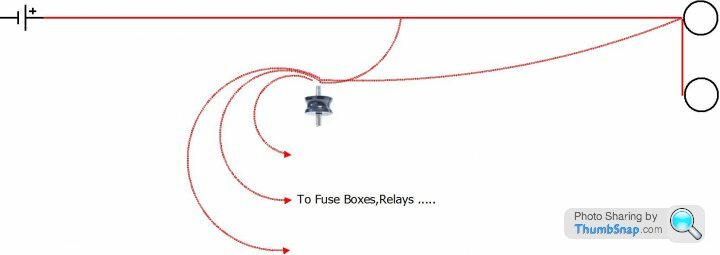
If you have read my above post you will understand the images below, the rubber exhaust bobbin (or purchased purpose built insulated terminal) can be mounted very close to the fuse boxes and relays as a main battery supply breakout point, this then gives you very short runs of power supply to fuses and relays etc. The battery cut off can still be wired at the rear or up front. Below are a couple of images showing some options.

In this second image I have shown 2 possible power supply breakout points, see dotted lines from starter and battery cable
A while back I mentioned that it is not possible to use the below type fusebox for fusing lighting circuits correctly

The problem with this type of fusebox is that there is only 1 input terminal for 10 out and this creates a big problem. 10 inputs/10 outputs is the way forward and should several inputs be needed to be used with a common supply they can be easily linked together
You have fitted your relays very close to the fuseboxes and that's a good thing, below is a diagram showing this layout and the correct way to fuse lighting circuits, I expect you know all of this but will post it all the same as it shows that a 10 way fuse box with a 1 common supply input rail can't possibly do the job.
Are you able to return those 3 fuseboxes in exchange for the correct type?


The heavy duty cable running from the battery to the starter motor is sufficient to supply everything, there is no need to run other cables from front to back
Due to the fuses and relays being at the front they can be powered from the main battery cable
The 100 AMP ignition controlled relay in the boot can be fitted close to the fuse-boxes in the front and be switched in the same way. I would like to see that 100 AMP relay, there is an awful lot relying on that relay. Have you looked at any 12 volt continuous current heavy duty solenoids, they work the same as a relay but are much more robust
Is there a real need to be wiring an ignition controlled relay for the main power supplies, have you considered a master switch?
There will be no supplies to anything once the 100 AMP relay is switched off
I don't know how much you know so please excuse me when I mention things that you already know
Here is a link to a very good article for choosing the correct battery cable size for a long run (Front to Back) http://www.wiringproducts.com/battery-cable
A starter motor current draw figure for your engine/set-up will come in handy for this and I don't have that, I would be guessing that the starter could draw 250/300 AMPS when cranking on a cold morning. The starter current draw can be measured with an ammeter that uses a current clamp to go around the cable, the only problem is that if your battery cable is not heavy enough then there will be a big volt drop along that cable when cranking and the meter won't be showing the true current draw, perhaps the starter current draw figure is knocking around the internet
Are you running a negative battery cable from front to back or using the chassis as the return?
Those 60 Amp fuses are not needed, you shouldn't be fusing the fuse boxes supply wires with 60 AMP fuses as they are only a short safe run away from the fuse boxes, Those 60 AMP fuses are protecting nothing yet they are lowering the fuse boxes maximum current rating to below 60 AMPS when the boxes themselves are rated 100 AMPS
Problems may arise later. The more unnecessary fuses and relays that are fitted only ups the chances of problems later. There will be volt drops at any connection points and across all fuses and relay contacts.
If you have read my above post you will understand the images below, the rubber exhaust bobbin (or purchased purpose built insulated terminal) can be mounted very close to the fuse boxes and relays as a main battery supply breakout point, this then gives you very short runs of power supply to fuses and relays etc. The battery cut off can still be wired at the rear or up front. Below are a couple of images showing some options.
In this second image I have shown 2 possible power supply breakout points, see dotted lines from starter and battery cable
A while back I mentioned that it is not possible to use the below type fusebox for fusing lighting circuits correctly
The problem with this type of fusebox is that there is only 1 input terminal for 10 out and this creates a big problem. 10 inputs/10 outputs is the way forward and should several inputs be needed to be used with a common supply they can be easily linked together
You have fitted your relays very close to the fuseboxes and that's a good thing, below is a diagram showing this layout and the correct way to fuse lighting circuits, I expect you know all of this but will post it all the same as it shows that a 10 way fuse box with a 1 common supply input rail can't possibly do the job.
Are you able to return those 3 fuseboxes in exchange for the correct type?
Edited by Penelope Stopit on Friday 12th May 08:07
Jerseyjohn said:
Great info
I do like the idea of fuse the lights etc after, as it will be so easy to fault find.
What fuse box do you recommend?
Before thinking about fuseboxes and relays you need to make a list of every circuit that will be included in the wiring harnessI do like the idea of fuse the lights etc after, as it will be so easy to fault find.
What fuse box do you recommend?
Now calculate how many fuses are needed to fuse the harness correctly and don't double or triple fuse anything, do think about what you may add at a later date that will require fusing. Once you know how many fuses you will be needing, list all circuits that you wish to relay, now calculate how many relays are needed to relay the circuits correctly and don't double or triple relay anything
You now have a total fuse and relay count, time to get searching the internet, I have recently noticed that China are selling fusebox/relay plates very cheap but haven't popped the question asking what the terminals are like, the chances are that the terminals are of good qaulity, Google madeinchina DOT COM, many Chinese suppliers will send samples
Alan Whitaker said:
On the fuse box, you say 10 separate inputs, you have to joint the 10 into 1 from the battery so what is wrong with the way the fuse box is. the box is rated at 100 amps so it should be ok for my use. I don't think there will be a voltage drop issue with this.
Alan
No this isn't the caseAlan
For the Side/tail and illumination, 3 fuses will use a seperate common input
For the dip beam, 2 fuses will use a seperate common input
For the main beam, 2 fuses will use a sepaerate common input
Seperate is a good word to explain this scenario, you will be unable to seperate the inputs for the required fusing

Edited by Penelope Stopit on Saturday 28th January 08:58
Alan Whitaker said:
I see what you are saying with the common input and split outputs as in the drawing, so where are you taking your feed cables to your switches and are they fused
I would presume the feed to the switches is also taken from either the alternator output or the starter motor to the column ignition switch. Activating the switch will then feed either a fuse (side lights for example) or the coil of a relay (this could also be via a fuse) Radiator fan for example.

Alan Whitaker said:
I see what you are saying with the common input and split outputs as in the drawing, so where are you taking your feed cables to your switches and are they fused
Going by your meticulous standard of work, there is a very slim chance that the dashboard loom or any other loom for that matter will ever rub and short out, the fuses that you are wiring into all circuits are to protect the loom from components (lights, motors etc) shorting out.If you wish to fuse all the inputs to switches you can do so. You need to bear in mind that the majority of switches that switch ignition supplies to relays are fused but not seperately fused. For instance-
Brake Light switch
Reverse Light switch
Indicator Lights switch
Can all be supplied by one ignition controlled fuse because they are not switched on for any length of time and when all switched on together will draw a current of approximately 10.5 Amps, a 15 AMP blade fuse will blow if any of those circuits short to earth, intentionally shorting out one of those circuits directly at one of their light sockets is a good test to prove the point I have made, sometimes when the length of wire to the lights is very long, the blow rates are affected, the wire can, but the majority of the time doesn't heat up rather than blow the fuse due to the resistance in a long length of wire, the other thing to bear in mind is that sometimes a flasher unit will go up in a puff of smoke rather than blow the fuse
There is nothing wrong with fusing inputs and there will not be a volt-drop problem when fusing inputs that are being switched to relays that switch outputs to fuses. Blade type fuses have solved most of the problems of fuses not blowing when they should, a standard 14/030 cables current rating is approximately 8.75 AMPS but will momentarily carry a current much higher than that, hence the 15 AMP blade fuse will blow, but don't forget about the length of the cable as mentioned above. Try the test for a bit of fun, short out a decent length of (5 Meters) 14/030 cable that has a 15 AMP rated in-line blue blade fuse across a battery, this test will put your mind at rest if it isn't (hold the wire with pliers as this will save burning your fingers should I be proven to be wrong)
I had to write a book there to explain something but it was needed so that you possibly have a better understanding. Back to answering your question bearing in mind the above
Many vehicles have a direct unfused battery supply to the side/headlamp switch that switches that supply to the Dip/Main column switch that in your case will switch forward that supply to a dip beam and main beam relay that will switch forward that supply to seperate fuses and on to the side/headlights
It's all about what you have decided to create, if you are using a side/headlamp switch that is doing nothing but switch 3 x relays on/off as in
Side lights position - 1 relay To 3 Fuses (RH/LH/Illumination)
Head lights position - To column Dip/Main switch
Column switch - To 2 x relays (Dip or Main Beam)
The above supply cable for side/headlamp and column switches will only be carrying a maximum current drawn by 1 x side light relay and 1 x headlight relay
The current draw of 1 standard 12 volt relay with a pull-in coil resistance of approximately 80 Ohms is 12 volts ÷ 80 = 0.15 AMPS, so 2 standard 12 volt relays require a supply cable to the side/headlight switch capable of carrying 0.3 AMPS which is a very thin cable, standard cable size 9/030 will carry 5.75 AMPS, this is why thin-wall cable is used as it is lighter and can go down to smaller sizes that will carry low current
If your circuits are as above, for peace of mind you could fuse the supply cable to the side/headlamp switch with a 3 or 5 AMP rated blade fuse that is powered directly from a main battery positive, the side lights need to work with the ignition off. If you want your headlights to work only when the ignition is on, you will need to wire the headlight relays/coils through a ignition controlled relay
If you have built your dashboard wiring harness to switch relays as in the above, you will have ended up with a nice lightweight thin harness
I will put you a list of circuits/fusing together and post it later
You will need to take a good look at your column switch, I am guessing that the indicators are built into the dip/main switch. There is a chance that your column switch includes LH/RH parking light contacts, you need to allow for this set-up if it's there
Edited by Penelope Stopit on Saturday 28th January 12:24
For the test time/current characteristics, temperature requirements etc of OEM blade fuses see HERE.
Other OEM manufacturers are available. Please bear in mind that other 'generic' fuses sourced off the internet may not meet the same characteristics, and may in particular generate more heat themselves than the OEM products. Also that there are 'fake' OEM fuses around which again may have different characteristics.
Other OEM manufacturers are available. Please bear in mind that other 'generic' fuses sourced off the internet may not meet the same characteristics, and may in particular generate more heat themselves than the OEM products. Also that there are 'fake' OEM fuses around which again may have different characteristics.
My column switches are Vauxhall Corsa B, The feeds up to and from are switch are only 5a rated, they use a fused feed out to a relay to do the switching. The harness has a separate feed for each function, Lh / Rh indicators and main dip and flash. No parking function on these.
On the indicators I have 3 wires black, black / yellow and black / white paired up they are, black, black/yellow for l/h and black, black/white for the r/h.
headlights have 4 wires, red, white, blue and yellow ,paired up they are red with white for high beam and blue with yellow for the flash,. That's as far as I have got with these so I guess the headlight switch will turn on in dipped beam mode and be controlled by a change over relay
Dash is on the table ready to wire up.
Alan

On the indicators I have 3 wires black, black / yellow and black / white paired up they are, black, black/yellow for l/h and black, black/white for the r/h.
headlights have 4 wires, red, white, blue and yellow ,paired up they are red with white for high beam and blue with yellow for the flash,. That's as far as I have got with these so I guess the headlight switch will turn on in dipped beam mode and be controlled by a change over relay
Dash is on the table ready to wire up.
Alan
Edited by Alan Whitaker on Saturday 28th January 16:15
Edited by Alan Whitaker on Saturday 28th January 16:16
I will take a look at those colour codes for the Corsa. I am as certain as can be that the White is for Main Beam and Yellow is for Dip Beam, Red will very likely be the supply for flash and Blue very likely be the supply from the side/headlight switch. I will check that
Below is part of what I would expect to find in a vehicle using a 10 way common rail fuse-box for ignition supplies to the interior, also some current ratings
Estimated Switched Circuits Ignition Controlled Current Consumption
Brake Lights 3.5 AMPS
Indicator Lights 3.5 AMPS
Reverse Lights 3.5 AMPS
Wipers/Washers 10 To 15 AMPS
Heater Fan Motor 10 To 15 AMPS
Cigar Lighter 5 To 10 AMPS
Instruments / Warning Lights. Guessing 3/6 AMPS MAX
Heated Rear Window 10 To 20 AMPS ***********Relay***********
Horns 10 To 20 AMPS ***********Relay***********

Below is part of what I would expect to find in a vehicle using a 10 way common rail fuse-box for ignition supplies to the interior, also some current ratings
Estimated Switched Circuits Ignition Controlled Current Consumption
Brake Lights 3.5 AMPS
Indicator Lights 3.5 AMPS
Reverse Lights 3.5 AMPS
Wipers/Washers 10 To 15 AMPS
Heater Fan Motor 10 To 15 AMPS
Cigar Lighter 5 To 10 AMPS
Instruments / Warning Lights. Guessing 3/6 AMPS MAX
Heated Rear Window 10 To 20 AMPS ***********Relay***********
Horns 10 To 20 AMPS ***********Relay***********
Have run a couple of spare feeds, battery in the boot but have run spares to front only. It looks like the Corsa uses the main beam with a change over relay so when the light switch (Durite rocker position 1 side lights position 2 main beam)is on the relay is still n/c and the dip beam is on, relay feed from 15A separate fuse to pin 30. the main beam stalk switch has a supply and is run to the relay 85 86 to ground so when the stalk is set to main beam the change over relay energises to main beam.
The flash looks like it is just a 4 pin relay fed from the battery + and is energised with the stalk flash function, as the relay is not energised in dip mode the flash feed is just connected to the main beam feed.
Spent this morning at a scrap Corsa freezing my bits off with a multi meter so I may have got it wrong
Alan
The flash looks like it is just a 4 pin relay fed from the battery + and is energised with the stalk flash function, as the relay is not energised in dip mode the flash feed is just connected to the main beam feed.
Spent this morning at a scrap Corsa freezing my bits off with a multi meter so I may have got it wrong
Alan

Does that Corsa B column switch have a click away from you and clicks back towards you plus a spring loaded further pull towards you for flash
If it has the above positions it will have the standard contact configuration inside it, there will be no need for a latching relay if it has the positions
White is Main Beam
Yellow is Dip Beam
One of the other 2 wires should be a supply for flash and I would expect it to be the red one
The other of the 2 wires should be a supply from the side/headlight switch which I would expect to be the blue one
The switch could be faulty
If it has the above positions it will have the standard contact configuration inside it, there will be no need for a latching relay if it has the positions
White is Main Beam
Yellow is Dip Beam
One of the other 2 wires should be a supply for flash and I would expect it to be the red one
The other of the 2 wires should be a supply from the side/headlight switch which I would expect to be the blue one
The switch could be faulty
Gassing Station | S Series | Top of Page | What's New | My Stuff